Fund peer group analysis is the work of choosing the funds a fund's fees are compared with, its peer group, and then reading where the fund sits among them: its rank, its distance from the median, and why. It looks like arithmetic, but most of the answer is settled before any fee is read. A median belongs to the set, so whoever picks the peers picks the answer, and that person is rarely named in the papers a pricing committee or a fund board reads. Botminds' Fee Benchmarking was built around that problem: its agents build the peer group from what each candidate fund holds and says it does, cite a reason for every fund in or out, and a person decides every change before a fee position is signed.
The stakes are concrete. In the United States, fund boards approve advisory fees each year on materials that lean on peer comparisons, and they must later describe any comparisons they relied on. In the UK, fund managers must test every unit class against comparable market rates. In the EU, supervisors expect a manager's pricing process to show how its costs compare with similar funds. All three rest on a set of funds that someone chose.
Five people around one peer group, and the one nobody sees
Today
Screens a category, opens each candidate prospectus and decides who is in, usually alone and close to a deadline.
With agents
Writes the peer rules, then accepts or rejects each proposed change with a reason; agents screen and read.
Still theirs: what "the same strategy" means for this fund
Today
Asks where the fund sits and gets a spreadsheet whose peer list cannot be traced.
With agents
Asks in plain words and sees every peer with the line that put it there.
Today
Signs a fee position built on peers she cannot check one by one.
With agents
Approves only after opening the reasons; the maker of the answer can never approve it.
Today
Rebuilds each expense-group section for the board materials from scratch.
With agents
Reuses positions pricing has already approved; an out-of-date one says so.
Today
See a rank and a median, rarely the choices behind them.
With agents
Can ask who chose each peer and see the rule, the reason and the date.
What is fund peer group analysis?
Fund peer group analysis compares one fund's fees with those of funds that pursue the same strategy through the same kind of vehicle and share class, as of one date, on one measure. Each of those four words hides a choice. The measure may be the total expense ratio before or after waivers, which is the subject of net expense ratio vs gross expense ratio. The vehicle may be ETFs only, or ETFs and comparable mutual fund classes, or European UCITS as well. The share class may be the cheapest institutional class or the one most investors hold. The date decides which fee cuts, waivers and launches count.
In US board materials the narrow comparison set is often called the expense group and a wider one the expense universe. Regulators use their own words for the same idea. The FCA's assessment of value rules ask about "comparable market rates" and "comparable services". ESMA's supervisory briefing on costs suggests a table of "funds with similar investment strategies and characteristics". None of them says which funds those are. That is left to the firm, and inside the firm it usually falls to one analyst.
How is a fund peer group chosen? Five decisions before any fee is read
A fund peer group is chosen through five decisions, and each one can move the median by more than a typical fee change. A category label from a data vendor answers the first of them for you, which is why it is fast and why it is risky: the label was assigned for a different purpose, and it lags new launches.
Five choices that settle a fee comparison before the fees are read
| Decision | The common shortcut | What it can do to the answer | A written rule (sample) |
|---|---|---|---|
| Strategy test | The vendor category label | Lets a quasi-index fund labelled active into an active set and drags the median down | Active share of at least 60% against the benchmark |
| Mandate shape | Same category, any region mix | Mixes a 64% US fund with a 48% US fund in one "global" set | Median market cap under $5 billion; US weight 35–70% |
| Vehicle and share class | Whatever class the screen returns | Compares a retail class carrying a 12b-1 fee and a load with an institutional class | ETFs, plus mutual fund classes with no load and no 12b-1 fee |
| Size and freshness | Every live fund | Keeps a fund that has just closed and misses one launched last month | At least $100 million; fee table filed in the last 15 months |
| Measure and date | Whatever the database shows | Ranks one fund net of a waiver and its neighbour gross | Net after waivers, as of the question date, with gross alongside |
The peer selector is the unseen role in a fee review
The person who picks the peers is usually a pricing or product analyst, and their decisions are the least visible part of the work. A board sees a median and a rank; a pricing committee sees a recommendation. The analyst's exclusions, often dozens of them and each one a judgement, are rarely shown at all. When a director asks where a median of 0.85% came from, the honest answer is often a spreadsheet only one person can explain.
The role is skilled and expensive, which is why it is worth spending on judgement rather than copying. The Bureau of Labor Statistics put the median pay of financial analysts at $103,570 a year in 2025, and lists securities and other financial investment firms as the largest employer of financial and investment analysts, at 24% (BLS Occupational Outlook Handbook). It publishes no separate figure for fund pricing analysts. Whatever the title, the useful hours are the ones spent deciding whether a fund belongs, not the ones spent opening its prospectus to find out what it holds.
Why a peer median is not a market price
A peer median tells you where a fee sits among other funds' fees; it does not tell you that any of those fees is competitive. Courts, supervisors and researchers have all said so. In Jones v. Harris Associates (2010), the Supreme Court warned courts against leaning heavily on comparisons with fees other advisers charge mutual funds, because those fees may not have been negotiated at arm's length either, and it added that the Investment Company Act does not guarantee fee parity between mutual funds and institutional clients (Jones v. Harris Associates, 559 U.S. 335). How that test shapes a 15(c) review is covered in what Jones v. Harris asks of a fee review, from Botminds' 15(c) Board Reporting.
The FCA reached a similar view from market data. Its 2017 asset management market study found weak price competition, and its first review of fund managers' value assessments, published in July 2021 and marked historical in August 2025, said so again in plain terms (FCA, 2021). ESMA's 2021 common supervisory action on costs told EU managers that comparison with peer funds should not be the only basis for setting a fund's price (ESMA, May 2022). And academic work adds a sharper reason: Gil-Bazo and Ruiz-Verdú found that "Funds with worse before‐fee performance charge higher fees" (Journal of Finance, 2009), so a median can be pulled up by exactly the funds a board would least want as a yardstick.
Funds’ fees tend to bunch around certain price points with abnormally high profit margins, and fund managers tend not to compete on price.
FCA, Authorised fund managers' assessments of their funds' value (2021)
None of this makes peer comparison useless. It makes it one piece of evidence whose quality depends on how the set was built. A board can weigh a peer median sensibly only if it can see what went in.
How one peer moves the median: a worked example
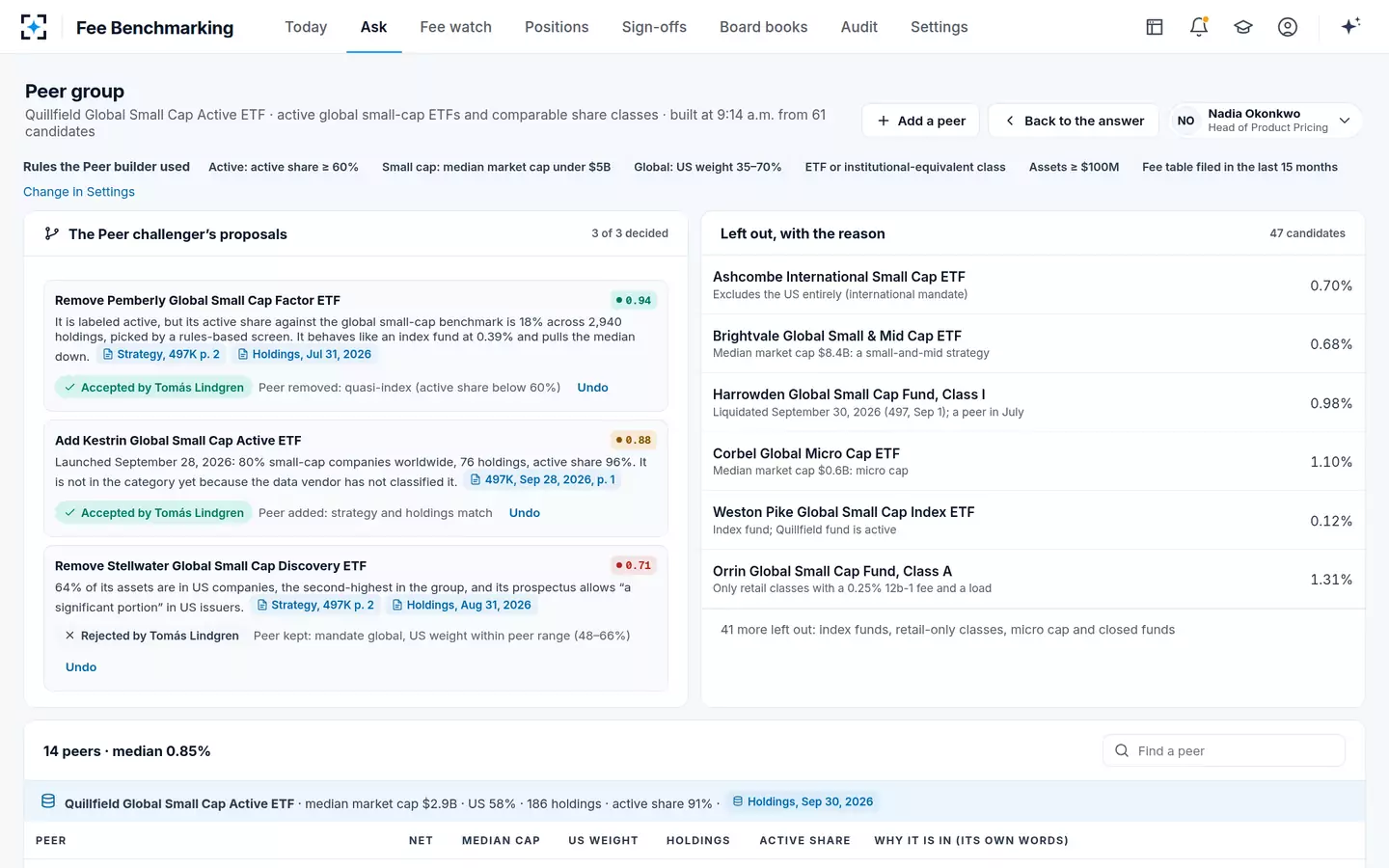
Take a sample from the solution, on fictional funds and firms: Quillfield Global Small Cap Active ETF, a $1.42 billion fund with a 0.79% unitary fee, compared with active global small-cap ETFs and comparable share classes. The Peer builder screened 12,412 share classes, kept 14 of 61 candidates and gave each a reason. Its first ladder put the fund 6th lowest of 15, 5 basis points below a peer median of 0.84%.
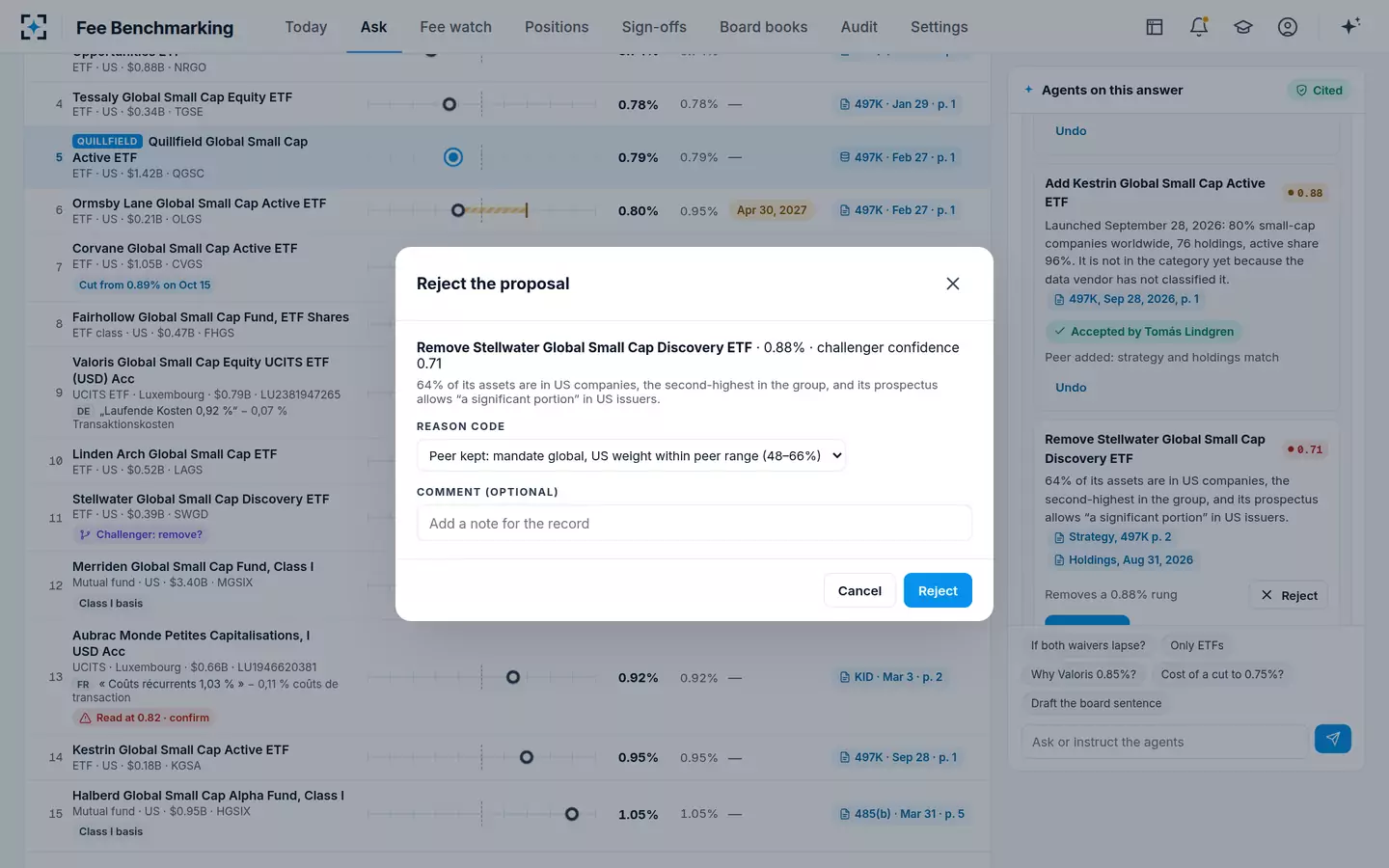
Then a second agent, the Peer challenger, argued with the set. Pemberly Global Small Cap Factor ETF was labelled active, but its active share was 18% across 2,940 holdings: a quasi-index fund at 0.39% that dragged the median down. Kestrin Global Small Cap Active ETF, launched on 28 September at 0.95%, was missing because the data vendor had not classified it yet. Stellwater Global Small Cap Discovery ETF held 64% in US companies. The product manager accepted the first two changes and kept Stellwater, with the reason that the mandate is global and its US weight sits inside the 48–66% range of the group.
One fund, one fee: four peer medians from peer decisions and dates
The fund's own fee never moved. Its gap to the median ranged from 5 to 8 basis points on peer decisions and dates alone, and on a $1.42 billion fund each basis point is $142,000 a year. A pricing committee deciding whether to hold or cut is, in effect, deciding on the peer group first.
Every peer decision, with its reason, in Fee Benchmarking
Peer group comparison of mutual funds: the share class decides the rank
In a peer group comparison of mutual funds, the share class matters as much as the fund. One portfolio can carry a class with a front-end load and a 12b-1 fee and another with neither, and Form N-1A requires a separate fee table response for each class a prospectus offers (Form N-1A, Item 3, Instruction 1(d)(ii)). Compare your institutional class with a peer's retail class and you have measured distribution arrangements, not management.
The opposite error is just as common. In its 2021 review, the FCA found that most managers compared at least one unit class, typically the clean wholesale class, with a peer group, but that higher-charging classes costing investors "significantly more than the peer group median" had been left out of the assessment (FCA, 2021). The fix is a written class rule applied to both sides: in the sample, mutual funds are compared on their class with no sales load and no 12b-1 fee, UCITS on their institutional accumulating class, and every other class of the firm's own fund is assessed on its own.
What should a board see about how the peers were chosen?
A board should see enough to judge the set, not just the result. Since 2004 the SEC has required a fund to say whether the board relied on comparisons with other advisory contracts, including other advisers' funds and institutional clients such as pension funds, and if it did, to "describe the comparisons that were relied on and how they assisted the board" (SEC, 69 FR 39798, 2004). Since the tailored shareholder report rules of 2022, that statement sits in Form N-CSR rather than the shareholder report (SEC, 87 FR 72758). The materials behind it must be kept for at least six years, the first two in an easily accessible place (Rule 31a-2(a)(6)).
Weak evidence about comparable funds has led to enforcement. In 2015 the SEC charged an adviser, its principal and three trustees under Section 15(c). One board had asked for the fees of comparable funds and nothing showed they were supplied or weighed; another was given a fee chart whose comparisons did not fit and whose figures were wrong (SEC press release 2015-124). A peer group that lives in one analyst's spreadsheet is the same risk in a milder form.
Six things to write down about any fund peer group
- The rules, with a version and an approver
Strategy test, mandate shape, vehicle and class, size and freshness, measure and date. A rule change is a decision, so it needs a name on it.
- Every candidate, in or out, with its reason
The exclusions are where judgement lives. "Index fund; our fund is active" is a reason; "not relevant" is not.
- The source of every fee
Filing, date, page and line for each figure, so a director’s question can be answered by opening the page.
- Who changed the set, and why
Additions and removals after the first build, each with the person who decided and the reason code.
- The sensitivity
What the median would be with the main judgement calls reversed. If one fund moves the answer, the board should know which one.
- The date it goes stale
Fee cuts, launches, closures and waiver end dates after the as-of date. A peer group is a snapshot; say when it expires.
Where agents fit in peer group analysis, and where the person stays
Agents are good at the parts of peer group analysis that are reading: screening thousands of share classes, opening each candidate's principal investment strategy text and latest holdings file, measuring active share, market cap and regional weights, and finding the fee line in each filing. They are also useful as an argument. In Botminds' Fee Benchmarking, a Peer challenger running on a different model from the Peer builder looks for quasi-index funds, missing launches, strategy drift and share-class mismatches, and proposes each change with citations and a confidence. Why the peer group needs a challenger covers that design in detail.
The person keeps what the agents cannot own: deciding what counts as the same strategy for this fund, accepting or rejecting each proposal with a reason, and signing. The Peer builder never uses a category label alone and never includes a fund without a cited reason; the challenger only proposes. The product manager decides, a Pricing Committee member approves, and the maker of an answer can never approve it.
A rejected proposal still leaves a reason behind
Questions people ask
What does peer group mean in a mutual fund?
A mutual fund's peer group is the set of other funds it is measured against, chosen because they follow a similar strategy in a similar vehicle and share class. It is used for fees and for performance, and the two sets need not be the same. For fees, the class basis matters most, because the same portfolio can carry very different charges in different classes.
What is an expense group in a 15(c) review?
An expense group is the narrow set of comparable funds used to rank a fund's fees in the materials a board reviews before renewing its advisory contract, often shown beside a wider expense universe. The terms are market practice, not defined in the statute. What the rules do require is that the fund say whether the board relied on such comparisons and, if so, describe them.
How many funds should a fee peer group have?
No US, UK or EU rule sets a number. A small set makes the median swing on one judgement call: in the sample, 14 peers and a single quasi-index fund were enough to move the median by a basis point. A useful habit is to show the sensitivity, meaning what the median would be if the closest calls went the other way.
Should a fund's fees be compared with institutional accounts?
In the UK it is required: COLL 6.6.21R asks for the manager's charges for comparable services, including institutional mandates of a comparable size with similar objectives. In the US, the 2004 disclosure release names pension funds as an example of comparisons a board may rely on, while Jones v. Harris notes that the Act does not ensure fee parity, because the services can differ. The FCA's assessment of value rules set out the UK test.
Who should choose a fund's peer group?
The adviser's analysts usually prepare it, sometimes with an outside data provider, and the board or the pricing committee should be able to challenge it. The FCA's 2023 review is a warning about the second part: it found some independent directors so close to gathering and analysing the information that they could no longer challenge it (FCA, August 2023). Whoever builds the set, someone else should test it.
Is fund peer group analysis the same as peer group analysis in finance generally?
It is the same idea applied to a narrower question. Corporate finance compares a company with similar companies on valuation or margins; fund peer group analysis compares a fund's fees, and sometimes performance, with funds of the same strategy. In both, the result depends on which comparables were chosen and on measuring them the same way.