Undue costs in UCITS are costs charged to a fund or its investors that are not in their best interest: costs that are unnecessary for the fund's objective, out of proportion to the service or to market standards, duplicated, hidden, or not disclosed. The duty comes from Article 22(4) of Directive 2010/43/EU, which requires management companies "to act in such a way as to prevent undue costs being charged to the UCITS and its unitholders", and the AIFMD has a twin. Neither defines the term. ESMA filled the gap in its June 2020 supervisory briefing with a structured pricing process, and one of its tests is a comparison: whether costs are "proportionate compared to market standards", for example by means of "a table displaying costs of funds with similar investment strategies and characteristics in order to detect outliers" (ESMA34-39-1042). In the EU, in other words, fee benchmarking is part of the supervisory method itself. Botminds' Fee Benchmarking builds that table from each fund's own KID or fee table, in its original language, with every figure cited.
ESMA's table for one fund: similar funds' costs, outliers marked
What are undue costs?
EU law does not say, and that is the point of ESMA's work on the subject. ESMA's 2023 opinion notes that Article 22(4) requires managers to prevent undue costs "without providing a definition of what is an “undue” cost", and that Article 17(2) of the AIFMD Level 2 Regulation does the same for alternative funds (ESMA, 17 May 2023). When ESMA surveyed national supervisors in 2019, 23 of them answered, the UK's FCA among them, and "No respondent to the survey provided a regulatory definition of the concept of “undue cost”."
What the supervisors did describe falls into two groups. Some judge a cost by eligibility: whether it is necessary for the fund to pursue its objective, functional to its ordinary activity, or required by regulation, such as the audit. Others judge it by size: costs "excessively high or disproportionate compared to the average rates of market standards, the fund size or the activities of the fund". ESMA's briefing asks for both, and the second is where a fee comparison does its work. A cost can be eligible and still undue "in terms of its quantum", as ESMA's opinion puts it.
ESMA's supervisory briefing on costs: the ten-point pricing process
ESMA's supervisory briefing of 4 June 2020 expects national authorities to require that management companies "develop and periodically review a structured pricing process" covering ten elements, labelled (a) to (j) (ESMA34-39-1042, paragraph 19). The briefing is a convergence tool, addressed to supervisors and non-binding, but it tells managers what their supervisor will look for, and ESMA's later work made clear it expected every manager to have such a process.
The ten elements of ESMA's structured pricing process, summarised
- (a) Linked to a service in the investor’s best interest
Necessary for the objective, or strictly functional to the fund’s ordinary activity or to regulation.
- (b) Proportionate to market standards
For example, a table of costs of funds with similar strategies and characteristics, to detect outliers.
- (c) Consistent with the fund’s characteristics
More complex strategies can justify higher costs; the balance should be visible.
- (d) Sustainable against expected net return
Given the fund’s risk profile and strategy.
- (e) Fair between investors
No material prejudice to any class of unitholders.
- (f) No duplication
The same fee is not charged under two cost categories.
- (g) Caps applied and disclosed
For example, on subscription and redemption fees, as a percentage of NAV.
- (h) Performance fees compliant
With ESMA’s guidelines on performance fees, where they apply.
- (i) Clearly disclosed
In line with the UCITS, AIFMD and PRIIPs rules and national requirements.
- (j) Reproducible
Based on reliable and documented data, so the supervisor can redo the calculations fund by fund.
Element (b) is the outlier table, and element (j) is what makes it usable: a table a supervisor cannot reproduce from documented data is an opinion. The briefing also asks that the process set out responsibilities among the firm's management bodies, manage conflicts of interest, and be "clearly documented and periodically reviewed".
The outlier table, step by step
The outlier table is a ranked list of the costs of funds similar to yours, on one cost basis, with a rule, set in advance, for what counts as unusually high or low. ESMA gives the purpose but not the method, so the method is the manager's to write down and defend. Five steps cover it.
Choose similar funds by strategy and characteristics, not by label: what each fund holds and says it does, its region and size bias, active or passive. Put every cost on one basis. A KID's ongoing costs include transaction costs; a UK OCF and a US expense ratio do not; performance fees sit differently in each. The sample table above moves the two Luxembourg UCITS to the US basis by taking out their KIDs' transaction-cost lines, as the UCITS ongoing charges guide explains. Compare like share classes, since distribution payments can be most of a retail class's cost. Set the outlier rule before you look, whether quartile fences, a distance from the median, or a percentile. Keep the table with its sources and date, so element (j) is met and next year's table can be compared with this one.
An outlier is a question, not a verdict
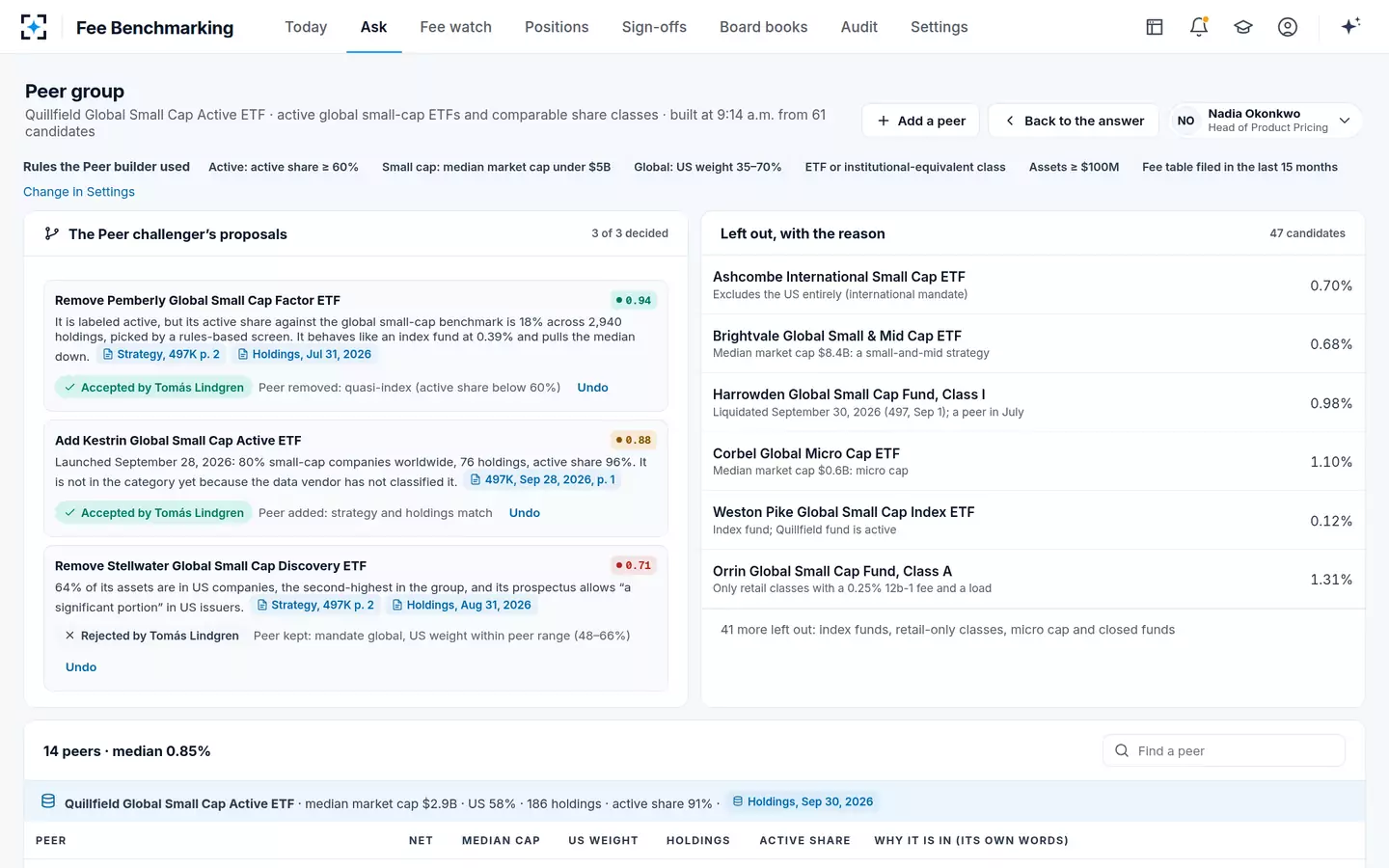
The table's first job is to make someone ask why. On the sample's first build, the only outlier was at the bottom: Pemberly Global Small Cap Factor ETF at 0.39%. It was not a bargain. It was labelled active, but its active share was 18% across 2,940 holdings, a quasi-index fund in an active set, and Botminds' Fee Benchmarking's Peer challenger proposed removing it. Once it was removed, and a fund launched three weeks earlier at 0.95% was added, the quartiles tightened and the fund at the top crossed the line.
The same outlier rule on two versions of the peer set
| Measure | First build, by category | After the challenge |
|---|---|---|
| Peers | 14, including a quasi-index fund at 0.39% | 14: quasi-index fund out, a new launch at 0.95% in |
| Median | 0.835% | 0.85% |
| Middle half (first to third quartile) | 0.75% to 0.875% | 0.785% to 0.8875% |
| Fences at 1.5 × the interquartile range | 0.56% and 1.06% | 0.63% and 1.04% |
| Flagged low | Pemberly at 0.39% | None |
| Flagged high | None | Halberd at 1.05% |
| Quillfield fund at 0.79% | Inside, below the median | Inside, below the median |
Neither flag proves anything. A fund at 1.05% may run a concentrated strategy that costs more to manage, which is element (c) of the pricing process; a fund at 0.39% may simply be a different product. What the table does is force the explanation to be written down, by someone, with evidence. ESMA's own words point the same way: comparison with peer funds "should not solely be used by management companies in order to set the pricing of the fund, but each cost category should be separately assessed and determined in the investor’s best interest" (ESMA, 2021 common supervisory action report, May 2022).
The low outlier, explained before anyone relied on it
How do regulators test fund fees in the EU?
Most national supervisors compare fees with market standards, usually when a fund is authorised and again in ongoing supervision. In ESMA's 2019 survey, published with its 2023 opinion, "Eighteen NCAs confirmed that they would compare funds’ fees with market standards, either on a regular basis or on an ad-hoc basis", five did so at the authorisation stage, and four did not do it at all (ESMA, 2023, Annex II). One authority reported that if authorisation showed an investment management fee above market standard, it would ask for a reduction before authorising the fund. Another compared new funds with peer funds by type, strategy and service providers.
ESMA then ran a common supervisory action on UCITS costs in 2021 with every national authority, reported in May 2022. Its findings read like a specification for the outlier table. Smaller managers had less formalised pricing processes, sometimes none. In some cases delegated portfolio managers effectively set the fees. Senior management joined late. And on the quantitative side, NCAs were asked to detect funds charging more than their peers, and "some NCAs reported that smaller entities constituted the largest part of the outliers identified" (ESMA, May 2022).
What EU supervisors reported about fee comparisons
18of 23
national authorities compared funds’ fees with market standards (2019 survey)
ESMA opinion, 2023
4
authorities said they did not compare fees with market standards at all
ESMA opinion, 2023
~20%
cheaper: the largest quarter of funds against the smallest quarter, on average
ESMA 2022 statistics, as cited in the CSA report
1a year
at least: ESMA’s expected frequency for reviewing costs and fees
ESMA CSA report, 2022
ESMA's view was that the level of costs "should be periodically reviewed and monitored in order to compare the estimated ongoing charges with the actual expenses incurred by the fund and, where possible, reduce the level of fees and ensure the viability and competitiveness of the fund over time against peer funds", at least as often as fund performance is assessed, which is at least annually. It also stressed "an independent analysis of the fee structures", without over-relying on the delegate portfolio manager's assessment.
ESMA's opinion on undue costs: from guidance toward law
In May 2023 ESMA asked the European Commission to put the substance of its briefing into legislation. Its opinion proposed that management companies be required to keep "a structured pricing process that (i) clearly demonstrates that all charged costs are due", to carry out due diligence, available to investors on request, "to ensure that all charged costs are equal to or better than market standards", and to reimburse investors "without undue delay" where undue costs were charged. It also suggested fines proportionate to the harm (ESMA, 17 May 2023).
These are proposals to the Commission, not rules in force, and ESMA itself notes that national authorities "are not price regulators". But they show the direction: a manager may one day have to show, on request, that each cost is at or below market standards, which is an outlier table with its sources attached.
NCAs should supervise that the payment of any fee or commission is aimed at remunerating a service provided to the fund/its investors and does not impair compliance with the management company’s duty to act in the best interests of the unit-holders.
ESMA, supervisory briefing on the supervision of costs (2020), paragraph 23
What ESMA's 2026 cost data mean for the table
The peer set itself is moving. ESMA's March 2026 report traced most of the fall in UCITS costs to cheaper new launches, with smaller cuts at funds that already existed (ESMA, 3 March 2026). An outlier table built two years ago, before a wave of cheaper launches, flatters an older fund. One built from a vendor category that has not yet classified the newest funds does the same. The table needs a date, and a way to know when new launches or fee cuts make it stale.
Building the outlier table with Botminds' Fee Benchmarking
Botminds' Fee Benchmarking builds the table the way the briefing implies. A Peer builder screens the universe and keeps funds by strategy text and holdings, each with a cited reason. A Fee reader reads every peer's KID, fee table or supplement in its original language, German, French or Italian beside the English. A Normalizer puts every figure on one basis under written rules and keeps the original line. A Checker reads every figure again on a different model and sends any reading below 0.90 confidence to a person. A Peer challenger argues with the set. Nothing is final until a person approves it, and the maker of an answer cannot approve it.
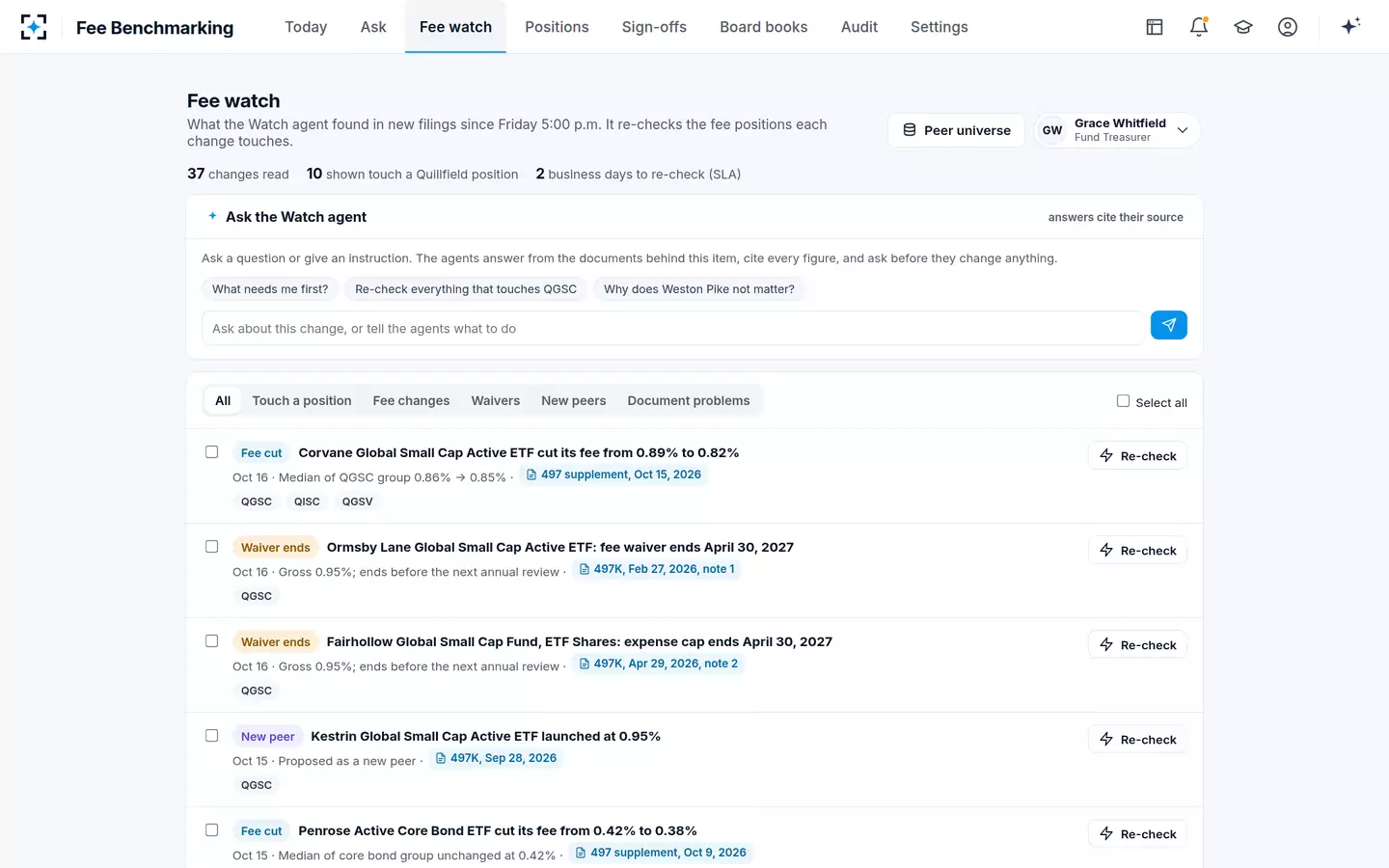
Two parts stay with the manager. The outlier rule is yours, approved by your pricing committee or board, and the explanation for any flagged fund, including your own, is yours to write. Between reviews, a watch agent reads new KIDs and filings overnight and tells the owner when a fee cut, a launch or a closure changes a table that has already been approved.
Fee cuts, waiver ends and launches, read from new filings overnight
Questions people ask
Is "undue cost" defined in the UCITS Directive?
No. Article 22(4) of Directive 2010/43/EU requires management companies to prevent undue costs being charged, but neither it nor the UCITS Directive defines them. ESMA's 2020 supervisory briefing sets out indicators and a pricing process, and its 2023 opinion asked the Commission to clarify the notion in law.
Does ESMA set a maximum fee for UCITS?
No. ESMA's opinion says national authorities "are not price regulators". The test is whether each cost is due and proportionate, including against market standards, which is why a documented comparison with similar funds matters more than any absolute level.
Do the undue costs rules apply to AIFs as well?
Yes. Article 17(2) of the AIFMD Level 2 Regulation requires managers to ensure that the AIFs they manage, or their investors, are not charged undue costs, and the national authorities ESMA surveyed treated the concept as equally applicable to UCITS and AIFs.
What happens if a supervisor finds undue costs?
ESMA's briefing expects supervisors to consider investor compensation where national law allows, a reduction of fees, a review of disclosure documents, and publicising good and poor practice. Its 2023 opinion proposed that managers be required to reimburse investors without undue delay and that fines reflect the harm.
How often should a UCITS manager review its fees?
At least once a year in ESMA's view: its 2021 common supervisory action said costs and fees should be reviewed at least as often as fund performance, which should be assessed at least annually. A fee cut by a close competitor or a wave of cheaper launches is a reason to look sooner.
Is there a UK equivalent of the undue costs rule?
Yes. COLL 6.6A.2R(5) requires the manager of a UK UCITS scheme to act so as to prevent undue costs being charged, and the FCA's assessment of value rules add an annual test of whether charges are justified by value; the FCA's guidance in COLL 6.6.24G ties the two together (FCA Handbook, COLL 6.6). The FCA assessment of value rules covers that test.