Price benchmarking software, in fund management, compares a fund's fee with the fees of peer funds so a product team can set a launch price, defend a fee at a pricing committee, or support a board's annual contract review and a UK assessment of value. The ranking is the easy part. The hard part is the peer set, and most tools build it and check it with the same logic: a category screen, then a review by whoever ran the screen. Errors that come from the method, such as a quasi-index fund filed as active or a launch the category has not caught up with, pass that review because the reviewer looks the same way. Botminds' Fee Benchmarking separates the two jobs. A Peer builder assembles the group from each fund's strategy text and holdings; a Peer challenger, running on a different model, argues with it; and a person decides every proposed change with a reason before a fee position is signed.
Eight steps in Botminds' Fee Benchmarking, and the two people who decide
Agent
PlannerTurns a plain question into a scope: the measure, the strategy, the vehicles, the share-class basis and the as-of date, shown before work starts.
Never: guess a fund or a measure when two readings are plausible; below 0.80 confidence it asks back
Agent
Peer builderScreens the universe and builds the group from each candidate’s principal investment strategy text and latest holdings: market cap, regional weights, holdings, active share.
Never: use a category label alone, or include a fund without a cited reason
Agent
Fee readerReads every fee-table line from summary prospectuses, prospectuses, supplements and KID cost tables, in the original language with the English beside it.
Never: round, recalculate or fill in a missing figure
Agent
NormalizerMakes figures like-for-like under written rules: net against gross, waivers and their end dates, KID transaction costs, share classes.
Never: apply a rule that is not written down; the original figure is always kept
Agent
Peer challengerOn a different model, looks for quasi-index funds, missing launches, strategy drift and share-class mismatches, and proposes each change with citations and a confidence.
Never: change the group itself; it only proposes
Agent
CheckerReads every cited figure again, blind, on a different model, and compares the two readings.
Never: pass a figure below 0.90 confidence; that goes to a person
A person decides
Product managerAccepts or rejects each proposed peer change with a reason code, confirms weak readings, and sends the answer for approval.
A person decides
Pricing Committee memberApproves the answer as a dated fee position. The person who prepared it cannot approve it.
What does price benchmarking software do for a fund manager?
It answers one question: where does this fee sit against funds that do the same thing? In practice that question is asked at three moments. At launch, a product team prices a new fund against the funds it will compete with. Between reviews, a pricing committee reacts to a rival's fee cut or a waiver ending. And once a year, the evidence goes to the people who must approve or justify the fee: a US fund board renewing the advisory contract, a UK manager's board in its assessment of value, an EU management company in its pricing process.
The tools sold for this are usually a fee database with a screen, a report produced once a year by a data provider, or a spreadsheet an analyst keeps. All three put the same figures in a ranked list. They differ in how the peers are chosen, how the figures are made comparable, and whether anyone other than the builder looks at the set before it is relied on. Those three differences decide whether the ranking can be defended, and the third is the one buyers ask about least.
How do you check a peer group?
You check a peer group by having someone, or something, that did not build it try to break it: look for funds that should not be there, funds that are missing, and figures that are not comparable, and make each finding a decision with a reason. A review by the builder confirms the build. Regulators have asked for exactly this separation in related settings. ESMA's 2021 common supervisory action on costs stressed "the importance of performing an independent analysis of the fee structures" without over-relying on the delegate portfolio manager's assessment (ESMA, May 2022). The FCA's 2023 review found most independent directors of UK fund managers did not provide sufficient challenge to value assessments, some because they had been too involved in gathering the information to question it later (FCA, August 2023).
Self-check vs independent challenge of a fund peer group
The builder checks its own set: Re-reads the same screen with the same rules and the same data.
An independent challenger checks it: Starts from the documents: what each fund holds, what its strategy text says, when it launched.
The builder checks its own set: Typing errors and figures copied into the wrong row.
An independent challenger checks it: Funds that pass the screen but fail the strategy, and funds the screen never saw.
The builder checks its own set: Anything the method itself gets wrong, such as a mislabelled fund.
An independent challenger checks it: Errors in its own reasoning, which is why it proposes and a person decides.
The builder checks its own set: A ticked box.
An independent challenger checks it: Each proposal with its reason, citations, confidence and the decision taken on it.
Four errors a peer builder misses, and the challenger looks for
Four kinds of error account for most bad peer sets, and each one survives a category screen. The challenger in Botminds' Fee Benchmarking is set to look for all four, and in the solution's fictional sample it found three of them in one 14-peer group for an active global small-cap ETF.
What the Peer challenger proposed for one sample peer group
| Error type | What the challenger found | Confidence | Decision and reason |
|---|---|---|---|
| Quasi-index fund in an active set | Pemberly Global Small Cap Factor ETF, labelled active: active share 18% across 2,940 holdings, at 0.39%, pulling the median down | 0.94 | Accepted: peer removed, quasi-index (active share below 60%) |
| Missing launch | Kestrin Global Small Cap Active ETF, launched 28 September at 0.95%: 80% small caps worldwide, active share 96%, not yet classified by the data vendor | 0.88 | Accepted: peer added, strategy and holdings match |
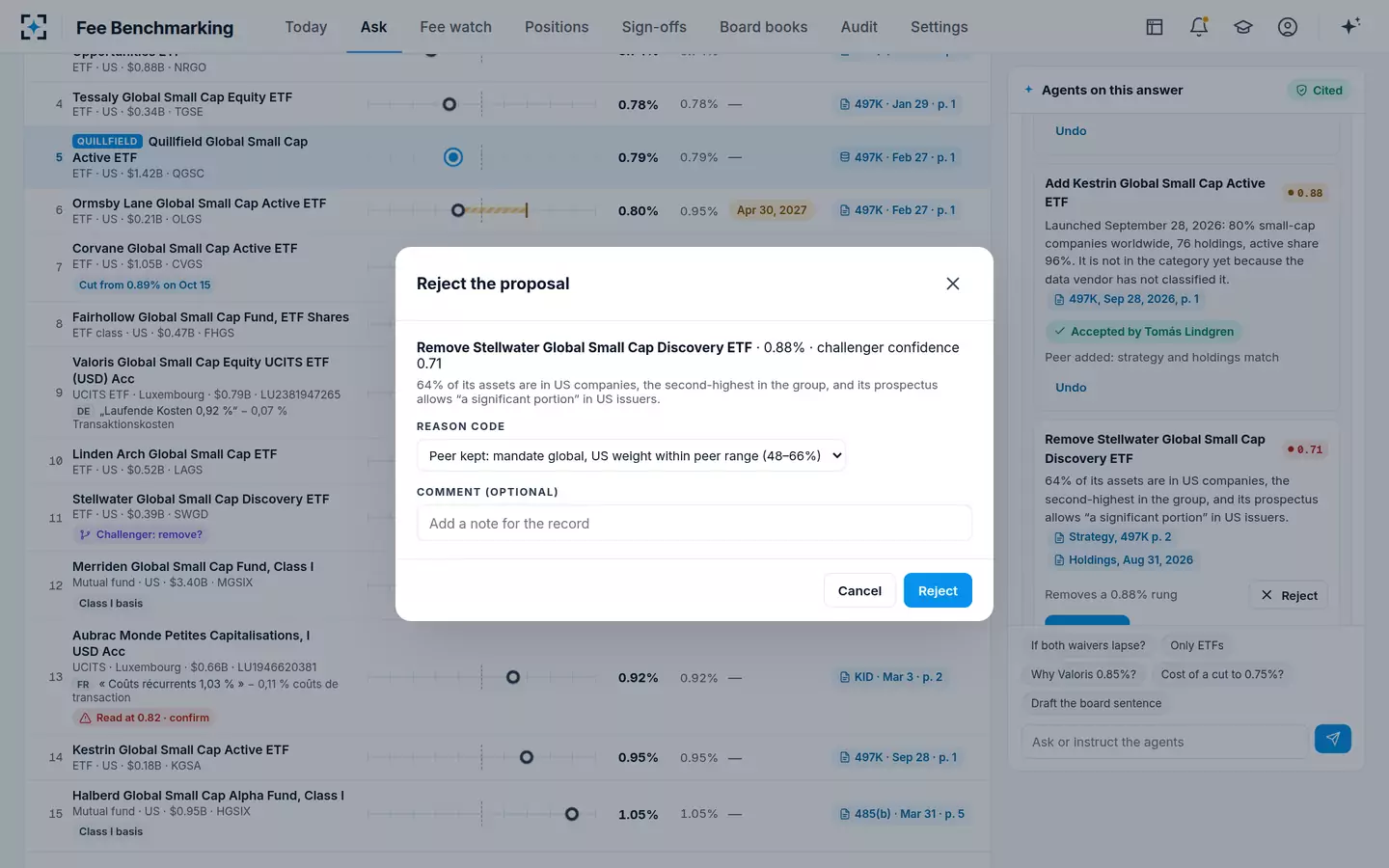
| Mandate drift | Stellwater Global Small Cap Discovery ETF: 64% in US companies, second-highest in the group, prospectus allows “a significant portion” in US issuers | 0.71 (low) | Rejected: mandate global, US weight within peer range (48–66%) |
| Share-class mismatch | None in this set: mutual funds were already compared on their class with no load and no 12b-1 fee | – | – |
The rejected proposal is as instructive as the accepted ones. Stellwater's US weight was high but inside the range the written rules allow, and its mandate is global, so the product manager kept it and said why. A challenger that is always right is not challenging hard enough; one whose proposals are decided with reasons leaves a trail a director can follow. How the choice of peers moves the answer is worked through in fund peer group analysis.
Each proposal decided by a person, with a reason code
Can AI build a fund peer group?
It can do most of the work, and it should not do the last part. Building a peer group is mostly reading: thousands of share classes screened, each candidate's strategy section and holdings file opened, active share and regional weights measured, fee lines found in prospectuses and KIDs in several languages. That is where agents save the days. Deciding whether a fund at 64% US belongs in a global group is a judgement about the fund's mandate and the question being asked, and it belongs to a person who will answer for it.
Supervisors are watching that line. ESMA's 2024 statement on AI in investment services warned that firms and clients might over-rely on AI for decisions and neglect human judgement, and expected management bodies to understand how their firms use it (ESMA, 30 May 2024). The SEC's examination priorities for fiscal 2027 describe registrants incorporating what the SEC calls "super intelligence" into research, drafting and compliance work, and say examiners will look at whether firms continue to meet existing, technology-neutral obligations (SEC, October 2026). A design in which agents propose and cite, and people decide and sign, fits both.
Why the challenger runs on a different model
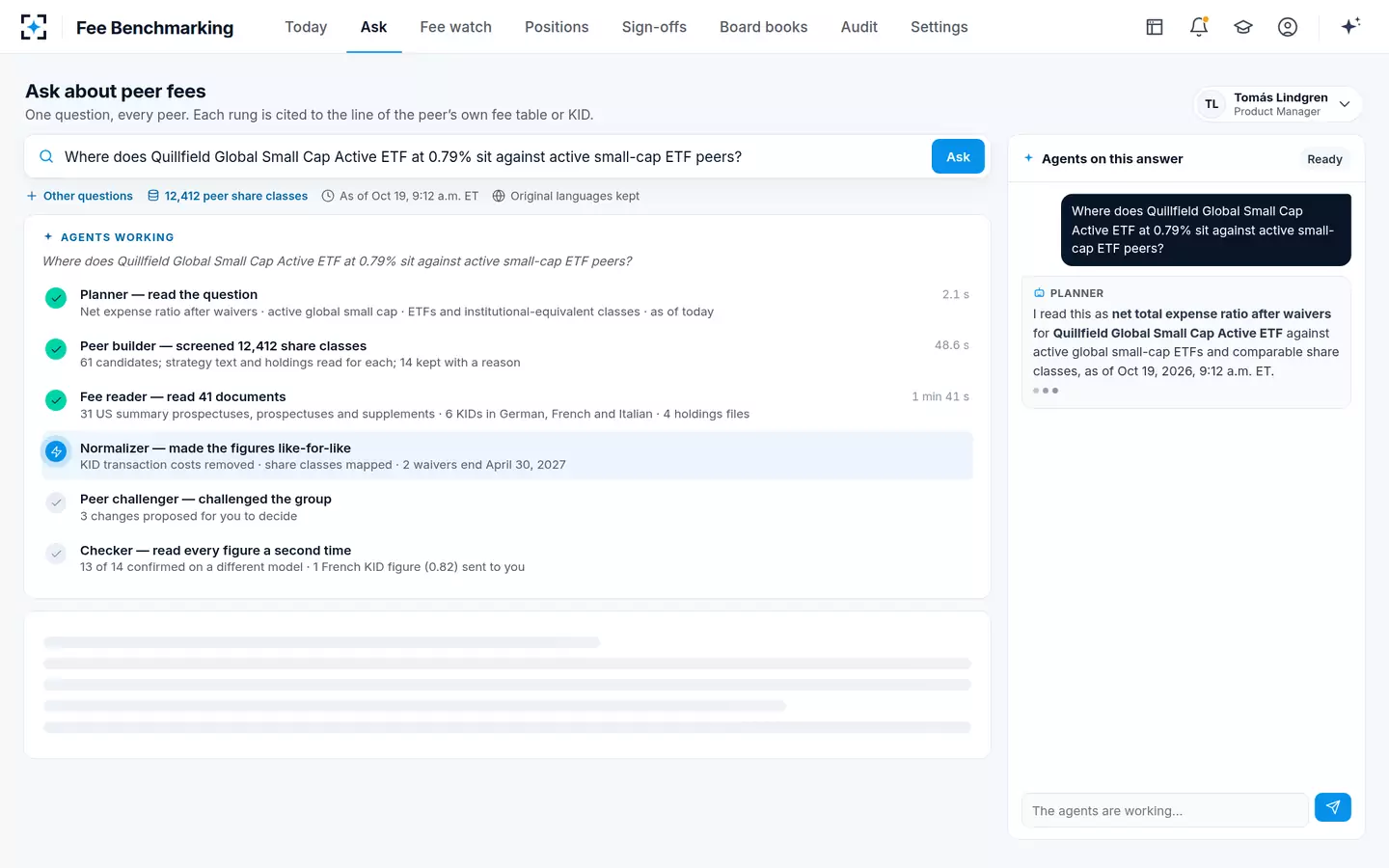
Two readings by the same model tend to make the same mistake, so agreement between them proves less than it seems. In Botminds' Fee Benchmarking the Peer challenger and the Checker run on a different model from the agents whose work they test. In the sample, the Checker re-read all 14 peer figures blind and confirmed 13; the 14th, a French KID figure read at 0.82 from a scan, fell below the 0.90 threshold and went to the product manager, who confirmed it against the page. The threshold itself can change only with Pricing Committee approval, backed by evaluation results.
The design costs little time. In the sample, the whole answer, from question to a cited, challenged ladder, took 3 minutes 41 seconds, against a design target of under five minutes. What it buys is a second, independent look at every figure and every peer, which a busy analyst checking their own spreadsheet the night before a committee cannot give.
The agents' steps in view, including the challenge and the second reading
Three signs a peer set has never been challenged
Most firms already have peer reports; the question is whether anyone has argued with them. Three signs suggest not. The first is a peer list with no exclusions: if the report shows the funds kept but not the dozens left out, nobody can check the judgement that matters most. The second is a peer list that never changes between years except for closures, which usually means the category was re-run rather than re-read, and launches since the last review are missing. The third is a median that nobody can move: ask what happens if the two closest calls go the other way, and if the answer takes a week, the set has not been tested.
Each sign has a regulatory echo. US boards must describe the comparisons they relied on, which is hard to do for a set whose exclusions were never written down. UK managers have been told that a comparison with peers cannot carry the whole assessment of value, which puts more weight on whether the comparison itself was sound. EU supervisors found outliers concentrated among smaller managers with informal pricing processes (ESMA, May 2022), the places where a single analyst builds and checks alone.
What a person decides, and what is kept
The person decides three things: each change to the peer set, each figure the Checker could not confirm, and the final position. Each decision carries a reason code, and the maker of an answer can never approve it. The trail of who chose each peer, and why, is what a 15(c) file, an assessment of value or an EU pricing process needs, and it is what is usually missing when a director asks. US funds must keep the materials a board considered in approving the advisory contract for at least six years (Rule 31a-2(a)(6)); the sample keeps positions, sources and decisions for seven, on a write-once audit trail.
Cost benchmarking software: what to ask before you buy
Ask to see the challenge, not just the ranking. A demonstration on the vendor's own sample fund shows the interface; a run on one of your funds, against last year's peer report, shows the method.
Seven questions for price or cost benchmarking software for funds
- Who builds the peer set, from what?
Category labels, or strategy text and holdings? Can you see the rules and change them under approval?
- Who challenges it, and is the challenger independent?
A different person or model, looking for quasi-index funds, missing launches, drift and class mismatches.
- Are disagreements shown or resolved silently?
Every proposal should be visible with its reason, citations and confidence, and decided by a named person.
- Is every figure read twice?
And what happens to a figure the second reading cannot confirm?
- Does every figure open its source?
Filing, date, page and line, including KIDs in their original language.
- Can the person who built the answer approve it?
They should not be able to. Ask to see the attempt blocked.
- What happens when a peer’s fee changes tomorrow?
New filings read, positions re-run, the owner told; approved positions never edited silently.
Where Botminds' Fee Benchmarking fits among pricing tools, and where it does not
Botminds' Fee Benchmarking is built for fund product, pricing and board teams who need peer-fee answers they can defend: US funds against fee tables and supplements, European funds against KIDs in their own languages, with the builder, challenger and checker split described here and people deciding every change. It fits a pricing committee that meets more often than the annual report arrives, and a board team that wants every figure in its materials traceable.
It is not a general price benchmarking tool for procurement or retail pricing, and it does not replace your data vendor: categories, peer assets and flows still come from there. It does not set the fee or judge whether it is justified; that is the pricing committee's call, and in the UK and EU it rests on considerations, such as the manager's own costs, that no peer table answers. For the rest of the method, ESMA's view that comparison with peers should inform pricing but not decide it alone is the right guide (ESMA, May 2022), and a 30-day pilot on your own funds is the way to test the fit.
Questions people ask
What is cost benchmarking in asset management?
It is comparing a fund's costs, usually its total expense ratio or ongoing charges, with those of similar funds to see whether they are in line with the market. EU supervisors expect it as part of a manager's pricing process, and UK fund managers do it under the comparable market rates consideration of the assessment of value.
What is pricing analysis software for funds?
It is software that models what a fee change does to a fund's rank among peers and to the manager's revenue. In Botminds' Fee Benchmarking those scenarios are restricted to the Pricing Committee, the fund's product manager and the fund treasurer, because an unannounced fee proposal is sensitive; the peer figures from public filings are open to everyone with access.
Can the peer challenger be a person instead of an agent?
Yes, and for decades it was: a second analyst, or the board's independent directors and counsel. The FCA's 2023 finding that most independent directors did not challenge enough suggests the role is under-staffed rather than unnecessary. An agent challenger makes the challenge routine; a person still decides each proposal.
How do confidence scores work in a peer challenge?
Each proposal and each figure reading carries a confidence from 0 to 1. In the sample, proposals below 0.75 are shown as low confidence and figure readings below 0.90 go to a person. The scores route work to people; they do not replace their judgement.
Is a fee analyzer the same as price benchmarking software?
No. A fee analyzer, such as FINRA's Fund Analyzer, projects what chosen funds will cost an investor over time. Price benchmarking software chooses the comparison set and ranks a fund's fee within it. Mutual fund expense analyzer or a peer fee study compares the two.