A fund fee waiver is an agreement by a fund's adviser to give up part of its management fee, or to reimburse some of the fund's expenses, so that investors pay less than the fund's full cost for a period. In a US prospectus fee table it appears as two extra lines, the waiver and the net total, and only if the arrangement will reduce expenses for at least one year from the effective date of the registration statement; the fund must also state when it is expected to end and who can end it. That is why a fee waiver fund's net expense ratio comes with an expiry date. A peer comparison that copies the net figure without the date can pass every arithmetic check and still mislead a board, because the fee it shows may be gone before the board acts on it. Botminds' Fee Benchmarking, which answers peer fee questions for fund product and board teams, reads each waiver's end date from the footnote and redraws the peer ladder for the day it lapses.
Two peers' waivers end between this board meeting and the next
- To the board51 days
- Board relies on waived fees142 days
- Waivers end: median 0.85% → 0.87%223 days to the next annual review
What is a management fee waiver in a fund?
A management fee waiver is a promise by the adviser to charge less than its contract allows, usually expressed as a percentage of assets waived or as a cap on total expenses, with the adviser absorbing or reimbursing the excess. Form N-1A calls these "expense reimbursement or fee waiver arrangements", and the fee table shows their effect as a "Fee Waiver [and/or Expense Reimbursement]" line and a net total beneath it (Form N-1A, Item 3, Instruction 3(e)). Many prospectuses call the same arrangement an expense limitation agreement or an expense cap.
Advisers use waivers to launch a fund at a competitive price before it has the assets to cover its costs, to hold a fee below a competitor's for a period, or to share savings without changing the contract. Whatever the reason, the waived fee is still the fund's cost: the gross figure is what the fund would charge without the adviser's subsidy. Net expense ratio vs gross expense ratio sets out how the two figures are built.
A different thing is also called a waiver. Sales charge waivers and discounts reduce the load an individual investor pays to buy shares; the fee table's narrative points investors to them separately. They change what one investor pays, not the fund's operating expenses, and they do not belong in a fee comparison.
How long does a fund fee waiver last?
As long as the agreement says, but a fee table can show its effect only if it runs at least a year. A fund may add the waiver and net lines only if the arrangement "will reduce any Fund operating expenses for no less than one year from the effective date of the Fund’s registration statement", and if it does, it must "disclose the period for which the expense reimbursement or fee waiver arrangement is expected to continue, including the expected termination date, and briefly describe who can terminate the arrangement and under what circumstances" (Form N-1A, Instruction 3(e)). The cost example may reflect the waiver only for the years it is expected to continue (Instruction 4(a)).
Because the net line can appear only if the waiver runs at least a year from the prospectus's effective date, a fund that wants to keep showing it has to extend the term at each annual update, so the footnote's date tends to move forward a year at a time. Extension is a decision, not an automatic step, and the footnote is the only public signal of when it falls due. In the sample, the footnote of one peer reads that the waiver runs "until at least April 30, 2027. The agreement may be terminated before that date only by the Fund’s Board of Trustees."
Contractual expense waivers and voluntary ones
The fee table draws the line for you. A contractual expense waiver that will run at least a year from effectiveness can be netted in the fee table, with its end date. A voluntary waiver that the adviser can stop at any time cannot be shown that way, because it does not meet the one-year condition, although it still lowers the expenses the fund actually pays. Those actual expenses, after waivers, show up in the financial highlights' ratio of expenses to average net assets, which looks back at the fiscal year just ended; how that ratio is built is covered in the financial highlights ratios guide.
For a peer comparison the consequence is practical. The forward-looking net figure in the fee table is a commitment with a date. The backward-looking ratio in the shareholder report may include voluntary waivers with no commitment at all. Mixing the two in one ranking compares a promise with a history.
Valid is not accurate: a net fee that passes every check
A peer figure can be valid, meaning it matches its source exactly and every check passes, and still be inaccurate for the decision it supports. The four cases below, all from the sample peer set, show the difference. The dangerous one is the second: nothing about it looks wrong.
Two questions about every peer fee: does it match its filing, and will it still be true?
Matches its filing
Does not match, or not yet confirmed
Still true when the board acts
No longer true by then
The checks most fee comparisons run, re-reading the figure, matching it to the filing, recomputing the median, catch the right-hand column. Only a date-aware check catches the bottom-left cell. That is why the solution's written rules include a waiver flag: any waiver that ends within 12 months of the next board date is marked on the ladder and in the answer, so the reader sees it before relying on the number.
One expiring waiver, followed for seven weeks
Take the sample as a board reporting analyst lives it. Kenji Arai, a fictional board reporting analyst, prepares the December 15(c) materials for 99 funds, including 38 expense-group sections. On Friday 16 October, the watch agent reading new filings flags two items in the peer group of Quillfield Global Small Cap Active ETF: Ormsby Lane's fee waiver ends on 30 April 2027, and so does Fairhollow's expense cap. Both peers are 0.95% gross. Neither change has happened yet, so a spreadsheet would show nothing.
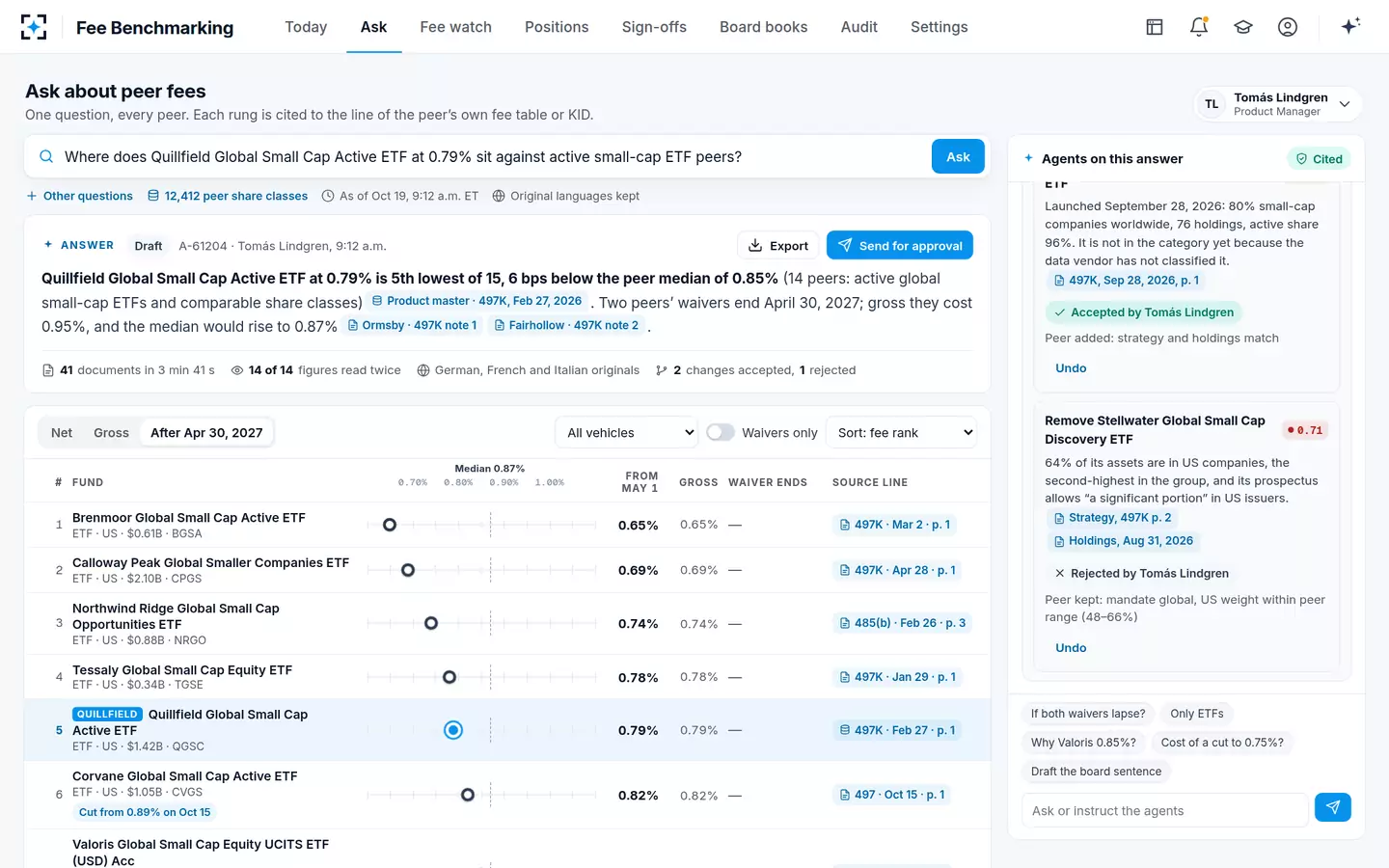
On Monday 19 October, the product manager asks where the fund sits. The answer, approved by the Head of Product Pricing at 10:42 a.m., says the fund at 0.79% is 5th lowest of 15 and 6 basis points below a peer median of 0.85%, and adds that the median would be 0.87% without the two waivers. At 10:43 Kenji inserts the approved position into section 4.12 of the trust's 15(c) materials. The drafted paragraph keeps the waiver sentence, so the directors read, in the same place as the rank, that "Two peers' contractual waivers end April 30, 2027; without them the median would be 0.87%."
The materials go to independent counsel on 18 November and to the board on 9 December. Kenji's job in between is to make sure nothing he sent has gone stale, and the watch agent re-checks the position each time a peer files. If either adviser renews its waiver, the footnote moves and the flag clears; if not, the board has already been told what changes on 1 May. US funds must keep the materials the board considered for at least six years (Rule 31a-2(a)(6)), so the waiver sentence, and the filings behind it, stay with the decision.
Waiver ends found in new filings, with the positions they touch
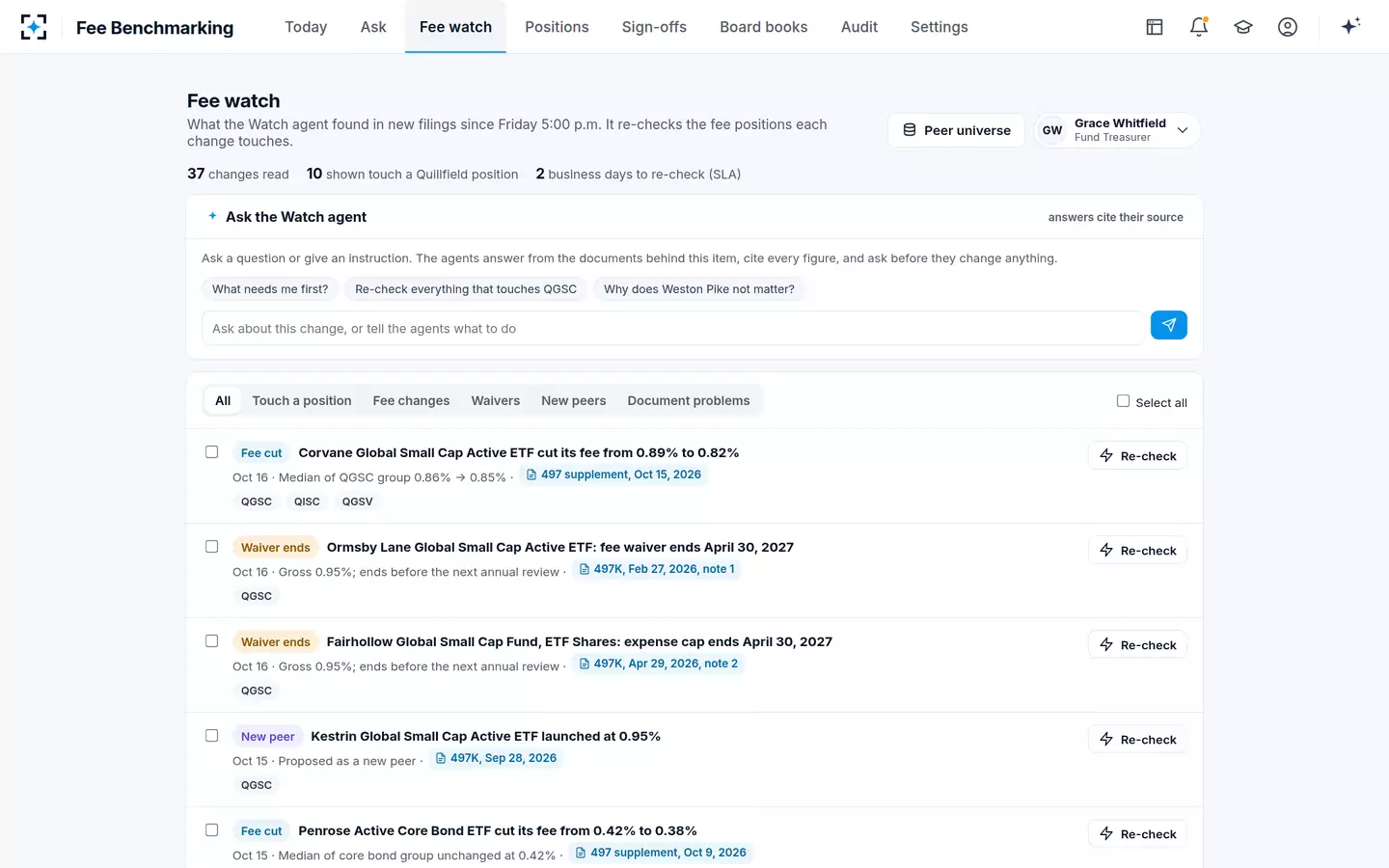
One peer group, two expiring waivers
2of 14
peers with a waiver ending before the next annual review
Both end 30 April 2027
15bp
between net and gross at Ormsby Lane; 10 bp at Fairhollow
0.85→0.87%
peer median, net today and after both waivers end
6→8bp
the fund’s distance below the median, with no change to its own fee
ETF fee waivers work the same way
An ETF registered on Form N-1A follows the same fee table rules, so an ETF fee waiver is netted only if it runs at least a year and must carry its end date. The difference is in the structure. Many ETFs charge a single unitary management fee and have few other expenses, so a waiver reduces the headline fee itself, and the gross figure is the price the sponsor has set. A rival's waived launch price in an ETF peer group is therefore a forecast as much as a fee: when it ends, the fee rises unless the sponsor renews. ETF management fees comparison puts a dollar value on each basis point of that difference.
Waivers are on the SEC's examination list
The SEC's Division of Examinations named fee waivers and reimbursements in its fiscal 2027 priorities, published on 23 October 2026: registered fund examinations will focus first on fund fees and expenses, including related waivers and reimbursements (SEC, FY2027 Examination Priorities). For a fund's own waiver, the questions are whether the fee table, the agreement and what was actually charged agree. For a peer's waiver in a board comparison, the question is simpler and more often missed: did the directors know it would end?
How Botminds' Fee Benchmarking catches an expiring waiver
The solution treats a waiver as a dated fact, not a lower number. The Fee reader takes the net and gross lines and the footnote from each peer's fee table, summary prospectus or supplement and cites them. The Normalizer records the end date and applies the written waiver rule, flagging any waiver that ends within 12 months of the next board date. Every rung of the peer ladder shows net, gross and the end date, and one switch redraws the ladder as it will look the day after the waivers lapse. The watch agent reads new filings every night and re-runs the positions a renewal, an early termination or a new waiver touches, drafting a new version for the owner rather than editing an approved one.
The peer ladder redrawn for 1 May 2027
Five checks for any waiver in a peer comparison
- Read the footnote, not just the line
Copy the expected termination date and who can end the waiver.
- Compare the date with your calendar
Flag any waiver ending before the next pricing review or board meeting.
- Show the gross figure beside the net
So the size of the subsidy, and the risk to the ranking, is visible.
- Show the ranking without the waivers
If the answer changes, the board should see both versions.
- Watch for renewals and early ends
A 497 supplement or the next prospectus can move the date either way.
Questions people ask
Can a fund fee waiver end early?
Only as its terms allow, and the fee table must say who can terminate it and under what circumstances. Many contractual waivers can be ended before their stated date only by the fund's board, as in the sample peer's footnote. A voluntary waiver can usually be stopped at any time, which is why it cannot be netted in the fee table.
Does a fee waiver improve a fund's returns?
Yes, while it lasts: lower expenses deducted from the fund's assets mean higher net returns. The financial highlights' expense ratio reflects the waivers in force during the year, so past returns and ratios may flatter the fund's cost once a waiver ends.
What is a mutual fund waiver?
The phrase is used for two things. A fee waiver lowers the fund's operating expenses for all investors in a class; a sales charge waiver lowers the load a particular investor pays to buy shares. Only the first changes the fund's expense ratio and belongs in a fee comparison.
Is an expense cap the same as a fee waiver?
It works the same way in the fee table. An expense cap limits total operating expenses to a set percentage, with the adviser waiving fees or reimbursing expenses to meet it; a fee waiver gives up a set part of the management fee. Both are netted in the fee table only if they run at least a year, and both must state an end date.
What happens to a peer median when waivers end?
It moves without any fee being changed. In the sample, two peers going from net to gross lifted a 14-peer median from 0.85% to 0.87%. A fund priced just below a cluster of waived peers can move the other way, from below the median to above it.