The FCA's assessment of value rules, in COLL 6.6.20R and 6.6.21R of its Handbook, require an authorised fund manager to assess at least once a year, for each fund and separately for each unit class, whether the payments taken from the fund are justified by the overall value delivered to investors. The assessment must cover at least seven considerations: quality of service, performance, the manager's costs, economies of scale, comparable market rates, comparable services and classes of units. Its conclusions go into the fund's annual report, independent directors on the manager's board are expected to challenge it, and a named senior person is accountable for it. For a US manager the shape is familiar from the annual advisory contract renewal under Section 15(c), but the UK test is stricter on one point: it asks for a fee to be justified, not just compared. Botminds' Fee Benchmarking prepares the fee-comparison evidence for both, with every peer figure cited to its page.
The UK's seven value considerations beside the US board-approval factors
UK: The range and quality of services to unitholders, including those of delegates
US: Nature, extent and quality of the adviser’s services
UK: After all charges, over a timescale that fits the objective, policy and strategy
US: Investment performance of the fund and the adviser
UK: For each charge, the cost of the service; for payments to associates, the amount paid
US: Costs of the services and the profits of the adviser and its affiliates
UK: Savings from scale, in the light of the fund’s growth or shrinkage
US: Economies of scale as the fund grows, and whether fee levels share them
UK: For each service, the market rate for comparable services
US: Comparisons with other advisers’ contracts with funds
UK: The AFM’s and associates’ charges to other clients, including institutional mandates of comparable size and objective
US: Comparisons with other types of client, such as pension funds
UK: Whether holders should be in a class with higher charges than a substantially similar one
US: No direct equivalent; Rule 18f-3 asks for a finding on each class in a multi-class plan
What are the FCA assessment of value rules?
They are a set of COLL rules that came into force in September 2019 as remedies from the FCA's 2017 asset management market study, which found "weak demand-side pressure on fund prices, resulting in uncompetitive outcomes for investors in authorised funds" (FCA, August 2023). The core duty is one sentence: an authorised fund manager "must conduct an assessment at least annually for each scheme it manages of whether the payments out of scheme property set out in the prospectus are justified in the context of the overall value delivered to unitholders" (COLL 6.6.20R(1)).
The rules apply to the manager of an authorised unit trust, an authorised contractual scheme or an investment company with variable capital, other than one operating under a temporary permission (COLL 6.6.19R). They sit beside the best-interests rules: COLL 6.6.23E says a failure to take sufficient steps where charges are not justified "may be relied on as tending to establish contravention" of the rules requiring a manager to act in investors' best interests and to prevent undue costs.
What are the FCA assessment of value criteria? Seven considerations, one class at a time
The criteria are the seven minimum considerations in the table at COLL 6.6.21R, and the manager must weigh them "separately for each class of units in a scheme" (COLL 6.6.20R(2)). The rules set no weighting. Two of the seven are fee comparisons. Comparable market rates asks, for each service, what a comparable service costs in the market, whether provided by the manager or to it, including by a delegate. Comparable services asks what the manager and its associates charge other clients for comparable services, "including for institutional mandates of a comparable size and having similar investment objectives and policies".
The other five look inward: the quality of service, including a delegate's; performance after all charges, over a timescale that fits the fund's objective, policy and strategy; the cost of providing each service behind each charge; whether the manager achieves economies of scale as the fund grows or shrinks; and whether investors should be in a unit class with higher charges than another class of the same fund with substantially similar rights.
Comparable market rates is not the whole test
The FCA's reviews say the most common failure is letting the peer comparison decide everything. In its 2023 review of 14 managers, it found comparable market rates "being used by many firms to override one or more of the other minimum considerations": when another consideration suggested fees might not be justified, most firms switched to market rates to justify them, and some would cut a fee only if it was out of line with competitors' (FCA, August 2023). It also found that where fees were cut, the cuts were "almost always driven by adverse comparable market rates findings", which it read as fund managers continuing to cluster around price points.
While the rules do not prescribe any weighting of the considerations, we consider that justifying fees solely based on a comparison with peer funds does not amount to meaningful compliance with COLL 6.6.20R.
FCA, Authorised fund managers’ assessments of fund value 2023
Comparison still has to be done well where it is used. The 2021 review found most managers comparing at least one unit class's ongoing charges figure, typically the clean wholesale class, with a peer group, while higher-charging classes "costing investors significantly more than the peer group median" were left out (FCA, July 2021, marked historical in August 2025). The 2023 review added comparisons made "without first adjusting for differences in service levels", such as an ongoing charges figure without a platform charge set against one with it. How to build the peer set itself is covered in fund peer group analysis.
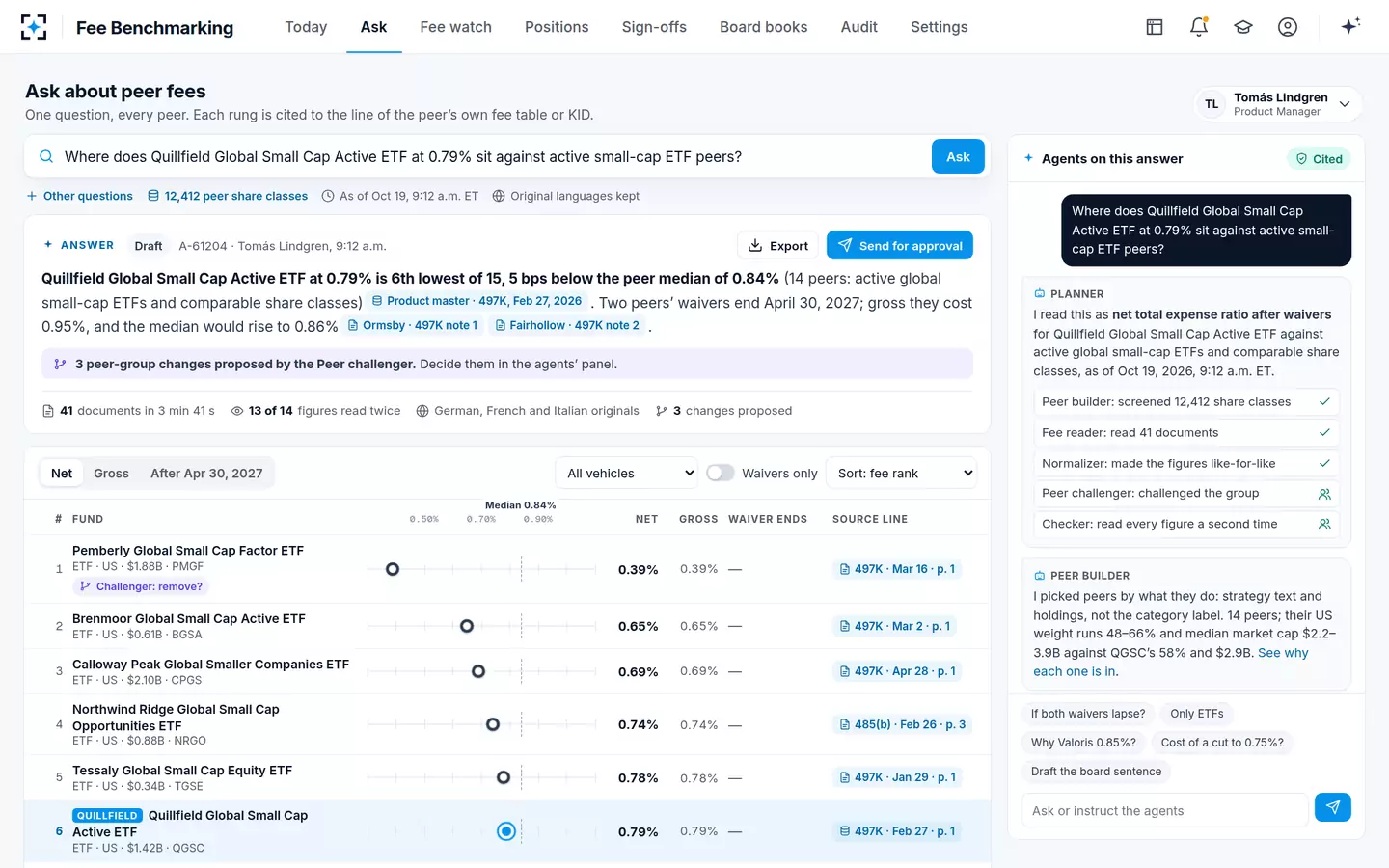
A comparable market rates answer, every rung cited to its filing
Comparable services: the institutional mandate question
Comparable services is where the UK test goes further than a market comparison: it points the manager at its own group's prices. If the same team runs a segregated pension mandate of similar size with a similar objective for a lower fee, the fund's higher fee has to be justified by the difference in service. The FCA found firms arguing the services were too different to compare without testing whether the extra fee matched the extra work, and one firm attributing lower institutional fees to relationship discounts without asking whether its funds, with their pooled buying power, could negotiate the same (FCA, 2021; FCA, 2023).
US law is more cautious here. The SEC's 2004 release names pension funds and other institutional investors as comparisons a board may rely on (69 FR 39798), but the Supreme Court in Jones v. Harris Associates held that a mutual fund need not pay what an institutional client pays, because the services and markets can differ (559 U.S. 335). How US boards handle that comparison is set out in what Jones v. Harris asks of a fee review, from Botminds' 15(c) Board Reporting. A group that runs funds on both sides of the Atlantic therefore needs the institutional fee evidence anyway; the difference is how much weight each regime puts on it.
AFM costs and economies of scale: the considerations firms merged
The FCA's first review found many managers misreading the costs consideration: instead of comparing each charge with the cost of providing the service, they "compared total fund charges with those of competitors’ funds", then repeated the same comparison under comparable services, so one test did the work of two (FCA, 2021). It noted that firms in US groups had more developed methods for economies of scale, reflecting "a history of disclosing information to inform the 15c process".
By 2023 almost all firms were testing fees against their own costs, and the best used activity-based cost allocation at fund and class level, which "typically revealed significant variations in profitability between larger and smaller funds". Firms still allocating costs by assets under management saw smaller differences, and less informed board discussions about scale (FCA, 2023). A fee benchmarking tool does not answer these two considerations; it keeps the market comparison from crowding them out.
What the FCA checked, and what it requires of the board
18
fund managers visited for the first review, July 2020 to May 2021
FCA, 2021
14
fund managers visited for the second, November 2022 to March 2023
FCA, 2023
¼
of the manager’s board must be independent; at least two members if it has fewer than eight
COLL 6.6.25R
10years
at most for an independent member, in terms of no more than five
COLL 6.6.25R(4)
Who signs an assessment of value?
The manager's board concludes, independent directors challenge, and one approved person answers for compliance. At least a quarter of the board must be independent natural persons, or at least two members if the board has fewer than eight, appointed for terms of no longer than five years and ten in all (COLL 6.6.25R). The FCA's guidance says their role "should include providing input and challenge" in the assessment (COLL 6.6.26G). Responsibility for compliance with the assessment of value rules must be allocated to an approved person, and to the chair if the chair is one (COLL 6.6.27R).
The 2023 review found challenge weaker than the structure suggests: most firms' independent directors "did not provide sufficient challenge", some because they were "too involved in the collection and analysis of information to be able to challenge its suitability subsequently", others because they accepted board information at face value. It also reminded boards whose fees were set by a global group that they alone are responsible for concluding whether fees are justified (FCA, 2023).
What is an assessment of value report?
An assessment of value report is the public account of the conclusions. The annual long report of an authorised fund must contain, at least, "the conclusion of the authorised fund manager’s assessment of whether the charges that apply to units in each class of the scheme are justified" and a summary of any remedial action taken or planned (COLL 4.5.7R(8)). A manager may instead publish a composite report covering two or more funds, in the same manner as the annual report (COLL 4.5.7R(9)), which is why many UK groups publish a single assessment of value report each year.
The FCA's 2023 review found reporting much improved, with reports organised around the seven considerations and explaining action on poor value, and it encouraged firms to cut production costs by placing the disclosures in the funds' annual reports (FCA, 2023). The 2021 review had pointed to reports that used charts of performance against comparator benchmarks and could be found easily online.
From market study to Consumer Duty: the assessment of value since 2017
- Rules in force, Sep 201927 mo
- First review, Jul 202122 mo
- Second review, Aug 202325 mo
- CP26/23, Jun 202634 mo
Assessment of value and the Consumer Duty in 2026
For authorised funds the assessment of value stands in for the Consumer Duty's price and value outcome. The FCA said so in 2023: "For authorised funds the AoV rules and guidance act in place of the price and value outcome rules of the Duty", while the rest of the Duty still applies (FCA, 2023). In June 2026 it proposed to make the wording consistent: its guidance would say that the price and value outcome rule in PRIN 2A.4 does not apply to firms subject to the value rules in COLL 6.6, COLL 8.5 and COLL 15.7 (FCA CP26/23, consultation closed 18 September 2026). That is a proposal at the time of writing, and it changes language, not the assessment itself.
The practical effect is that the assessment of value is the UK fund manager's fair-value test, and its quality is judged by the Duty's standard of good outcomes. The FCA's 2023 review put it bluntly: firms "that fail to make reasonable decisions to deliver good outcomes will likely fall short of the standards expected to comply with our rules".
One evidence set for two regimes: where Botminds' Fee Benchmarking fits
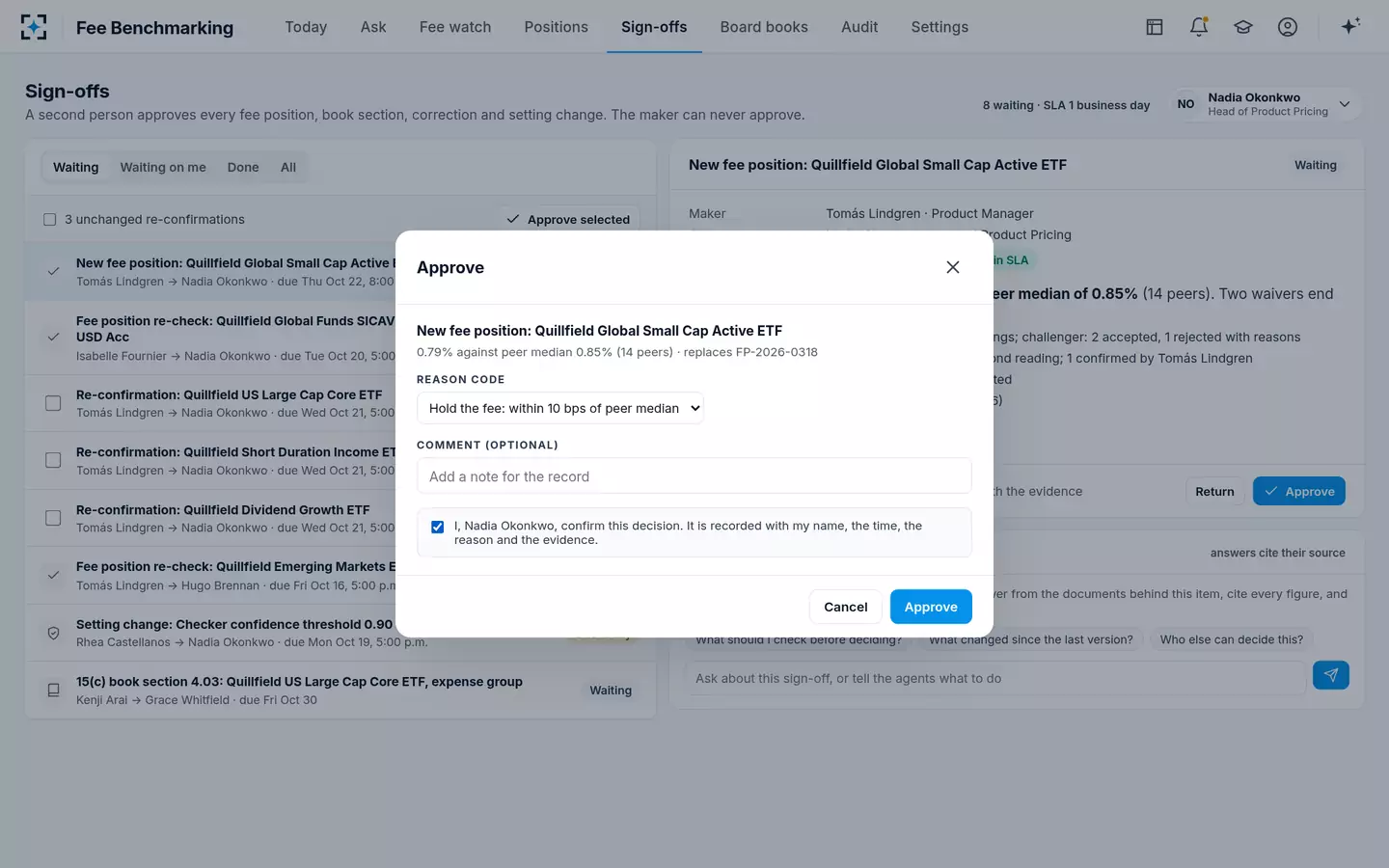
A group with UK and US funds can build the fee-comparison evidence once and use it twice, provided it is built to the stricter test. Botminds' Fee Benchmarking answers the comparable market rates question class by class: agents build the peer set from each candidate's strategy text and holdings, read every peer's own fee table or KID in its original language, make the figures like-for-like under written rules, and cite each one to its page. A person decides every peer change with a reason, and a Pricing Committee member approves the result as a dated fee position, with the maker unable to approve their own work.
It does not do the rest of the assessment. The cost, scale, quality and performance considerations need the manager's own cost allocation, service data and performance analysis, and comparable services needs the group's institutional fee schedules, which only the firm holds. What the solution can promise is narrower and still useful: that the market comparison is complete, current and traceable, so it informs the assessment instead of overriding it. For a European fund that must also show its costs are not undue, the same peer table does double duty, as undue costs in UCITS explains.
A dated fee position, approved by someone who did not build it
Six tests for the fee comparisons in an assessment of value
- Every unit class assessed, not just the clean one
Including higher-charging classes, against peers of the same kind.
- Service differences adjusted before comparing
Platform charges, distribution payments and transaction costs treated the same on both sides.
- Institutional mandates compared, not dismissed
Where the service differs, the fee difference is explained by the work, not asserted.
- Market rates do not override the other six
A fee in line with peers is not, on its own, a justified fee.
- Evidence an independent director can test
Peer rules, exclusions and the source of each figure, without having built them.
- Conclusions and remedies that match the evidence
Each class’s conclusion and any action, as COLL 4.5.7R(8) requires in the annual report.
Questions people ask
How often must an assessment of value be done?
At least once a year for each fund, under COLL 6.6.20R(1). The FCA's 2023 review found the stronger firms treating it as continuous, checking the considerations before launching new funds and when funds changed during the year, rather than as a stand-alone annual exercise.
Which funds do the assessment of value rules apply to?
COLL 6.6.19R applies them to the authorised fund manager of an authorised unit trust, an authorised contractual scheme or an investment company with variable capital, other than one managing a fund under a temporary permission. Related rules in COLL 8.5 and COLL 15.7 cover qualified investor schemes and long-term asset funds.
What happens if a fund's charges are not justified?
The manager must act: cut fees, move investors to a cheaper class, change the fund or merge it, and report the remedy in the annual report. Under COLL 6.6.23E, failing to take sufficient steps may be relied on as tending to establish a breach of the manager's best-interests duties.
Is the assessment of value the same as the Consumer Duty fair value assessment?
For authorised funds it takes its place: the FCA said in 2023 that the assessment of value rules act in place of the Duty's price and value outcome rules, and in its June 2026 consultation it proposed guidance saying the price and value outcome does not apply to firms under those COLL value rules. The rest of the Duty still applies.
Do US fund groups have to do an assessment of value?
Only for UK authorised funds they manage. For US funds the board's annual approval of the advisory contract under Section 15(c) plays a similar role, with a disclosure in Form N-CSR of the factors the board weighed and any comparisons it relied on; the evidence overlaps, but the UK test of justification by value is broader.
Can the peer comparison come from an outside provider?
Yes, and many managers use one, but the manager's board remains solely responsible for the conclusion. The FCA expects the comparison to be adjusted for service differences and every unit class to be assessed, so the board should be able to see how the provider built the peer group and sourced its figures.