Jones v. Harris Associates is the 2010 Supreme Court decision that set the test for when a mutual fund adviser's fee breaches the fiduciary duty Section 36(b) of the Investment Company Act imposes on compensation. The Court adopted the Second Circuit's Gartenberg standard: to be liable, an adviser must charge a fee so disproportionately large that it bears no reasonable relationship to the services rendered and could not have been the product of arm's-length bargaining (Jones v. Harris Associates L.P., No. 08-586, March 30, 2010). It also told courts how much to defer to the fund board that approved the fee: more when the directors considered the relevant factors with full information, less when the process was deficient or the adviser withheld information. That second holding is why the 15(c) renewal file matters, and why Botminds' 15(c) Board Reporting cites every answer to its source and checks it against last year before the board sees it.
Jones v. Harris Associates in four numbers
2010
decided March 30; reported at 559 U.S. 335
1982
the Gartenberg standard the Court adopted, from the Second Circuit
3
mutual funds whose shareholders brought the case
1 yr
how far back 36(b) damages reach before the suit is filed
What did Jones v. Harris decide?
It decided what a fund shareholder must prove to win a Section 36(b) claim, and it chose the standard on which, in its words, "something of a consensus" had developed among the lower courts. The Court held that Gartenberg "was correct in its basic formulation of what §36(b) requires," vacated the Seventh Circuit's judgment, which had rejected Gartenberg, and sent the case back for further proceedings (Jones, Parts II-B and IV).
The opinion then settled three disputes the parties had about how the standard works: how to treat comparisons with the fees an adviser charges its institutional clients, how to treat comparisons with fees other advisers charge their funds, and how much weight to give the board's approval. On each, its answer pushes the case away from fee levels and toward the evidence the board had and how it used it. How the peer set behind such a comparison gets chosen is the subject of fund peer group analysis.
The case: three funds, one adviser, and a fee challenge
The plaintiffs were shareholders in three mutual funds managed by Harris Associates. They sued in the Northern District of Illinois under Section 36(b), alleging fees "disproportionate to the services rendered" and outside anything arm's-length bargaining would have produced. The district court applied Gartenberg and granted summary judgment for the adviser, finding the fees within the range arm's-length bargaining could produce, in light of comparisons both with the adviser's other clients and with fees other advisers charged similar funds.
A Seventh Circuit panel affirmed, but on a different theory, explicitly disapproving Gartenberg. Rehearing en banc was denied by an equally divided vote, and the dissent from that denial noted the adviser charged "its captive funds more than twice what it charges independent funds." The Supreme Court granted certiorari to resolve the split among the circuits.
Why the Seventh Circuit's market test lost
The panel's view was that a fiduciary must make full disclosure but is not subject to a cap on compensation, and that competition among thousands of funds keeps fees in check; fee amount would matter only if it were so unusual that deceit or abdication must be inferred. The Supreme Court said that by focusing almost entirely on disclosure the panel erred. It read "fiduciary duty" through Pepper v. Litton (1939), whose test is whether a transaction "carries the earmarks of an arm's length bargain", and noted that the Act shifts the burden of proof from the fiduciary to the plaintiff.
The Seventh Circuit's test and the Supreme Court's, point by point
Seventh Circuit panel (2008): Full disclosure and "no tricks"; no cap on compensation
Supreme Court (2010): Gartenberg: a fee so disproportionately large it could not come from arm's-length bargaining
Seventh Circuit panel (2008): Competition among funds keeps fees in check; Gartenberg "relies too little on markets"
Supreme Court (2010): The debate about today's fund market is "a matter for Congress, not the courts"
Seventh Circuit panel (2008): Comparison with other client types firmly rejected
Supreme Court (2010): No categorical rule: weight depends on how similar the services are
Seventh Circuit panel (2008): Implicitly the market's verdict
Supreme Court (2010): Not to be relied on too heavily; they may not be arm's-length either
Seventh Circuit panel (2008): Almost the whole test
Supreme Court (2010): A factor that calibrates how much deference the board gets
Seventh Circuit panel (2008): Not analysed as a separate question
Supreme Court (2010): Deference proportional to the robustness of the board's process
The Court also explained why Gartenberg suits the statute's structure. Board scrutiny of adviser pay and shareholder suits under Section 36(b) are, in its words, "mutually reinforcing but independent mechanisms for controlling conflicts." To give directors the information they need, the Act requires advisers to furnish what is reasonably necessary to evaluate the contract under Section 15(c) (15 U.S.C. 80a-15(c)), and it instructs courts to give the board's approval such consideration as is appropriate under all the circumstances.
What is the 36(b) standard?
A plaintiff must show that the adviser's fee is outside the range arm's-length bargaining would produce: so disproportionately large that it bears no reasonable relationship to the services. The plaintiff carries the burden, and need not prove personal misconduct (15 U.S.C. 80a-35(b)(1)). All relevant circumstances count, which is how the Gartenberg factors enter: what the adviser provides, what it costs and earns, whether scale savings are shared, how the fee compares, what side benefits the adviser collects, and how independent and careful the directors were. Where the evidence for each factor lives is mapped in its own guide.
The Court was explicit that this is not rate-setting. Congress had rejected a "reasonableness" test that would have made courts set fees, and the Act "does not require courts to engage in a precise calculation of fees representative of arm's-length bargaining." It added that the standard "does not call for judicial second-guessing of informed board decisions." The word that matters in that sentence is informed.
Are mutual fund fees compared to institutional fees?
They can be, but only for what they are worth. The Court refused a categorical rule either way: since the Act requires all relevant factors to be considered, courts may give such comparisons the weight they merit given how alike the services are, and must reject them when the services differ so much that the comparison proves nothing. It listed the usual differences between a fund and a pension account: more frequent shareholder redemptions, higher turnover of assets, heavier regulatory and legal obligations and higher marketing costs. And it said the Act does not necessarily guarantee that a fund pays what an institutional client pays.
Footnote 8 shows how high the bar is in litigation. "Only where plaintiffs have shown a large disparity in fees that cannot be explained by the different services in addition to other evidence that the fee is outside the arm's-length range will trial be appropriate." For a board, that cuts both ways: an institutional fee schedule in the book is worth something only if it comes with a description of how the services differ.
How Jones v. Harris treats each kind of fee comparison
| Comparison | What the Court said | What the 15(c) file should show |
|---|---|---|
| Same adviser, institutional clients | No categorical rule; weight depends on the similarity of services; inapt comparisons to be rejected | The institutional fee schedule with the services each fee buys, and why they differ |
| Other advisers, similar funds | Courts should not rely on them too heavily; those fees may not be arm's-length either | The peer group, how it was chosen, its edition, and whether it changed from last year |
| The fund's own fee over time | Not addressed directly; all relevant circumstances count | Last year's fee, rate and margin beside this year's, with every move explained |
| Fee against services and cost | The core of the test: bargaining range relative to services rendered | Cost and profitability by fund, under a stated and unchanged method, or the change disclosed |
Peer fee comparisons: why the Court discounted them
Comparisons with other advisers' fund fees are the comparison most 15(c) books lead with, and the Court treated them warily. Its reason was structural: the fees charged to other funds were set the same way as the fee under challenge, by advisers dealing with boards they work closely with, so they may not reflect arm's-length negotiation either. It cited Gartenberg's observation that vigorous competition among funds for investors does not imply competition among advisers for funds.
That does not take peer data out of the board book. The SEC's 2004 disclosure rule asks the fund to say whether the board relied on comparisons with other advisory contracts and, if so, which and how (69 FR 39798). What it changes is the weight a peer rank can carry on its own. A fee at the median of a peer group that is itself expensive shows the fee is ordinary, not that it is fair.
Process and substance: "considerable weight" or "a more rigorous look"
This is the holding fund boards read most closely. The Court said a court's evaluation "must take into account both procedure and substance," and that where the board's process for negotiating and reviewing the adviser's pay is robust, the court should give commensurate deference to the outcome.
“[I]f the disinterested directors considered the relevant factors, their decision to approve a particular fee agreement is entitled to considerable weight, even if a court might weigh the factors differently.”
Jones v. Harris Associates L.P., 559 U.S. 335 (2010), Part III
The other side follows in the next paragraph of the opinion: "where the board's process was deficient or the adviser withheld important information, the court must take a more rigorous look at the outcome." The Court gave the reason: withheld information "might have hampered the board's ability to function as 'an independent check upon the management.'" And it tied the two together: an adviser's compliance or non-compliance with its disclosure obligations "is a factor that must be considered in calibrating the degree of deference that is due a board's decision to approve an adviser's fees."
The deference is not unconditional. The Court added that a fee may still be excessive even if a fully informed board negotiated it, but only on evidence that it meets the Gartenberg standard. Process earns weight; it does not end the case.
What Jones v. Harris means for a 15(c) file
The practical reading is that the board's 15(c) materials are evidence twice over: of what the directors knew, and of whether the adviser told them everything. A file that shows a structured request, complete answers with sources, follow-ups and their replies, and minutes that record how each factor was weighed is the file that earns considerable weight. A file with a carried-forward sentence that was no longer true, or a cost method changed without a word, is the file that invites the more rigorous look.
The SEC's Kornitzer order of 2015 is the cautionary case on the second point. The board had asked for the adviser's profitability with its expense allocation method; the adviser's CFO adjusted the allocation of the chief executive's compensation, in part to keep reported profitability consistent year over year, and did not tell the board (SEC, IC-31560, April 21, 2015). That is withheld information in exactly the sense Jones describes. Whether a 15(c) file would hold up in a 36(b) case turns these points into tests.
What a 15(c) file needs to earn the deference Jones describes
- The directors asked, in writing
The request letter and every follow-up, dated: the "process for negotiating and reviewing" starts here.
- Every factor answered with evidence
The Court's phrase is "considered the relevant factors"; the file has to show each one.
- Nothing material withheld
Method changes, waivers, affiliate fees and anything that moved since last year, stated.
- Comparisons explained, not just listed
Institutional fees with the service differences; peers with how the group was chosen.
- The board's own reasoning recorded
Minutes that say how each factor was weighed, not a template.
- The materials kept as considered
Six years, the first two easily accessible, under Rule 31a-2(a)(6).
How 15(c) Board Reporting builds a file that shows its process
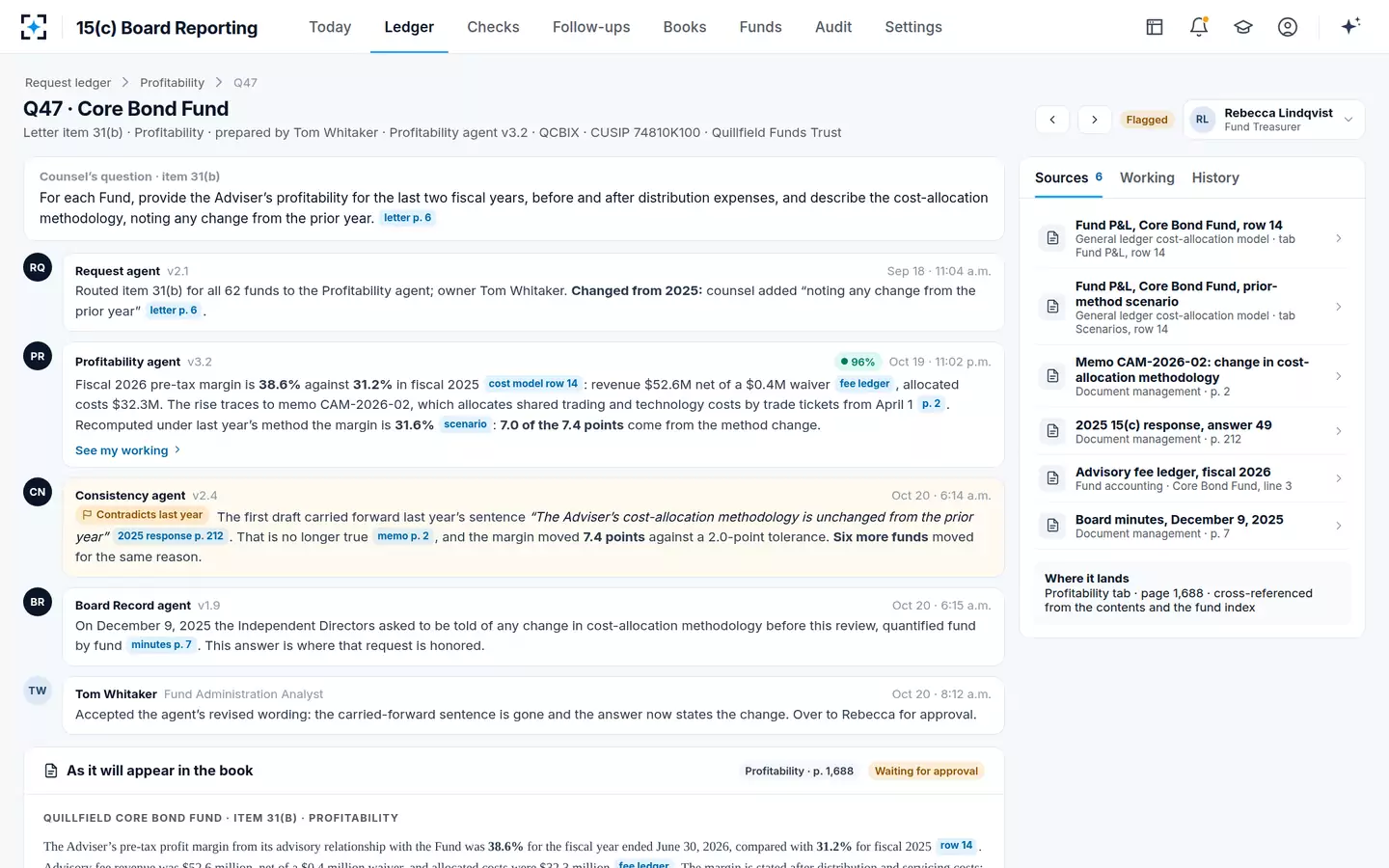
15(c) Board Reporting is built around the Jones distinction. Agents draft each answer from the system of record and cite the row or page behind every figure; a Consistency agent compares each answer with last year's response and with the rest of this year's book, so a moved margin or a sentence that is no longer true is flagged before the board sees it; and the board's prior requests, found in its minutes, are linked to the answers that must honor them. People decide: the fund treasurer approves each answer with a reason code, nobody approves their own work, and only the chief legal officer releases the book. Every step is on a tamper-evident audit trail, kept six years.
A profitability answer in 15(c) Board Reporting that discloses a method change, with its six sources
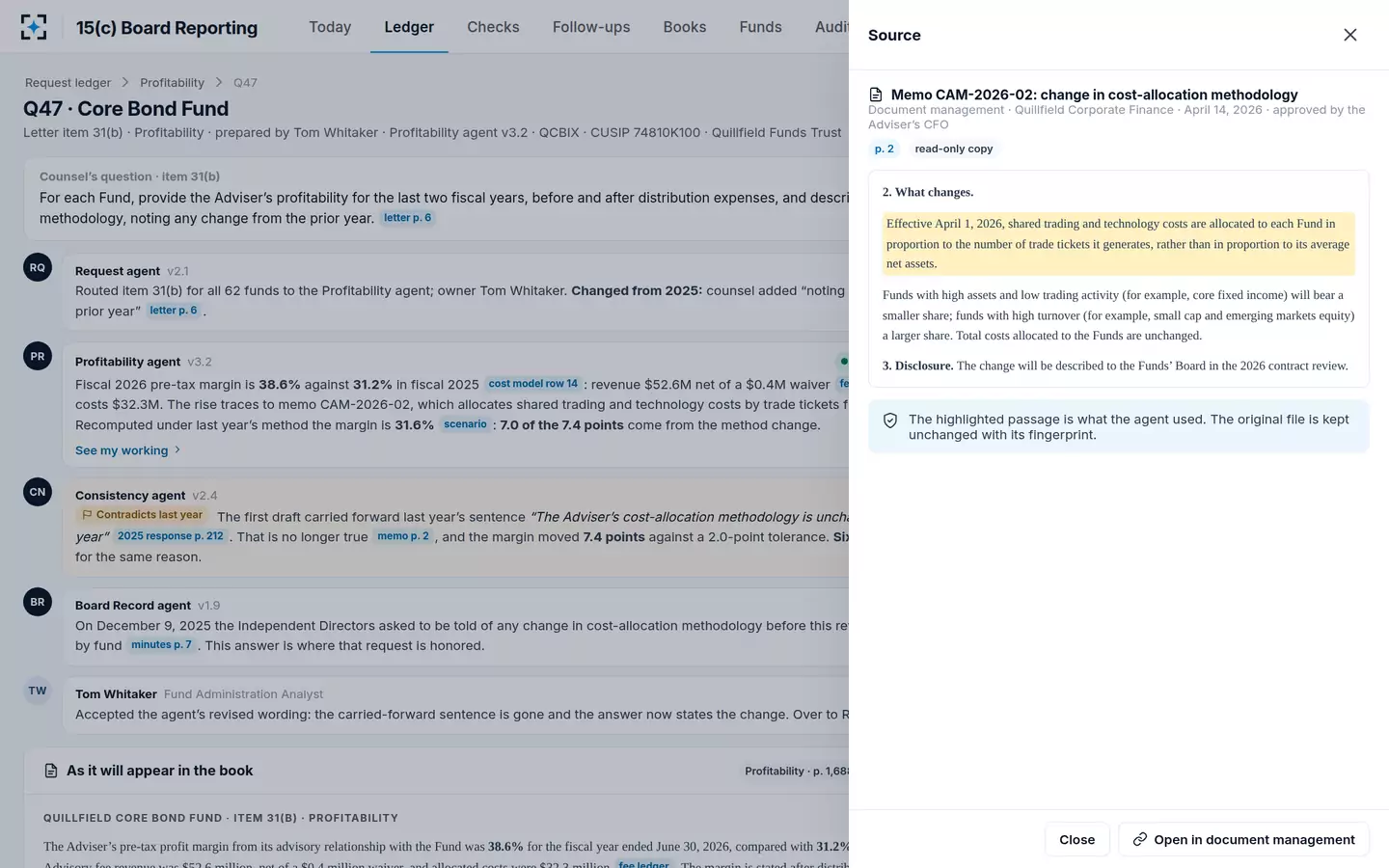
The source behind the figure: the methodology memo, highlighted
Questions people ask
What did Jones v. Harris decide?
That the Gartenberg standard governs Section 36(b): an adviser is liable only for a fee so disproportionately large that it bears no reasonable relationship to the services and could not have come from arm's-length bargaining. The Court vacated the Seventh Circuit's judgment, which had rejected that standard, and remanded the case.
Was Jones v. Harris a Supreme Court case?
Yes. Jones v. Harris Associates L.P., No. 08-586, was decided by the Supreme Court on March 30, 2010, with the opinion of the Court by Justice Alito. It is reported at 559 U.S. 335.
What is the 36(b) standard after Jones v. Harris?
The plaintiff must prove the fee is outside the range arm's-length bargaining would produce, weighing all relevant circumstances. Board approval gets such consideration as is appropriate: considerable weight where the directors considered the relevant factors, and a more rigorous look where the process was deficient or information was withheld.
Are mutual fund fees compared to institutional fees under Jones v. Harris?
They may be, with weight that depends on how similar the services are, and courts must reject comparisons that are not probative. The Court said the Act does not necessarily ensure fee parity between funds and institutional clients.
Does Jones v. Harris require boards to use peer fee comparisons?
No. The Court said courts should not rely too heavily on comparisons with fees other advisers charge their funds, because those fees may not be arm's-length either. Boards still disclose whether they relied on comparisons, under the SEC's 2004 rule.
What happened to Jones v. Harris after the Supreme Court?
The Supreme Court vacated the Seventh Circuit's judgment and sent the case back to that court for further proceedings under the standard it had set. Later proceedings belong to the lower courts' records; the Supreme Court's opinion is the part that binds every fund board.