36(b) litigation is a lawsuit under Section 36(b) of the Investment Company Act, brought by a fund shareholder on the fund's behalf or by the SEC, claiming that the adviser breached its fiduciary duty with respect to the compensation it receives from the fund. The shareholder must prove the breach, damages cannot reach back more than one year before the suit was filed, and the court gives the board's approval of the fee "such consideration … as is deemed appropriate under all the circumstances" (15 U.S.C. 80a-35(b)). Since Jones v. Harris Associates in 2010, how much consideration depends on the board's process: an informed review earns considerable weight, a deficient one a more rigorous look. The evidence of that process is the 15(c) file. Botminds' 15(c) Board Reporting builds it answer by answer, each cited to its source, checked against last year and approved by a named person.
The tests below come from three SEC orders about 15(c) processes, each read in full; the sample answers come from a fictional complex, Quillfield Funds, as it runs through the solution.
Six tests a 15(c) file must pass, each drawn from an SEC case
- 1. The method described is the method applied
Kornitzer (2015): profitability said compensation was allocated by labor hours; the CEO's share was adjusted to keep margins steady.
- 2. Every item the board requested is answered
Commonwealth (2015): no documentary evidence the requested comparable-fund fees were provided; the trustees approved anyway.
- 3. Answers match the adviser's own books
Commonwealth: "no fees waived" while a waiver ran under an expense cap; breakpoints described that were not in the contract.
- 4. Comparisons are apt, and their limits stated
Commonwealth: a peer chart mixing share classes, an ETF and an index fund; Northern Lights: a fee nearly double the peer mean described as acceptable.
- 5. What is said about the review is true
Northern Lights (2013): reports said trustees had reviewed peer fee data that was never provided to them.
- 6. The file is kept whole
Northern Lights: advisers' 15(c) financials discarded or returned after meetings; Rule 31a-2(a)(6) requires six years.
What is Section 36(b) of the Investment Company Act?
Section 36(b) makes a registered fund's investment adviser a fiduciary "with respect to the receipt of compensation for services, or of payments of a material nature," paid by the fund or its shareholders to the adviser or its affiliates, and gives a private right to enforce that duty (15 U.S.C. 80a-35(b)). Congress added it in 1970. The Supreme Court described it as "a delicate compromise": stronger for shareholders than the old corporate-waste standard, but not the review of fees for "reasonableness" the SEC had proposed, which the industry feared would give the Commission ratemaking authority (Jones v. Harris Associates, Part I-A).
The duty sits beside the board's duty under Section 15(c), not instead of it. The Court called board scrutiny and 36(b) suits "independent checks on excessive fees," quoting its earlier decision in Daily Income Fund, and quoted another, Kamen, for why Congress added 36(b): shareholders "should not have to rely solely on the fund's directors to assure reasonable adviser fees."
Section 36(b) in four terms
1 year
no damages for any period before one year prior to the suit
Plaintiff
carries the burden of proving a breach
Recipient
only the person who received the pay can be sued or ordered to pay
Federal
actions only in a US district court
36(b) cases: who can sue, whom, and where
An action may be brought by the SEC, or by a security holder of the fund on the fund's behalf. It may be brought against the adviser, its affiliated persons and any officer, director or other person with a fiduciary duty over the compensation, but no action may be maintained, and no relief granted, against anyone other than the recipient of the compensation. Suits go only to a federal district court (80a-35(b)(3) and (5)).
Two limits narrow the field further. The section does not reach sales loads, or compensation in transactions governed by Section 17, the affiliated-transaction provision. And a court's finding of breach under 36(b) cannot by itself be the basis for an industry bar or a finding of violation under the sections the statute lists. A 36(b) case is about money paid, and its remedy is that money.
What is the burden of proof under 36(b)?
The plaintiff carries it, and need not allege or prove personal misconduct (80a-35(b)(1)). What must be proved, after Jones v. Harris, is that the fee is so far out of line with the services that no arm's-length negotiation could have produced it. The Court noted that this reverses the ordinary rule for fiduciaries, who usually have to prove a transaction's fairness themselves (Jones, Part II-B).
Comparisons do not shift the burden. In footnote 8 the Court reserved trial for cases where plaintiffs show a large fee gap that the difference in services cannot explain, plus other evidence that the fee lies outside the arm's-length range. How Jones treats each kind of comparison is set out in its own guide.
How far back can 36(b) damages go?
One year. The statute says no award of damages "shall be recoverable for any period prior to one year before the action was instituted," and any award is limited to actual damages and may not exceed the compensation the defendant received from the fund (80a-35(b)(3)). The board's approval in the year before the suit is therefore the one most likely to be examined, which is a reason to treat every season's file as if it will be read in court.
Why the 15(c) file decides how hard the court looks
Because Jones made the board's process the measure of deference. When the independent directors weighed the relevant factors, a court gives their decision substantial weight even if it would have weighed them differently; when the process was flawed or the adviser held back important information, the court looks harder at the result. Whether the adviser met its disclosure duties is itself part of how much deference the board earns (Jones, Part III; the Court's own words are in what the Supreme Court asks of a fee review).
The 15(c) file is where both questions get answered. It shows what the directors asked for, what the adviser furnished, what was missing, and what the directors did about it. The SEC added Rule 31a-2(a)(6) in 2004 for that reason: to improve the documentation of the board's basis for approving a contract, which would help its examiners determine whether directors were meeting their fiduciary duties (69 FR 46378, August 2, 2004).
Three SEC 15(c) cases scored against the six tests
Kornitzer (2015)
Adviser and its CFO/CCO
Allocation said "estimated labor hours"; CEO pay share adjusted to steady the margin
Method as stated✕ fails
Every item answered—
Matches the books—
Apt comparisons—
Statements true—
File kept—
Commonwealth (2015)
Adviser, its owner, three trustees, administrator
No fee comparison supplied; no written allocation method; waivers and breakpoints misdescribed; inapt peer chart
Method as stated—
Every item answered✕ fails
Matches the books✕ fails
Apt comparisons✕ fails
Statements true—
File kept—
Northern Lights (2013)
Administrator, CCO firm, five trustees
Boilerplate described peer data the board never had; 15(c) materials discarded or not kept
Method as stated—
Every item answered—
Matches the books—
Apt comparisons✕ fails
Statements true✕ fails
File kept✕ fails
Six tests a 15(c) file must pass, and the case behind each
The method described is the method applied. In Kornitzer, the board asked each year for profitability with an explanation of the expense allocation method. The analysis said salaries and benefits were allocated by estimated labor hours; in fact the CFO set the share of the chief executive's compensation charged to the funds in part to keep reported profitability consistent, at 35%, 40% and 49.5% in fiscal 2010 to 2012, then 25% in 2013 as that compensation rose by more than 70% (IC-31560, paragraphs 14–20).
Every item is answered, and the board follows up. In Commonwealth, one trust's trustees requested comparative fee information with the questionnaire; there was no documentary evidence it was furnished, and the trustees approved because they considered the fees within an appropriate range. The SEC found the trustees themselves violated Section 15(c) because they "did not follow up to obtain such information" (IC-31678, paragraphs 32–33 and 55).
Answers match the adviser's own books. For the second Commonwealth trust, the adviser answered that no fees had been waived since the last renewal when it had waived part of its fee under an expense limitation agreement capping expenses at 2.75%, and told the directors the fund had appropriate breakpoints when they had been omitted from the contract (paragraphs 48–50).
Comparisons are apt. The same adviser's peer table, built from an industry database without editing, mixed share classes with different distribution fees, an ETF and an unmanaged index fund, and funds with combined advisory and administration fees, while the fund paid them separately (paragraphs 42–45). In Northern Lights, a report implied a fee near the middle of its peer range when it was higher than every fee in the adviser's 74-fund peer group and nearly double the mean (IC-30502, paragraph 23).
What is said about the review is true, and the file is kept. Northern Lights' shareholder reports said the trustees had reviewed peer fee data that the adviser had never provided; and advisers' written 15(c) financial information was, on three occasions, discarded or returned after meetings at the advisers' request (paragraphs 23 and 25). Rule 31a-2(a)(6) requires anything the directors considered to be kept six years, the first two in an easily accessible place (17 CFR 270.31a-2(a)(6)).
A weak answer and a defensible one, side by side
The difference between the two is rarely the number. It is whether the answer would survive the questions a plaintiff's expert, or an SEC examiner, would ask of it. Take one profitability answer from the sample complex, where the adviser changed its cost-allocation method on April 1 and counsel's letter asked this year for "any change from the prior year".
One 15(c) profitability answer, weak and defensible
The answer copied from last year: Core Bond pre-tax margin 38.6% for fiscal 2026
The answer the file can defend: 38.6% for fiscal 2026 against 31.2% for fiscal 2025, both on the cost model's rows
The answer copied from last year: "The Adviser's cost-allocation methodology is unchanged from the prior year" (carried forward)
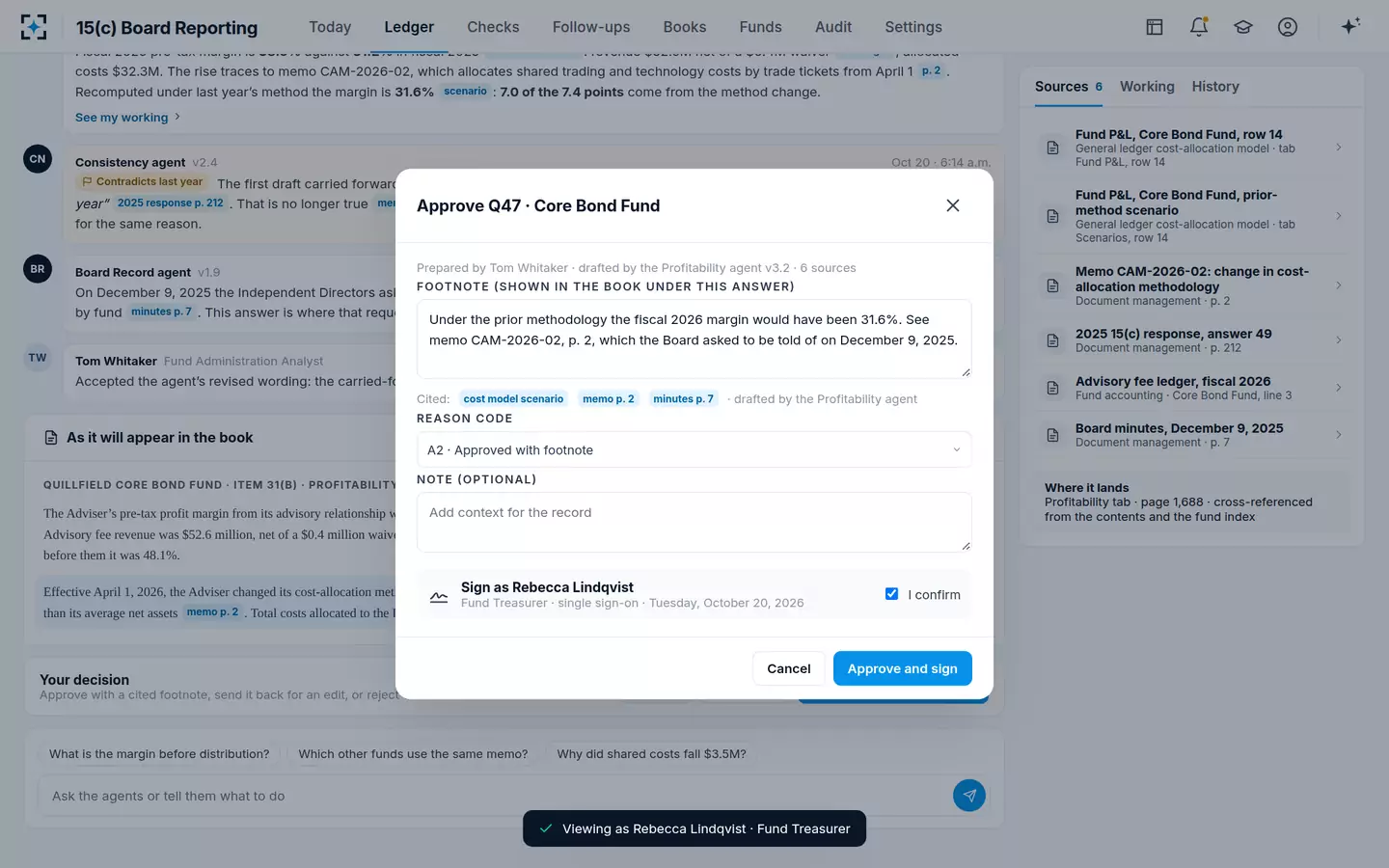
The answer the file can defend: Shared trading and technology costs moved from net assets to trade tickets on April 1, citing the memo, page 2
The answer copied from last year: Not stated
The answer the file can defend: Under last year's method 31.6%; 7.0 of the 7.4-point rise is the method change
The answer copied from last year: Not linked
The answer the file can defend: December 2025 minutes asked to be told of any such change, fund by fund: answered here and for six more funds
The answer copied from last year: Not yet approved: flagged before review
The answer the file can defend: Prepared by an analyst; approved by the fund treasurer with reason code "approved with footnote"
The weak answer is not careless. It is what every renewal produces when this year's file starts as a copy of last year's. Under Jones it is also the answer most likely to be read as information withheld.
The defensible answer in 15(c) Board Reporting, approved by someone who did not prepare it
Keeping the file: six years, and what goes in it
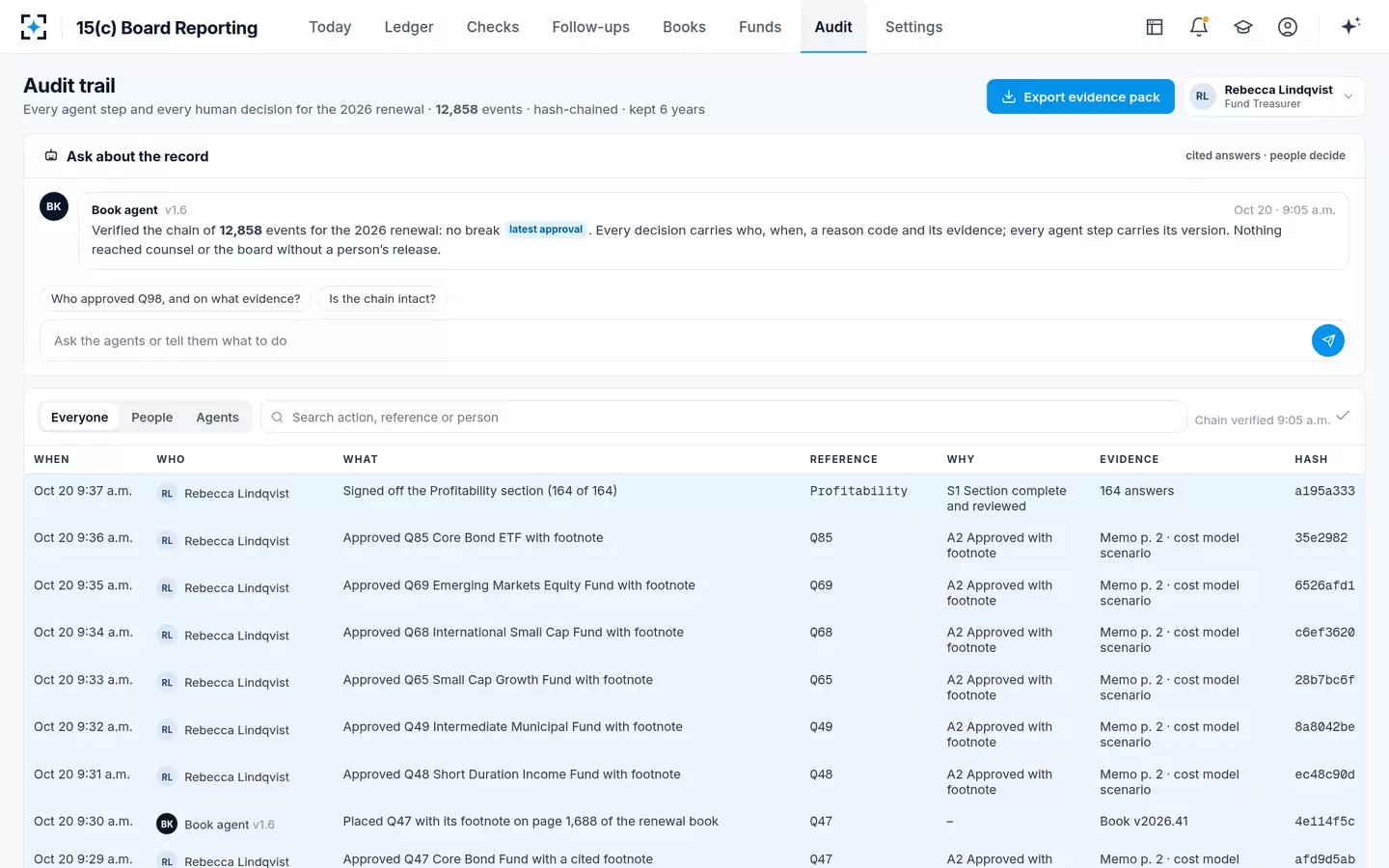
The rule asks for what the directors considered, which is more than the final book. For a file that is meant to be evidence, that means the letter and each follow-up; every answer as it was when the directors read it, not only the final version; the sources behind each figure; the minutes; and the record of who prepared and who approved each answer. If an answer changed after the board read it, the file should show both versions and why.
Retention has two halves under Rule 31a-2(a)(6): six years in total, and the first two in an easily accessible place. The Northern Lights failures were about the first half: materials that left the building after the meeting. The second half is what makes an examiner's or a litigant's request a day's work rather than a project.
Every approval and agent step on a hash-chained audit trail
What 15(c) Board Reporting adds to a file that must hold up
Each of the six tests maps to a control in the solution. Agents draft answers from the system of record and cite the row or page; a Profitability agent states margins for both years under both methods whenever the method changes; a Consistency agent compares every figure and statement with last year's response and with every other place it appears, against tolerances such as 2.0 points for a margin and 2 basis points for an expense ratio, and never clears its own flag; a Board Record agent links the board's prior requests to the answers that must honor them. A preparer cannot approve their own answer, the treasurer approves each with a reason code, and only the chief legal officer releases the book. Materials and sources are kept six years, the first two easily accessible.
What the solution does not do is judge the fee. Agents never propose a fee change, pick a peer group or alter the cost model; whether the fee is fair is the board's question. What the SEC's 15(c) cases cost the people charged is the other half of the argument for getting the file right.
Questions people ask
What is an excessive fee lawsuit against a mutual fund?
For a registered fund it is usually a claim under Section 36(b), brought by a shareholder on the fund's behalf, alleging the adviser's compensation breaches its fiduciary duty. The plaintiff must show the fee is so disproportionately large it could not have come from arm's-length bargaining.
Can the SEC bring a 36(b) case?
Yes. Section 36(b) lets the Commission, as well as a fund shareholder, bring an action. The three SEC orders discussed here were instead settled administrative proceedings about the information given to boards and what funds said about it.
Is board approval a defence in 36(b) litigation?
Not a complete one. The statute tells courts to give the board's approval the consideration that is appropriate under all the circumstances, and Jones v. Harris gives it considerable weight when the directors considered the relevant factors, and less when the process was deficient or information was withheld.
How long must a fund keep its 15(c) materials?
Six years, the first two in an easily accessible place, under Rule 31a-2(a)(6). The rule covers any documents or other written information the directors considered in approving the contract or its renewal.
Who can be sued under Section 36(b)?
The adviser, its affiliated persons and others with a fiduciary duty over the compensation can be named, but relief can be granted only against the recipient of the compensation, and damages cannot exceed what it received from the fund.
Do 36(b) cases look at the 15(c) process or the fee?
Both. The question is whether the fee is outside the arm's-length range, but the board's process decides how much deference its approval gets, and an adviser's failure to disclose material information calls for a more rigorous look.