AI board reporting, for a fund board, means using AI agents to assemble the materials directors read, starting with the annual 15(c) renewal: splitting counsel's request letter, drafting each answer from its source, and checking it against last year's response before anyone signs. It works only if the split between agent and person is explicit, because the law puts the duties on people: the directors must request and evaluate the information, the adviser must furnish it, and a majority of the independent directors must vote in person (15 U.S.C. 80a-15(c)). Botminds' 15(c) Board Reporting draws that line task by task. Seven agents read, route, draft, compute and compare; the treasurer approves every answer, the chief legal officer releases the book, and the directors decide.
Examples come from a fictional complex, Quillfield Funds, with 62 funds and 1,140 questions in one renewal, as it runs through the solution.
Fourteen 15(c) renewal tasks in 15(c) Board Reporting: what agents take, what people keep
1
Read counsel's letter and expand each "for each Fund" requestRequest agent; never rewords counsel's questions
Agent
2
Mark each request carried, changed or new against last year's letterCounsel's added words highlighted
Agent
3
Route every question to an ownerAgent proposes; head of fund administration approves before anything runs
Agent drafts, person decides
4
Pull figures from the cost model, fee accruals, returns and peer reportEvery figure cited to its row or page
Agent
5
Recompute margins under this year's and last year's cost methodNever alters the cost model
Agent
6
Draft narrative answers fund by fundAgent drafts with sources; analyst accepts or edits
Agent drafts, person decides
7
Compare every answer with last year's response and the rest of the bookFlags beyond tolerance; never clears its own flag
Agent
8
Explain a figure that movedAgent drafts the footnote; a person approves the explanation
Agent drafts, person decides
9
Choose or change a peer groupAgents never pick or change one
Person
10
Approve each answerFund treasurer, with a reason code; never the preparer
Person
11
Sign off each section of the bookFund treasurer
Person
12
Release the book to the board portalChief legal officer only
Person
13
Answer counsel's follow-upsAgent drafts on the question's thread; treasurer approves before it goes
Agent drafts, person decides
14
Vote on the contractIndependent directors, in person: Section 15(c)
Person
What is AI board reporting for a fund board?
It is AI applied to the preparation of board materials, not to the board's judgement. A fund board receives several rule-driven reports a year: the annual 15(c) renewal materials, the chief compliance officer's annual report under Rule 38a-1, quarterly valuation reports and others. In the sample complex the 15(c) book dwarfs the rest: 14 pages of counsel's letter became 1,140 fund-level questions and a book of 2,860 pages, against 312 pages for the third-quarter board book.
The useful division is between work that turns sources into answers and work that decides what the answers mean. The first is copying, computing and comparing, done at a volume people cannot check line by line. The second is approving, explaining, signing and voting, which the law and the fund's own controls assign to named people. Most of the hours sit in the first; all of the accountability sits in the second.
Can AI draft a 15(c) response?
Yes, if every figure it writes can be traced to its source and a person approves the result. A drafted answer is only as good as its citations: a margin needs the cost-model row for each year and the method memo behind it, a peer rank needs the report and its edition, a statement about the adviser's organization needs the document it comes from. An AI draft without citations is a new source of the error the 15(c) process exists to prevent.
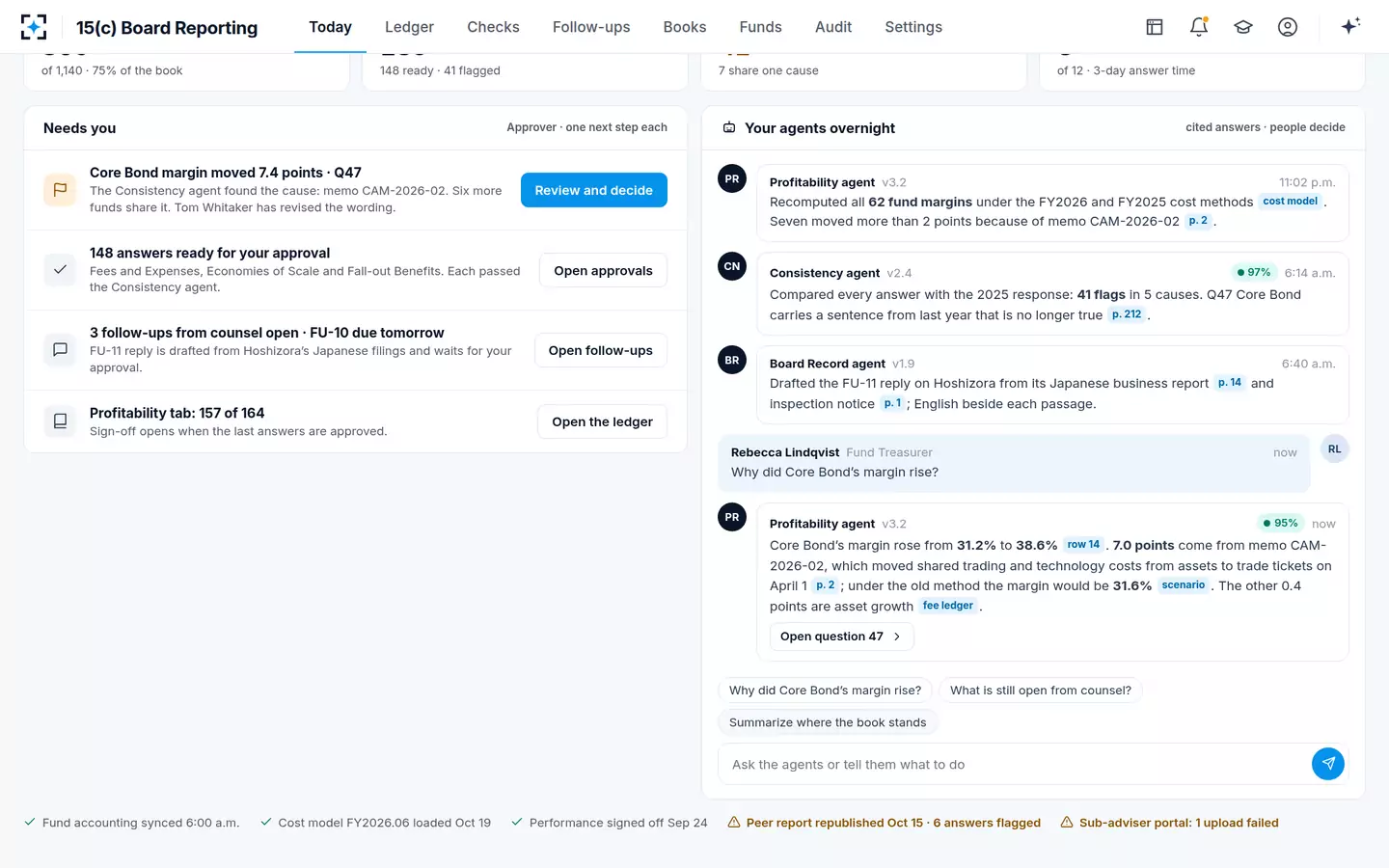
The harder part is not drafting but noticing what changed. In the sample season, the Profitability agent recomputed every fund's margin under both this year's and last year's cost method and found seven that moved more than two points because of one methodology memo; the Consistency agent found that the draft for one of them still carried last year's sentence that the method was unchanged. That sentence is exactly what a drafting tool would copy forward. What a complete answer to a questionnaire item carries is set out item by item.
The treasurer asks why a margin rose; the agent answers with its sources
Fourteen 15(c) tasks, sorted: agent, person or both
Sorted honestly, the fourteen tasks split into five that agents can do outright, five that stay with people, and four where an agent drafts and a person decides. The agent tasks are reading, matching, extracting, computing and comparing. The person tasks are the ones with a signature or a vote attached: choosing a peer group, approving an answer, signing a section, releasing the book and voting on the contract. The shared tasks are where most of the design effort goes, because each needs a clear hand-off: who sees the draft, what they are shown, and what their approval means.
Routing is a good example. The Request agent proposes which agent and which owner should answer each of the 1,140 questions, but nothing runs until the head of fund administration approves the plan; in the sample season that approval came at 2:30 p.m. on the day the letter arrived. Explaining a moved figure is another: the agent drafts the footnote with the old-method figure, and a person decides whether that explanation is right before it reaches the board.
One answer in 15(c) Board Reporting, from counsel's letter to the board, agent by agent and person by person
Agent
Request agentSplits the letter, matches each request with last year's, proposes owners
Never: Rewords counsel's questions
A person decides
Head of fund administrationApproves the routing plan before anything runs
Agent
Profitability, Performance, Fees and scale, Board Record agentsDraft each answer from its source, every figure cited
Never: Alter the cost model, pick a peer group or propose a fee change
Agent
Consistency agentCompares with last year's response and the rest of the book; groups flags by cause
Never: Clears its own flag
A person decides
PreparerAccepts or edits the draft; cannot approve it
A person decides
Fund treasurerApproves each answer with a reason code; signs each section
A person decides
Chief legal officerReleases signed sections to the board portal
What the agents never do
Limits are part of the design, not a policy layered on afterwards. In the solution, agents never approve an answer, never release the book, never change a peer group, never alter the cost model, never propose a fee change, and never clear a flag they raised. The Request agent never rewords counsel's questions; the Board Record agent never characterizes a director's view beyond what the minutes say. Each limit removes a way an agent could change what the board sees without a person deciding it.
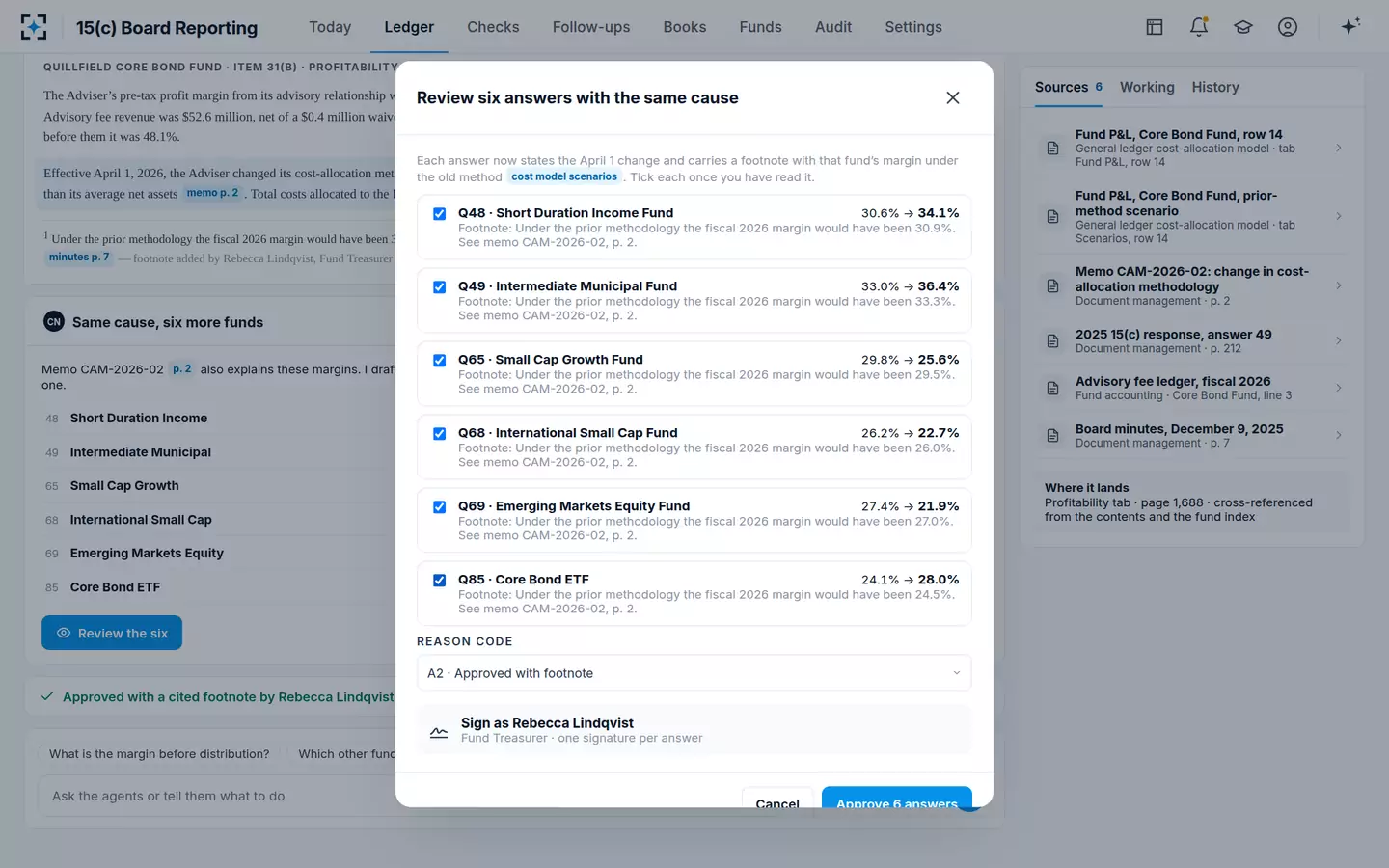
Three controls make the limits hold in practice. A preparer cannot approve an answer they prepared or edited, and the button says so. An agent that reports less than 90% confidence hands the answer to a person. And a batch approval, such as six answers with the same cause, first needs a sample of at least 10%, chosen by risk, to be read and attested; even then each answer carries its own signature.
Who approves an AI-drafted board answer?
The same person who would approve it if a person had drafted it, and never the person who prepared it. In the sample complex that is the fund treasurer for financial answers, with the chief compliance officer confirming compliance answers drafted from the annual report Rule 38a-1 requires (17 CFR 270.38a-1(a)(4)(iii)). Each approval carries a reason code, such as "approved with footnote", and the signer and time are written to a hash-chained audit trail.
“It would be difficult for a board to reach a final conclusion as to whether to approve an advisory contract without reaching conclusions as to each material factor that forms the basis for the board's approval.”
SEC, Disclosure Regarding Approval of Investment Advisory Contracts, 69 FR 39798 (2004)
The approval matters more under AI drafting, not less, because the law's test of the board's process looks at what the directors received. In Jones v. Harris the Supreme Court said a board that considered the relevant factors earns considerable weight, and that where the adviser withheld important information a court must take a more rigorous look (Jones v. Harris Associates, 2010). An approver who can see the source behind every figure, and the flag against last year, is approving information rather than prose.
Six answers with the same cause, each read and signed one by one
What the SEC's exam priorities say about "super intelligence"
The SEC's Division of Examinations uses its own term. Its priorities for fiscal 2027, published on October 23, 2026, describe registrants building what it calls "super intelligence" (SI) into their businesses, with generative SI tools used for research, drafting, coding and client communications, in advisory and portfolio management work, and in compliance monitoring. The Division says it is working to understand how these technologies influence outcomes, and whether firms still meet their existing obligations, which apply whatever technology is used (SEC Division of Examinations, Fiscal Year 2027 Examination Priorities).
The same document puts fund fees and expenses, including waivers and reimbursements, at the top of its focus for registered fund examinations, and says examiners will look at firms' policies and procedures for monitoring SI. For a fund using agents in its 15(c) process, the practical reading is that the existing duties apply unchanged: the information furnished must be accurate and complete, and the fund's procedures must show how the drafting is supervised.
Board responsibility for AI risk oversight
Directors do not need to understand the models, but they do need to understand where AI is used in what they receive. European supervisors have said so directly for investment firms: ESMA's 2024 statement warns that firms and their clients may come to over-rely on AI and neglect human judgment, and expects a firm's management body to understand how AI is applied and used within the firm (ESMA, Public Statement on AI and investment services, May 30, 2024). That statement addresses firms under MiFID II, not US fund boards, but its two points carry over.
Some boards now ask in the 15(c) letter itself. In the sample season, one of counsel's follow-ups asks the adviser to reconcile its answer on artificial intelligence with the chief compliance officer's annual report, and one of the board's standing requests from the prior year's minutes asks the adviser to describe its oversight of artificial intelligence. A board that can see which answers an agent drafted, from which sources, and who approved each, can answer that question about its own book.
Where the days move: the solution's estimate
Most of the time saved comes from the agent tasks, and review shrinks least. The solution's own estimate for a 62-fund complex answering one letter is 45 business days of work by hand and 14 with the agents. The largest saving is in pulling and re-keying figures; the smallest is in treasurer and legal review, which falls from eight days to four because a person still reads and approves every answer.
Business days each 15(c) step gives back when agents take the drafting
For context on what drafting assistance does to people's work, one large field study comes from customer support, not funds: access to an AI assistant raised issues resolved per hour by 15% on average, with the most experienced and highest-skilled workers seeing small gains in speed and small declines in quality (Brynjolfsson, Li and Raymond, Quarterly Journal of Economics, 2025). The lesson for a renewal team is the second half: the experienced reviewer's job is to catch what the draft gets wrong, and the tool should make that easier, not faster.
What to ask before buying an AI agent for board reporting
Most demonstrations show drafting. The questions that separate a tool a board can rely on from one it cannot are about evidence, comparison and control. How agents compare with board portals and spreadsheet trackers covers the wider choice.
Ten questions for any AI board reporting tool, applied to the 15(c) renewal
- Does every figure cite its row, line or page, and open it?
If not, the draft cannot be checked, and the file cannot show it later.
- Does it compare this year's answer with last year's?
A sentence carried from last year that is no longer true reads perfectly well on its own.
- Does it recompute under last year's method when a method changes?
Otherwise a margin move has no explanation the board can weigh.
- Can the agent approve, release or clear its own flag?
The answer should be no, enforced by the system, not by policy.
- Can a preparer approve their own work?
Look for a locked button, not a reminder.
- What happens below a confidence threshold?
It should go to a named person, not into the book.
- Does it keep counsel's wording exactly?
An agent that tidies the question can answer a different one.
- Is every step on an audit trail kept six years?
Rule 31a-2(a)(6) covers what the directors considered.
- How is a new agent version tested?
In the solution, side by side on last year's approved answers before the treasurer approves it.
- Is the fund's data used to train models?
In the solution, it is not.
Questions people ask
Can AI write board reports?
It can draft them, and for a 15(c) renewal it can do most of the copying, computing and comparing. Approving answers, explaining moved figures, signing sections and the directors' vote stay with people, because the statute and the fund's controls assign those duties to them.
Who is accountable for an AI-drafted 15(c) answer?
The adviser, which has the statutory duty to furnish the information, and the person who approves the answer. In 15(c) Board Reporting that is the fund treasurer for financial answers, never the preparer, with every approval written to the audit trail.
What does the SEC say about AI in fund firms?
Its fiscal 2027 examination priorities use the term "super intelligence" (SI), note firms are using generative SI tools for drafting and compliance monitoring, and say the Division will examine whether firms still meet existing obligations and how they monitor SI.
What is agentic AI for reporting?
Software agents that take steps on their own within limits: reading a request letter, pulling figures from systems, drafting and checking answers. The distinction from a drafting assistant is that agents act on sources and report what they did; the limits decide which steps need a person.
How do boards oversee AI risk?
By knowing where AI is used in what they receive and how it is supervised. ESMA's 2024 statement asks investment firms' management bodies for an appropriate understanding of how AI is applied and used; some fund boards now ask about AI oversight in their 15(c) letters.