A 15(c) questionnaire, often searched for as a 15c questionnaire, is the letter, usually drafted by the independent directors' counsel, in which a fund board asks its adviser, and each sub-adviser, for the information it needs to evaluate the advisory contract before the annual vote. It exists because Section 15(c) of the Investment Company Act gives the directors a duty to request and evaluate that information and gives the adviser a matching duty to furnish it (15 U.S.C. 80a-15(c)). A typical letter runs to dozens of numbered items, many of them asked "for each Fund", so a complex of sixty funds answers well over a thousand questions. Botminds' 15(c) Board Reporting reads the letter, splits it into fund-level questions, and has agents draft each answer from its source while people approve every one.
The sample letter on this page belongs to a fictional complex, Quillfield Funds, with 62 funds and 71 advisory and sub-advisory agreements. The rules and the SEC's findings are quoted from their own texts.
Six items from one 15(c) questionnaire, read for the evidence each answer needs
1(b)
What it asksChanges in the organization, ownership or control of the Adviser since the last renewal
FactorNature, extent and quality
Evidence the answer needsCorporate records and Form ADV; a "no change" answer needs last year's answer beside it
How it goes wrongA carried-forward "no change" after a change
3(b)
What it asksHow portfolio managers are paid, including any link to fund performance
FactorNature, extent and quality
Evidence the answer needsCompensation policy as approved, not as described in last year's answer
How it goes wrongA description that no longer matches the plan
4(a)
What it asksThe Adviser's most recent audited financial statements and its financial condition
FactorNature, extent and quality
Evidence the answer needsThe audited statements themselves, for the years asked
How it goes wrongOne year supplied where two were requested
31(b)
What it asksEach fund's profitability to the Adviser for two fiscal years, before and after distribution, with the cost-allocation method and any change from the prior year
FactorCosts and profitability
Evidence the answer needsCost-model rows for both years, the methodology memo, and the old-method figure if the method changed
How it goes wrongA method described one way and applied another
51
What it asksEach fund's management fee against its expense group
FactorFees and comparisons
Evidence the answer needsThe peer report edition, the fund's fee schedule and any waiver
How it goes wrongA comparison requested and never supplied
71
What it asksA sub-adviser's compliance record and financial condition
FactorNature and quality (sub-adviser)
Evidence the answer needsThe sub-adviser's own filings and inspection results, in their original language
How it goes wrongAn answer that refers the board to someone else's answer
What is a 15(c) questionnaire?
It is the board's request, put in writing. The statute does not prescribe a form, and no regulator publishes a template; what it prescribes is the duty. The directors must ask for, and weigh, what is reasonably necessary to evaluate the contract's terms, and the adviser must supply it. The questionnaire is how boards discharge the first half of that duty in a way that can be shown later.
The SEC's orders describe what one looks like in practice. In the Commonwealth matter, the board, acting through the fund administrator, asked the adviser and its sub-adviser for their Form ADV, compliance manuals, code of ethics and current financial statements, and asked both to complete a questionnaire prepared by independent counsel with numerous questions about each adviser's operations, compensation and compliance procedures, including the Gartenberg factors and comparative fee information (SEC, IC-31678, June 17, 2015). Counsel's cover letter put the legal basis in one sentence.
“we are writing to request that the adviser provide the Board with the information reasonably necessary for the Board to fulfill its obligation under section 15(c). The Board believes that such information includes your responses to the items requested below.”
Cover letter to a 15(c) questionnaire, as quoted in the SEC's Commonwealth order (2015)
Two things follow from that sentence. The items are the board's own definition of "reasonably necessary", so an item left unanswered is information the board itself said it needed. And the same order records that the questionnaire told the adviser the board's approval would be based, in part, on its responses: the answers are the evidence for the vote.
Who sends the 15(c) letter, and who must answer it?
The independent directors send it, usually through their independent counsel, and the adviser must answer it. Where a fund has sub-advisers, each receives its own questionnaire, because each sub-advisory contract is also renewed under Section 15(c). In the sample complex, counsel's letter arrives in mid-September, about twelve weeks before the December vote, and the first tranche of answers goes back three weeks later.
On the adviser's side the letter lands with fund administration, which splits it and assigns each request: profitability and expenses to the treasurer's team, performance to the performance group, fee comparisons and breakpoints to whoever owns the peer study, and corporate and compliance items to legal and the chief compliance officer. The fund treasurer usually approves the financial answers before they go back. The season from letter to vote sets out who carries each part.
What a 15(c) questionnaire asks: the six blocks
Almost every letter is built on the factors the board's approval statement must address. Since 2004 the SEC has required funds to discuss, at a minimum, the nature, extent and quality of the adviser's services; the investment performance of the fund and the adviser; the adviser's costs and profits from the relationship; whether the adviser would gain from scale as the fund grows; and whether the fee levels pass those gains on to fund investors. The statement must also say whether the board relied on comparisons with other advisory contracts, including fees charged to other types of clients (69 FR 39798, June 30, 2004).
Counsel turns those into blocks of items, usually in the same order the board book will follow: the adviser itself (organization, personnel, financial condition, litigation, examinations, insurance); nature, extent and quality of services; performance against benchmark and peers; fees and expenses against an expense group; costs and profitability; economies of scale and breakpoints; and fall-out benefits such as soft-dollar research or affiliated service fees. Where each factor's evidence lives is the subject of its own guide.
Where 1,140 questions from one letter land, by board-book tab
What does a 15(c) questionnaire ask a sub-adviser?
A sub-adviser gets the same blocks, narrowed to what it does: its organization and financial condition, its investment personnel and their compensation, its compliance program and examinations, its performance on the sleeve it manages, and the fees it charges other clients for similar mandates.
The trap is at the boundary between the two answers. In Commonwealth, the adviser's contract and the sub-adviser's described their duties in nearly identical language; the adviser's questionnaire said the sub-adviser handled portfolio management and referred the trustees to the sub-adviser's response, which did not describe the adviser's own services. The trustees did not ask for more, and the SEC found they approved the contracts without all the information they had requested as reasonably necessary (IC-31678, paragraphs 34–36). Choosing and monitoring sub-advisers is a discipline of its own, covered in what a sub-adviser is and who oversees it.
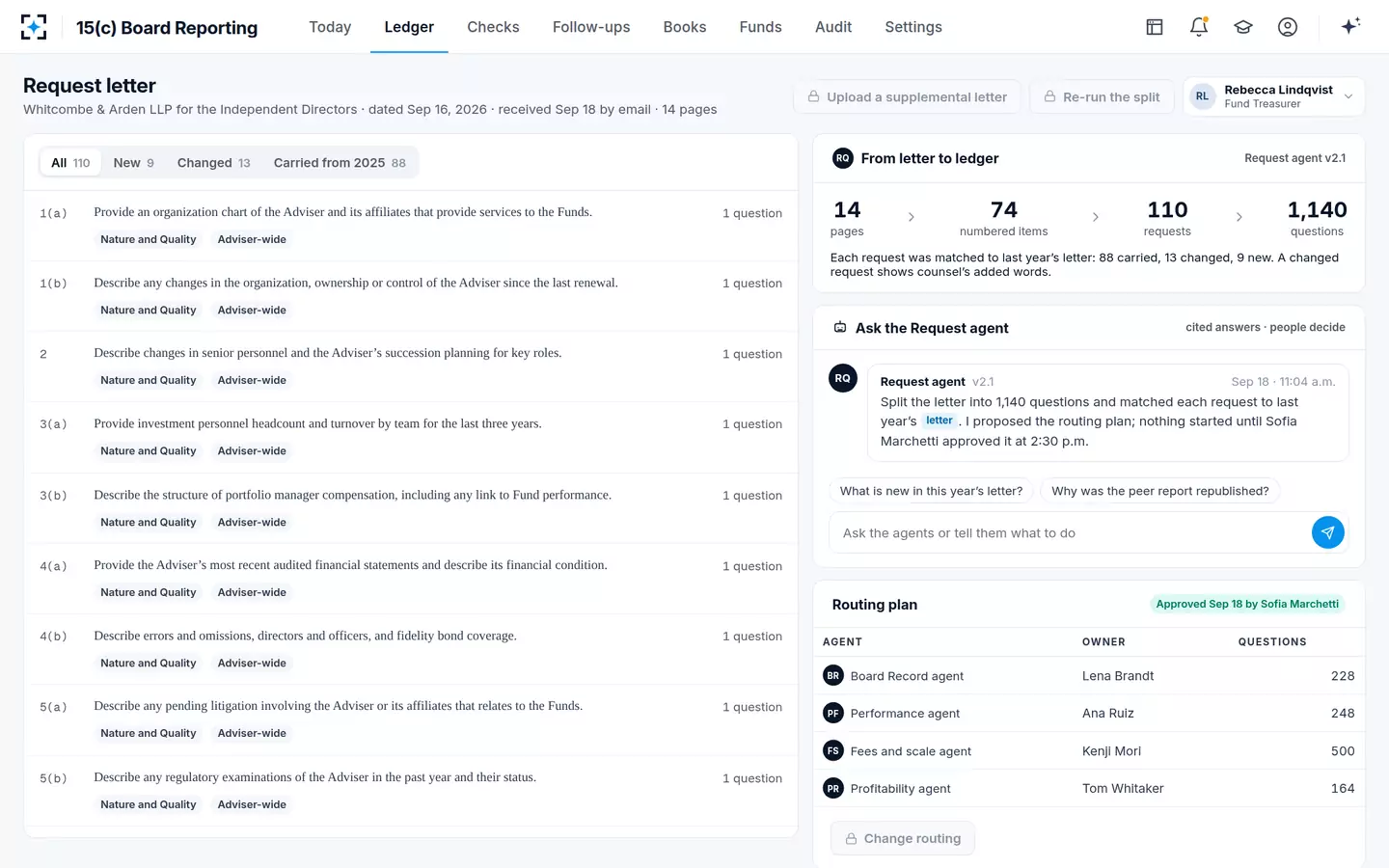
Counsel's 15(c) questionnaire in 15(c) Board Reporting: numbered requests, new, changed or carried
What is a 15(c) report, and what format does it take?
"15(c) report" is used for three different documents, and it helps to keep them apart. The first is the adviser's response to the questionnaire: answers by item and by fund, with exhibits. The second is the board book, the bound set of materials the directors read before the vote, usually arranged by factor and including the response, peer reports and counsel's memorandum on the directors' duties. The third is the public statement of the basis for the board's approval, which since the SEC's 2022 tailored shareholder report rule is filed on Form N-CSR, Item 11, rather than printed in the shareholder report (87 FR 72758, November 25, 2022).
Only the third has a prescribed content, and the SEC has said what it may not be. In 2004 it noted that conclusory statements or a list of factors will not be considered sufficient disclosure, and required the discussion to state how the board evaluated each factor (69 FR 39798). That requirement reaches back into the first two documents: a board can only explain how it weighed a factor if its materials let it weigh it.
Three documents people call a 15(c) report
What it is: The adviser's answers to counsel's items, fund by fund, with exhibits and sources.
What makes it fail: An item not answered, answered for the complex instead of each fund, or answered from last year's file.
What it is: Everything the directors considered, arranged by factor, kept six years under Rule 31a-2(a)(6).
What makes it fail: Materials discarded or returned after the meeting, so the file cannot show what was considered.
What it is: The fund's public discussion of the factors and conclusions, now on Form N-CSR Item 11.
What makes it fail: Boilerplate that describes information the board never received, or omits the discussion.
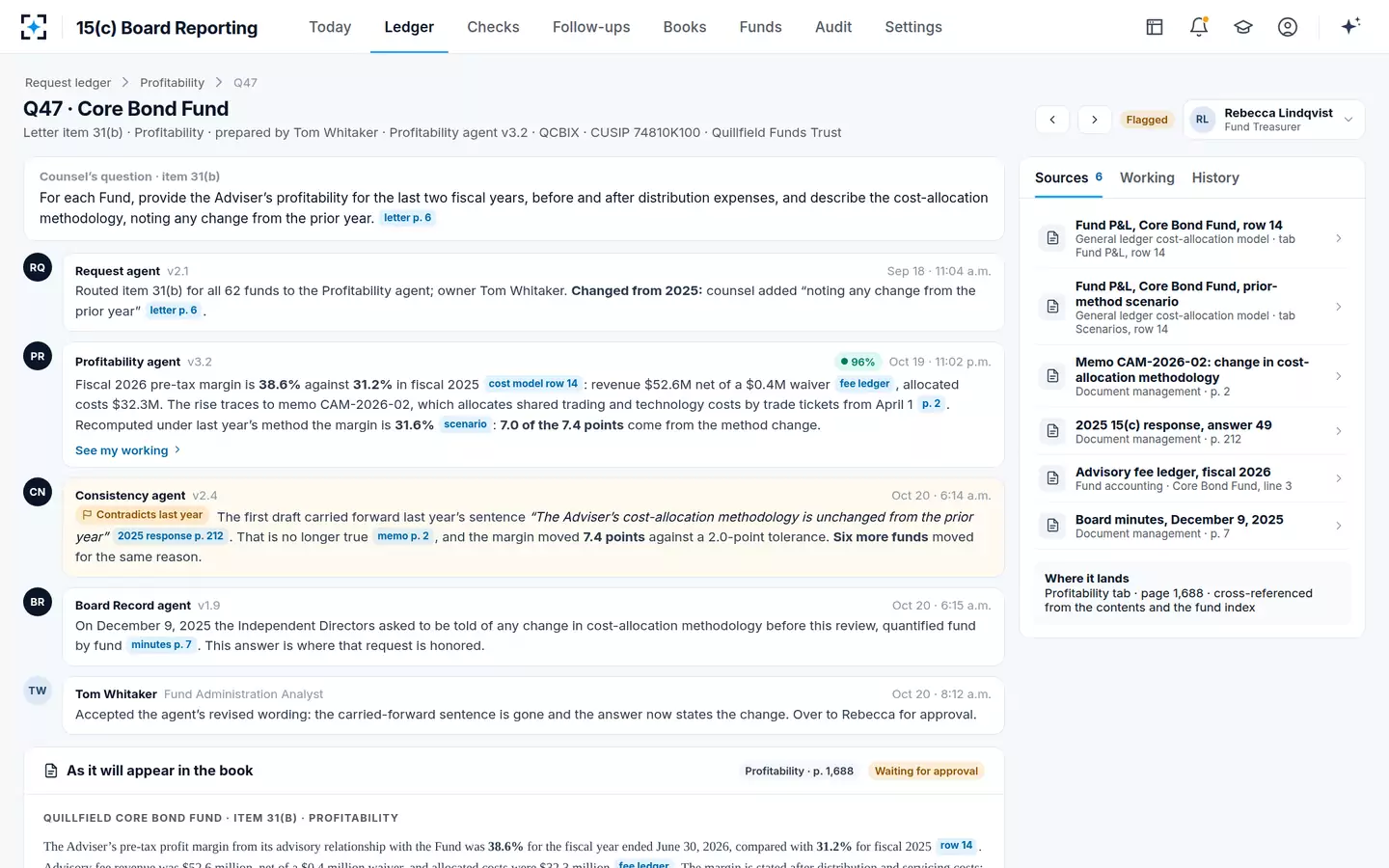
An item, an answer, and the evidence behind it
An answer is only as good as the evidence it can point to. Take item 31(b) in the sample letter: for each fund, the adviser's profitability for the last two fiscal years, before and after distribution expenses, and a description of the cost-allocation method, noting any change from the prior year. Counsel added the last clause this year. For the fictional Core Bond Fund, the answer the board needs reads: pre-tax margin 38.6% in fiscal 2026 against 31.2% in fiscal 2025, on revenue of $52.6 million net of a $0.4 million waiver and allocated costs of $32.3 million; 7.0 of the 7.4-point rise comes from a memo that moved shared trading and technology costs from net assets to trade tickets on April 1; under last year's method the margin would be 31.6%.
Every number in that answer has a home: the cost-model row for each year, the fee accrual line for the waiver, page 2 of the methodology memo, and the board's minutes of December 2025 asking to be told of any such change. An answer drafted from last year's file would have said the method was unchanged, which was true last year and false this year. The questionnaire asked the right question; only a year-over-year check catches the wrong answer.
One questionnaire item answered with its sources, and the flag against last year
When the questionnaire is not answered: what the SEC found
The SEC has treated an unanswered item as a breach on both sides of the table. In Commonwealth, the trustees of one trust had requested comparative fee information with the questionnaire, and there was no documentary evidence the adviser provided it; the trustees approved the contracts because they considered the fees within an appropriate range. For the second trust, the adviser supplied one year's income statement where the questionnaire asked for two years of financial statements, gave no written description of its cost-allocation method, answered that no fees had been waived when it had waived part of its fee under an expense limitation agreement, and told the directors the fund had appropriate breakpoints when the breakpoints had been omitted from the contract (IC-31678, paragraphs 32–50).
The order found that the adviser and three trustees violated Section 15(c). Each of those failures is visible item by item: a request with no response, a response that answers a narrower question, a response contradicted by the adviser's own books. What each SEC 15(c) case cost the people charged is set out separately.
What a complete answer to a 15(c) questionnaire item carries
- Counsel's words, unchanged
Answer the question asked, not a tidier one; mark where this year's wording differs from last year's.
- One answer per fund where the item says "each Fund"
A complex-wide answer to a fund-level request is an unanswered request for every fund but the average.
- Both periods where two are asked
Commonwealth's adviser gave one year of statements where two were requested.
- The method, not only the result
For profitability, the allocation method and any change from last year, with the old-method figure if it changed.
- A source for every figure
Row, line or page, so counsel and the board can check it, and so the file shows it later.
- Last year's answer compared
A carried sentence that is no longer true is easy to miss on a reread.
- A named approver
The person who signs is not the person who prepared it.
From one letter to 1,140 questions in 15(c) Board Reporting
In 15(c) Board Reporting the questionnaire is the first thing the agents read. The Request agent takes counsel's letter and any supplemental letter, expands each "for each Fund" request across the funds, matches each request with last year's letter as carried, changed or new, and proposes an agent and an owner for every question. It never rewords counsel's questions, and nothing runs until the head of fund administration approves the routing plan. In the sample season the agent split its 74 numbered items into 110 requests and 1,140 questions, of which 88 requests carried over, 13 changed and 9 were new.
From there, agents for profitability, performance, fees and scale, and the board's own minutes draft answers with their citations; a Consistency agent compares each answer with last year's response and with every other place the same figure appears; and the fund treasurer approves each answer. Counsel's follow-ups land on the thread of the question they ask about. The solution is at 15(c) Board Reporting.
Questions people ask
Is there a standard 15(c) questionnaire template?
No regulator publishes one. Section 15(c) sets the duty, not the form; the natural template is the list of factors the SEC's 2004 release requires the board's approval statement to cover: services, performance, costs and profits, economies of scale and whether fees reflect them, plus any fee comparisons the board relied on.
What documents come with a 15(c) questionnaire response?
Usually the adviser's Form ADV, its compliance manual and code of ethics, its financial statements, peer fee and performance reports, and the profitability analysis with its allocation method. The Commonwealth order lists the first four as items the board requested alongside the questionnaire.
Who answers a 15(c) questionnaire?
The adviser, and each sub-adviser for its own contract. Inside the adviser, fund administration usually coordinates and the fund treasurer approves the financial answers; the chief compliance officer confirms compliance answers, which draw on the annual report Rule 38a-1 requires.
What does a 15(c) questionnaire ask a sub-adviser?
Its organization and financial condition, investment personnel and compensation, compliance program and examinations, performance on the assets it manages and its fees for similar mandates. In the Commonwealth order, an adviser's reliance on its sub-adviser's answer left the board without a description of the adviser's own services.
What is the difference between a 15(c) questionnaire and a 15(c) report?
The questionnaire is the board's request; the report is the answer, which may mean the adviser's response, the board book or the public statement on Form N-CSR Item 11. Only the public statement has a prescribed content, and the SEC said in 2004 that a list of factors is not enough.
How many questions does a 15(c) questionnaire contain?
It depends on how many items apply fund by fund. In the fictional sample complex, a 14-page letter of 74 numbered items became 110 requests and 1,140 questions across 62 funds and 71 agreements.