The 15(c) process, often searched for as the 15c process, is how a fund board requests and evaluates the information it needs before it renews an advisory contract, and how the adviser furnishes it; the SEC has enforced it directly. In three settled orders between 2013 and 2015, against Northern Lights, Kornitzer Capital Management and Commonwealth Capital Management, the SEC charged advisers, administrators, a compliance firm and trustees personally, and none of the orders was about whether a fee was too high. Each was about information: a cost method described one way and applied another, comparisons requested and never supplied, statements about a review that did not happen. Civil penalties ranged from $3,250 per trustee to $50,000 per firm. Botminds' 15(c) Board Reporting is designed against exactly those gaps: every answer is cited to its source, compared with last year's, and approved by someone who did not prepare it.
What the SEC's three 15(c) process cases cost, by respondent
What is the 15(c) process for mutual funds?
It is the annual exchange in which the directors request, and the adviser furnishes, the information reasonably necessary to evaluate the advisory contract, followed by the non-interested directors' in-person vote. Section 15(c) of the Investment Company Act makes requesting and evaluating that information the directors' duty and furnishing it the adviser's (15 U.S.C. 80a-15(c)). In practice it runs from the independent directors' counsel's request letter through the adviser's answers, follow-ups and the board book to the vote, the minutes and the public statement of the basis for approval.
The SEC's orders describe the duty in the same terms each time, and Northern Lights adds how seriously the Commission takes it: the order quotes the SEC's own description of the directors' duty under Section 15(c) as "one of the most important fund governance obligations assigned to directors under the Investment Company Act" (SEC, IC-30502, paragraph 14). How the season runs, from letter to vote, is covered separately.
What does the SEC require in a 15(c) process?
The statute does not define what is "reasonably necessary," and each of the three orders below says so. What it has done is set disclosure rules that tell boards which factors they will be expected to explain. Since 2004 the fund's approval statement must discuss the nature, extent and quality of services, the fund's and the adviser's performance, the adviser's costs and profits, economies of scale and whether fees reflect them, and whether the board relied on fee comparisons; it must say how the board evaluated each factor (69 FR 39798, June 30, 2004). The directors' materials must then be kept six years (17 CFR 270.31a-2(a)(6)).
The examiners are still looking. The SEC's examination priorities for fiscal 2027 say registered fund examinations typically look at compliance programs, disclosures, governance practices and filings, and put fund fees and expenses, with any related waivers or reimbursements, first among their areas of focus (SEC Division of Examinations, Fiscal Year 2027 Examination Priorities). Waivers figure in one of the three cases below.
Kornitzer: a steady margin made by moving the CEO's pay
The board of the Buffalo Funds asked each year from 2010 to 2013 for an analysis of the adviser's profitability with "an explanation of the expense allocation methodology." The adviser's analysis said salaries and benefits were allocated to the funds based on estimated labor hours. The adviser's chief financial officer, who was also its chief compliance officer, in fact reviewed the prior year's profitability and revenue growth and the margin a proposed allocation would produce, then set the share of the chief executive's compensation charged to the funds "in a manner in part designed to achieve consistency of KCM's reported profitability" (SEC, IC-31560, paragraphs 10–17).
Kornitzer: the CEO's pay share moved so the reported margin would not
The order found the adviser failed to furnish information reasonably necessary for the board to evaluate the contracts, in violation of Section 15(c), and that the CFO caused the violation. The adviser paid $50,000 and the CFO $25,000. The finding turns on a sentence the board was given each year, about how compensation was allocated, that was not how it was allocated. That is a test any year-over-year comparison can run: whether the method stated this year is the method applied, and whether it is last year's.
Commonwealth: trustees who approved without the answers
The Commonwealth order is the one that charged trustees for what they did not ask. The board of one trust requested comparative fee information with counsel's questionnaire; there was no documentary evidence the adviser provided it, and the trustees approved the contracts because they considered the fees within an appropriate range. The adviser's description of its services relied on the sub-adviser's answer, and the trustees did not ask for more. The SEC found that the adviser and three trustees violated Section 15(c), and that the adviser's owner caused the adviser's violations (SEC, IC-31678, June 17, 2015).
For a second fund group, the adviser's answers were wrong rather than missing: one year's income statement where two years of financial statements were requested, no written allocation method, "no fees waived" when it had waived part of its fee under an expense cap, breakpoints described that the contract omitted, and a peer chart full of inapt comparisons. The trustees each paid $3,250; the adviser, its affiliated administrator and its owner paid $50,000 jointly. The SEC's press release put the trustees' failure plainly.
“The advisory fee typically is the largest expense reducing investor returns. The WFT trustees fell short as the shareholders' watchdog by essentially rubber-stamping the adviser's contract and related fee.”
Julie M. Riewe, Co-Chief, SEC Enforcement Division's Asset Management Unit, press release 2015-124
Northern Lights: boilerplate that described data the board never had
Northern Lights involved two series trusts with up to 71 funds, most run by unaffiliated advisers under one board of five trustees, who considered 113 advisory and 32 sub-advisory contracts at 15 meetings over two years. Shareholder-report disclosures of the 15(c) review were drafted by the administrator from minutes that started as a template with boilerplate on the factors. Some said the trustees had reviewed peer fee data the adviser never provided; others implied fees near the middle of the peer range when they were higher than every fund in the peer group and about double its mean (SEC, IC-30502, paragraphs 20–23).
The administrator also let advisers' 15(c) financial information be discarded or returned after meetings, and failed to keep peer comparisons and counsel's 15(c) summaries for some series. The administrator and the compliance firm paid $50,000 each; the trustees were ordered to cease and desist from causing violations of Section 34(b) and Rule 38a-1; and all respondents undertook to hire an independent compliance consultant within 60 days, at their own expense and never the funds', and to adopt its recommendations.
From the board meetings to the SEC's order: one to five years
- Meetings under reviewJan 2009–Dec 2010
- Until the order29 months
- Renewals under review2010–2013
- Until the order16 months
- Approvals under reviewOct 2008–Aug 2010
- Until the order58 months
The timeline is an argument for retention as much as for accuracy. Every one of these orders reached back years, to materials the six-year rule requires a fund to keep, and in Northern Lights some of those materials were gone.
What happens if the board did not get the information?
Under the Commonwealth order, the directors can be in breach themselves, not only the adviser. Section 15(c) gives both sides a duty, and the SEC held that trustees who received incomplete answers and "did not follow up to obtain such information" violated it when they approved the contracts. The order called the violation willful in the securities-law sense, which only requires that the person knew what they were doing, not that they knew it broke a rule (IC-31678, paragraph 55 and note 5).
In a fee case the consequence is different but related: under Jones v. Harris, information withheld by the adviser calls for closer judicial scrutiny of the fee the board approved (Jones v. Harris Associates, 2010). What a 15(c) file needs to pass in a 36(b) case takes that further.
Can fund trustees be charged by the SEC?
Yes, and they have been. In Commonwealth, three trustees were found to have violated Section 15(c) and paid $3,250 each; in Northern Lights, five trustees were found to have caused violations of Section 34(b) and Rule 38a-1 and were ordered to cease and desist. Neither group was charged over the size of a fee. In the Northern Lights press release the SEC's Co-Director of Enforcement called determining the terms of the advisory contract, especially compensation, "one of the most critical duties of a mutual fund board."
Officers are exposed too. Kornitzer's CFO, who also served as chief compliance officer, paid $25,000 personally for causing the adviser's violation.
The larger cost: losing the deference a sound process earns
The penalties in these orders total $234,750 across three cases, small against any adviser's fee revenue. The costs that matter are less visible. Each order is public and permanent, names the people involved, and includes a cease-and-desist order. Northern Lights added a consultant's review and mandatory adoption of its recommendations. And each describes a process that, in a shareholder's fee case, would invite the more rigorous look Jones reserves for a deficient process or withheld information, in place of the considerable weight it gives directors who considered the relevant factors.
That is the economic case for getting the 15(c) process right: not the fine, but the value of a board approval a court will respect. It is earned by a file that shows the request, complete and accurate answers with their sources, the follow-ups, and minutes written from the materials.
One method change found by 15(c) Board Reporting in seven funds before the board saw any of them
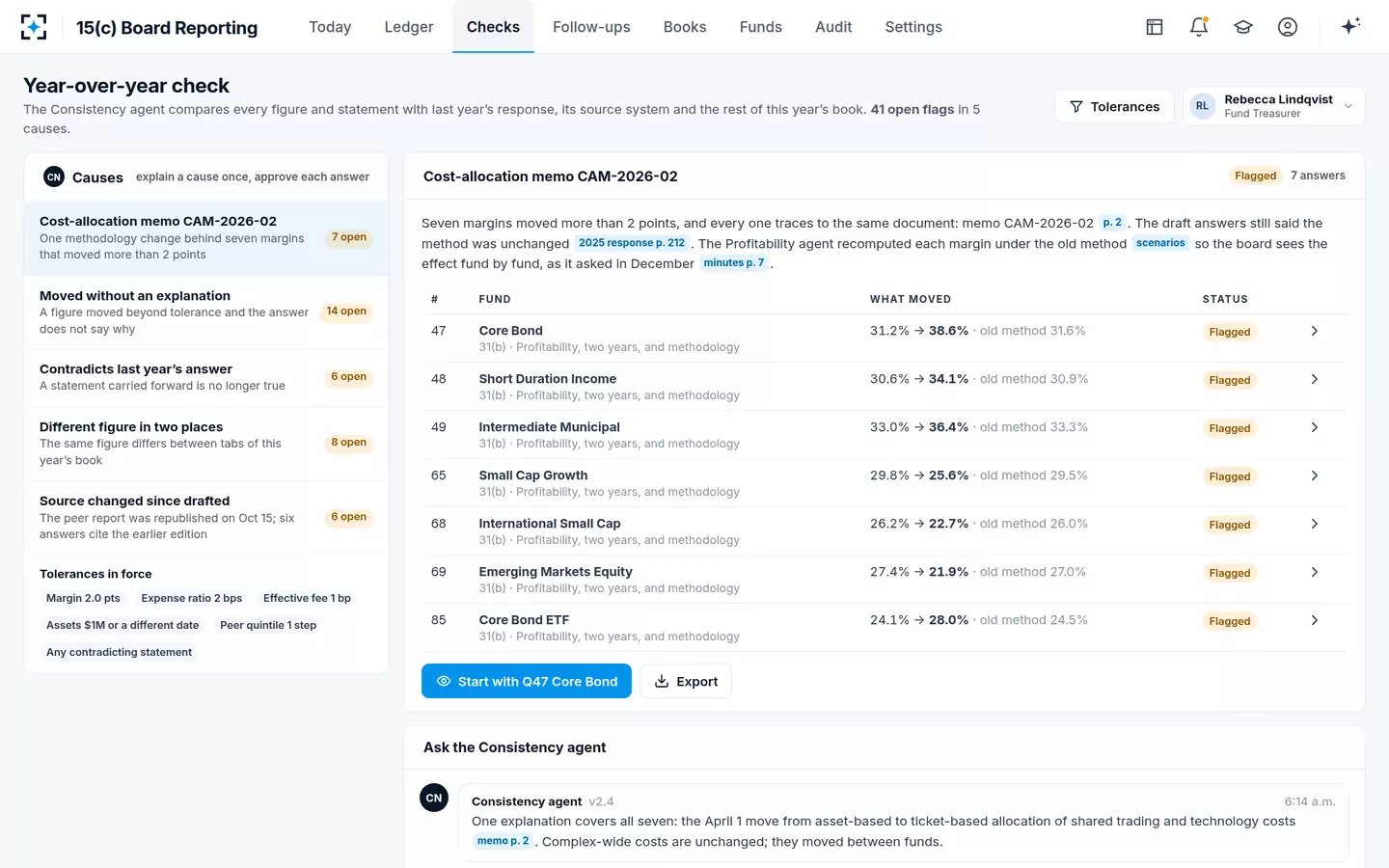
Five controls that answer the three cases, as 15(c) Board Reporting applies them
Each failure in the orders has a control that would have caught it before the vote. None is new; what is new is being able to run them on every answer rather than on a sample, which is where agents help.
The SEC's 15(c) findings, and the control that answers each
| Finding | Case | Control | In 15(c) Board Reporting |
|---|---|---|---|
| Allocation method described differently from how it was applied | Kornitzer | Margins recomputed under last year's method; any change stated | Profitability agent states both years under both methods, citing the memo |
| Requested comparison never supplied; board did not follow up | Commonwealth | Every request tracked to an answer; open items visible before the vote | Request agent splits the letter into questions; nothing is complete until each is approved |
| Answers contradicted the adviser's books (waivers, breakpoints) | Commonwealth | Each figure tied to its system of record | Every figure links to its row or page; fee accruals and contracts are sources |
| Boilerplate described data the board never had | Northern Lights | Statements checked against the materials actually provided | Consistency agent flags any statement that contradicts a source |
| 15(c) materials discarded or not kept | Northern Lights | Everything considered kept six years, first two easily accessible | Materials and sources kept six years; hash-chained audit trail |
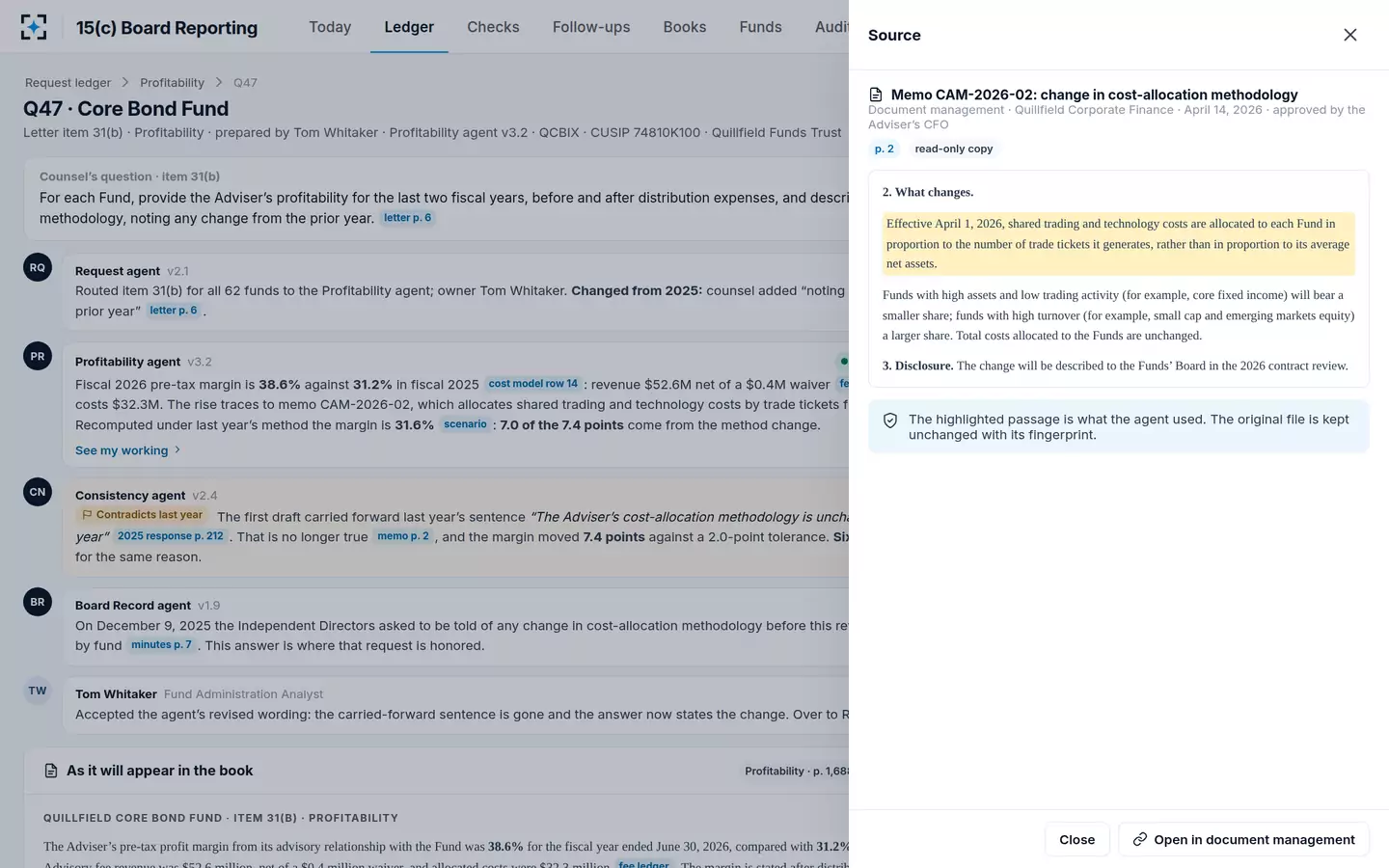
The source behind a moved margin, opened from its citation
Questions people ask
What are the 15(c) requirements for a fund board?
A majority of the non-interested directors must approve the advisory contract and each renewal in person at a meeting called for the vote, after requesting and evaluating the information reasonably necessary to judge its terms; the adviser must furnish that information. The fund then explains the basis for approval publicly, now on Form N-CSR, and keeps the materials six years.
Has the SEC ever charged a fund over its 15(c) process?
Yes. The SEC's settled orders against Northern Lights (2013), Kornitzer Capital Management (2015) and Commonwealth Capital Management (2015) all concerned the 15(c) process, with penalties from $3,250 per trustee to $50,000 per firm and cease-and-desist orders.
Did the SEC say any of these fees were too high?
No. None of the three orders found a fee excessive. Each found information withheld, inaccurate or misdescribed, or materials not kept, which is why the cases are about process rather than price.
What happens if the board did not get the information it asked for?
The directors can violate Section 15(c) themselves if they approve without following up, as the Commonwealth trustees did. In a shareholder's fee suit, withheld information also reduces the deference a court gives the board's approval.
What are the 15(c) regulations beyond the statute?
The main ones are the SEC's 2004 disclosure rules on the board's approval statement, now Item 11 of Form N-CSR, and Rule 31a-2(a)(6) on keeping the directors' materials six years. Funds relying on the SEC's exemptive rules must also meet the fund governance standards of Rule 0-1(a)(7).