Board reporting software, for a US fund board, covers three different jobs that are often sold as one: delivering the board book securely to directors, tracking the work of assembling it, and producing the content itself. Board portals do the first, spreadsheet trackers with shared documents do the second, and only agents attempt the third: drafting each answer from its source and checking it against last year's. The difference shows on the annual 15(c) renewal, where directors must request and evaluate the information reasonably necessary to judge each advisory contract (15 U.S.C. 80a-15(c)) and the book runs to thousands of pages. Botminds' 15(c) Board Reporting is an agent approach: it drafts and checks the 15(c) answers, people approve every one, and the released book goes to the board portal the fund already uses.
The comparison uses one answer from a fictional complex, Quillfield Funds, with 62 funds and 1,140 questions in its 2026 renewal, as it runs through the solution. No vendors are named; the categories are what matter.
Three kinds of board reporting software, against what a 15(c) renewal needs
Delivers the book to directors securely
Board portalYes
Spreadsheet trackerNo
AgentsThrough the portal
Tracks every request to an owner and a due date
Board portalPartly
Spreadsheet trackerYes
AgentsYes
Drafts each fund's answer from the source system
Board portalNo
Spreadsheet trackerNo
AgentsYes
Cites the row or page behind every figure
Board portalNo
Spreadsheet trackerBy hand
AgentsYes
Compares this year's answer with last year's
Board portalNo
Spreadsheet trackerBy hand
AgentsYes
Groups moved figures by the document that explains them
Board portalNo
Spreadsheet trackerNo
AgentsYes
Stops a preparer approving their own answer
Board portalPartly
Spreadsheet trackerNo
AgentsYes
Threads counsel's follow-ups to the question they ask about
Board portalPartly
Spreadsheet trackerBy hand
AgentsYes
Keeps what directors considered, six years
Board portalYes
Spreadsheet trackerDepends
AgentsYes
What is board reporting software?
It is any software used to prepare, deliver or track the materials a board reads, and the term covers tools that do very different things. For a registered fund the materials are defined largely by rule: the annual 15(c) renewal book, the chief compliance officer's annual report, quarterly reports on 12b-1 spending and valuation, and the findings the board must make on share classes and other matters. A tool that helps with one of those jobs may do nothing for the others.
The useful question is not which tool is best but which job is the bottleneck. Where directors already receive their books electronically, it is not delivery. It is producing correct answers to counsel's letter fast enough that directors have time to read them. The board's full calendar of rule-driven reports shows where the 15(c) renewal sits among the rest.
What should a fund board book contain?
For the 15(c) renewal, everything the directors considered: counsel's request letter, the adviser's and sub-advisers' answers, peer fee and performance reports, profitability analyses with their allocation methods, counsel's memorandum on the directors' duties, and anything requested in follow-ups. The SEC's Commonwealth order describes one: a "Board Book" compiled by the fund administrator with the counsel's memorandum, the advisers' questionnaires, codes of ethics, Forms ADV, financial statements, and advisory fee and performance tables (SEC, IC-31678, June 17, 2015).
Rule 31a-2(a)(6) then requires the fund to keep any documents or other written information the directors considered for six years, the first two in an easily accessible place (17 CFR 270.31a-2(a)(6)). The book as delivered is therefore a document with legal weight, and the tool that produces it should be able to show what each page said when the directors read it.
Board portal software: delivery, not drafting
A board portal's job is to get the right materials to the right directors securely and on time, and to let them read, annotate and sometimes vote. It is the last mile of board reporting, and many fund boards use one. What a portal does not do is produce the content: it receives a finished book and distributes it. Whether page 1,688 says the right thing about a fund's margin is decided before the file is uploaded.
That makes a portal necessary and insufficient. Its strengths, access control, version delivery and an archive of what was distributed, matter for Rule 31a-2. Its blind spot is everything upstream: the request letter, the drafting, the year-over-year comparison and the approvals. A complex choosing a portal is choosing how directors read the book, not how good the book is.
Spreadsheet trackers: who has what, not whether it is right
Most 15(c) seasons are run from a tracking spreadsheet: one row per request, an owner, a due date and a status, with answers drafted in last year's word-processing file. It is cheap, flexible and familiar, and it answers the coordinator's question every morning: what is still open and who has it.
It does not answer the treasurer's question: is this answer right. A tracker records that request 31(b) is "done" when a margin has been typed in; it does not know that the cost method changed on April 1, that last year's sentence about the method was carried forward, or that six other funds moved for the same reason. Those checks happen, if at all, when someone rereads the book. In Kornitzer, the profitability analysis given to the board each year said compensation was allocated by labor hours when it was not, and no tracker would have flagged it (SEC, IC-31560, April 21, 2015).
Agents in 15(c) Board Reporting: drafting with citations and a year-over-year check
Agents change the third job: producing the content. In 15(c) Board Reporting, a Request agent splits counsel's letter into fund-level questions and proposes owners; agents for profitability, performance, fees and scale, and the board's minutes draft each answer from the cost-allocation model, fund accounting, the performance system, the peer report and document management, with every figure linked to its row or page; and a Consistency agent compares each figure and statement with last year's response, its source and every other place it appears in this year's book.
What agents do not change is who decides. A preparer edits the draft and cannot approve it; the fund treasurer approves each answer with a reason code; the chief legal officer releases signed sections to the board portal. Agents never pick a peer group, alter the cost model, propose a fee change or clear their own flags.
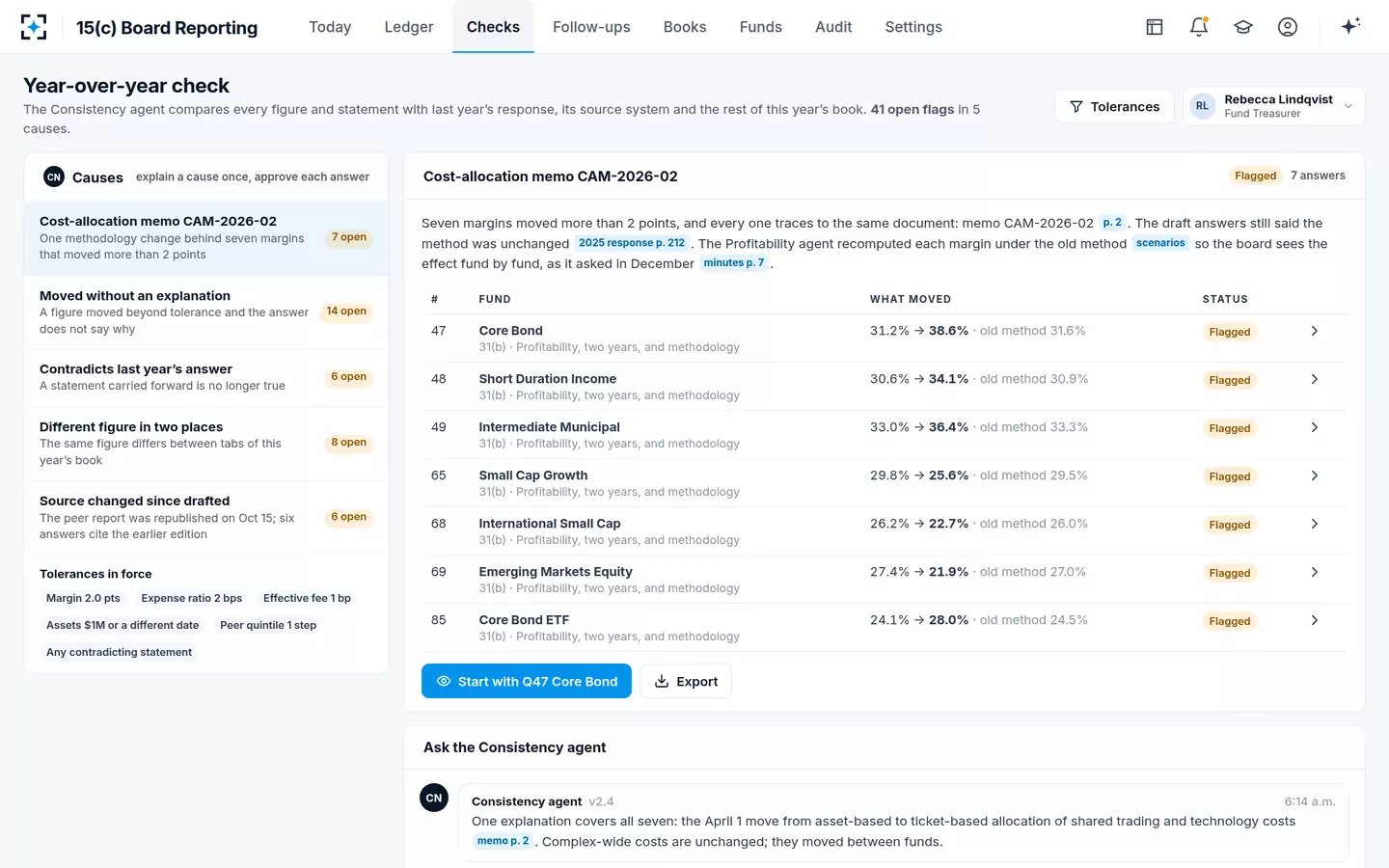
Moved figures grouped by the document that explains them, against stated tolerances
One 15(c) answer through all three approaches
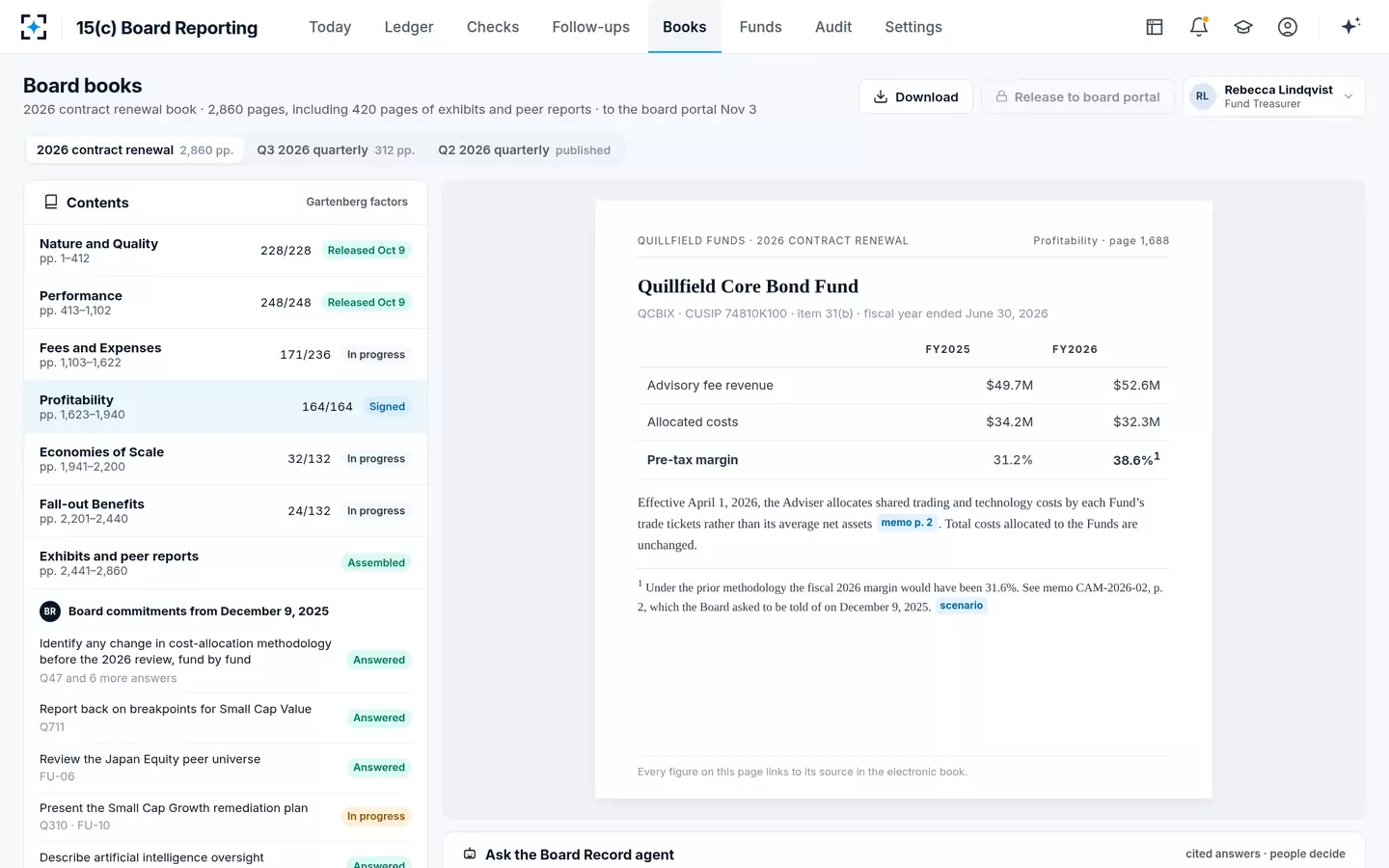
Take question 47 in the sample season: counsel's item 31(b) for the Core Bond Fund, asking for two years of profitability before and after distribution, the cost-allocation method, and, new this year, any change from the prior year. The fund's pre-tax margin rose from 31.2% to 38.6%; 7.0 of the 7.4 points came from a methodology memo that moved shared trading and technology costs from net assets to trade tickets on April 1. Last year's answer said the method was unchanged.
Question 47, handled three ways
| Step | Spreadsheet tracker and last year's file | Board portal | Agents with a person approving |
|---|---|---|---|
| Drafting | Analyst types 38.6% and 31.2% into last year's answer; the method sentence stays | Not involved | Profitability agent drafts both years, cites the cost-model rows, and recomputes under last year's method: 31.6% |
| Checking | Depends on someone rereading item 31(b) against the memo | Not involved | Consistency agent flags the carried sentence as contradicting the memo, and finds six more funds with the same cause |
| Board's prior request | Found only if someone remembers last December's minutes | The minutes are in the archive | Board Record agent links the December 2025 minutes asking to be told of any such change |
| Approval | Marked done in the tracker | Not involved | Treasurer approves with a cited footnote; the preparer cannot |
| Delivery | Book assembled by hand, uploaded | Delivers the book | Released by the chief legal officer to the portal |
| Six years later | Final file kept; drafts and sources scattered | Delivered version archived | Answer, sources, flags, approvals and the released version on one audit trail |
The table is not an argument against portals. In the agent column the portal still delivers the book; what changes is what arrives in it. Under Jones v. Harris, where an adviser withholds important information, a court looks harder at the outcome (Jones v. Harris Associates, 2010). A carried sentence about an unchanged method is how important information gets withheld without anyone intending it.
What none of the three replaces
No tool replaces the board's judgement, counsel's letter or the vote. None should pick a peer group, set a fee or write the directors' conclusions; none can make the directors read the book. And none fixes a weak source: if the cost-allocation model or the peer report is wrong, a tool that cites it faithfully will cite the error. That is why the source must be visible in every answer: a reader can only challenge what they can see.
Nor do tools remove the people who carry the season. They change what those people spend the season on. The solution's own estimate for the sample complex moves 45 business days of work by hand to 14, with treasurer and legal review shrinking least, from eight days to four. Which tasks agents take and which stay human sets out the split task by task.
Where 15(c) Board Reporting fits, and where it does not
A good fit: Many funds and agreements, with fund-by-fund requests that multiply into hundreds or thousands of questions
Less of a fit: A single fund with a short letter that one person can answer and reread in a day
A good fit: A cost-allocation model, fund accounting, a performance system and a peer report that change each year
Less of a fit: Answers that are mostly narrative and rarely change
A good fit: Sub-adviser materials in other languages, read with the original beside the English
Less of a fit: No sub-advisers, or one long-standing one
A good fit: Keep the existing board portal; the solution publishes released sections to it
Less of a fit: Looking for a board portal itself: this is not one
A good fit: People approve every answer and own every judgement
Less of a fit: Hoping software will decide the fee or the peer group
The 15(c) book by factor, signed section by section, ready for the portal
Questions to ask a board reporting tool vendor
A demonstration on the vendor's sample data proves little. Ask to see the tool on your own last request letter and last year's response, and ask these questions of it.
Questions to ask any board reporting software, tested on a 15(c) letter
- Show me last year's answer next to this year's, for one fund
A carried sentence that is no longer true is the error the SEC's Kornitzer order turned on.
- Open the source behind this figure
A cost-model row, a fee accrual line or a page in the peer report, highlighted.
- What happens when the cost method changes?
The answer should be both years under both methods, not one number.
- Who can approve, and who cannot?
A preparer locked out of approving their own answer, enforced by the system.
- How do counsel's follow-ups come back?
On the thread of the question they ask about, with a clock, not as loose supplements.
- What does it hand to our board portal?
Released, signed sections only; no second portal for directors to learn.
- What will we have in six years?
What the directors considered, its sources and every approval, under Rule 31a-2(a)(6).
- Where is the data kept, and is it used to train models?
In the solution: in the United States, and never used for training.
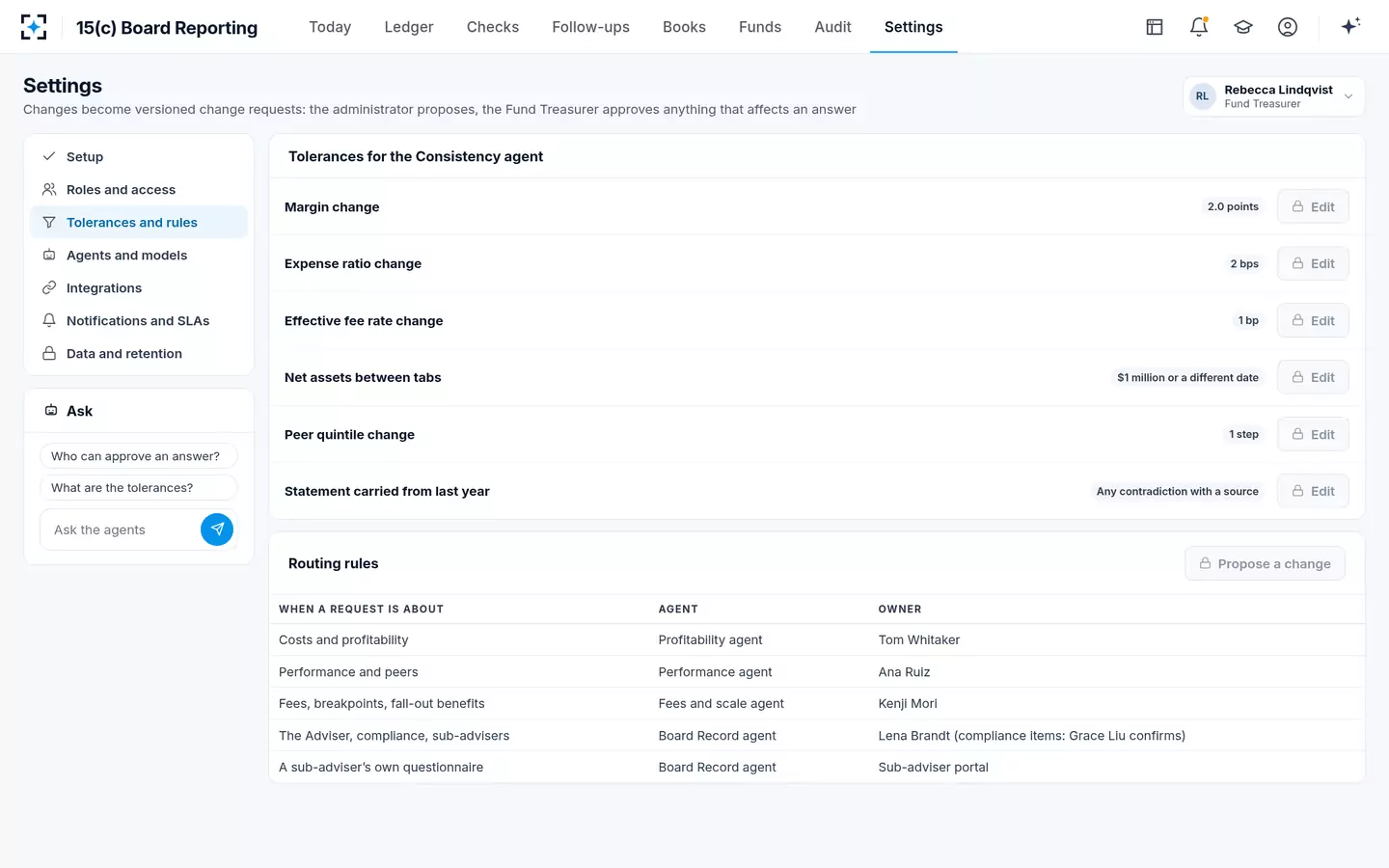
Tolerances and routing are the fund's settings, changed only by approval
Questions people ask
What is the difference between board portal software and board reporting software?
A board portal delivers finished materials to directors securely and lets them read and annotate them. Board reporting software, in the wider sense, includes tools that help produce the materials. For a fund's 15(c) renewal the production step, drafting and checking answers, is where most of the work and most of the risk sit.
What are board reporting tools for fund boards?
In practice three kinds: board portals for delivery, tracking spreadsheets with shared documents for coordination, and agent-based tools that draft and check answers from source systems. Many complexes use the first two together; an agent tool works alongside the portal rather than replacing it.
Is there an example of a 15(c) board book?
Funds do not publish their books, but the SEC's 2015 Commonwealth order describes one: counsel's memorandum on the directors' duties, the advisers' questionnaires, codes of ethics, Forms ADV, financial statements and advisory fee and performance tables, compiled by the fund administrator.
Does 15(c) Board Reporting replace our board portal?
No. It drafts and checks the 15(c) answers, assembles the book by factor, and publishes sections the chief legal officer has released to the portal the fund already uses.
What is board materials software?
Usually another name for board portal software, used for tools that assemble, distribute and archive board books. For a fund, check whether a tool only packages documents or also helps produce and verify their content.
Can board reporting software prove what directors saw?
It should. Rule 31a-2(a)(6) requires the fund to keep what directors considered for six years; the strongest evidence is the delivered version of each answer with its sources and approvals, which is what the solution's audit trail keeps.