Fund governance solutions are tools that help a US registered fund's adviser, officers and directors produce, deliver and keep the reports and findings the Investment Company Act and the SEC's rules require of a fund board. The obligations are many and recurring: the annual 15(c) renewal of every advisory contract (15 U.S.C. 80a-15), the chief compliance officer's annual report under Rule 38a-1, quarterly 12b-1 and valuation reports, the annual liquidity report, executive sessions, findings on share-class plans and more. A governance tool should be judged by how well it serves that calendar, not one meeting. Botminds' 15(c) Board Reporting covers the largest single deliverable on it, the 15(c) renewal, and assembles the quarterly board books alongside, with every answer cited and approved by a named person.
A fund board's year in four meetings: what the rules put on each agenda
First quarter
- 12b-1 spending report (quarterly)
- Valuation designee's quarterly report
- Independent directors' executive session
Second quarter
- 12b-1 spending report
- Valuation quarterly report
- Executive session
- CCO annual report and separate meeting (timing varies)
Third quarter
- 12b-1 spending report
- Valuation quarterly report
- Executive session
- Liquidity program annual report
- Valuation annual assessment
- 15(c) request letter goes out
Fourth quarter
- 12b-1 spending report
- Valuation quarterly report
- Executive session
- 15(c) renewal vote, in person
- 12b-1 plan continuance
- Board self-assessment
What is fund governance?
Fund governance is the system of checks the Investment Company Act puts around the relationship between a fund and its adviser, enforced mainly through the board. The Supreme Court, quoting its earlier decisions, called the independence of fund boards the "cornerstone" of the Act's efforts to check conflicts of interest (Jones v. Harris Associates, 2010). The Act caps interested directors at 60 percent of the board (15 U.S.C. 80a-10(a)), and a fund that relies on the SEC's exemptive rules must meet stricter standards: a majority of independent directors, who select and nominate the others, independent counsel, an annual self-evaluation, quarterly sessions without interested directors, and authority to hire their own staff and experts (17 CFR 270.0-1(a)(7)).
The rest of fund governance is a series of things the board must approve, review or find, each on its own cadence. Research on whether board structure changes outcomes is mixed: one study of index funds from 1998 to 2007 found an inverse relation between board size and performance, and concluded there may not be "a single optimal board structure" for all funds (Adams, Mansi and Nishikawa, Review of Financial Studies, 2010). What is not in doubt is the workload: the reports arrive whether or not the board is the right size.
What fund governance rules set the board's calendar?
Eight provisions do most of the work, and each sets a frequency rather than a date. The table lists what each requires the board to receive or decide, how often, and who usually prepares it.
The rules behind a fund board's calendar, with their cadence
| Rule | What the board receives or decides | How often | Usually prepared by |
|---|---|---|---|
| Section 15(a) and (c) | Continuance of each advisory and principal underwriting contract, after the information it requested; non-interested directors vote in person | At least annually after the first two years | Adviser's fund administration, treasurer and legal |
| Rule 38a-1 | Approval of the fund's and service providers' compliance policies; review of their adequacy; the CCO's written report; a separate meeting with the CCO | At least annually; CCO designation and pay approved by the board | Chief compliance officer |
| Rule 12b-1 | Written report of amounts spent under the distribution plan and their purposes; continuance of the plan | Report at least quarterly; continuance at least annually | Distributor and treasurer |
| Rule 2a-5 | Valuation designee's reports on fair value matters; annual assessment of its process; material matters promptly | At least quarterly; at least annually; no later than five business days for material matters | Valuation designee, usually the adviser |
| Rule 22e-4 | Written report on the liquidity risk management program and its effectiveness | At least annually | Program administrator |
| Rule 0-1(a)(7) | Independent directors' session without interested directors; the board's evaluation of itself and its committees | At least quarterly; at least annually | Independent directors and their counsel |
| Rule 18f-3 | Finding that a multi-class plan, including expense allocation, is in the best interests of each class and the fund | Before adopting or materially amending the plan | Adviser and fund legal |
| Rule 15a-4 | Approval of an interim advisory contract after a contract ends | Within 10 business days of termination, when it happens | Fund legal |
The 38a-1 annual report: what the chief compliance officer must cover
Rule 38a-1 requires the fund's chief compliance officer, no less frequently than annually, to give the board a written report covering, at a minimum, how the compliance policies of the fund and of each adviser, principal underwriter, administrator and transfer agent are working; material changes to those policies, and those the annual review recommends; and every material compliance matter since the previous report. Once a year, too, the CCO meets the independent directors without management present (17 CFR 270.38a-1(a)(4)(iii)–(iv)).
The report sits close to the 15(c) renewal in two ways. Its findings on the adviser's compliance program are evidence for the nature and quality of the adviser's services, so the 15(c) answer should cite it rather than restate it. And the board's approval of the service providers' policies must rest on a finding that they are reasonably designed to prevent violations. In Northern Lights, the SEC found trustees approved advisers' compliance programs based mainly on a brief written statement that the manuals were "sufficient and in use," rather than the review the trusts' own procedures required (SEC, IC-30502, 2013).
Quarterly: 12b-1 spending, valuation and the independent directors' session
Three items recur at every regular meeting. Under Rule 12b-1, anyone authorized to direct payments under the fund's distribution plan must give the board, and the directors must review, a written report of the amounts spent and their purposes, at least quarterly (17 CFR 270.12b-1(b)(3)(ii)). Under Rule 2a-5, the valuation designee reports in writing at least quarterly on fair value matters, including a summary of material fair value matters in the prior quarter (17 CFR 270.2a-5(b)(1)). And under Rule 0-1(a)(7), the independent directors meet at least once a quarter without interested directors present.
The valuation reports have an annual and an urgent version too: an annual assessment of the adequacy and effectiveness of the designee's process, and prompt reporting of material matters within a time the board sets, no later than five business days after the designee becomes aware of them. The substance of valuation oversight is its own discipline, covered in the 2a-5 board report, annotated; on the calendar, it is four reports and a standing obligation.
Annual: contracts, compliance, liquidity and the board's own evaluation
The annual items cluster, and the 15(c) renewal is the heaviest. Every advisory contract past its first two years must be continued at least annually, by the board or the shareholders, with the terms approved by a majority of the non-interested directors in person after they have requested and evaluated the information reasonably necessary. The same section requires annual continuance of the principal underwriting contract. The 12b-1 plan must also be continued at least annually, with its own in-person vote of the independent directors who have no financial interest in it.
Around them sit the CCO's report and separate meeting, the liquidity program administrator's annual written report on the program's operation and effectiveness (17 CFR 270.22e-4(b)(2)(iii)), the valuation designee's annual assessment, and the board's evaluation of its own performance and committee structure. After the renewal, the fund files its statement of the basis for approving the advisory contract on Form N-CSR, Item 11 (87 FR 72758, 2022). How the renewal season itself runs is the subject of its own guide.
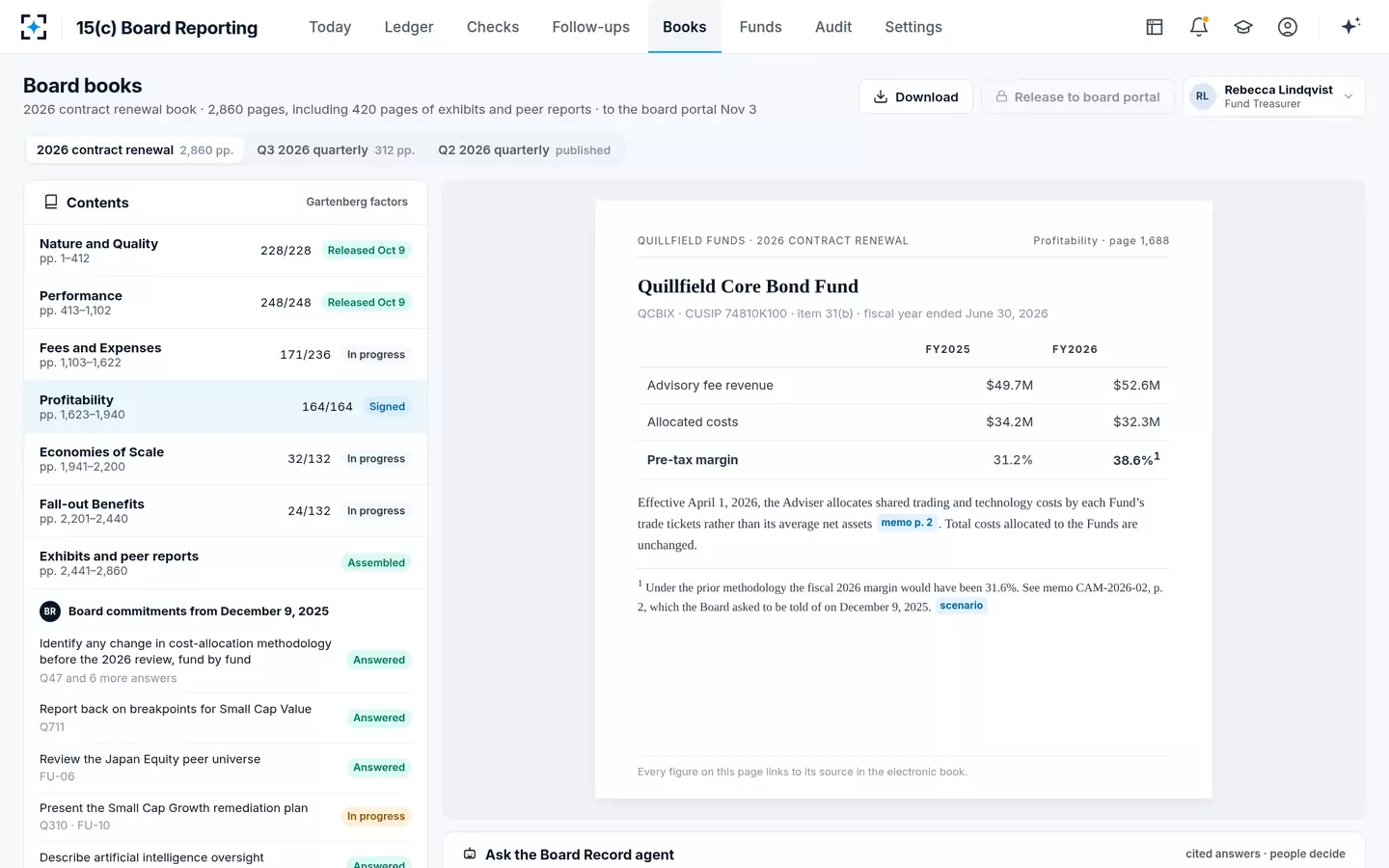
The renewal book and the quarterly books side by side in 15(c) Board Reporting
Event-driven findings: share classes, interim contracts and ETF classes
Some board decisions have no calendar slot because they follow events. A multi-class plan needs a finding by a majority of the directors and of the independent directors that the plan, including its expense allocation, is in the best interests of each class individually and of the fund as a whole, before it is adopted or materially amended (17 CFR 270.18f-3(d)). A contract that ends unexpectedly needs an interim contract approved within 10 business days under Rule 15a-4, and a new contract approved by shareholders before the interim one runs out, at most 150 days later.
The newest event-driven item comes from the SEC's ETF share-class exemptive orders. In the first application the SEC noticed, in September 2025, the board would find the multiple class plan in the best interests of each mutual fund class, the ETF class and the fund; the adviser would prepare an "Initial Advisor Report"; and the board would approve numeric thresholds for monitoring costs associated with portfolio transactions, cash levels and capital gains distributions (SEC, IC-35770, notice of application). Each fund that adds such a class adds monitoring reports to the calendar.
Who owns each deliverable
The board receives everything, but each item has a different author, and a governance tool that serves one author may not serve the next. The adviser's fund administration and treasurer carry the 15(c) renewal; the CCO owns the compliance report; the valuation designee, usually the adviser, owns the valuation reports; the distributor and treasurer own the 12b-1 report; the fund's legal officer owns the minutes and findings; and independent counsel advises the directors throughout.
The authors of a fund board's year, and what each delivers
Today
Owns the financial answers in the 15(c) renewal and the 12b-1 spending figures.
With agents
Approves agent-drafted 15(c) answers with their sources; signs each section.
Still theirs: Approval of every financial answer
Today
Writes the annual 38a-1 report and meets the independent directors.
With agents
Confirms the compliance answers in the 15(c) book, drafted from that report.
Still theirs: The compliance report and its findings
Today
Reports quarterly and annually under Rule 2a-5, and promptly on material matters.
With agents
Unchanged: valuation reporting is its own process.
Still theirs: Fair value determinations
Today
Keeps the minutes, drafts findings and assembles books for the portal.
With agents
Releases signed 15(c) sections and quarterly books to the board portal.
Still theirs: The board record and release
Today
Writes the 15(c) letter and follow-ups; advises on findings.
With agents
Receives follow-up answers on the thread of each question, with sources.
Still theirs: Advice to the independent directors
Fund governance documents the calendar leaves behind
Every item on the calendar leaves documents the fund must keep. Rule 31a-2(a)(6) requires anything the directors considered under Section 15(c) to be kept six years, the first two in an easily accessible place (17 CFR 270.31a-2(a)(6)). Rule 38a-1 has its own recordkeeping requirements for the policies, the CCO's reports and the annual reviews, and Rule 22e-4 requires the materials given to the board on the liquidity program to be kept at least five years, the first two in an easily accessible place. Minutes tie them together: they are where the board's findings are recorded, and the public statements are drafted from them.
The Northern Lights order shows what happens when that chain is weak: minutes drafted from a template carried boilerplate into shareholder reports, and some 15(c) materials were discarded or not kept. A governance tool's archive is only as useful as its link between what was decided and what the board actually received.
What to ask of fund governance solutions
Three categories of tool are sold as fund governance solutions: board portals for delivering books, compliance platforms for testing and documenting policies, and tools that produce board content. Each serves part of the calendar. The questions below test whether a tool serves the deliverable you need it for, and the calendar it sits in. Board portals, spreadsheet trackers and agents compared on one 15(c) answer covers the content side in detail.
Questions for any fund governance solution, tested against the board's calendar
- Which deliverables on our calendar does it produce, and which does it only store?
Delivery and archive are not drafting; know which job you are buying.
- Does it know each item's cadence and owner?
Quarterly, annual and event-driven items with a named author for each.
- Can it show what the board received, as received?
Rule 31a-2(a)(6) is about what was considered, not a later clean copy.
- Does it link this year's report to last year's?
A statement carried forward that is no longer true is invisible without the comparison.
- Does it connect the board's requests to the answers that honor them?
Minutes create commitments; the next book should show each one answered.
- Who can approve, and who can release?
Separate roles enforced by the system: preparer, approver, releaser.
- Does it work with the portal and systems we have?
A governance tool that needs a second portal adds a step for directors.
- How long does it keep everything, and where?
Six years at least for 15(c) materials, with legal hold when needed.
Where 15(c) Board Reporting fits in a governance calendar
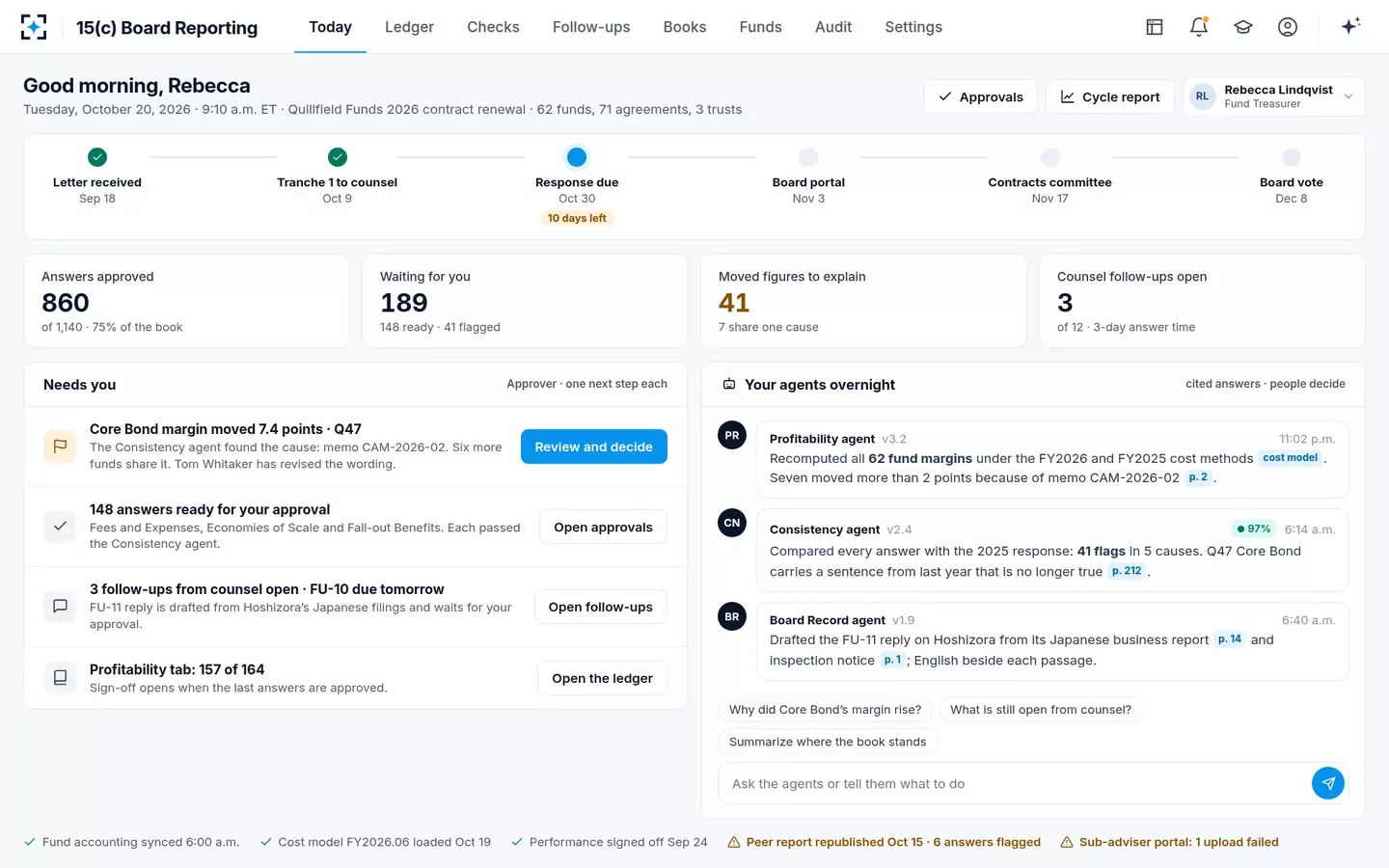
15(c) Board Reporting is built for the heaviest single item on the calendar. It reads counsel's letter, drafts every answer from the cost-allocation model, fund accounting, the performance system, the peer report and the minutes, checks each against last year's response, and assembles the book by factor; the fund treasurer approves each answer and signs each section, and the chief legal officer releases the book to the board portal. The same agents assemble the quarterly board books by tab with footnotes and sources, and the compliance answers are confirmed by the CCO from the annual 38a-1 report. It does not replace the CCO's testing, the valuation designee's work or the board portal.
The renewal at a glance, with the board's dates and what waits for a decision
Questions people ask
What are the fund governance rules for US mutual funds?
The core is the Investment Company Act's board provisions, Sections 10 and 15, with SEC rules that add recurring duties: Rule 38a-1 on compliance, Rule 12b-1 on distribution plans, Rule 2a-5 on valuation, Rule 22e-4 on liquidity, Rule 18f-3 on share classes and Rule 0-1(a)(7) on governance standards for funds using exemptive rules. A fund with an ETF share class adds the findings and reports in the ETF share class operational considerations, and a merger adds the Rule 17a-8 findings.
What is in a 38a-1 annual report?
The operation of the compliance policies of the fund and its adviser, principal underwriter, administrator and transfer agent; material changes since the last report and any recommended after the annual review; and each material compliance matter. The CCO must provide it to the board at least annually and meet the independent directors separately.
How often do fund boards meet?
The rules do not set a number of meetings, but several require quarterly reports or sessions: 12b-1 spending reports, the valuation designee's reports and, for funds under the governance standards, the independent directors' executive session, which must happen at least once a quarter.
What documents must a fund board keep?
Among others, everything the directors considered in approving advisory contracts, for six years under Rule 31a-2(a)(6), and the compliance policies, CCO reports and annual review records Rule 38a-1 requires. Minutes record the findings the rules call for.
Is a board portal a fund governance solution?
It is one part: it delivers and archives books. Producing the content of those books, checking it against last year's and recording who approved it are separate jobs, which other tools, or people, must do.