The Rule 17a-8 adopting release is the SEC's "Investment Company Mergers" release, Investment Company Act Release No. 25666 of 18 July 2002, published at 67 FR 48512 on 24 July 2002, which widened the rule that lets funds of the same complex merge without an SEC order and set the test for when the merging fund's shareholders must vote. Under the rule as adopted, the merging fund's shareholders vote unless four things hold: no fundamental policy is materially different, the advisory contract is not materially different, the merging fund's shareholder-elected independent directors will be a majority of the survivor's independent directors, and the survivor's 12b-1 fees are no higher. Botminds' Fund Rationalization, which reviews a fund line-up each quarter for merge, close or keep, runs that four-part test for every candidate partner and shows the vote arithmetic, flagged for fund counsel to confirm.
The worked case is a fictional sample fund from the solution: Quillfield Clean Energy Innovators ETF, $18.4 million in net assets and 850,000 shares, proposed for merger into a larger ETF in the same trust.
What a fund merger asks of the people who run it
445hours
the SEC's estimated average burden of one Form N-14 registration statement
$75K
SEC staff estimate of a merger shareholder vote in 2002: legal, mailing, printing, solicitation, tabulation
150+
merger exemptive orders the SEC issued between 1980 and 2002 for mergers the old rule did not cover
163
Form N-14 filings in 2025, against 110 in 2023
What does the Rule 17a-8 adopting release say?
The 2002 release did two things to a rule that had existed since 1980. It let funds merge with other funds of the complex "without regard to the reason for their affiliation", and it let funds merge with bank common and collective trust funds and unregistered insurance company separate accounts, as long as the survivor is a registered fund (IC-25666, Executive Summary). Before 2002 the rule covered only funds affiliated "solely because they have common investment advisers, officers and/or directors", and everything else needed an order; the SEC had issued "more than 150 orders", and "The 16 orders we issued in 2001 provided exemptions for 120 mergers involving approximately 220 funds."
In return for removing the order, the release added conditions. Three matter in every review: the board's two determinations and the information behind them, the shareholder vote in defined cases, and the records. The release explains the vote test plainly. A commenter had suggested requiring a vote "only when the merger would result in a change that, in a context other than a merger, would require a shareholder vote under the Investment Company Act", and the SEC agreed.
"We believe such an approach has merit because it would preserve important values embodied in the Investment Company Act while reducing the need for a fund to incur the expense of soliciting proxies when the merger may not raise significant issues for shareholders."
SEC, Investment Company Mergers, Release IC-25666 (July 2002)
The logic gives counsel a way to read every condition: each one mirrors a change that would need a vote outside a merger. A fundamental policy can be changed only by a shareholder vote under section 13; a material change to an advisory contract needs shareholder approval under section 15; and so on. A merger cannot be used to make one of those changes quietly.
When does a fund merger need a shareholder vote under Rule 17a-8?
A merger needs the merging fund's shareholder vote if any one of four conditions fails; it needs no vote under the rule only if all four hold. The surviving fund's own shareholders are not asked under the rule. The decision tree below puts the rule's text at each branch, in the order Fund Rationalization tests it.
Four questions, in order: any yes means the merging fund's shareholders vote
- 1
Is any fundamental policy of the merging fund materially different from a policy of the surviving fund?
17a-8(a)(3)(i): policies that under section 13 could not be changed without a shareholder vote
YesVote required
NoGo to 2
- 2
Is the surviving fund's advisory contract materially different, apart from the names of the funds?
17a-8(a)(3)(ii); the release treats a higher advisory fee as a material change
YesVote required
NoGo to 3
- 3
Will the merging fund's shareholder-elected independent directors fail to be a majority of the survivor's independent directors?
17a-8(a)(3)(iii)
YesVote required
NoGo to 4
- 4
Can the surviving fund pay higher 12b-1 distribution fees, as a percentage of average net assets?
17a-8(a)(3)(iv)
YesVote required
NoNo vote under the rule; check state law and the charter
Take each condition in turn, because each has a trap. The first reaches further than investment objectives. The release's summary of section 13 covers changing between open-end and closed-end or from diversified to non-diversified, borrowing, issuing senior securities, underwriting, real estate, commodities and lending, and deviating from "any investment policy that is changeable only by shareholder vote or any policy that is 'fundamental'" (IC-25666, note 22). The statute itself also lists a departure from the fund's stated policy on concentrating its investments in an industry or group of industries (15 U.S.C. 80a-13(a)(3)). A difference in a concentration policy buried in the statement of additional information is enough.
The second condition turns on fees. The release says that if the acquiring fund's advisory fees "will be greater than the advisory fees of the acquired fund, we would consider the increase in the advisory fee to be a material change requiring shareholder approval" (note 23). A merger into a cheaper fund passes this test; one into a dearer fund fails it, whatever else is equal.
The third condition is often misread. It is not enough that the two funds share a board in a general sense: the merging fund's independent directors "who were elected by its shareholders" must "comprise a majority of the directors of the Surviving Company who are not interested persons" (Rule 17a-8(a)(3)(iii)). Directors appointed to fill vacancies and never elected by shareholders do not count. The fourth compares authorised 12b-1 distribution fees as a percentage of average net assets: if the survivor may charge more, holders vote.
The two findings the board makes whether or not there is a vote
The vote is conditional; the board's findings are not. The board of each merging fund, with a majority of its independent directors, must determine that participation "is in the best interests of the Merging Company" and that existing shareholders' interests "will not be diluted as a result of the Merger", having "requested and evaluated such information as may reasonably be necessary" (Rule 17a-8(a)(2)). The release lists factors a board should consider "if relevant": fees and expenses the fund will bear for the merger, the effect on annual operating expenses and shareholder fees and services, any change in objectives, restrictions and policies, and the federal income tax consequences to shareholders.
The release is careful about what the list is. The factors "do not represent legal requirements", but "consideration of these factors may not suffice if the directors have not considered other relevant factors", and the directors "must make their own determination as to what factors are relevant" (note 15). It also points at a conflict boards should test: whether the fund paying merger expenses "that would otherwise be paid by the fund's investment adviser" raises questions under sections 15(a)(1) and 36(b) (note 16). In the sample case the adviser bears all of the estimated $310,000 cost, which takes that question off the table.
What counts as "a majority of the outstanding voting securities"?
The vote Rule 17a-8 requires is the 1940 Act's defined majority, which is the lesser of two figures, not simply half the shares. Section 2(a)(42) sets it as whichever is smaller: two thirds (67%) of the shares voted at the meeting, provided holders of more than half the outstanding shares are there in person or by proxy, or more than half of all outstanding shares (15 U.S.C. 80a-2(a)(42)). The release added the cross-reference in response to a comment, so that merger votes are "subject to the Act's requirements for majority approval" (note 20).
The same 850,000 shares, three turnouts: how many votes the merger needs
| Turnout at the meeting | Route (A): 67% of shares present | Route (B): more than half of all shares | Votes needed (the lesser) |
|---|---|---|---|
| 70% present · 595,000 shares | 398,650 | 425,001 | 398,650 |
| 55% present · 467,500 shares | 313,225 | 425,001 | 313,225 |
| 45% present · 382,500 shares | Not available: half the shares are not present | 425,001, more than are present | Cannot pass; adjourn and solicit |
The table shows why turnout, not the yes share, usually decides a fund vote. A fund held mainly by retail investors through brokers may struggle to get half its shares represented at all, and every adjournment costs solicitation money. The SEC staff put the cost of a merger vote at about $75,000 in 2002, against about $30,000 for the information statement a fund sends when no proxies are solicited (IC-25666, note 47); in the sample case, the estimated proxy solicitation alone is $185,000 of the adviser's $310,000.
What state law, the charter and the board can add
Passing the four conditions removes the rule's vote requirement, not every vote requirement. The release says so directly: "In some cases rule 17a-8 may permit a merger to occur without shareholder approval, but state law or the fund's organizational documents may require shareholder approval. Nothing in rule 17a-8 relieves a fund of its obligations in this regard" (note 18). The vote condition itself exists because, as the proposing release worried, funds were increasingly organised under state laws that did not require shareholder approval of mergers, "which could deny shareholders a voice in an important change in their investment".
The release also records what the staff saw in practice: "Our staff rarely sees fund mergers in which there is no shareholder vote", and "Even funds that are not required to obtain shareholder approval may do so in order to maintain good relations with their shareholders" (note 46). It rejected a proposed "echo vote" requirement, but warned that advisers that are also fund shareholders "should carefully consider their fiduciary responsibilities to the fund when deciding how to cast their votes" (note 18). A template that records the vote result of the four-part test should also record whether the board chose to seek a vote anyway, and why.
Form N-14: what the vote needs on paper, and how long it takes
When the surviving fund issues shares to the merging fund's holders, it registers them on Form N-14, which doubles as the proxy statement when a vote is sought. Item 3 asks for "a table showing the current fees for the registrant and the company being acquired and pro forma fees", a synopsis comparing objectives, distribution, redemption and "any other significant considerations", and a discussion of "the primary federal tax and other consequences of the proposed transaction to the security holders" (Form N-14, Item 3). The SEC estimates the average burden at 445 hours per response.
What counsel confirms before the N-14 is drafted
- The four vote conditions, each against its document
Fundamental policies in the SAI, both advisory contracts, the trustee roster with how each independent trustee took office, both 12b-1 plans.
- The governance standards are met
A majority of independent directors, who select and nominate the other independent directors, with independent legal counsel if they have counsel (Rule 0-1(a)(7)).
- State law and the declaration of trust
Whether either requires a vote even where Rule 17a-8 does not.
- Who bears the merger costs
If the fund pays costs the adviser would otherwise pay, the section 15(a)(1) and 36(b) questions the release raises.
- The tax opinion is planned
The N-14 must discuss federal tax consequences with Code references; the reorganization stays "intended" until counsel opines.
- The timetable fits the 30-day clock
Rule 488 makes a qualifying N-14 effective on the thirtieth day after filing; the prospectus goes to holders at least 20 business days before the meeting if the SAI is not sent with it.
- Financial information follows Rule 6-11
For fund acquisitions, Regulation S-X Rule 6-11 calls for supplemental information, including the pro forma fee table, in place of pro forma financial statements.
The clock is shorter than many teams assume. Under Rule 488 an open-end fund's N-14 "shall become effective on the thirtieth day after the date upon which it is filed", or a later date the registrant chooses up to fifty days, provided the proxy covers only the merger and a short list of routine matters (17 CFR 230.488). The delay usually sits before filing: in finding, late, the policy difference that turns an information statement into a proxy campaign.
Records and governance: the parts of the rule that outlast the merger
Two conditions survive the closing date. The merging fund's board must satisfy the fund governance standards in Rule 0-1(a)(7), and the surviving fund must preserve "written records that describe the Merger and its terms for six years after the Merger (and for the first two years in an easily accessible place)" (Rule 17a-8(a)(4)–(5)). The release lists what those records include: "the minute books setting forth the determinations of the funds' boards and the bases for those determinations, any supporting documents provided to the directors in connection with the merger, and documentation of the prices at which securities were transferred". The stated purpose is that examiners "have adequate information to assess the merging funds' compliance with the rule's conditions".
How Fund Rationalization runs the test on the sample merger
In Fund Rationalization the Rule Checker tests the four conditions for each partner the Partner Finder ranks, so the vote answer arrives with the partner, not after it. On the sample fund, the best partner by holdings overlap was Quillfield Sustainable Equity ETF: 71% of the fund's portfolio by weight, a 0.49% fee against 0.65%, the same board and no 12b-1 fee in either fund. Three conditions passed. The first failed: the merging fund's statement of additional information commits it to concentrate 25% or more in clean-energy industries, and the partner does not concentrate. A vote is required.
Merger partners ranked by overlap in Fund Rationalization, with the Rule 17a-8 test beside the winner
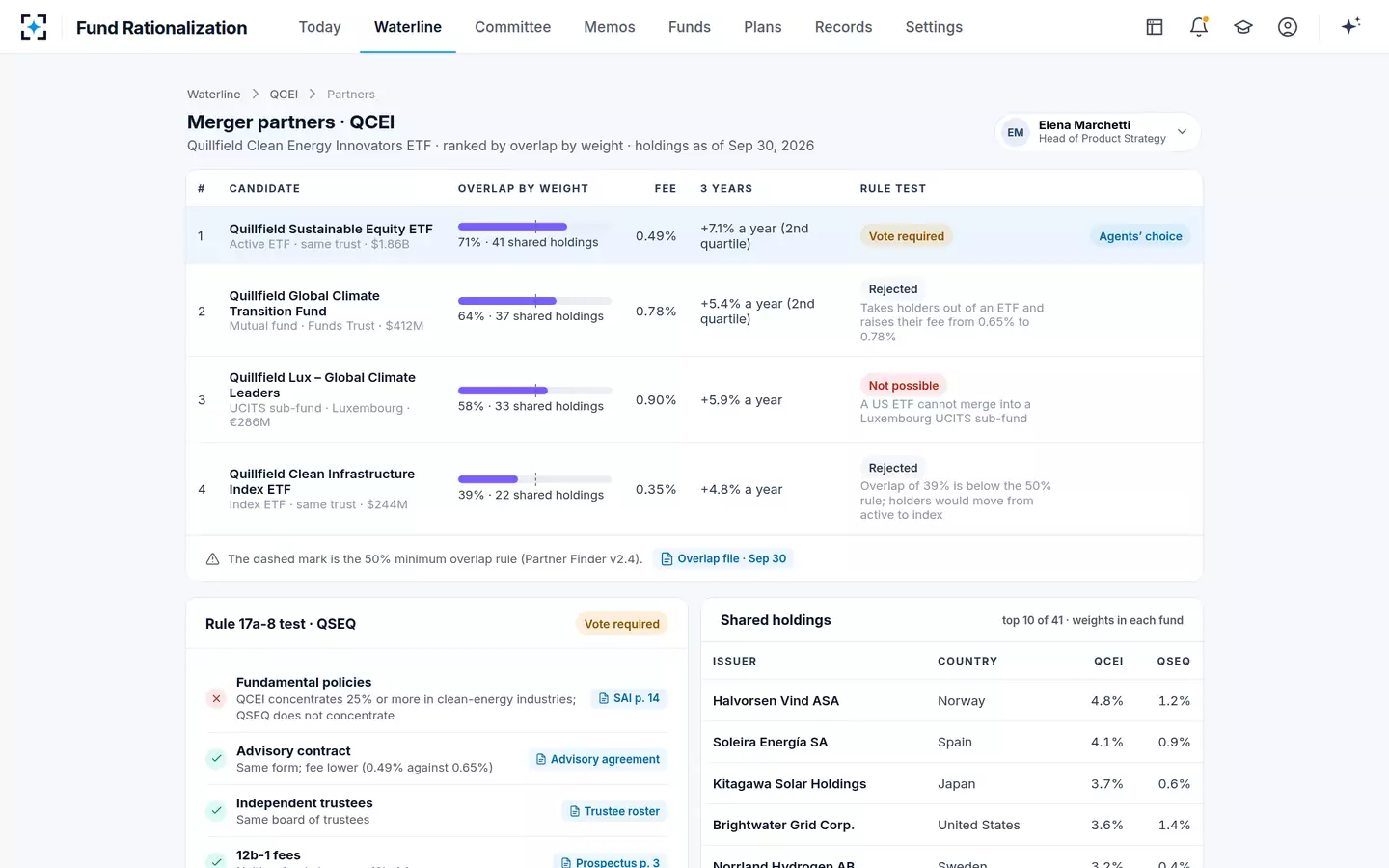
The answer changes the economics before anyone has decided. A merger that needs a vote costs more, takes longer and can fail; the devil's advocate uses exactly that in its case to keep the fund, and the treasurer sees the solicitation estimate in the per-share comparison. The tax side of the same merger, including what happens to the fund's loss carryforward, is worked through in keeping a mutual fund reorganization tax-free.
The agents' case, with the vote condition and its source in one message
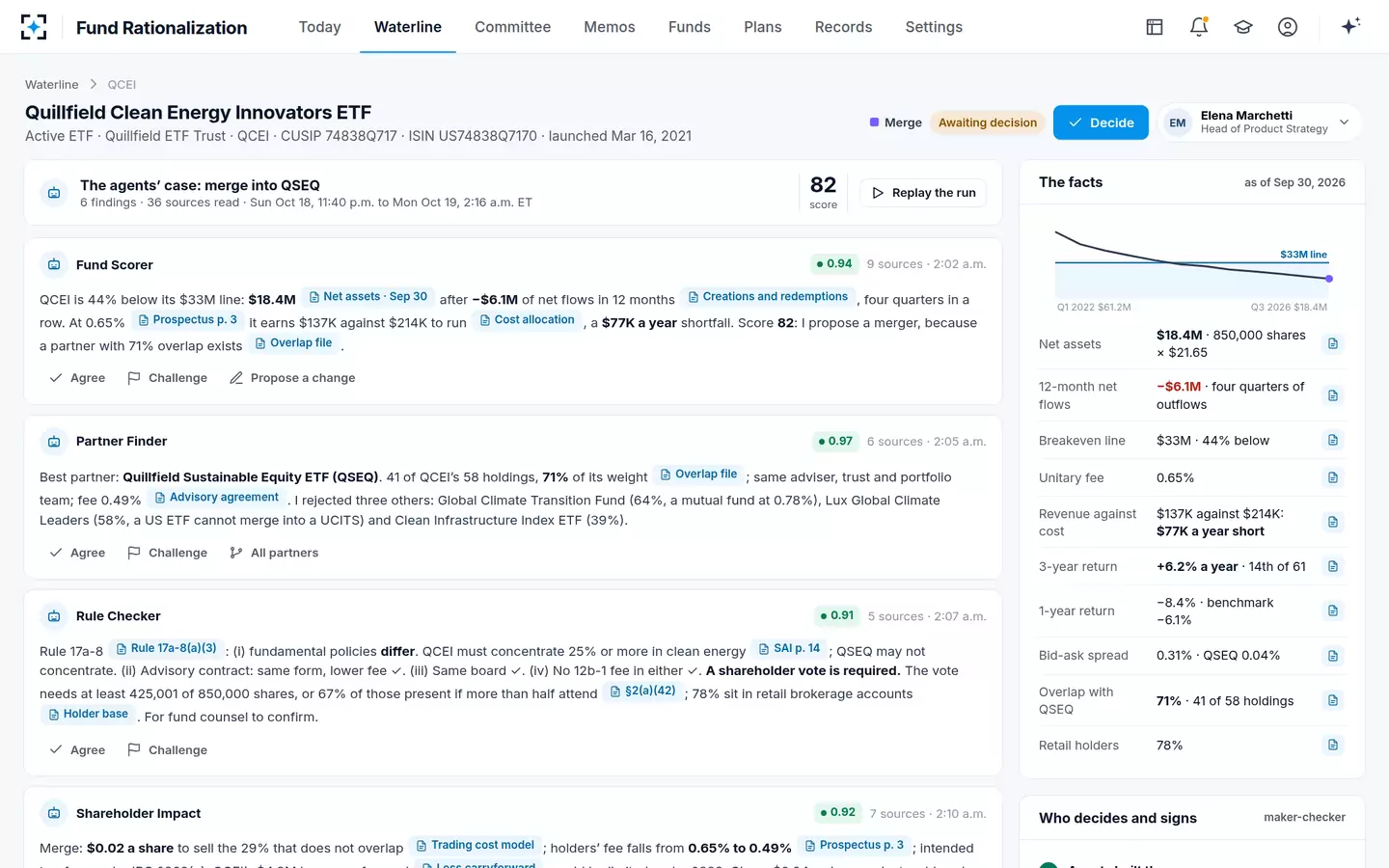
Every result in the thread is a proposal. Fund counsel signs the memo that carries the findings, and the committee chair records the decision to seek the vote as a condition of the merger. To see the four-part test run on your own funds, start from Fund Rationalization; how the vote question fits into the committee's template is in the product rationalization template.
Questions people ask
What is Rule 17a-8 under the 1940 Act?
Rule 17a-8 is an exemption from section 17(a) of the Investment Company Act, which otherwise bars a fund from buying from or selling to an affiliated person. It lets a registered fund merge with affiliated funds, and with certain bank and insurance company funds, without an SEC order, if the board makes its determinations, a vote is held where the rule requires one, and records are kept six years.
Is Rule 17a-8 the same as Exchange Act Rule 17a-8?
No. Exchange Act Rule 17a-8 (17 CFR 240.17a-8) concerns broker-dealers' recordkeeping and reporting of currency transactions. The fund merger rule is Investment Company Act Rule 17a-8, at 17 CFR 270.17a-8.
Do the surviving fund's shareholders have to vote?
Not under Rule 17a-8: its vote requirement applies to a merging fund "that is not a Surviving Company". The surviving fund's board still makes its own best-interests and no-dilution determinations, and state law or the fund's charter can require a vote of the survivor's holders in some structures.
What is Form N-14 used for?
Form N-14 registers the shares a fund issues in a merger or other business combination, and usually serves as the proxy statement or information statement too. It carries the current and pro forma fee table, a synopsis comparing the two funds, the tax consequences and the voting information; the SEC estimates 445 burden hours per response.
What happens if the merger vote fails?
The merger cannot proceed in reliance on Rule 17a-8, and the board decides what comes next: adjourn and solicit again, choose a partner that passes the four conditions, keep the fund with a plan, or liquidate it, which is a taxable event for holders. A failed or adjourned vote also adds solicitation cost, which is why turnout belongs in the case before the committee decides.
Do ETF mergers need a shareholder vote?
The same four conditions apply to an ETF merging into another registered fund. ETF shares are mostly held through brokers, so reaching the section 2(a)(42) turnout can be hard; in the sample case 78% of the fund's shares sit in retail brokerage accounts.