ETF closure risk is the chance that an exchange-traded fund you hold is liquidated, together with what that fund costs you while it drifts toward closing: a wider bid-ask spread each time you trade, an expense ratio that is low only while the adviser absorbs the shortfall, distributors and model portfolios dropping the fund, and finally a liquidation that sells your shares on a date and at a tax cost you did not choose. Most of that bill falls on the shareholders who stay, not on those who leave early, and it grows the longer a subscale fund is kept open without a plan. Botminds' Fund Rationalization scores every fund in a line-up each quarter against its breakeven line and prices merge, close and keep per share for the people who own it, so the product committee sees the stayers' bill next to the adviser's subsidy.
The worked figures are fictional sample data from the solution: an active ETF with $18.4 million of net assets, a 0.65% fee and a 0.31% average spread, and a larger fund in the same trust it could merge into. Research is linked where it appears.
What holders of a subscale ETF pay that holders of a large one do not
0.31%
average bid-ask spread of the sample subscale ETF, against 0.04% for its merger partner
16bps
lower fee holders would pay a year after merging into the partner: 0.65% to 0.49%
30%
risk-adjusted loss of specialized ETFs over their first five years, in a 2023 study
78
applications to deregister a fund filed with the SEC in 2025, after a merger or a liquidation
What is ETF closure risk, and who bears it?
The holder bears most of it, in three forms. The first is cost while the fund is small: a thinly traded ETF has wider spreads, and every purchase and sale pays them. The second is the subsidy that can end: when a fund is below breakeven, the adviser covers the gap through expense caps or, for a unitary-fee ETF, by paying expenses the fee no longer covers, and a cap the adviser can end, or a fee it raises, moves the cost to holders. The third is the exit: if the fund closes, holders receive cash on the fund's timetable and realise a gain or loss for tax in that year.
Disclosure rules make the second form visible, if one reads closely. Form N-1A lets a fee waiver into the prospectus fee table only if it has at least a year to run from the effective date (SEC Form N-1A, Item 3 instructions). A holder sees this year's net fee, not the promise behind it. The SEC's examiners are looking at the same thing: registered fund examinations in fiscal 2027 put fund fees and expenses first among their focus areas, waivers and reimbursements included (SEC Division of Examinations, 23 October 2026).
Where a stayer's money goes: the yearly bill of staying in a subscale ETF
For a holder who stays, the difference between a subscale fund and a large one is a few dozen dollars a year per $10,000, made of three parts. The split below is our arithmetic on the sample fund for a holder with $10,000 who buys or sells once in the year, comparing staying in the subscale fund with holding the fund it would merge into.
One year in the subscale sample ETF instead of its partner costs a $10,000 holder about $52, and most of it is the spread
Extra cost of staying, $10,000 holder, one trade a year
- Wider spread: 0.31% against 0.04% on one round trip, $27 · 52%
- Higher fee: 0.65% against 0.49%, $16 · 31%
- Costlier exit if it later closes: $0.04 against $0.02 a share, about $9 · 17%
The figure understates the bill in two ways. It assumes the subsidy continues; if the adviser stopped absorbing the sample fund's $77,000 shortfall, holders would carry that cost through the fee, about 0.4% of the fund's assets a year. And it leaves out performance. A fund that has lost its distributors may also lose its capacity to trade efficiently in the names it holds, and a holder in a closing fund carries the market until the liquidation date. A holder who trades often pays the spread many times; the spread then dominates everything else.
Why do ETFs close? What the research says about which ones
The short answer is size, flows and the cycle of fashionable themes. The SEC's investor bulletin names weak performance, shrinking assets and fading investor interest among the reasons funds liquidate (SEC Office of Investor Education and Advocacy, 2021). The academic evidence is sharper for thematic funds. Ben-David, Franzoni, Kim and Moussawi found that specialized ETFs lose about 30%, risk-adjusted, over their first five years, and that the underperformance "cannot be explained by high fees or hedging demand" but follows from the stocks being overvalued at launch, consistent with "providers catering to investors’ extrapolative beliefs by issuing specialized ETFs that track attention-grabbing themes" (Review of Financial Studies, 2023).
"While early ETFs invested in broad-based indexes and therefore offered diversification at low cost, more recent products track niche portfolios and charge high fees."
Ben-David, Franzoni, Kim and Moussawi, Review of Financial Studies (2023)
Signals that an ETF may close, and where a holder can see them
Which closures happen, and when, is less settled. A working paper on ETFs that closed between 2012 and 2019 found that "returns and flows are good predictors of the ETFs’ decision to close, whereas larger funds and those with high net expenses are less likely to close" (Boehmer and Finta, SSRN working paper, 2023). The second finding cuts against intuition and fits the subsidy story: a fund charging high net expenses is one the adviser can afford to keep. For a holder, the practical signals are the ones a sponsor's own review uses.
Signals that an ETF is a closure candidate, and where a holder can see each one
| Signal | What the sponsor sees | What a holder can see |
|---|---|---|
| Size against breakeven | Net assets against its own cost to run the fund | Net assets on the fund's website and in shareholder reports |
| Flows | Twelve months of creations and redemptions | Shares outstanding falling quarter after quarter |
| Subsidy | Expense-cap reimbursements or a unitary-fee shortfall | A waiver line in the fee table and its end date |
| Distribution | Platform and model-portfolio letters, sales by channel | Little, until a platform drops the fund from a list |
| Trading | Spread and volume against peers | The bid-ask spread on your own trades |
| Theme | Whether the theme still sells | Whether the fund's niche is still in the news |
Merge, close or keep: what each option costs the holders who stay
For holders, merging into a larger, cheaper fund in the same wrapper is usually the least costly exit, and keeping a fund with no path to its line is usually the most costly. The SEC said as much when it rewrote its merger rule: "investment advisers can realize economies of scale through fund mergers, which spread the costs of management, some of which are fixed, across a larger pool of assets", and "Shareholders may benefit from these economies of scale in the form of lower fees and expenses" (SEC Release IC-25666, 2002). Jayaraman, Khorana and Nelling found that target funds' shareholders saw lower expense ratios after mergers (Journal of Finance, 2002).
Fund Rationalization's per-share view of the sample fund: merging costs half as much as closing, then pays holders every year
Why some funds are closed when a merger would serve holders better
The comparison has a vote attached. A merger may need the merging fund's holders to approve it, and with 78% of the sample fund's shares held in retail brokerage accounts the turnout may be hard to reach; the adviser bears an estimated $310,000 to merge, $185,000 of it for proxy solicitation, against $95,000 to close. Those are the adviser's costs, not the holders', but they are why some subscale funds are closed when a merger would have served holders better. When a fund merger needs a vote explains the conditions.
Is closing sooner better for shareholders?
Often, if the fund has no credible path to scale; not always, and not by the same margin for every holder. Acting early stops the extra spread and fee, and a merger keeps holders invested without a taxable sale. But a holder sitting on a gain prefers a merger to a liquidation at any date, and a holder sitting on a loss may not mind a liquidation. In the sample fund, net asset value is about 13% below the average price at which shares were created, so the solution estimates that most holders would realise losses if it closed: for them a closing is less costly in tax than it looks.
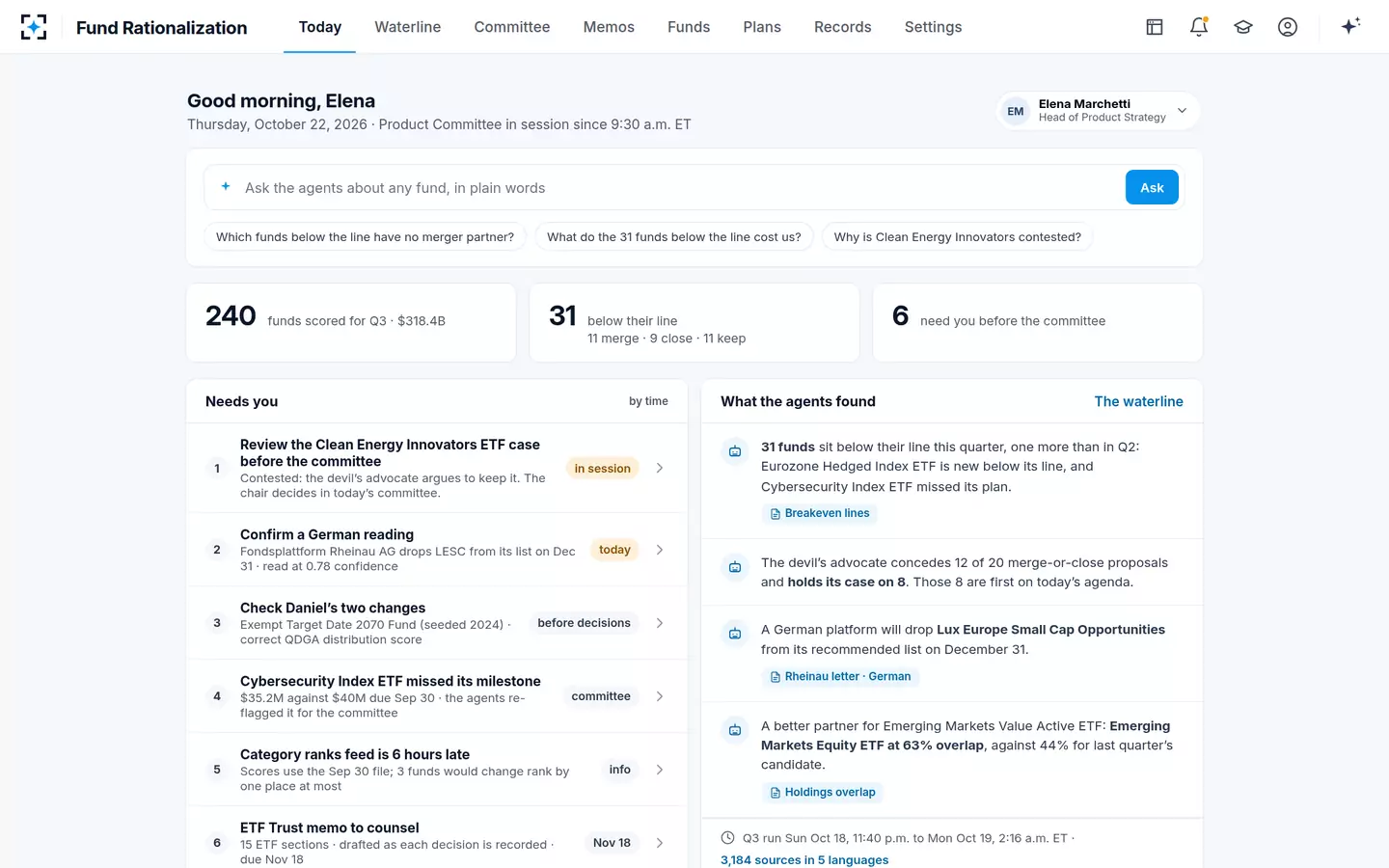
Keeping a fund "with a plan" is a real option when the plan has a date. In the sample review, 11 of the 31 funds below their lines were proposed to keep with a plan, each with a milestone; one, a cybersecurity index ETF, missed its plan at $35.2 million against a $40 million milestone due on 30 September and was flagged back to the committee. Without the milestone, the stayers pay the bill indefinitely.
The review's morning: a missed milestone and a contested case on the agenda
What the adviser saves, and why that is not the decision
A subscale fund costs the adviser money too, and the sum across a line-up is large. In the sample review, the solution estimates that the 31 funds below their lines cost the adviser $14.2 million a year in expense-cap reimbursements and unitary-fee shortfalls; the 20 merge and close proposals would end about $9.6 million of it, and the 11 funds kept with a plan carry $4.6 million. These are estimates from twelve months of the sample firm's fund accounting.
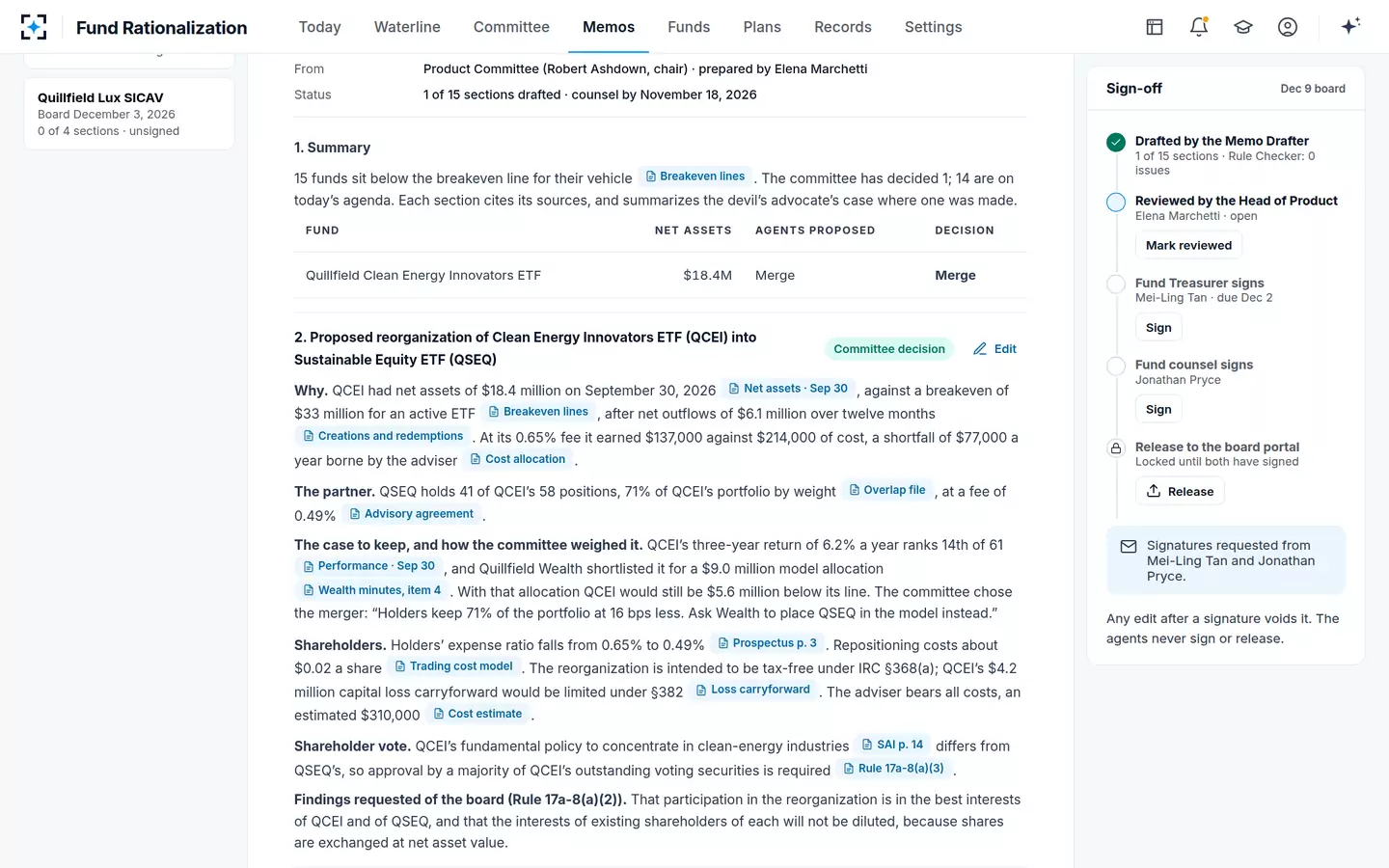
That number explains why sponsors review their line-ups, but it should not decide the case for any one fund. The board's finding for a merger is about the merging fund's holders, and the template should lead with what they lose or gain. In the sample memo, the shareholders' paragraph comes before the adviser's costs: holders' expense ratio falls from 0.65% to 0.49%, repositioning costs about $0.02 a share, and the adviser bears all reorganization costs.
The board memo Fund Rationalization drafts leads with the holders: fee, cost per share, tax and vote
To see the stayers' bill priced on your own funds, start from Fund Rationalization. How a fund that does close is wound down is set out in a fund liquidation plan; why young thematic funds fill the closure list is in mutual fund incubation.
Questions people ask
How many ETFs closed in 2025?
No regulator publishes an ETF-only closure count. Across all registered funds, our count of the SEC's EDGAR indexes shows 78 applications to deregister on Form N-8F in 2025, each after a merger or a liquidation, and 163 merger registration statements on Form N-14.
What is ETF liquidation risk for an investor?
It is the risk that the fund closes and pays you cash on its own timetable, realising a gain or loss for tax in that year, plus the costs of holding a small fund before that happens, mainly wider spreads. In the sample fund the spread is 0.31% against 0.04% for its larger merger partner.
Are small ETFs riskier to hold?
They are more likely to close and costlier to trade, but not necessarily riskier in what they hold. The cost shows up in spreads and, if the adviser stops subsidising the fund, in fees; a working paper on ETFs closed in 2012–2019 found larger funds were less likely to close.
What happens to shareholders when a fund merges?
They receive shares of the surviving fund at net asset value, usually in a tax-free reorganization that keeps their cost basis, and then pay the survivor's fees. Research on US fund mergers found target funds' holders saw better performance and lower expense ratios afterwards.
Should I sell an ETF that might close?
That depends on your own costs and taxes, and this guide is not investment advice. A working paper on closed ETFs found holders were generally better off waiting for the liquidating payment at net asset value than selling after the announcement, in normal circumstances.
Why do sponsors keep subscale ETFs open?
Because closing has costs and a fund may still grow: an allocation from a model portfolio, a theme coming back, or a short record that has not had time to prove itself. A keep decision with a dated milestone, re-checked each quarter, limits how long holders pay for the wait.