A cross-border UCITS merger is, in the Directive's words, a merger of UCITS "at least two of which are established in different Member States", or of funds in one member state "into a newly constituted UCITS established in another Member State" (Article 2(1)(q)). It needs prior authorisation from the merging fund's home regulator, which must answer within 20 working days of receiving a complete file; holders of both funds must then be told at least 30 days before the last date on which they can redeem or switch free of charge; and that free exit ends five working days before the date the exchange ratio is calculated. The clocks are short, but the work before the file goes in is not: common draft terms, two depositaries' statements, an auditor's or depositary's validation and a notice that must work in every language the fund is sold in. Botminds' Fund Rationalization scores Luxembourg UCITS sub-funds against their own euro breakeven line alongside US funds, checks the merger steps of Articles 39 to 46 of the UCITS Directive, and drafts the unit-holder notice in English, German, French and Italian for the Conducting Officer who decides.
Article numbers here refer to Directive 2009/65/EC as adopted, read on legislation.gov.uk's copy; the merger chapter, Articles 37 to 48, sets the steps, and national law sets the details. Fund examples are fictional sample data from the solution.
Europe's largest fund centre keeps fewer funds, holding more money
13,268
Luxembourg fund units (funds plus sub-funds) in June 2026, down from 14,322 in December 2022
€6,731bn
net assets of Luxembourg funds in June 2026, up from €5,028.5bn in December 2022
20working days
for the merging fund's home regulator to decide on a complete merger file
75%
the most a member state may require of the votes cast, where national law asks holders to approve a merger
What is a cross-border UCITS merger?
It is one of the merger types the UCITS Directive harmonised in 2009 so that a fund range spread across member states can be consolidated without liquidating. Article 38 requires member states to "allow for cross-border and domestic mergers" using the techniques the Directive defines: absorption into an existing fund, a merger into a newly constituted fund, or a transfer of net assets in which the merging fund "continues to exist until the liabilities have been discharged" (Article 48(3)). Article 37 makes the chapter apply to sub-funds, "investment compartments", which is how many consolidations are done: a sub-fund of a Luxembourg SICAV merging into a sub-fund of an Irish ICAV, or into another sub-fund of the same umbrella.
The pressure to do it is visible in the statistics. Luxembourg's regulator counts fund units, meaning standalone funds and umbrella sub-funds. Between December 2022 and June 2026 their number fell by about 7%, from 14,322 to 13,268, while net assets rose by about 34%, from €5,028.5 billion to €6,731.3 billion (CSSF, July 2026). Fewer, larger funds is what consolidation looks like from the outside.
Luxembourg fund units fell every half-year since 2022 while assets grew
How long does a UCITS merger take? The clocks, laid end to end
The regulatory part takes about a month once the file is complete; the unit-holder part takes at least another five to six weeks. The Directive fixes the regulator's clocks in working days and the holder notice in days. Article 39(5) gives the merging fund's home authority 10 working days to ask for more information if the file is incomplete and 20 working days from "submission of the complete information" to say "whether or not the merger has been authorised"; within that window the receiving fund's authority may require, "no later than 15 working days" after receiving the copies, that the receiving fund change the information for its own holders (Article 39(3)).
From a complete file to the exchange ratio: the Directive's minimum calendar
- Completeness check≤ 10 wd
- Decision windowby day 20
- Noticeday 0
- At least 30 days to the last free exit≥ 30 days
- Exit closed5 wd
- Ratioby law
The holder clock starts only after authorisation: the information "shall be provided to unit-holders ... only after the competent authorities of the merging UCITS home Member State have authorised the proposed merger", and "at least 30 days before the last date for requesting repurchase or redemption or, where applicable, conversion without additional charge" (Article 43(2)). The free exit itself starts when holders are informed and "shall cease to exist five working days before the date for calculating the exchange ratio" (Article 45(1)). These are two clocks, not one: a notice period of 30 days ends at the last free-exit date, and the free exit ends five working days before the exchange ratio.
What goes in the merger file: common draft terms, depositaries and an auditor
The file is fixed by Article 39(2): the "common draft terms of the proposed merger duly approved by the merging UCITS and the receiving UCITS", the receiving fund's prospectus and key investor information if it is in another state, a statement from each depositary, and the information both funds will send their holders. Regulators "shall not require that any additional information is included in the common draft terms" (Article 40(1)), which makes the list below the whole of what the terms must contain.
The common draft terms of merger, item by item, and who checks each
- The type of merger and the funds involved
Article 40(1)(a). Verified by both depositaries under Article 41.
- The background to and rationale for the merger
Article 40(1)(b). The regulators read it against the holder notice.
- The expected impact on holders of both funds
Article 40(1)(c). The same impact must be described to holders under Article 43(3)(b).
- The valuation criteria on the exchange-ratio date
Article 40(1)(d). Validated by a depositary or an independent auditor under Article 42.
- The method for calculating the exchange ratio
Article 40(1)(e). Validated, with the actual ratio, under Article 42(1)(c).
- The planned effective date
Article 40(1)(f). Verified by both depositaries.
- The rules for transferring assets and exchanging units
Article 40(1)(g). Verified by both depositaries.
- The new fund's rules, if the receiving fund is newly constituted
Article 40(1)(h).
Two articles protect holders' money directly. Article 46 provides that, except where a fund has no management company, "any legal, advisory or administrative costs associated with the preparation and the completion of the merger shall not be charged to the merging or the receiving UCITS, or to any of their unit-holders" (Article 46). And the free exit is free "without any charge other than those retained by the UCITS to meet disinvestment costs". The merger's paperwork is the manager's bill.
What must the unit-holder notice say, and in which languages?
The notice must let holders make "an informed judgement of the impact of the proposal on their investment" (Article 43(1)). Article 43(3) lists its contents: the background and rationale; the possible impact, "including but not limited to any material differences in respect of investment policy and strategy, costs, expected outcome, periodic reporting, possible dilution in performance", and where relevant a prominent tax warning; holders' rights, including the free exit and "the last date for exercising that right"; the procedure and planned effective date; and a copy of the receiving fund's key investor information, since 2023 the PRIIPs key information document for most UCITS sold to retail investors.
Language is where cross-border mergers get slow. For a fund marketed in other states, the notice must be in the host state's official language or one its regulator approves, the fund "shall be responsible for producing the translation", and "That translation shall faithfully reflect the content of the original" (Article 43(4)). A sub-fund sold in Germany, France and Italy needs three faithful translations, each consistent with the others, inside a 30-day window that cannot start until authorisation. The sample firm's Memo Drafter drafts the notice in English, German, French and Italian once the Conducting Officer has decided, and translation review stays with people.
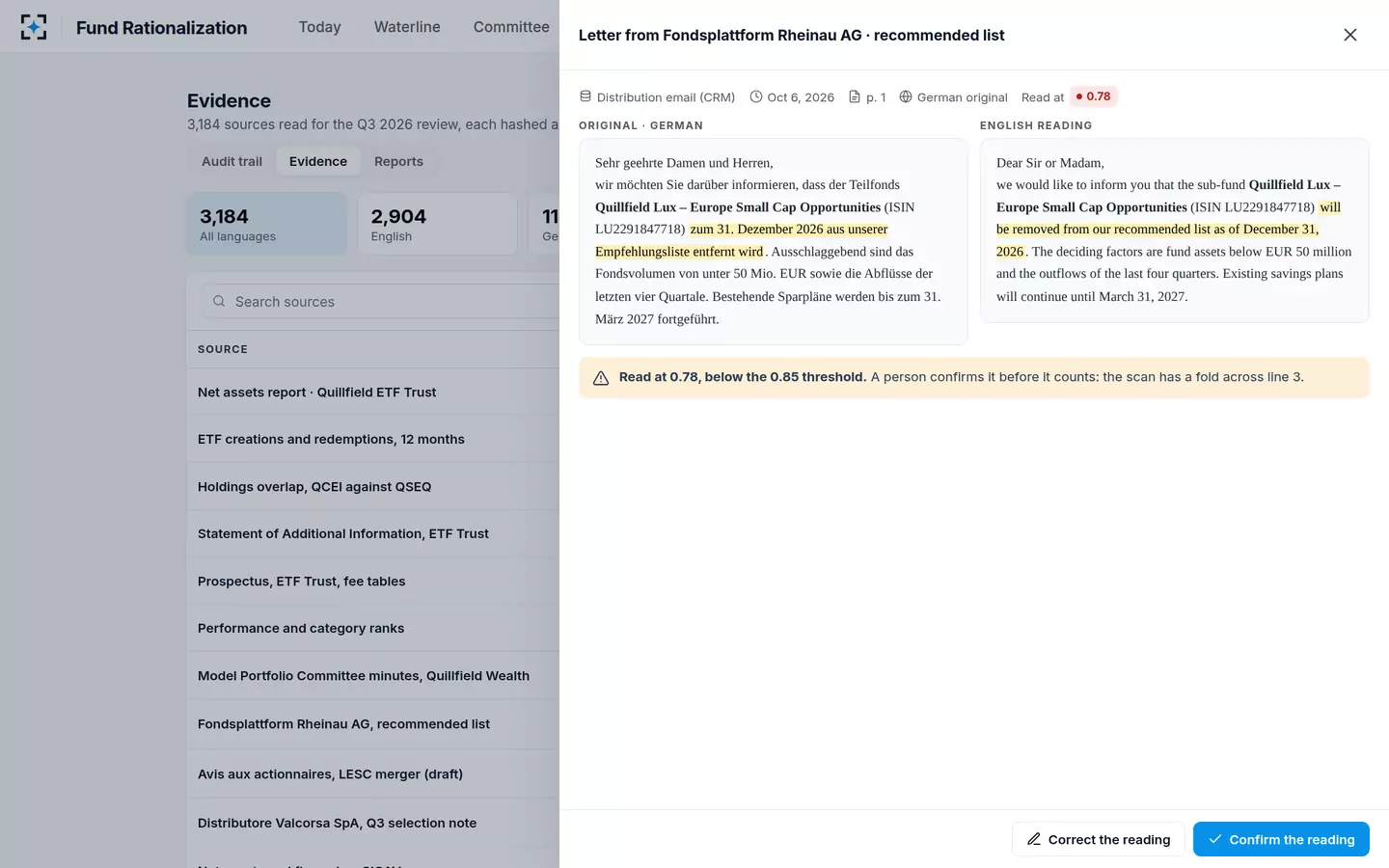
A distributor's German letter, read beside its English reading and held for a person
Do UCITS holders vote on a merger?
Only if national law or the fund's documents require it, and the Directive caps the majority. Article 44 says that where national law requires holder approval, it may not require "more than 75 % of the votes actually cast by unit-holders present or represented at the general meeting", and that member states may not impose stricter presence quorums for cross-border than for domestic mergers (Article 44). Compare the US: under Rule 17a-8 the merging fund's holders vote only if one of four conditions fails, and the majority is the Investment Company Act's defined majority (Rule 17a-8(a)(3)).
Luxembourg shows how the Directive is applied. Its 2010 fund law leaves it to the fund's documents to say who decides the effective date; where they provide for a holder vote on the common draft terms, "such an approval shall be adopted by simple majority, without however requiring more than 75% of the votes cast"; and where they are silent, a common fund's merger is approved by the management company and a SICAV's by a meeting "deciding by simple majority of the votes cast" (Law of 17 December 2010, Article 66(4), CSSF consolidated text). For a merging investment company that ceases to exist, the effective date "shall be recorded by notarial deed". Article 67 then makes any merger of a Luxembourg merging UCITS "subject to prior authorisation by the CSSF".
Luxembourg, Ireland and the UK: what each regulator adds
The Directive's steps are the same everywhere in the EU; the forms, portals and timing conventions are national. The table sets the three regimes a European product team meets most often next to the US rule.
Fund mergers in four regimes: who approves, who votes, and the clock
| Step | Luxembourg (UCITS) | Ireland (UCITS) | United Kingdom (authorised funds) | United States (Rule 17a-8) |
|---|---|---|---|---|
| Who approves | Prior authorisation by the CSSF (2010 Law, Art. 67) | The Central Bank must authorise before any circular to holders (UCITS Regulations, Reg. 61(2)(a)) | Written notice to and approval by the FCA (COLL 7.6.1G) | No SEC approval if the rule's conditions are met; the board makes findings |
| Holder vote | Per the fund's documents; simple majority, never above 75% of votes cast | Per national law and the fund's documents, within the Directive's 75% ceiling | Extraordinary resolution: at least three-quarters of votes validly cast (COLL 7.6.2R) | Only if one of four conditions fails; the 1940 Act majority |
| Clock | Directive clocks: 20 working days on a complete file | Clean documents by noon the business day before authorisation; receiving authority up to 15 business days | Set by the FCA's approval and the meeting notice | N-14 effective on the 30th day after filing under Rule 488 |
| How filed | CSSF procedures for UCIs | UCITS Merger Application Form, through the Portal only since 1 October 2024 | FCA application for a scheme of arrangement | Form N-14 on EDGAR |
Ireland's page is specific about the last day. Once the application is "cleared of comment", the applicant submits "all clean, executed merger documents to the Central Bank in advance of 12pm on the business day before the date of the circular", and a signed authorisation letter follows "before close of business on the merger authorisation date"; for a cross-border merger out of Ireland, the receiving fund's authority "then has up to 15 business days to provide any comments", and the Central Bank asks firms to factor that into their timelines (Central Bank of Ireland). Since 1 October 2024 merger applications "must be received via the Portal, and will no longer be accepted by email" (Markets Update, Issue 8 2024).
The UK left the Directive's merger regime behind with Brexit. An authorised fund's merger is now a scheme of arrangement needing FCA approval under section 251 of the Financial Services and Markets Act or the OEIC Regulations, and the transfer "must not be implemented without the sanction of an extraordinary resolution of the unitholders" (COLL 7.6.2R(3)), defined as a resolution passed by "not less than three-quarters of the votes validly cast". COLL 7.7, the UK's copy of the UCITS merger rules, now reaches only a domestic UCITS merger in which one fund was notified for marketing in the EU before the end of the transition period (COLL 7.7.2G).
Where cross-border mergers go wrong
Most delays come from three places: the notice, the receiving authority and the exchange-ratio date. The notice cannot go out before authorisation, so a translation not ready on the authorisation date delays the whole calendar. The receiving fund's regulator has 15 working days to object to the information for its own holders, and an objection reopens the file. And the exchange-ratio date is set by the receiving fund's home law, so the free exit's last day must be worked backwards from a date the merging fund's team does not control.
Rationalization reviews add a fourth risk: the decision is made before anyone has checked whether the partner is even possible. In the sample review, the Partner Finder ranked a Luxembourg UCITS sub-fund third by overlap for a US ETF, at 58%, and marked it "Not possible": a US ETF cannot merge into a Luxembourg UCITS sub-fund. The same check works the other way for a Luxembourg sub-fund whose best overlap sits in a US fund.
How Fund Rationalization runs a UCITS merger case
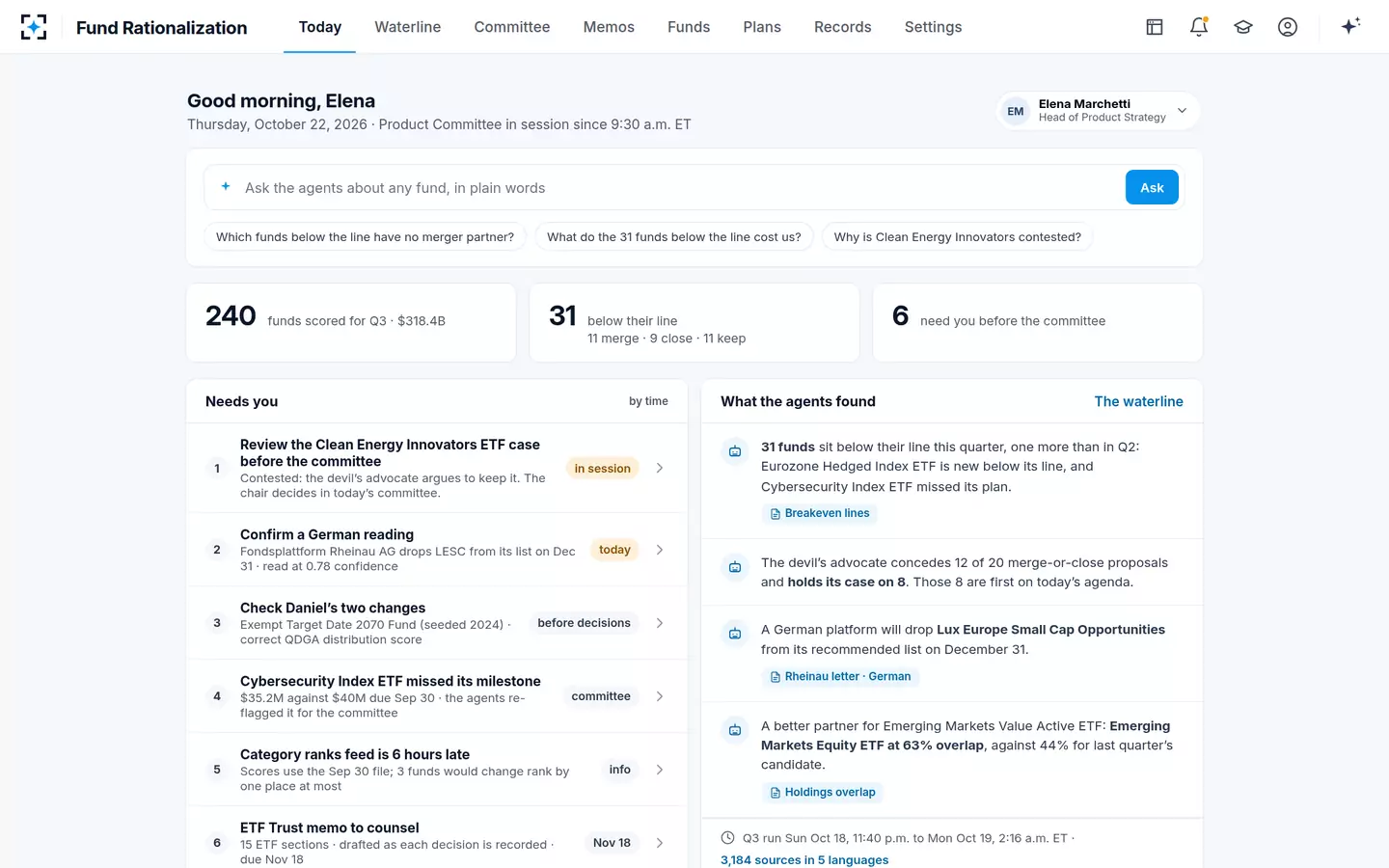
For the sample firm's Luxembourg SICAV, sub-funds are scored against their own line, €75 million, set by the firm as its own policy; the Rule Checker checks the Directive's steps, from the regulator's authorisation and the common draft terms to the depositary and auditor checks, the notice and the free exit; and the Conducting Officer decides for the SICAV, with a reason code, in place of the US committee chair. The evidence that matters often arrives from distributors: in the sample, a German platform will drop one sub-fund from its recommended list on 31 December 2026, a letter the agents read at 0.78 confidence and held for a person to confirm.
The day's review in Fund Rationalization, with a Luxembourg sub-fund's distribution problem among the findings
The agents draft; people decide and sign. Counsel and the Luxembourg team own the file to the CSSF and the translations. For the parallel US question on the same review, see when a fund merger needs a shareholder vote; for how a review decides which funds to put forward at all, see the product rationalization template, or start from Fund Rationalization.
Questions people ask
How long does a UCITS merger take?
The regulator must decide within 20 working days of a complete file, and holders must then get at least 30 days' notice before their last free-exit date, which closes five working days before the exchange ratio. Adding up the Directive's own minimums gives roughly nine to ten weeks from a complete file to the exchange-ratio date; our planning assumption, with file preparation, translations and the receiving authority's review, is two to four months from board decision to effective date.
Do UCITS unit-holders have to approve a merger?
Only where national law or the fund's documents require it. Where they do, the Directive caps the required majority at 75% of the votes actually cast; Luxembourg's law sets a simple majority unless the documents say otherwise, within that ceiling.
Who pays the costs of a UCITS merger?
The management company, in nearly all cases. Article 46 bars charging legal, advisory or administrative costs of preparing and completing the merger to either fund or its holders, unless the fund has no management company; holders who exit free pay only the fund's disinvestment costs.
What is the CSSF merger procedure for a Luxembourg UCITS?
A merger in which the merging UCITS is established in Luxembourg needs prior CSSF authorisation under Article 67 of the 2010 Law, on a file of common draft terms, depositary statements and the holder information. For a merging SICAV that ceases to exist, the effective date is recorded by notarial deed.
How does the Central Bank of Ireland approve a UCITS merger?
The fund submits the UCITS Merger Application Form and supporting documents through the Central Bank's Portal, the only route since 1 October 2024. When the documents are cleared, clean executed copies are due by noon on the business day before the circular, and the signed authorisation letter is issued by close of business on the authorisation date.
Can a UCITS merge with a US mutual fund?
No: the Directive's merger chapter applies between UCITS, and a US registered fund is not one. Consolidating across the Atlantic means closing one fund and offering holders another, which is a taxable sale for them in most cases.