Fund liquidation services are the outside work a sponsor buys to close a fund: counsel drafts the plan of liquidation and the notices, the administrator strikes the final net asset value and pays the distribution, the transfer agent or the exchange handles the last trades and the holder records, the tax adviser covers the final distributions and the auditor the last financial statements, and the fund files Form N-8F to deregister. Whoever runs each piece, the plan is the same sequence of decisions, notices, trades, tax steps and filings, with an owner and a date at each step, and the product committee should own it rather than any one provider. Botminds' Fund Rationalization reviews a fund line-up each quarter for merge, close or keep; when the committee chair decides to close a fund, its agents draft the prospectus supplement and track the exchange notice, the last day of trading and the liquidating distribution, each with an owner and a date, and no agent files anything.
The plan below uses the solution's fictional sample: four ETF closures decided in the third-quarter 2026 review, with a board meeting on 9 December 2026 and a last trading day of 22 January 2027. It is a planning outline, not legal or tax advice.
A closing has few hard deadlines, and each one is a rule
7days
the longest a fund may normally delay paying a redemption without an SEC order or an emergency
1business day
to report to the board if illiquid investments pass 15% of net assets as the fund sells down
24months
from adopting a plan of liquidation within which liquidating distributions count toward the fund's dividends-paid deduction
78
Form N-8F deregistration applications filed with the SEC in 2025, after mergers and liquidations
What do fund liquidation services cover?
They cover the execution, not the decision. A liquidation touches the fund's legal documents, its holders, its portfolio, its tax position and its registration, and most sponsors already have a provider for each: fund counsel, the administrator, the custodian, the transfer agent for a mutual fund or the listing exchange and market makers for an ETF, the auditor and the tax adviser. Series-trust platforms and some administrators sell a bundled closing service across all of these. Vendors do not publish prices for liquidation services, and no regulator or independent study publishes the cost of a typical closing; the deregistration form itself asks the fund to list "Legal expenses", "Accounting expenses" and other expenses, and to say "Who paid those expenses?" (SEC Form N-8F, item 22).
What a liquidation service cannot decide for the committee
What a service cannot supply is the judgement around the mechanics: whether to close rather than merge, how long to give holders, which assets to sell first, and what to tell a distributor. Those choices sit with the committee, the board and the officers, and they are where closings go wrong. The SEC's investor bulletin notes that the requirements for liquidating "generally depend on state corporate or trust law, on the fund's charter documents, or both", that most funds need a board vote, and that "In some cases, a vote by the fund's shareholders will also be necessary" (SEC Office of Investor Education and Advocacy, 17 December 2021).
The closing plan, week by week, with a checkpoint at each step
A fund liquidation plan has about a dozen checkpoints between the committee's decision and the deregistration. The checklist sets them in order; each one names what must be true before the next step starts.
A fund liquidation plan in twelve checkpoints, from decision to deregistration
- Week 0 · The committee decides, with a reason
Close rather than merge or keep, with the per-share cost and tax of each option on the case, and the chair's reason code.
- Week 0 · Counsel confirms who must approve
Board vote, and a shareholder vote if state law or the charter requires one.
- Week 1 · The board adopts the plan of liquidation
A formal plan starts the 24-month window in which liquidating distributions count toward the fund's dividends-paid deduction.
- Week 1 · Holders and distributors are told
A prospectus supplement and, for an ETF, a press release, with the dates purchases stop, trading or redemptions stop, and the liquidation date.
- Week 1 · New money stops
Purchases and regular investment plans are closed; platforms and model-portfolio providers are notified directly.
- Weeks 1–6 · The sell-down is planned
Order of sales set so illiquid holdings do not rise above 15% of net assets as the easy positions go first.
- Weeks 2–6 · Tax is settled
Final income and gains distributions, and the treatment of the liquidating payment as a sale by each holder.
- Week 6 · Trading or redemptions end
The last trading day for an ETF; for a mutual fund, redemptions at net asset value until the suspension date.
- Week 6–7 · The portfolio is sold and the final NAV struck
Trading cost recorded against the estimate; any asset that cannot be sold is valued and held for later distribution.
- Week 7 · Holders are paid pro rata
On the liquidation day an ETF may redeem single shares from any holder, not only authorised participants.
- After · Remaining holders and expenses
Unpaid or unreachable holders, final expenses and who bore them, outstanding liabilities.
- After · Form N-8F and the files
Deregistration application, and the board papers and plan kept with the fund's records.
Two of the checkpoints are tax, and both are easy to miss. Section 562 provides that, for a complete liquidation "occurring within 24 months after the adoption of a plan of liquidation, any distribution within such period pursuant to such plan shall, to the extent of the earnings and profits ... be treated as a dividend for purposes of computing the dividends paid deduction" (26 U.S.C. 562(b)(1)(B)), which is why counsel wants a formal plan adopted on a known date. For holders, the tax code treats the payment as the price of their shares (26 U.S.C. 331(a)): a sale, realising a gain or loss.
How long does a fund liquidation take?
In the sample plan about seven weeks pass from the board's vote to the cash payment, for a fund holding liquid securities, and the deregistration follows. Most of that time is notice; the money moves in days. The timeline below lays out the sample plan's lanes.
The sample ETF closing plan: who is busy in which week
- Decidewk 0
- Adopt planwk 1
- Quiet
- Supplement and noticewk 0–1
- Notice periodwk 2–5
- N-8Fafter
- Plan saleswk 1
- Fund trades as normalwk 2–5
- Sell, strike NAV, paywk 6–7
- Final expensesafter
The rules leave room for the plan, but not much for delay once redemptions are due. A fund may not delay paying a redemption "for more than seven days after the tender" except in the cases section 22(e) lists, which include periods the SEC permits by order (15 U.S.C. 80a-22(e)). As the fund sells, the liquidity rule watches the remainder: if illiquid investments exceed 15% of net assets, the fund must tell the board within one business day, with a plan to get back under the limit, and if the excess lasts 30 days the board, including a majority of independent directors, must reassess that plan, and keep reassessing it every 30 days (Rule 22e-4(b)(1)(iv)). The mutual fund liquidity rule is explained in full elsewhere.
Who owns each step of a fund closure?
Every step has one owner, and most owners are people already in the firm. The figure below sets out the seats in the sample firm's closing, what each did when closings were run by hand, and what each does with the solution.
The seats in a fund closing, before and with Fund Rationalization
Today
Decided on a one-sided deck, then handed the closing to operations.
With agents
Decides with a reason code, with close, merge and keep priced per share; the plan opens with his decision.
Still theirs: The decision, and any override of the agents
Today
Approved a plan prepared after the decision, with figures that were hard to trace.
With agents
Receives a memo section in which each figure links to its source.
Still theirs: Approval of the plan of liquidation
Today
Priced the trading cost and tax late, and reconciled final expenses at the end.
With agents
Sees the sell-down cost and the tax status before the committee, and signs the memo.
Still theirs: Final NAV, expenses and a signature
Today
Drafted the supplement and notices from scratch for each closing.
With agents
Starts from a drafted supplement and plan with every date filled, and files through the filing agent.
Still theirs: The legal judgement, the filings and a signature
Today
Chased each provider by email for dates.
With agents
Sees every checkpoint with its owner and due date, and is told when one slips.
Still theirs: Distributor and platform conversations
Today
Received instructions late and in pieces.
With agents
Work to one plan whose dated milestones the agents track for everyone.
Still theirs: The distribution and holder records
Liquidation services, agents or in-house: what each does
The choice is not either-or. Outside services do the regulated execution; agents can prepare, track and check the work around it; people decide and sign. The table compares the three for each part of a closing.
Who does each part of a fund closing: a service provider, the agents or your own team
| Part of the closing | Liquidation service or provider | Fund Rationalization agents | Stays with your people |
|---|---|---|---|
| Deciding to close | Not offered | Score the fund, price close, merge and keep per share, argue the case to keep | The committee chair's decision and reason |
| Plan of liquidation and notices | Counsel drafts and files | Draft the prospectus supplement and the plan's dates from the decision | Counsel's review, signature and filing |
| Holder and distributor communication | Transfer agent or press release service | Read distributor and platform letters in German, French, Italian and Japanese and show them on the case | Conversations with distributors |
| Sell-down and final NAV | Portfolio team, custodian and administrator | Track the plan's milestones and dates and flag one that slips | Trading decisions and the final NAV |
| Tax | Tax adviser and auditor | Show the tax status and per-share effect for the committee | The opinion and the final returns |
| Deregistration and files | Counsel prepares Form N-8F | Assemble the decision, plan and memo in one evidence file | The filing and its accuracy |
That division is also the answer to where the solution fits. A sponsor that closes one fund every few years may need nothing beyond good counsel and an administrator who has done it before. A sponsor that reviews hundreds of funds each quarter and closes several a year, across trusts and countries, gains most from having the decision, the plan and the evidence in one place, so that each closing starts from the reasons it was chosen.
Seconds after the decision: the agents draft, then send for two signatures
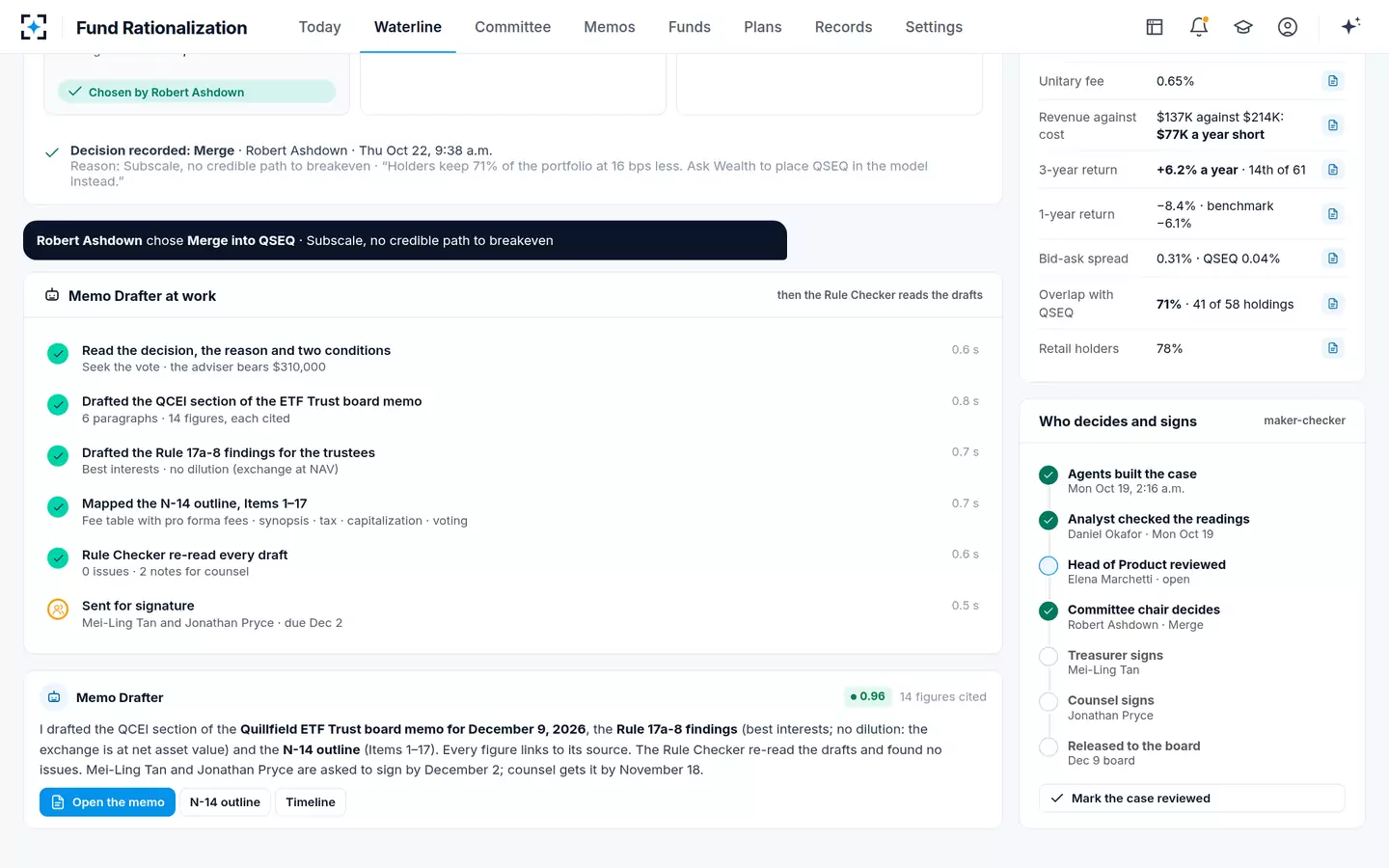
What to ask a fund liquidation service provider
Ask about the plan, not only the price. A provider who has closed many funds will have a standard timetable; the questions below test whether it fits your fund and your holders.
Seven questions for a fund liquidation service, before you sign
- What is your timetable from board vote to payment, for a fund like ours?
And what changes it: less liquid holdings, a shareholder vote, holders on many platforms.
- How do you sequence the sell-down?
Ask how the plan keeps illiquid holdings under 15% of net assets and what is reported to the board if it does not.
- Who bears which costs?
Legal, accounting, printing, trading and any unamortised expenses, each item as Form N-8F will ask for it.
- How are holders you cannot reach handled?
Form N-8F asks whether any shareholders "have not yet received distributions" and what the plan is for them.
- What do you need from us, and when?
The decision date, the plan, holder lists, distributor contacts, tax lots.
- How are tax distributions coordinated?
Final income and gains distributions, and the dividends-paid deduction for liquidating distributions within 24 months of the plan.
- What do we receive at the end?
A file with the plan, notices, final NAV, distribution records and the N-8F, kept with the fund's records.
For a fund outside the US, the regulator's process replaces the N-8F. In Ireland, the Central Bank asks that from 1 June 2026 a UCITS "proposing to revoke its authorisation or the revocation of 1 or more of its sub-funds" complete its revocation form and submit it on the Portal (Central Bank of Ireland, Post Authorisation for UCITS). The checkpoints are the same; the forms differ. Mergers, which avoid most of this work for holders, run on the clocks set out in cross-border UCITS merger.
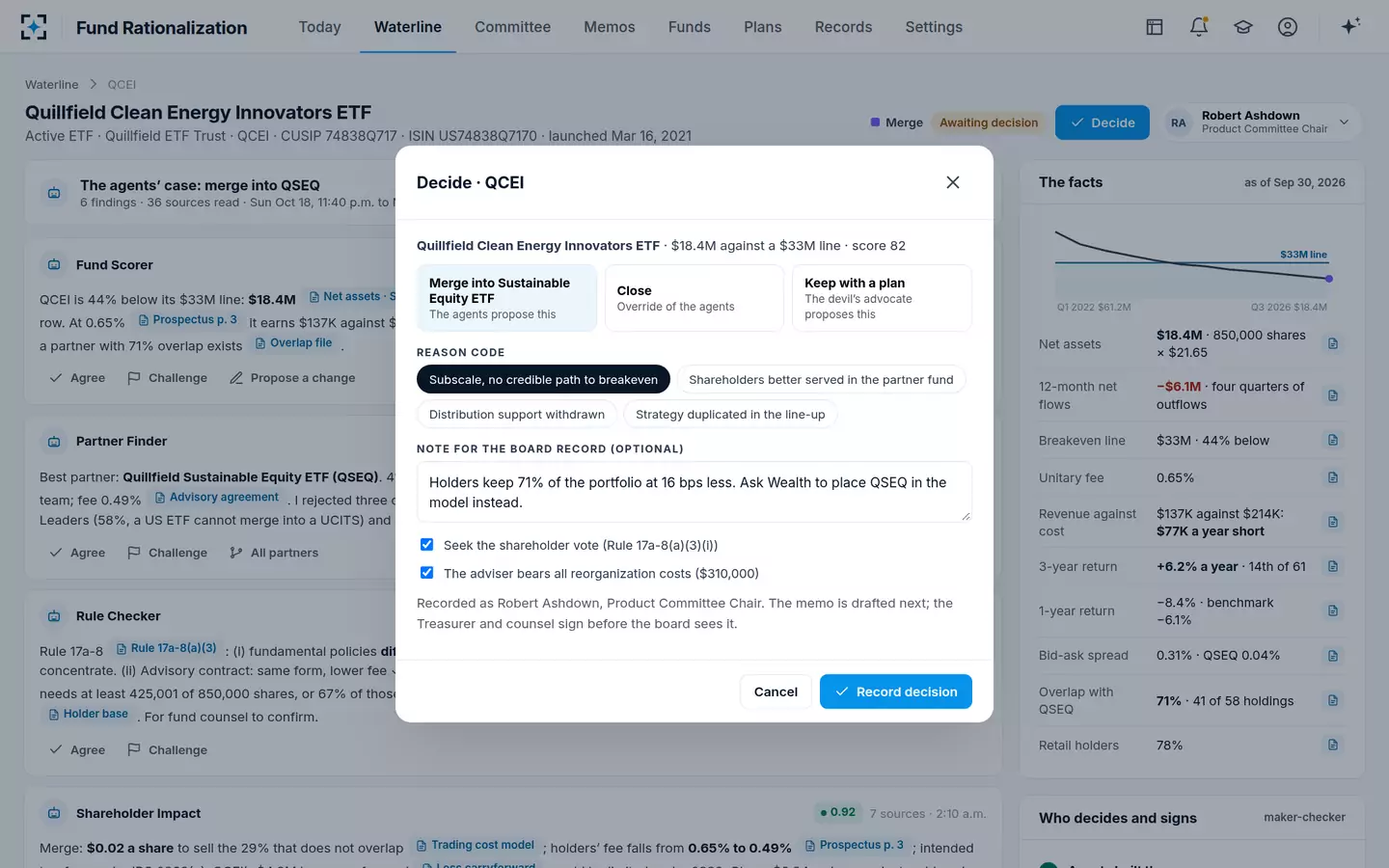
Where the closing plan starts in Fund Rationalization: the decision to close
A closing plan is only as good as the reasons it was chosen over a merger. In the sample review, the funds proposed for closure were the smallest relative to their lines, and for each the devil's advocate conceded that it could not build a case to keep; a merger partner either did not exist or failed the firm's 50% overlap rule. That reasoning is what a board, an auditor or an examiner will ask for first. How the committee reaches it is in the product rationalization template.
The chair's decision is where the plan begins
To see a closing planned from the decision onward on your own funds, start from Fund Rationalization.
Questions people ask
What is Form N-8F?
Form N-8F is the SEC application a registered fund files to deregister after a merger, a liquidation, an abandonment of registration or becoming a business development company (Rule 8f-1). It asks about the board and shareholder approvals, the distributions, any remaining assets, holders and liabilities, and the expenses and who paid them; the SEC estimates 5.2 hours to complete it.
What are the requirements for liquidating a mutual fund?
They depend on state law and the fund's charter, but most funds need a board vote and some a shareholder vote; the fund then notifies holders, typically by a prospectus supplement, sells its assets, pays holders pro rata and deregisters on Form N-8F. Redemptions must be paid within seven days unless section 22(e) allows otherwise.
What is the ETF liquidation process?
The sponsor announces the closing, usually by press release and a prospectus supplement; the fund trades until a last trading day; then it sells its holdings and pays remaining holders cash. Rule 6c-11 lets an ETF redeem individual shares from any holder on the day of the liquidation.
Who pays the costs of a fund liquidation?
It varies: the adviser may agree to bear legal and administrative costs, while trading costs fall inside the fund unless someone else pays them. Form N-8F requires the fund to list legal, accounting and other expenses and to say how they were allocated and who paid them; in the sample plan the adviser bears $95,000 to close.
How much do fund liquidation services cost?
Vendors do not publish prices for liquidation services, and no regulator or independent study publishes a typical cost. Ask for a quote broken down the way Form N-8F reports expenses: legal, accounting and other, and who pays each.
Do agents file the liquidation documents?
Not in Fund Rationalization. The agents draft the board memo section and the prospectus supplement after a recorded decision and track each date in the plan; counsel reviews, signs and files through the filing agent, and no agent files, signs or releases anything.