A 15(c) advisory contract renewal is the yearly cycle in which a registered fund's independent directors ask for, read and vote on the information behind each advisory and sub-advisory contract. Under Section 15 of the Investment Company Act, a contract can run beyond its first two years only if it is approved again at least annually, and the renewal must carry the votes of a majority of the directors who are not parties to the contract or interested persons of one, cast in person at a meeting called for that vote (15 U.S.C. 80a-15(a) and (c)). The work is hard because the directors' counsel asks hundreds of questions, every answer must be fund by fund, and the honest answer to many of them is "the same as last year", except where it is not. Botminds' 15(c) Board Reporting gives that work to agents that draft each answer from its source and check it against last year's response, so the treasurer, administrators and counsel who carry the season spend it on the figures that moved.
The examples below come from a fictional fund complex, Quillfield Funds, with 62 funds and 71 advisory and sub-advisory agreements, as it runs through the solution. Each rule cited links to the statute, SEC rule or order it comes from.
The seats a 15(c) renewal season fills, and what each keeps
Today
Reads financial answers re-keyed into last year's file; nobody has compared them with last year's figures.
With agents
Opens each answer with its sources and any flag against last year, and approves it with a reason.
Still theirs: Approves every answer and signs each section
Today
Splits counsel's letter by hand, assigns each request by email and chases owners to the deadline.
With agents
Approves a routing plan the agents propose, then works the questions that need a person.
Still theirs: Owns the plan and counsel's clock
Today
Retypes numbers from the cost model and fee accruals into last year's sentences, fund after fund.
With agents
Starts from a drafted, cited answer, edits it, and hands it on; cannot approve own work.
Still theirs: Prepares and corrects
Today
Waits for a book assembled by hand, then posts it to the board portal.
With agents
Releases only signed sections, with the board's prior requests linked to the answers that honor them.
Still theirs: Releases the book
Today
Gets follow-up answers by email, bolted into the book as loose supplements.
With agents
Sees each follow-up answered on its question's thread, with sources.
Still theirs: Writes the letter and the follow-ups
What is the 15(c) advisory contract renewal?
It is the board's annual decision to continue each advisory contract, and the information exchange the law attaches to that decision. Two provisions set it up. Section 15(a) says a contract may continue for more than two years from its execution only so long as the continuance is specifically approved at least annually, by the board or by a majority of the fund's outstanding voting securities. Section 15(c) adds that no fund with a board may enter into, renew or perform an advisory contract unless its terms and any renewal are approved by a majority of the non-interested directors, voting in person at a meeting called for the purpose (15 U.S.C. 80a-15).
The same subsection carries the obligation that turns a vote into a season. It makes it the directors' duty to ask for, and weigh, the information reasonably needed to evaluate the contract's terms, and the adviser's duty to provide it. That two-way duty is why each renewal starts with a letter from the independent directors' counsel and ends with a board book of answers. What a 15(c) questionnaire asks, item by item, is covered separately; this guide is about the calendar and the people.
One detail of the statute catches newcomers. The annual vote covers sub-advisory contracts too, because a sub-adviser "regularly" serves as an investment adviser of the fund. In the sample complex, 62 advisory and 9 sub-advisory agreements are up at once, and each needs its own answers and its own vote.
When is the 15(c) renewal? A season with a fixed end
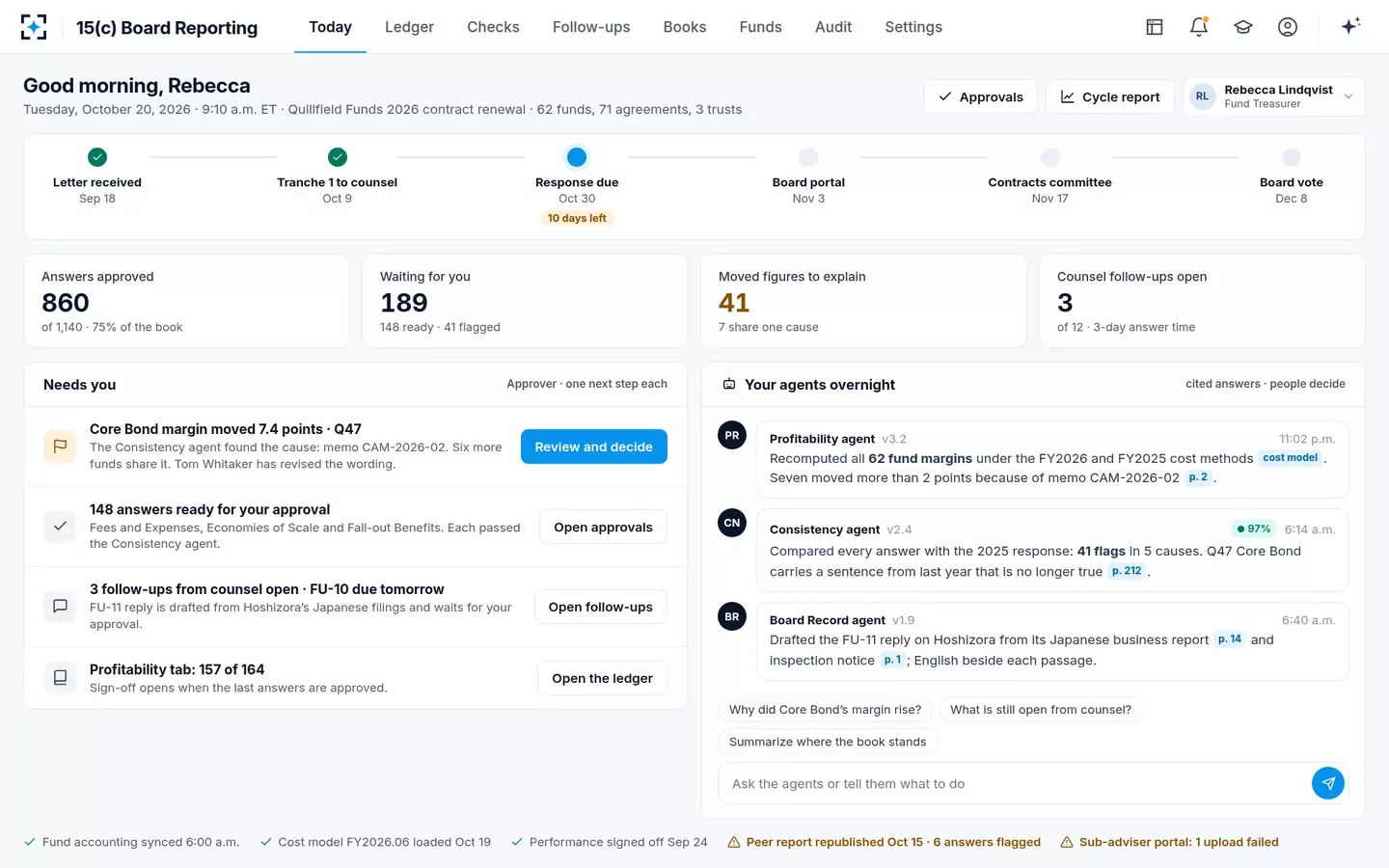
The renewal falls wherever the contracts' anniversary dates put the board meeting, and the season runs backwards from that meeting. Where a complex renews every contract at one meeting, as the sample complex does, the season is set by four dates: when counsel's letter arrives, when the adviser's answers are due, when the book reaches the directors, and the vote. Everything between those dates is either preparing answers or reading them.
One 15(c) renewal season, from counsel's letter to the in-person vote
- Letter to first tranche21 days
- Rest of the response21 days
- Book to portal; directors read18 days
- Committee to vote21 days
The squeeze sits in the middle. Six weeks of answering must leave the directors time to read before the contracts committee meets, and counsel's follow-up questions arrive in that same window. A complex that answers late does not miss the vote; it shortens the directors' reading time, which is the part of the season the law cares about most.
The calendar is not optional in its last step. If a contract lapses without renewal, Rule 15a-4 lets the adviser keep serving under an interim contract for no more than 150 days, at no more than the old compensation, provided the board, including a majority of the independent directors, approves it within 10 business days of the termination (17 CFR 270.15a-4(b)(1)). That is a remedy for an accident, not a schedule.
Who must vote on an advisory contract renewal?
A majority of the directors who are neither parties to the contract nor interested persons of a party must approve it, in person, at a meeting called for that purpose. Interested persons may sit on the board, but the statute caps them at 60 percent of its members (15 U.S.C. 80a-10(a)), and a fund that relies on one of the SEC's exemptive rules must go further.
Those rules carry the SEC's fund governance standards, in Rule 0-1(a)(7). A board meets them if a majority of its directors are disinterested, the disinterested directors select and nominate the others, their counsel is independent, the board evaluates itself and its committees at least once a year, the disinterested directors meet at least quarterly without interested directors present, and they may hire employees and advisers (17 CFR 270.0-1(a)(7)). For the renewal season the third and sixth items matter most: independent counsel writes the letter, and the directors can retain their own experts to read the answers.
Who does what in the vote, and where the rule comes from
| Who | Role in the renewal | Where it is written |
|---|---|---|
| Independent directors | Request and weigh the information; a majority of them must approve, in person | Section 15(c) |
| Whole board or shareholders | Approve the continuance at least annually after the first two years | Section 15(a)(2) |
| Adviser and sub-advisers | Furnish the information reasonably necessary to evaluate the contract | Section 15(c) |
| Independent counsel | Advises the disinterested directors; in practice drafts the request letter | Rule 0-1(a)(7)(iii) |
| Fund chief compliance officer | Reports to the board at least annually and meets the independent directors separately | Rule 38a-1(a)(4) |
Who carries the season: the five seats behind one vote
The vote is the directors', but the season is carried on the adviser's side by a small team that does this once a year and never at any other time. The fund treasurer, who in many complexes is also the principal financial officer, owns the financial answers: profitability, expenses, fee rates, waivers. The head of fund administration coordinates: splits the letter, assigns each request, and runs the clock. Analysts prepare the answers. The fund's chief legal officer owns the minutes and the book, and releases it to the directors. On the other side of the table, the independent directors' counsel writes the letter, reads every answer and sends the follow-ups.
The chief compliance officer sits slightly apart, because the compliance answers draw on a report the CCO writes anyway. Rule 38a-1 requires the CCO, at least once a year, to report to the board in writing on how the compliance policies of the fund and its service providers are working and on each material compliance matter since the previous report, and to meet the independent directors alone (17 CFR 270.38a-1(a)(4)(iii)–(iv)). In a well-run season the 15(c) answer on compliance quotes that report rather than restating it.
What makes the season hard for these five is not the volume alone. It is that the work is mostly copying, and the copying hides the few answers that changed. A treasurer who reads a thousand answers that match last year's file has no way to see the one where the file is wrong.
The season clock in 15(c) Board Reporting, nine days before the response is due
Where the weeks go: re-keying, not judging
Most of a renewal season is spent producing answers, not deciding them. The solution's own estimate for the sample complex puts the season at 45 business days of work by hand, and the largest blocks are pulling and re-keying figures from source systems and drafting narrative answers fund by fund, ten days each. Review by the treasurer and legal takes eight. Answering counsel's follow-ups takes another eight, because they come back by email and each has to be traced to the answer it questions.
Where a 15(c) renewal's working days go, by hand and with agents
By hand · 45 days
- Split and assign · 11.1%
- Re-key figures · 22.2%
- Draft answers · 22.2%
- Treasurer and legal review · 17.8%
- Assemble book · 8.9%
- Follow-ups · 17.8%
With agents · 14 days
- Split and assign · 7.1%
- Re-key figures · 14.3%
- Draft answers · 21.4%
- Treasurer and legal review · 28.6%
- Assemble book · 7.1%
- Follow-ups · 21.4%
Read the second bar for its shape, not its total. With the copying done by agents, review becomes the largest share of the season, which is where it belongs: the treasurer's time moves from checking that a number was retyped correctly to deciding whether a moved number is explained. The review days fall less than any other step, from eight to four, because a person still reads and approves every answer.
What changed since last year is the only new work
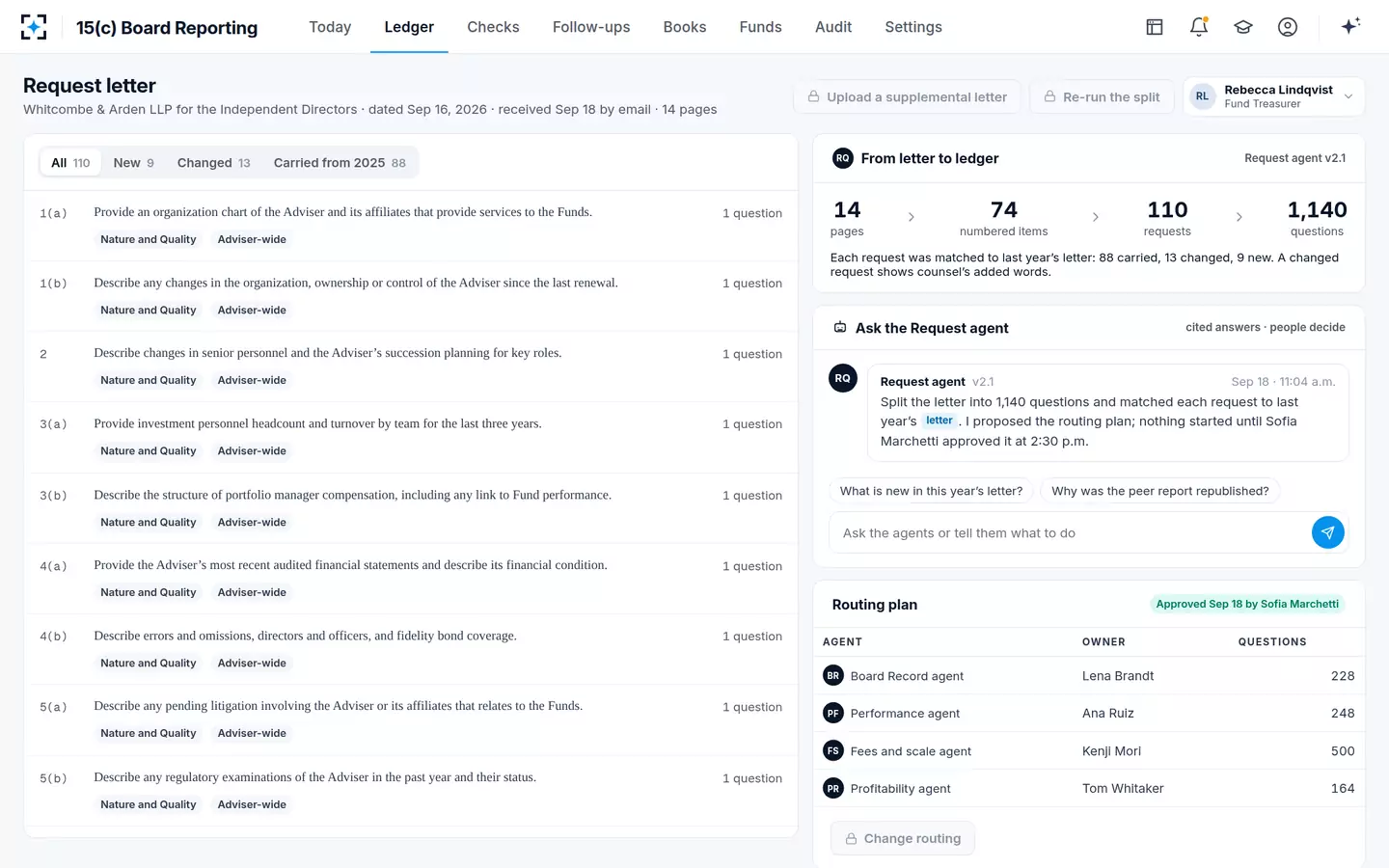
Most of counsel's letter repeats. In the sample season the letter's 74 numbered items expand into 110 requests, and against last year's letter 88 were carried over unchanged, 13 changed and 9 were new. The 13 changed requests matter more than their number suggests, because counsel changes a request when the board wants something different; one of this year's changes adds a single clause to the profitability item, asking the adviser to note any change in cost-allocation method from the prior year.
That clause is the season's real work in miniature. An answer copied from last year will say the method is unchanged; if the method changed, the sentence is now false and the margin it describes has moved for a reason the board has not been told. Why that kind of sentence matters if the fee is ever challenged in court is the subject of its own guide, and so is what the SEC charged when an adviser's cost allocation was adjusted and not disclosed.
Counsel's letter split into requests, each matched with last year's
How long are 15(c) materials kept?
Six years, the first two in an easily accessible place. Rule 31a-2(a)(6) requires a fund to preserve, for at least six years, the first two years in an easily accessible place, any documents or other written information the directors considered under Section 15(c) in approving the terms or renewal of an advisory contract (17 CFR 270.31a-2(a)(6)). The SEC added that requirement in 2004 so that its examination staff could tell whether directors were meeting their duties when they approved contracts (69 FR 46378, August 2, 2004).
The rule is not theoretical. In the Northern Lights order of 2013, the SEC found that written financial information advisers had submitted for the 15(c) process was, on three occasions and at the advisers' request, discarded or returned after the board meetings over confidentiality concerns, and that peer fee comparisons and counsel's 15(c) summaries were not kept for certain series (SEC, IC-30502, May 2, 2013). A file that is not kept cannot show what the board saw.
After the vote: the statement the fund must file
The season ends with a vote, but its written output lasts longer. Since 2004 a fund has had to explain the material factors and conclusions behind the board's approval, including the costs and profits of the adviser and whether fee levels reflect economies of scale (69 FR 39798, June 30, 2004). The SEC then estimated the added work at two hours per portfolio a year. In 2022 it moved that statement out of shareholder reports and onto Form N-CSR, Item 11 (87 FR 72758, November 25, 2022).
That statement is drawn from the minutes, and the minutes from the season's materials. In the Commonwealth order of 2015, a fund administrator omitted the required discussion from one fund's 2010 shareholder report altogether (SEC, IC-31678, June 17, 2015). The safest statement is one written from answers the board actually received, each traceable to its page in the book.
What a 15(c) renewal season must leave behind
- Counsel's letter and every follow-up, dated
The directors' request is the start of the evidence that they asked for what they needed.
- An answer for every request, fund by fund
A request that applies "for each Fund" is answered for each fund, or the answer says why it does not apply.
- The source behind every figure
Cost-model row, fee accrual line, peer report edition: the page the board could have checked.
- Last year's answer beside this year's
A moved figure is explained; a carried sentence is still true.
- The book as the directors received it, with the date
Rule 31a-2(a)(6) asks for what was considered, not a later clean copy.
- Minutes that match the materials
The Item 11 statement on Form N-CSR is drafted from them.
A 15(c) renewal season in 15(c) Board Reporting, and what stays with people
In 15(c) Board Reporting the season starts the same way: counsel's letter arrives by email. A Request agent splits it into fund-level questions, matches each request with last year's letter, and proposes who answers each one; nothing runs until the head of fund administration approves that plan. Agents for profitability, performance, fees and scale, and the board's own minutes draft each answer from the systems of record, with every figure linked to its row or page. A Consistency agent compares each answer with last year's response and the rest of this year's book, and groups what moved by its cause.
The decisions do not move. A preparer edits; the fund treasurer approves each answer with a reason code and signs each section; nobody approves their own work; and only the chief legal officer releases the book to the board portal. The target is a response ready with ten days to spare on counsel's date, so the directors read the book before they vote. How the answers are arranged by the factors the board weighs follows the book from there, and the solution itself is at 15(c) Board Reporting.
Questions people ask
What is a 15(c) contract renewal?
It is the annual approval a fund's board must give to continue an advisory or sub-advisory contract beyond its first two years. Section 15(a) requires the continuance to be approved at least annually, and Section 15(c) requires a majority of the non-interested directors to approve the terms in person, after requesting and evaluating the information reasonably necessary to do so.
When is the 15(c) renewal?
At least once a year, at a board meeting called for the vote; the date follows the contracts' anniversaries. A complex that renews every contract at one meeting starts the season about three months earlier, when counsel sends the request letter; the sample complex's letter arrived on September 18 for a December 8 vote.
Who must vote on an advisory contract renewal?
A majority of the directors who are not parties to the contract or interested persons of a party, voting in person at a meeting called for the purpose. The board as a whole, or the fund's shareholders, must also approve the continuance under Section 15(a)(2).
How long are 15(c) materials kept?
At least six years, the first two in an easily accessible place, under Rule 31a-2(a)(6). The rule covers any documents or other written information the directors considered in approving the terms or renewal of the contract.
What is a 15(c) request?
It is a numbered item in the letter the independent directors' counsel sends the adviser, asking for information the directors need to evaluate the contract. In the sample complex, one letter of 74 items became 110 requests and 1,140 fund-level questions.
What happens if the board does not renew in time?
The adviser may continue under an interim contract for up to 150 days under Rule 15a-4, at compensation no greater than before, if the board, including a majority of the independent directors, approves it within 10 business days after the old contract ends. A new permanent contract then generally needs the shareholder approval Section 15(a) requires.