The Gartenberg factors are the considerations courts and fund boards use to judge whether an investment adviser's fee is one that arm's-length bargaining could have produced: the nature and quality of the adviser's services, the adviser's costs and the fund's profitability to it, economies of scale as the fund grows, comparative fees, fall-out benefits to the adviser, and the independence and care of the board itself. The Supreme Court set them out in 2010 in Jones v. Harris Associates, drawing on the Second Circuit's 1982 decision in Gartenberg v. Merrill Lynch Asset Management (Jones v. Harris Associates, No. 08-586, March 30, 2010). For the people who prepare a 15(c) renewal, each factor is less a question of judgement than a question of where the evidence lives. Botminds' 15(c) Board Reporting builds the board book by factor and links every answer to the system it came from.
Examples come from a fictional complex, Quillfield Funds, with 62 funds, as it runs through the solution. Case findings are quoted from the Supreme Court's opinion and the SEC's orders.
Seven factors, seven sources: where the evidence for each Gartenberg factor lives
Nature, extent and quality of services
Where the evidence livesOrganization charts, personnel and turnover data, Form ADV, the CCO's annual report, service agreements
Who owns itFund legal; chief compliance officer
How it goes wrongAdviser's and sub-adviser's services described in the same words, so neither is evaluated (Commonwealth, 2015)
Investment performance
Where the evidence livesSigned-off returns from the performance system; the peer report edition; watch-list plans
Who owns itPerformance team
How it goes wrongA peer report republished after answers were drafted, so the ranks cite an old edition
Costs and profitability
Where the evidence livesThe cost-allocation model by fund, both fiscal years; the methodology memos
Who owns itFund treasurer; adviser's CFO
How it goes wrongA method described one way and applied another (Kornitzer, 2015)
Comparative fees
Where the evidence livesThe independent expense-group report; fee schedules; other clients' fee schedules
Who owns itFee analyst
How it goes wrongA comparison requested and not supplied, or a chart of inapt peers (Commonwealth, 2015)
Economies of scale
Where the evidence livesThe contract's breakpoint schedule; asset history; effective fee rate by fund
Who owns itFund accounting
How it goes wrongBreakpoints described to the board but missing from the contract (Commonwealth, 2015)
Fall-out benefits
Where the evidence livesFees to affiliates for administration, transfer agency and distribution; soft-dollar research
Who owns itFund treasurer; legal
How it goes wrongBenefits listed but not quantified, so the board cannot weigh them
The board's own care
Where the evidence livesMinutes, counsel's memorandum, executive-session notes, the board's self-assessment
Who owns itFund secretary; independent counsel
How it goes wrongMinutes from a template describing data the board never had (Northern Lights, 2013)
What are the Gartenberg factors?
They are the facts a court weighs in deciding whether an adviser breached its fiduciary duty on compensation under Section 36(b), and that a board weighs before it approves the fee. Jones v. Harris lists them in two places. In the text, quoting Gartenberg, the Court names "the adviser-manager's cost in providing the service, … the extent to which the adviser-manager realizes economies of scale as the fund grows larger, and the volume of orders which must be processed by the manager." In footnote 5 it adds the other factors Gartenberg cited: the nature and quality of the services provided to the fund and shareholders; the profitability of the fund to the adviser; any fall-out financial benefits; comparative fee structure; and the independence, expertise, care and conscientiousness of the board in evaluating adviser compensation (Jones, Part II-A and note 5).
The list has no hierarchy and no scoring. Gartenberg, as the Court quotes it, insisted that "all pertinent facts must be weighed." What the list gives a board is a set of headings under which no relevant fact should be missing, and what it gives a court is a way to check whether one was.
Gartenberg v. Merrill Lynch: the 1982 case behind the factors
Gartenberg was a challenge to the fee a money market fund paid its adviser, decided by the Second Circuit in 1982. Its test, as the Supreme Court later quoted it, was "essentially whether the fee schedule represents a charge within the range of what would have been negotiated at arm's-length in the light of all of the surrounding circumstances." The Second Circuit refused to make the fees other advisers charge similar funds "the principal factor," because competition among advisers for a fund's business may be "virtually non-existent," and it refused to measure a money market fund's fee against pension fund fees, because a pension fund does not face the same daily purchases and redemptions.
For almost three decades other courts followed it, and the Supreme Court noted that the SEC's own rules had, in the words of the government's brief, "recognized, and formalized, Gartenberg-like factors." In Jones v. Harris the Court adopted the standard: an adviser is liable only when its fee is so out of proportion to what it provides that no arm's-length negotiation could have produced it. What the Supreme Court asks of a fee review takes the 2010 decision on its own.
Gartenberg factors and 15(c): the SEC's list beside the court's
A 15(c) review uses two lists that overlap but are not the same. The court's list comes from Gartenberg through Jones. The SEC's comes from its 2004 rule on board approval disclosure, which requires the fund to discuss, at a minimum, the nature, extent and quality of services, the investment performance of the fund and the adviser, the adviser's costs and profits, the scale savings growth would bring and whether the fees share them, plus any fee comparisons the board relied on (69 FR 39798, June 30, 2004). In its 2015 Commonwealth order the SEC said Section 15(c) does not define what is reasonably necessary, but that the analysis may be informed by factors "known as the Gartenberg Factors" (SEC, IC-31678).
The court's factors and the SEC's: what each list adds
Gartenberg, as quoted in Jones v. Harris (2010): Nature and quality of the services provided to the fund and shareholders
The SEC's disclosure list (2004): Nature, extent and quality of the services to be provided
Gartenberg, as quoted in Jones v. Harris (2010): Not listed as a separate factor
The SEC's disclosure list (2004): Investment performance of the fund and of the adviser
Gartenberg, as quoted in Jones v. Harris (2010): The adviser's cost of providing the service; the fund's profitability to the adviser
The SEC's disclosure list (2004): Costs of the services and profits realized by the adviser and its affiliates
Gartenberg, as quoted in Jones v. Harris (2010): Economies of scale as the fund grows larger; volume of orders processed
The SEC's disclosure list (2004): Economies of scale as the fund grows, and whether fee levels reflect them
Gartenberg, as quoted in Jones v. Harris (2010): Comparative fee structure, with fees of similar funds not the principal factor
The SEC's disclosure list (2004): Whether the board relied on comparisons with other contracts, and if so which
Gartenberg, as quoted in Jones v. Harris (2010): Fall-out financial benefits to the adviser
The SEC's disclosure list (2004): If applicable, benefits the adviser derives from the relationship, such as soft-dollar research
Gartenberg, as quoted in Jones v. Harris (2010): Independence, expertise, care and conscientiousness of the board
The SEC's disclosure list (2004): Implicit: the statement must say how the board evaluated each factor
The practical result is the six tabs most board books use: nature and quality, performance, fees and expenses, profitability, economies of scale, and fall-out benefits. The seventh factor, the board's own conduct, has no tab because it is proved by the whole book and the minutes.
Nature, extent and quality: evidence about people, not funds
The services factor is answered mostly at the adviser level, and its evidence is organizational: who manages the money, how they are paid, who left, what the compliance program found, what the adviser's examinations and litigation look like. Much of it already exists in another report. Rule 38a-1 requires the fund's chief compliance officer to report to the board in writing, at least annually, on how the compliance policies of the fund and its service providers are working and on each material compliance matter (17 CFR 270.38a-1(a)(4)(iii)); the 15(c) answer should cite that report, not paraphrase it.
The trap is a description of services that does not distinguish who performs them. In Commonwealth, the advisory and sub-advisory contracts described the duties in nearly identical language, and the adviser's questionnaire answer referred the trustees to the sub-adviser's, which did not describe the adviser's own services; the SEC found the trustees approved without the information they had asked for (IC-31678, paragraphs 34–36).
Where 2,860 pages of a 15(c) board book go, by factor
Performance and comparative fees: the peer report is a source, not an answer
Performance and fee comparisons both rest on a peer universe someone else built, and both fail when the answer forgets which edition it used. In the sample season the independent peer report was republished on October 15, after answers had been drafted from the earlier edition, and six answers were flagged because the source had changed under them. A rank in a board book should always carry the report's name and edition date, and the peer group should not move between years without a reason the board is told.
The courts treat peer fees with caution for a different reason. Gartenberg declined to make other advisers' fees the principal factor, and Jones repeats the warning: such fees may themselves not be the product of arm's-length negotiation. That makes the comparison necessary, because the SEC's disclosure asks whether the board relied on it, but never sufficient. In Northern Lights, shareholder reports said trustees had compared fees with a peer group when no peer data had been given to them, and implied fees near the middle of the range when one was nearly double the peer group's mean (SEC, IC-30502, May 2, 2013).
Costs and profitability: the allocation method is the evidence
Profitability is the factor where a number can be right and the answer still wrong. An adviser that manages other accounts has to allocate shared costs to the funds, and the margin the board sees is only as meaningful as the method behind it. Boards therefore ask for the method, and counsel increasingly asks for any change in it.
The SEC's Kornitzer order shows why. The board asked each year for an analysis of the adviser's profitability with an explanation of its expense allocation method; the analysis said employee compensation was allocated by estimated labor hours. In fact the CFO adjusted the share of the chief executive's compensation charged to the funds, in part to keep reported profitability consistent year over year: 35%, 40% and 49.5% as revenue grew from $22.7 million to $34.1 million, producing reported margins of 28.1%, 26.9% and 26.8% (SEC, IC-31560, April 21, 2015). The evidence that matters for this factor is the cost model, the method, and a comparison with last year's method.
“The expertise of the independent trustees of a fund, whether they are fully informed about all facts bearing on the [investment adviser's] service and fee, and the extent of care and conscientiousness with which they perform their duties are important factors to be considered.”
Gartenberg, as quoted by the Supreme Court in Jones v. Harris Associates (2010)
Economies of scale: the breakpoint must be in the contract
The scale factor asks whether the adviser's savings as a fund grows are shared with shareholders, and the usual evidence is a breakpoint schedule: lower fee rates on assets above set levels. The evidence chain is short but has to be checked end to end: the schedule in the signed contract, the fund's assets against each threshold, and the effective rate actually charged. In Commonwealth, the adviser told the directors the fund had appropriate breakpoints; they had been omitted from the contract (IC-31678, paragraph 50). How a board tests whether scale savings are shared goes further than the schedule.
What is a fall-out benefit?
A fall-out benefit is any collateral benefit the adviser or its affiliates receive because of their relationship with the fund, beyond the advisory fee itself. Jones describes them as "those collateral benefits that accrue to the adviser because of its relationship with the mutual fund." Common examples are fees an affiliate earns as the fund's administrator, transfer agent or distributor, including 12b-1 fees, which the board already reviews quarterly under Rule 12b-1 (17 CFR 270.12b-1(b)(3)(ii)); research paid for with the fund's brokerage commissions; and the value to the adviser's other business of the fund's track record.
The evidence lives in the affiliated service contracts and the fee accruals under them, and the usual weakness is description without amounts. A fall-out tab that lists affiliated services without the dollars each earned gives the board nothing to weigh against the advisory fee.
The board's own care: the factor the minutes must prove
The last factor is about the directors, and only the file can prove it. Gartenberg treated the trustees' expertise, how fully they were informed and the care they took as factors in their own right; Jones made them decisive for how much deference the board's decision gets. The evidence is the request letter, the follow-ups the directors sent, counsel's memorandum on their duties, the time they spent, and minutes that record what they actually considered.
Minutes written from a template undo all of it. In Northern Lights, paralegals drafted a first version of the minutes from a template that included boilerplate language on the material factors and conclusions, and some of that language, carried into shareholder reports, described peer data the trustees never received (IC-30502, paragraphs 21–24).
Building a Gartenberg evidence map for your own board book
- One owner per factor
Name the person who answers for each tab, not only who prepares it.
- One system of record per figure
Margins from the cost model, fees from fund accounting, ranks from the named peer report edition.
- The method beside the number
For profitability and peer groups, state the method and whether it changed from last year.
- Amounts for fall-out benefits
Dollars earned by each affiliate, not a list of services.
- The contract, not a description of it
Breakpoints and waivers checked against the signed agreement.
- Minutes written from the materials
What the board considered, in its own words, never a template.
How 15(c) Board Reporting maps the Gartenberg factors
In 15(c) Board Reporting, the 15(c) board book is built in six tabs, one per factor, and each fills as its answers are approved. Each of counsel's questions is routed to the agent that owns its evidence: a Profitability agent working from the cost-allocation model and methodology memos, a Performance agent from signed-off returns and the current peer report, a Fees and scale agent from fee schedules, breakpoints and fall-out benefits, and a Board Record agent from the minutes and last year's response. A Consistency agent checks every figure against last year's answer and against every other place it appears in this year's book.
The 15(c) board book by Gartenberg factor in 15(c) Board Reporting, with the board's prior requests
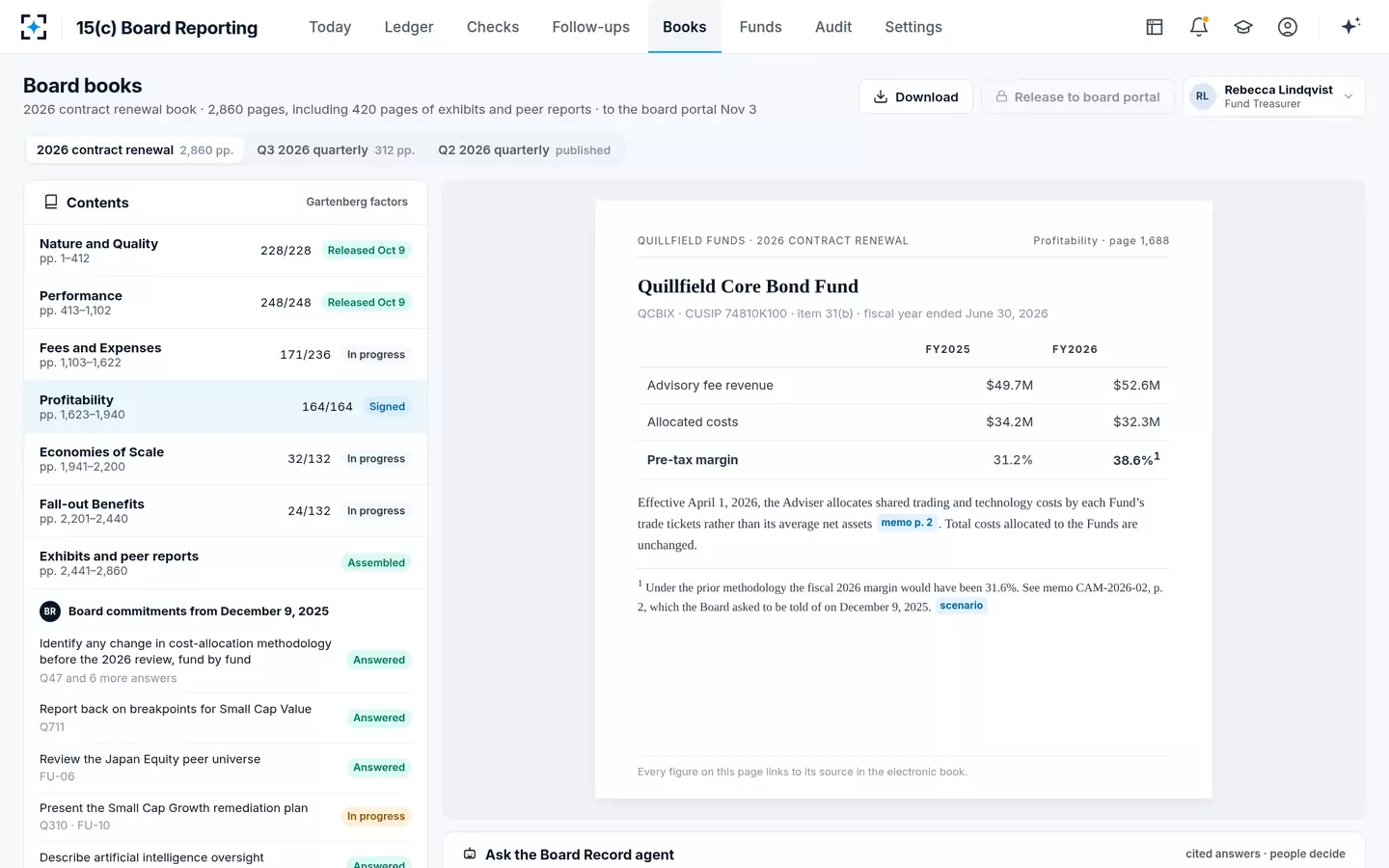
The decisions stay with people. Agents never pick or change a peer group, never alter the cost model and never propose a fee change; the fund treasurer approves each answer and signs each tab, and the chief legal officer releases the book.
Every 15(c) question routed to the factor it answers
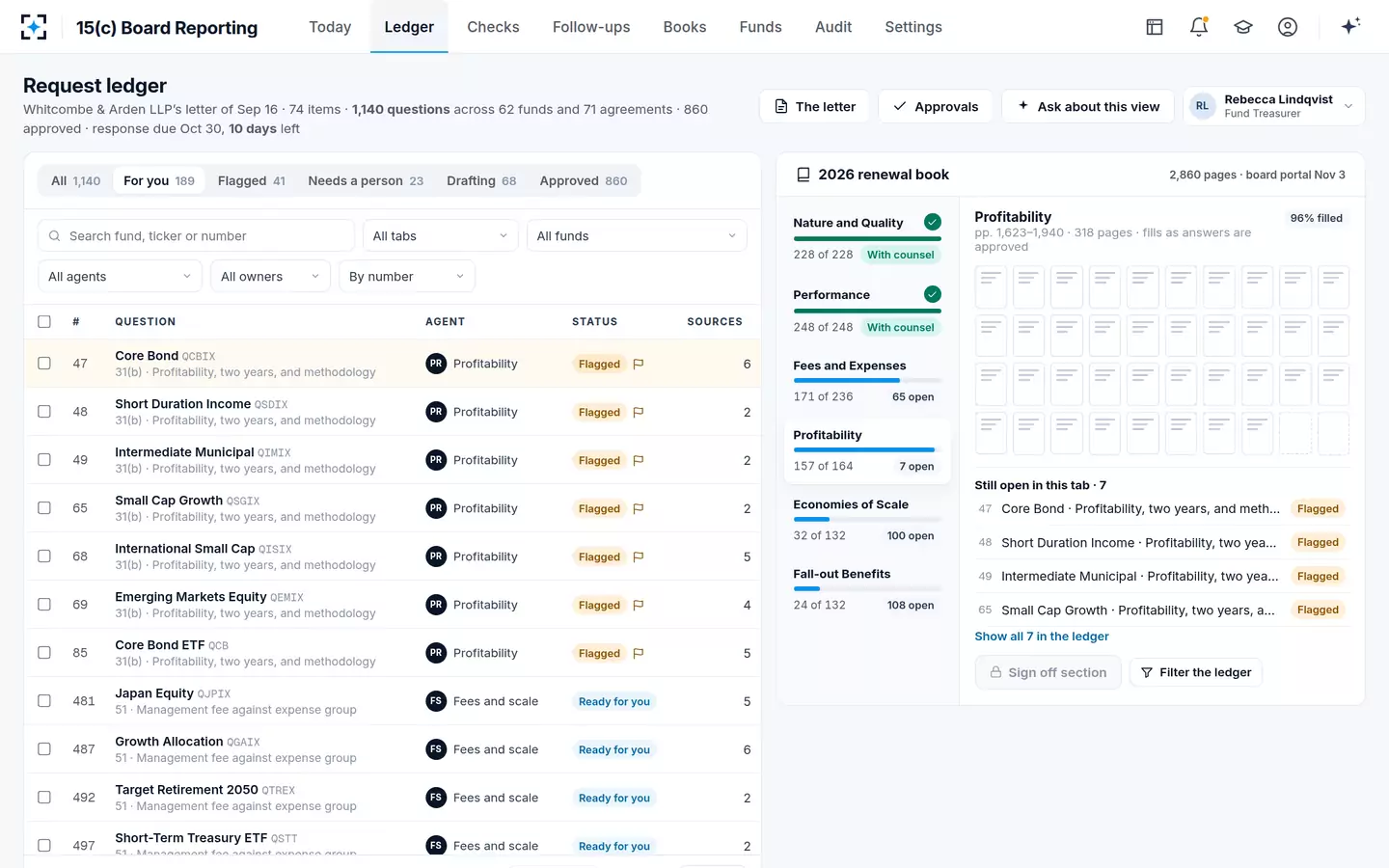
Questions people ask
What are the Gartenberg factors in a 15(c) review?
The nature and quality of the adviser's services, the adviser's costs and the fund's profitability to it, economies of scale, comparative fees, fall-out benefits, and the independence and care of the board, as listed in Jones v. Harris. A 15(c) review also covers investment performance, which the SEC's 2004 disclosure rule requires the board to address.
Are the Gartenberg factors an SEC rule?
No. They come from case law; the SEC's 2004 release on board approval disclosure lists similar factors that a fund's approval statement must discuss. The SEC's 2015 Commonwealth order said the factors may inform what information is reasonably necessary under Section 15(c).
Is performance a Gartenberg factor?
Not in the list the Supreme Court quoted from Gartenberg. It is in the SEC's 2004 list, which asks how the board evaluated the investment performance of the fund and the adviser, so every 15(c) book covers it.
What is a fall-out benefit?
A collateral benefit the adviser or its affiliates receive because of their relationship with the fund, such as fees for administration, transfer agency or distribution, or research paid with fund commissions. Boards weigh it against the advisory fee, so the evidence should show amounts, not only a list.
What did the court decide in Gartenberg v. Merrill Lynch?
The Second Circuit held in 1982 that a fee breaches Section 36(b) only when it is so out of line with the services that no arm's-length negotiation could have produced it. The Supreme Court adopted that standard in Jones v. Harris in 2010.
Which Gartenberg factor matters most?
None is ranked; the courts weigh all relevant circumstances. In practice the SEC's 15(c) cases turned on costs and profitability, comparative fees, breakpoints and the board's information, which is where an evidence map pays for itself.