Economies of scale in asset management are the savings a manager gets as assets grow: the cost of researching, trading and administering a portfolio rises far more slowly than the assets themselves. For a US registered fund the question is not whether they exist but who keeps them, and the board must answer it every year. Since 2004 the SEC has required a fund's statement on the board's approval of the advisory contract to discuss how far the adviser would gain from scale as the fund grows and whether investors share in those gains through fee levels (69 FR 39798, June 30, 2004). The research suggests the answer is less obvious than a breakpoint schedule makes it look: in one peer-reviewed decomposition, expense ratios fell with fund size mainly because of the small fees paid to outside service providers, while advisory fees barely moved for the larger funds (Gao and Livingston, 2008). Botminds' 15(c) Board Reporting puts the evidence for the scale factor in front of the board fund by fund: breakpoints, effective rates and the adviser's margin over two years.
One breakpoint schedule, worked to the effective fee rate at five fund sizes
What are economies of scale in asset management?
They are the fall in cost per dollar managed as assets grow. A portfolio team that manages $1 billion can often manage $5 billion in the same strategy with modest additions; compliance, legal, systems and the board's own costs are largely fixed; and fund accounting, custody and transfer agency are priced in ways that fall per dollar as balances rise. The Supreme Court, quoting Gartenberg, counted among the factors a court weighs how far the adviser gains from scale as the fund grows (Jones v. Harris Associates, 2010; the full list is in the Gartenberg factors evidence map).
Scale is not free in every direction. Larger funds can face higher trading costs in less liquid markets, capacity limits in small-company strategies, and distribution costs that grow with the shareholder base. That is why the regulatory question is framed as "the extent to which" savings arise, and why a board must look at the fund's own costs rather than assume a curve.
Economies of scale in mutual funds: what the research finds
Peer-reviewed studies agree that bigger funds and fund families tend to charge less, and disagree on how much of that reaches advisory fees. Khorana, Servaes and Tufano studied fees on 46,580 fund share classes sold in 18 countries and found lower fees at bigger funds and bigger fund families, and lower fees in countries with stronger investor protection (Review of Financial Studies, 2009). Gao and Livingston broke the expense ratios of actively managed US equity funds into their components: the fall in total expense ratio with size came mainly from fees paid to outside service providers, and mostly among the smallest third of funds, while advisory fees, the largest component, stayed roughly flat for the larger funds and marketing fees rose with size (Financial Markets, Institutions and Instruments, 2008).
Governance appears in the same literature. Gil-Bazo and Ruiz-Verdú found that the funds doing worst before fees tend to charge the most, and "some evidence that better fund governance may bring fees more in line with performance" (Journal of Finance, 2009). Read together, the studies suggest scale savings are real and that the advisory fee is where they are least likely to show up unless a board looks for them.
What three peer-reviewed studies found on fund size and fees
46,580
share classes in 18 countries studied: fees fall with fund and family size
Flat
advisory fees for larger US equity funds; the decline is in outside providers' fees
⅓
smallest funds, where most of the expense-ratio decline with size occurs
What must a fund board say about economies of scale?
Two things, under the SEC's 2004 rule: how far economies of scale would be realized as the fund grows, and whether the fee levels reflect them for the benefit of investors. The statement must say how the board evaluated each factor, and if the board considers a factor not relevant it must say so and explain why; conclusory statements or a list of factors are not enough (69 FR 39798). That statement now sits in Item 11 of Form N-CSR.
The rule asks about the fund's fee levels, not the adviser's intentions. A board that says scale is shared through breakpoints has to be able to show where the fund sits on the schedule, what rate it actually pays, and how the adviser's cost and margin have moved as assets grew. Where each factor's evidence lives in the book places the scale tab among the others.
What are breakpoints in an advisory fee?
Breakpoints are asset levels at which the advisory fee rate steps down for assets above the level. The fee is charged in tiers, like a progressive tax in reverse: each tier's assets pay that tier's rate, so the effective rate, total fee divided by assets, falls smoothly as the fund grows. A schedule of 0.60% on the first $1 billion and 0.55% above it charges a $2 billion fund 0.575% overall, not 0.55%.
The mechanics of applying breakpoints correctly, including the day assets cross a threshold and the errors that follow when they are missed, are a fund accounting question covered in the cost of a missed breakpoint tier. For the 15(c) review, the question is whether the schedule shares anything at all.
A breakpoint schedule, worked to the effective rate
The illustrative schedule in the opening chart has four tiers. Working it at two fund sizes shows how slowly the effective rate moves even when the marginal rate falls by a quarter.
The same schedule at $5 billion and $10 billion: fee dollars by tier
| Tier | Rate | Fee at $5 billion | Fee at $10 billion |
|---|---|---|---|
| First $1 billion | 0.60% | $6.0 million | $6.0 million |
| Next $1 billion | 0.55% | $5.5 million | $5.5 million |
| Next $3 billion | 0.50% | $15.0 million | $15.0 million |
| Above $5 billion | 0.45% | — | $22.5 million |
| Total fee | — | $26.5 million | $49.0 million |
| Effective rate | — | 0.530% | 0.490% |
The last line of the caption is the board's real question. If the adviser's cost of running the fund rose by much less than 85% while assets doubled, the schedule shared some of the saving and kept more of it. Whether that is reasonable depends on the cost evidence, which is why the scale factor cannot be answered from the fee schedule alone.
Why a breakpoint schedule does not prove sharing
A schedule shows how the fee responds to assets; it says nothing about how the adviser's costs respond. Three gaps recur. A schedule whose first breakpoint sits above the fund's assets shares nothing yet. A schedule set when the fund was small may have tiers far below where its costs actually flatten. And a falling effective rate can coexist with a rising margin, if costs fall faster.
The profitability evidence closes the gap. A board that sees the adviser's revenue, allocated costs and margin for the fund over two years, under a stated allocation method, can see whether growth is widening the margin. That is also why the method matters: in Kornitzer, the adviser's reported margin on the funds held near 27% to 28% from 2010 to 2012 while revenue rose from about $22.7 million to $34.1 million, because the share of the chief executive's pay charged to the funds rose with it, which the board was not told (SEC, IC-31560, 2015). A margin that stays flat as assets grow can be evidence of shared savings, or of costs allocated to keep it flat; what the SEC's 15(c) cases cost the people charged shows how the second reads to an enforcement division.
How do boards test economies of scale?
By putting four pieces of evidence side by side for each fund. The fee schedule as written in the signed contract; the fund's assets against each breakpoint over several years; the effective rate actually charged, from fund accounting; and the adviser's revenue, cost and margin for the fund, for at least two years and under a stated method. Comparisons with similar funds help place the fee, but Jones v. Harris warns against leaning on other advisers' fees too heavily, since they may not be arm's-length either.
Evidence a board needs to answer the scale question for one fund
- The breakpoint schedule in the signed contract
Not a summary; Commonwealth's board was told of breakpoints the contract did not contain.
- Assets against each breakpoint, several years
Shows whether the fund has reached any tier, and how fast it is growing.
- The effective rate charged, from fund accounting
Checked to the schedule: the rate paid is the rate that shares or does not.
- Revenue, allocated cost and margin, two years
With the allocation method stated, and any change shown under the old method too.
- Waivers and caps, with their expiry
A waiver shares scale only while it lasts.
- Other sharing mechanisms named
Fee reductions, new share classes or reinvestment in services, each with its amount.
Breakpoints that were never in the contract
The Commonwealth order shows the scale factor failing at its simplest point. The board's questionnaire asked the adviser to address the adequacy and appropriateness of the fund's breakpoints; the adviser said the fund had breakpoints and that those in the contract were appropriate. They had been omitted from the contract at an earlier reorganization, although everyone believed they were there; the order notes the fees paid never exceeded the levels believed to be in place (SEC, IC-31678, paragraph 50). The SEC still counted it among the inaccurate information that led to the Section 15(c) findings.
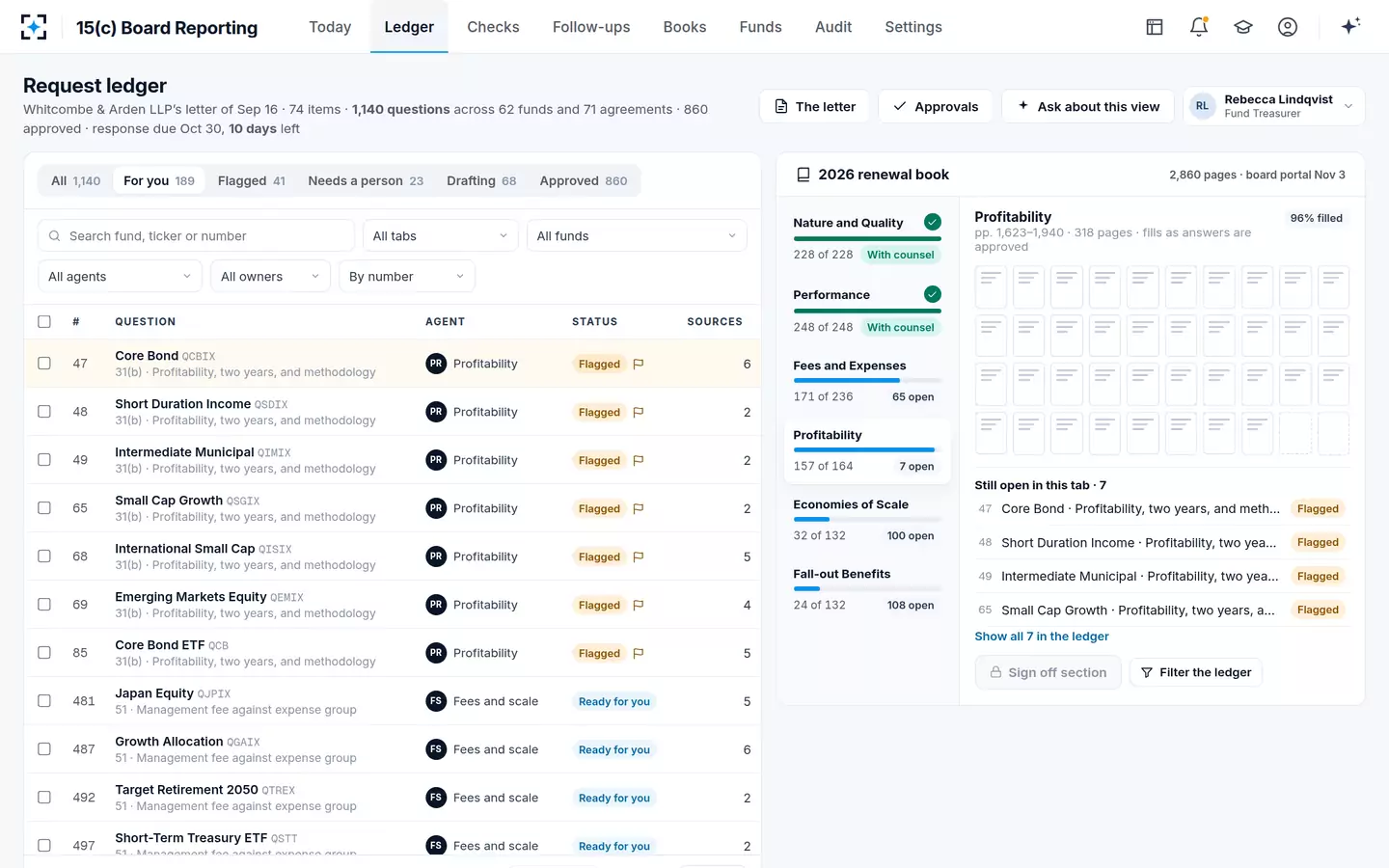
The lesson is mechanical: the evidence for breakpoints is the signed agreement, read each year, not the adviser's description of it. In 15(c) Board Reporting, the Fees and scale agent states each fund's breakpoints and effective fee rate from the agreements and fund accounting, and the Consistency agent flags any change in effective rate beyond one basis point from last year's answer.
Fee and scale answers in 15(c) Board Reporting, fund by fund, beside the book's scale tab
The UK version: economies of scale in the assessment of value
UK fund managers face a parallel annual test with economies of scale written into it. The FCA's rules require an authorised fund manager to assess at least annually, for each fund and each unit class, whether what the fund pays out is justified by the value it delivers overall, against at least seven considerations; the fourth is whether the manager can achieve savings and benefits from economies of scale, taking into account whether the fund has grown or contracted (FCA Handbook, COLL 6.6.20R–6.6.21R). The same rules require at least a quarter of the manager's governing body to be independent.
Economies of scale in the US 15(c) review and the UK assessment of value
US: Section 15(c) and the 2004 disclosure rule: The fund board; a majority of its non-interested directors vote on the contract
UK: FCA assessment of value: The authorised fund manager's governing body, at least a quarter independent
US: Section 15(c) and the 2004 disclosure rule: At least annually, with each renewal
UK: FCA assessment of value: At least annually, for each fund
US: Section 15(c) and the 2004 disclosure rule: How far economies would be realized as the fund grows, and whether fee levels reflect them
UK: FCA assessment of value: Whether the manager achieves savings from scale, given growth or contraction
US: Section 15(c) and the 2004 disclosure rule: Each fund and its advisory contract
UK: FCA assessment of value: Each fund and each class of units
The FCA has tested how well firms do it. In a review of 18 fund managers between July 2020 and May 2021, it found most had not implemented the assessment arrangements it expected (FCA, multi-firm review, July 2021). The wider UK test is a subject of its own, covered in Botminds' Fee Benchmarking guide to the FCA assessment of value rules; for a group with US and UK funds, the scale evidence for both tests is the same evidence.
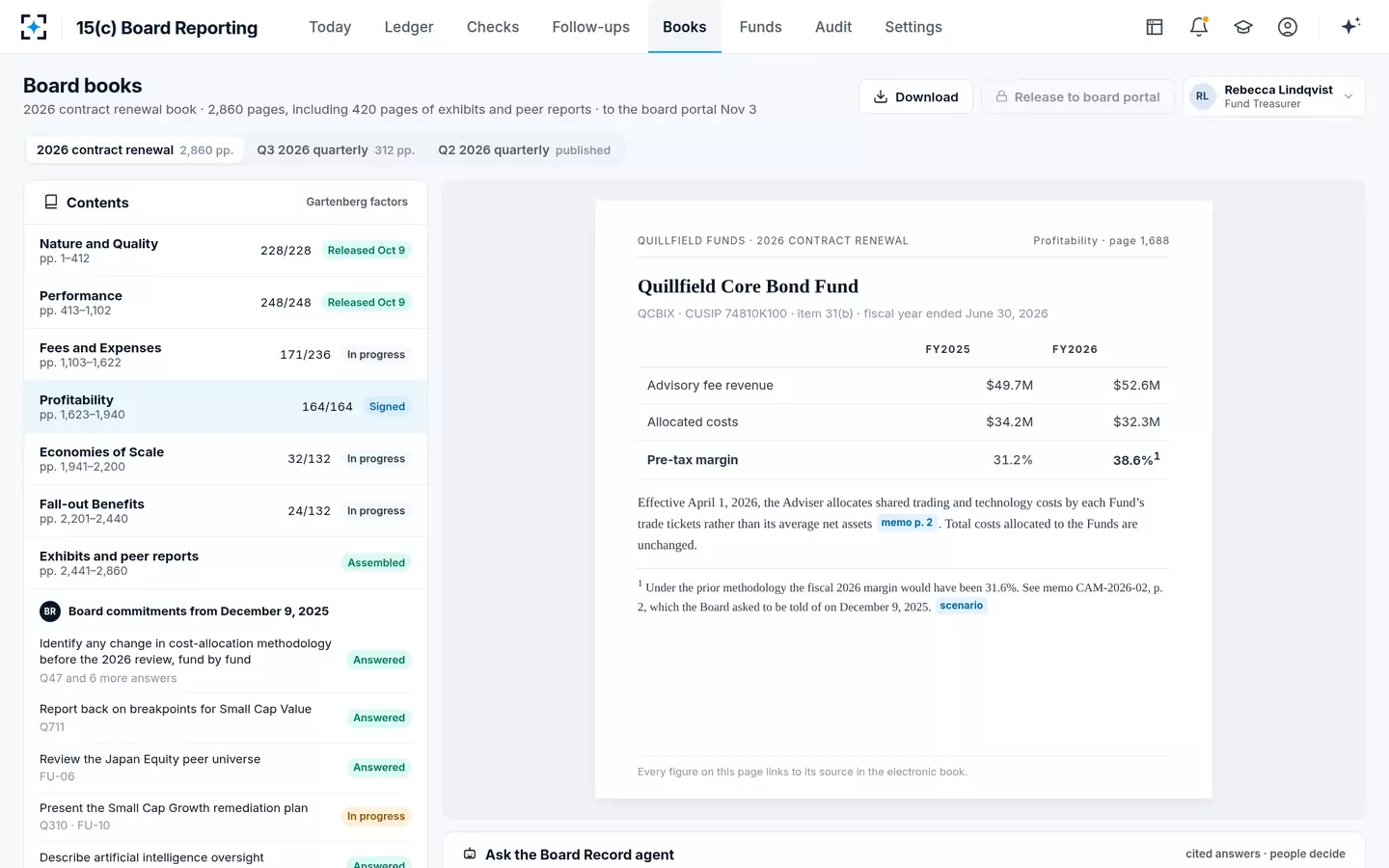
Board commitments on breakpoints in 15(c) Board Reporting, tracked to the answers that honor them
Questions people ask
What do economies of scale mean in a mutual fund?
The fall in the cost of managing and servicing each dollar as the fund grows, because many costs are fixed or grow slowly. The SEC's 2004 rule requires the board's approval statement to discuss how far those economies would be realized and whether fee levels reflect them.
What are breakpoints in an advisory fee?
Asset levels above which a lower fee rate applies to the additional assets. With tiers of 0.60% on the first $1 billion and 0.55% above, a $2 billion fund pays an effective 0.575%.
How do boards test economies of scale?
By comparing the fee schedule in the contract, the fund's assets against each breakpoint, the effective rate charged and the adviser's revenue, cost and margin for the fund over at least two years under a stated method. A schedule alone shows how the fee moves, not how the adviser's costs move.
Do larger mutual funds have lower fees?
On average, yes: a study of 46,580 share classes in 18 countries found lower fees at bigger funds and fund families. But a breakdown of US equity fund expenses found the decline came mainly from outside service providers' fees, with advisory fees roughly flat for the larger funds.
Are breakpoints required by law?
No. Neither the statute nor the SEC's rules require breakpoints; the rules require the board to address economies of scale and whether fees reflect them. Breakpoints are one way to share savings; fee waivers, lower base fees and added services are others.