The Rule 6c-11 website requirements are the daily disclosures an ETF must post, prominently and free of charge, to rely on the SEC's ETF rule: before the primary exchange opens, every holding that will form the basis of the next NAV, with its ticker, CUSIP or other identifier, description, quantity and percentage weight; the prior business day's NAV, market price and premium or discount; a table and a line graph of premiums and discounts; the median bid-ask spread over the last 30 calendar days; and, after more than seven trading days beyond 2%, a statement explaining why. For a new fund they are conditions of the exemption from its first day, not a marketing page. Botminds' Fund Launch Management schedules the website as a dated step before first NAV, and its Readiness agent checks each item against the rule and the administrator's figures before the fund opens.
The examples use a fictional sample fund from the solution, Quillfield Short Duration Muni ETF. The rule text is quoted from the eCFR and the SEC's 2019 adopting release.
What the website must carry each business day, in the rule's order
- Holdings, before the open
For each holding behind the next NAV: ticker symbol; CUSIP or other identifier; description; quantity; percentage weight. Rule 6c-11(c)(1)(i).
- NAV, market price, premium or discount
Each as of the end of the prior business day. (c)(1)(ii).
- A premium and discount table
Days traded at a premium or discount in the last calendar year and the quarters since, or the fund's life if shorter. (c)(1)(iii).
- A premium and discount line graph
Same periods as the table. (c)(1)(iv).
- Median bid-ask spread
As a percentage rounded to the nearest hundredth, over the last 30 calendar days, from the spread at the end of every 10-second interval. (c)(1)(v).
- The 2% statement, when triggered
Premium or discount above 2% for more than seven consecutive trading days: the fact and the factors behind it, kept up for at least a year. (c)(1)(vi).
What is Rule 6c-11? The rule that replaced the orders
Rule 6c-11 is the SEC's ETF rule: it lets an open-end fund whose shares list on an exchange operate as an ETF without its own exemptive order, provided it meets the rule's conditions. The website disclosures are the first of those conditions, and the basket policies are the second.
The Commission adopted the rule on September 25, 2019; it was published in the Federal Register on October 24, 2019 and took effect on December 23, 2019 (84 FR 57162). Its purpose was to spare ETFs that meet its conditions the cost and wait of an individual exemptive order, and the Commission said it would "rescind certain exemptive relief that has been granted to ETFs and their sponsors." The related amendments to Form N-1A came with a compliance date of December 22, 2020.
The rule's exemptions are what make an ETF work as one. With the conditions met, an ETF share is treated as a redeemable security, dealers may trade the shares at market prices rather than the NAV-based price section 22(d) would otherwise require, and certain affiliates may deposit and receive baskets (Rule 6c-11(b)). A website that fails the conditions is not a disclosure lapse; it puts the fund outside the rule it relies on.
Holdings before the open: what "the basis for the next NAV" means
The holdings disclosure must show, before regular trading opens on the primary listing exchange, each portfolio holding "that will form the basis of the next calculation of current net asset value per share" (Rule 6c-11(c)(1)(i)). Paragraph (c)(2) pins the date: they "must be the ETF's portfolio holdings as of the close of business on the prior business day."
That is a reconciliation, not a download. The administrator strikes NAV on the portfolio as recorded at the close; the website must show the same list, by the next morning, with identifiers a market maker can price. In the sample fund, three municipal bonds bought before launch were new issues with CUSIPs the custodian had not yet set up. The same identifiers must appear on the website the first morning, so a mismatch in the custodian's files is also a website risk.
The holdings table a new municipal ETF shows before its second open
NAV per share · prior business day
$25.012
Market price · closing
$25.030
Premium
+0.07%
Median bid-ask spread
0.12%
Ticker—
CUSIP or identifier54218P KQ7
DescriptionLake Avalon Public Utility District (WA) 5.000% 07/01/2031
Quantity500,000
Weight2.07%
Ticker—
CUSIP or identifier13921C HX2
DescriptionCalder Bay Port Authority (CA) 4.000% 11/01/2029
Quantity400,000
Weight1.62%
Ticker—
CUSIP or identifier95783R DM5
DescriptionWestbrook County School District No. 4 (CO) 5.000% 12/01/2030
Quantity300,000
Weight1.24%
Ticker—
CUSIP or identifierUSD
DescriptionCash and equivalents
Quantity412,880
Weight1.65%
… and every other holding, to 212 lines, weights summing to 100%
Two practical consequences follow. First, a fund that trades late in the day reflects those trades on the website the following morning, because the disclosure tracks the prior close. Second, the website and the fund's books must agree on the same morning, which is why the Readiness agent in the solution compares the website file with the administrator's holdings before the open rather than after a complaint.
ETF premium or discount: the daily figure, the table and the graph
The premium or discount is the gap between the ETF's market price and its NAV, as a percentage of NAV, measured at the time NAV is struck. The website must show yesterday's figure, a table counting the days at a premium and at a discount, and a line graph, for the last calendar year and the quarters since, "or the life of the exchange-traded fund, if shorter" (Rule 6c-11(c)(1)(iii)–(iv)).
The two calculations behind the daily figures
Premium or discount
(Market price − NAV per share) ÷ NAV per share
Market price is the official closing price, or the midpoint of the national best bid and offer at the time NAV is calculated if that better reflects value. Rule 6c-11(a).
Median bid-ask spread
Median of (offer − bid) ÷ midpoint, taken at the end of every 10-second interval of every trading day in the last 30 calendar days
Expressed as a percentage rounded to the nearest hundredth. Rule 6c-11(c)(1)(v).
The market price definition gives a choice that should be written down before launch. The official closing price is the default; the bid-ask midpoint at the NAV time may be used if it "more accurately reflects the market value" of the shares at that time (Rule 6c-11(a)). A municipal bond fund that strikes NAV with evaluated prices at 4:00 p.m. has a reason to think about which is fairer, and the choice should be the same every day.
How is the median bid-ask spread calculated?
Take the national best bid and offer at the end of each 10-second interval of every trading day in the last 30 calendar days, divide each spread by its midpoint, and take the median. The SEC considered a time-weighted average and rejected it: sampling every 10 seconds "has the same effect as time-weighting," and the median "is less likely to give disproportionate effect to outlier values" (84 FR 57162).
The data problem is the volume of it. A 6.5-hour trading day has 2,340 ten-second intervals, so a 30-calendar-day window of about 21 trading days is roughly 49,000 observations per fund, refreshed daily. Most sponsors buy the calculation from a data vendor; the launch question is who checks the first one, and against what. The rule sets no separate method for a fund with fewer than 30 calendar days of trading, so how the first weeks are shown is a decision for counsel before launch, not on the morning of day two.
The prospectus points to the same page. Form N-1A, Item 6(c), requires an ETF to tell investors "how to access recent information, including information on the Fund's net asset value, Market Price, premiums and discounts, and bid-ask spreads, on the Exchange-Traded Fund's website," and a fund that meets the rule's website condition may omit its fiscal-year median spread from the prospectus (SEC Form N-1A).
What must an ETF post when its premium or discount exceeds 2%?
If the premium or discount is greater than 2% for more than seven consecutive trading days, the website must say so and give "a discussion of the factors that are reasonably believed to have materially contributed to the premium or discount," kept on the site "for at least one year thereafter" (Rule 6c-11(c)(1)(vi)). The SEC's release says the statement goes up on the trading day after the eighth consecutive day above 2%.
The SEC expected this to be rare: in its proposal it estimated that every ETF would need to post such a statement once in its lifetime (84 FR 57162). Rare events are the ones nobody has a template for. A launch file that already holds the draft statement, its approver and the monitoring that triggers it turns an eighth day into a routine post rather than a scramble.
The required website disclosure should be easily accessible on the website, presented without encumbrance by user name, password, or other access constraints, and should not be subject to usage restrictions on access, retrieval, distribution or reuse.
SEC, Exchange-Traded Funds adopting release (2019), on the website disclosures
Publicly available, free and findable: the access standard
The rule says "prominently," "publicly available and free of charge," and the SEC's release explained what that excludes: restrictive terms of use, log-ins, and limits on reuse of the data. The rest of a sponsor's website may sit behind a password; the required disclosures may not.
The SEC went further and encouraged a format, not just a page: ETFs "could include the portfolio holdings information in a downloadable or machine-readable format, such as comma-delimited or similar format" (84 FR 57162). For a launch, that means two things to test before first NAV: that a person can find the disclosures from the fund's page in one or two clicks, and that the holdings file downloads without a cookie wall or terms of use standing in front of it.
Rule 6c-11 custom baskets: policies, records, not the website
Custom baskets are governed by written policies and records, not by website posting. The SEC proposed requiring a published basket each day and dropped it: "the Commission is not including a basket publication requirement in rule 6c-11" (84 FR 57162). What the rule requires instead is policies and procedures for constructing and accepting baskets and, for custom baskets, "detailed parameters," the process for any deviation, and the titles or roles of the adviser's employees who review each one (Rule 6c-11(c)(3)).
The rule defines a custom basket as one made of "a non-representative selection" of the fund's holdings, or a representative basket that differs from the day's initial basket. Each basket exchanged must be recorded, with whether it was custom and a record that it complied with the policies, and kept for five years (Rule 6c-11(d)). The file every creation actually runs on, and what can go wrong with it, is the subject of the portfolio composition file, field by field.
Each website item, the check before launch, and who owns it
| Rule item | Check before first NAV | Typical owner |
|---|---|---|
| (c)(1)(i) holdings | The website file matches the administrator's holdings for the test portfolio; every identifier resolves; weights sum to 100% | Fund operations, with the administrator |
| (c)(1)(ii) NAV, price, premium | The feed populates from the second trading day; the market price method is chosen and written down | Fund operations and fund accounting |
| (c)(1)(iii)–(iv) table and graph | Empty-state wording agreed for a fund with no completed quarter; the periods roll correctly | Compliance, with counsel |
| (c)(1)(v) median spread | Vendor method matches the rule's 10-second, 30-calendar-day calculation; first-weeks treatment agreed | Compliance |
| (c)(1)(vi) 2% statement | Monitoring set to count consecutive trading days; a draft statement and its approver on file | Compliance and the portfolio manager |
| Access | No log-in, no terms-of-use barrier, holdings downloadable | Digital or web team |
What the SEC estimated the website would cost
The SEC priced the disclosures in its paperwork estimates. Per ETF, it estimated 37.5 hours of internal time to set up the website disclosures and 19.25 hours a year once annualized, with $3,000 of initial external cost and $1,000 a year after that, using wage rates for senior systems analysts, programmers, compliance managers and compliance attorneys (84 FR 57162, Table 11). It increased its proposal-stage estimates by 50% because the final rule added the median spread.
The SEC's estimate of what the website disclosures cost one ETF
37.5hours
internal time to build and review the disclosures, initial
19.25hours
internal time a year, initial work annualized over three years plus updates
$3,000
initial external cost, then $1,000 a year
Those are small numbers, and they are the right order of magnitude for a fund that copies an existing template. For a sponsor's first ETF, or a first fund in an asset class without exchange tickers, the hours are in agreeing the market price method, the vendor's spread calculation and the identifiers, and in testing them before anyone outside can see a mistake.
Fund Launch Management: the website as a first-NAV readiness check
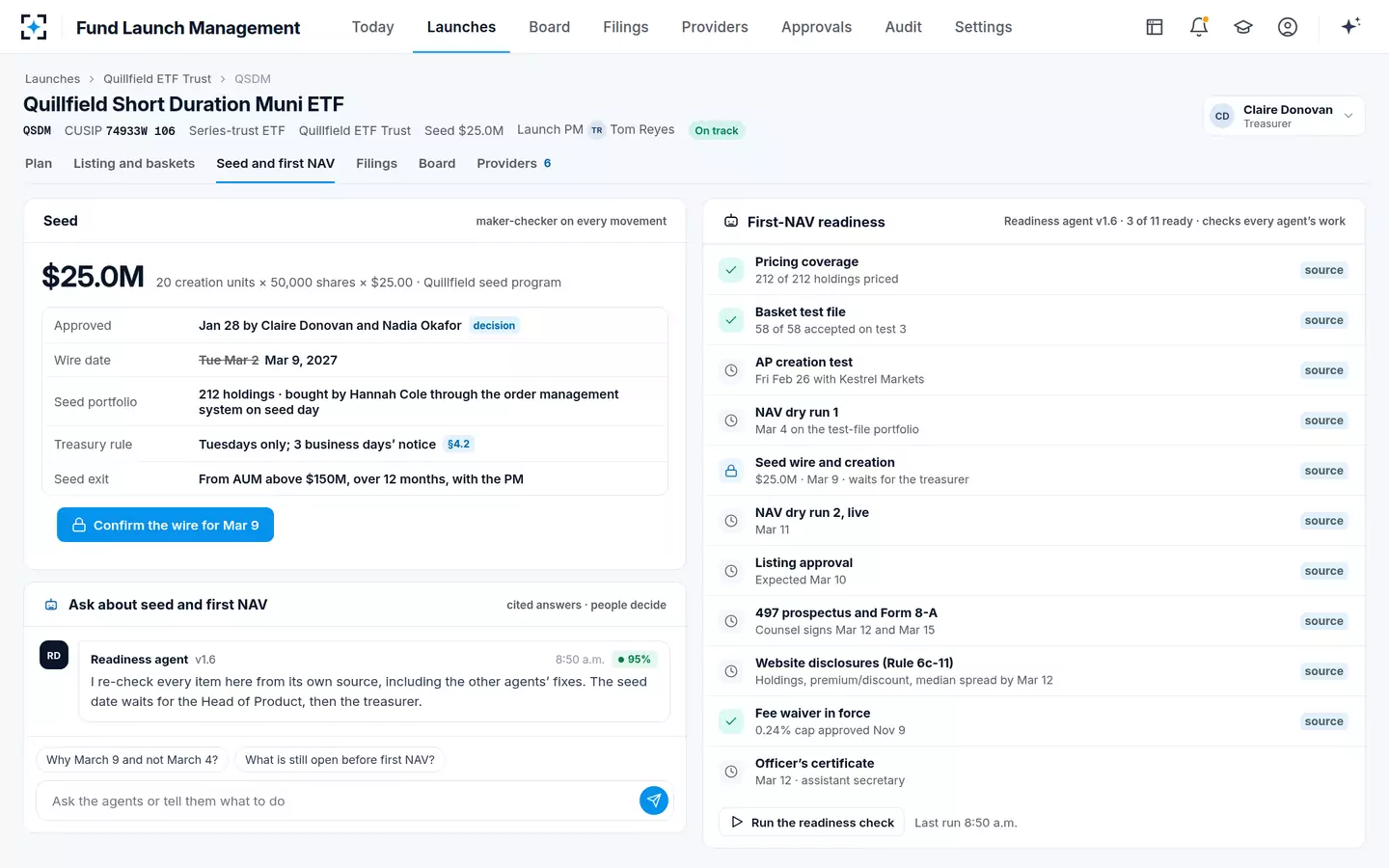
How Fund Launch Management checks the website before first NAV
In the solution the website is a step on the launch plan, in the Operations band, with an owner and a date, and the steps that feed it (pricing coverage, the custodian's acceptance of the basket, the NAV dry runs) are linked to it. If pricing coverage slips, the website step leans with it, and the launch project manager sees it before the date moves.
The Readiness agent checks the disclosures from its own sources: the administrator's holdings for the dry-run portfolio, the identifiers in the security master, the market price method in the procedures, and the vendor's spread method against the rule. It never declares go-live; it reports what passed and what did not, each with its evidence, and a person decides. Where a fix comes from another agent, the Readiness agent re-checks it without reading that agent's working. The Rule 6c-11 website requirements are one item on the full ETF launch sequence, and the lead market maker is one of the firms that depends on them, as who an ETF launch waits on explains. The solution is at Fund Launch Management.
Questions people ask
Does Rule 6c-11 require ETFs to publish their basket?
No. The SEC proposed a daily published basket and dropped it in the final rule. ETFs must publish full holdings daily and keep records of every basket exchanged, including whether it was a custom basket, for five years.
Do ETFs still have to publish an intraday indicative value under Rule 6c-11?
The rule's website conditions do not include one. The SEC noted that market makers and authorized participants for fully transparent ETFs calculate their own intraday values from the daily holdings disclosure and pricing data.
What time must the holdings be posted?
Before the opening of regular trading on the ETF's primary listing exchange, each business day. The holdings shown must be those as of the close of business on the prior business day, the basis for that day's NAV.
Can a non-transparent active ETF rely on Rule 6c-11?
No. The SEC said in its adopting release that non-transparent ETFs "would not meet the conditions of rule 6c-11," because they do not provide daily portfolio transparency; they operate under their own exemptive orders.
How long must the 2% statement stay on the website?
At least one year after it is posted. It is required when the premium or discount exceeds 2% for more than seven consecutive trading days, and must discuss the factors reasonably believed to have materially contributed.