A portfolio composition file, or PCF, is the daily file that tells an ETF's authorized participants what one creation unit costs that day: each security and the quantity to deliver, the cash to add or receive, and the net asset value of the unit the basket is meant to equal. It is the document every creation and redemption runs on, and for a new ETF it is the first thing that has to work, because the authorized participant's creation test, the seed and the first NAV all wait on a file the custodian has accepted line by line. Botminds' Fund Launch Management has a Basket agent that builds the creation basket and its test files, runs them with the custodian and reconciles every rejected line against the security master before anyone asks why the seed date moved.
The file below is from a fictional sample launch in the solution, Quillfield Short Duration Muni ETF, an active municipal bond ETF whose second test file came back with three lines rejected. The rules come from Rule 6c-11 and the SEC's 2019 adopting release.
One basket file, annotated: the header and the lines a custodian checks
Header
Fund and identifier
Quillfield Short Duration Muni ETF · QSDM · CUSIP 74933W 106
Must match the listing and clearing setup; a new fund's CUSIP is days old.
Trade date
The business day the basket applies to
A file dated for the wrong day is rejected, or worse, accepted.
Creation unit
50,000 shares
Fixed in the prospectus and the participant agreement.
NAV per creation unit
$1,250,000.00 (50,000 × $25.00 at launch)
From the administrator; on day one, from the seed price.
Basket lines · per creation unit
54218P KQ7
Lake Avalon Public Utility District (WA), rev. 2027A, 5.000%, 7/1/2031
$25,000 par
Rejected · not set up at custodian
13921C HX2
Calder Bay Port Authority (CA), ref. 2027, 4.000%, 11/1/2029
$20,000 par
Rejected · not set up at custodian
95783R DM5
Westbrook County School District No. 4 (CO), GO 2027B, 5.000%, 12/1/2030
$15,000 par
Rejected · not set up at custodian
… 55 more
Other municipal bonds in the representative basket
par per unit
Accepted
Cash
Cash balancing amount
NAV per creation unit − value of the basket lines
Estimated in the morning file; the actual figure follows NAV.
What is a portfolio composition file for an ETF?
It is the operational form of what Rule 6c-11 calls the basket: "the securities, assets or other positions in exchange for which an exchange-traded fund issues (or in return for which it redeems) creation units" (Rule 6c-11(a)). The rule defines the basket; the industry's daily file carries it to the people who must deliver it.
The SEC's release shows where the file goes. Commenters told the Commission that "authorized participants already have access to basket information through the daily portfolio composition file provided to NSCC," the clearing corporation, and that other institutions using baskets for hedging reach it through the clearing corporation, an intermediary such as an authorized participant, or the ETF itself (SEC, Exchange-Traded Funds, 84 FR 57162). That is why the SEC did not require the basket on the website: the people who trade on it already receive it.
The fund, or the service provider it appoints, produces the file every business day from the portfolio manager's basket and the administrator's prices. For a launch, three parties must agree on it before the first creation: the custodian, which must recognise every security and be able to settle it; the authorized participant, which must be able to source and deliver it; and the administrator, whose NAV the basket and cash must add up to.
Portfolio composition file example: the header
The header says which fund, which day, and how big a unit is. Each field has a source outside the file, and each source can be wrong in a way the file will not show.
The creation unit size comes from the prospectus and the participant agreement; the sample's is 50,000 shares. The NAV per creation unit comes from the administrator: at launch it is the seed price times the unit size, $25.00 × 50,000 = $1,250,000. The fund's own identifier comes from the listing work, and for a new fund it is days old: the sample's CUSIP was assigned on November 24, and its clearing eligibility was scheduled for March 8, eight days before first NAV. A test file that refers to the fund by an identifier the clearing system does not yet know fails for a reason that has nothing to do with the basket.
The lines: identifiers, quantities and the setup behind each one
Each line is a security and the quantity of it one creation unit requires. For an equity fund the quantity is shares; for a bond fund it is par. In the sample, Lake Avalon Public Utility District bonds are $25,000 par per creation unit, so the 20 units the seed buys need $500,000 par of them.
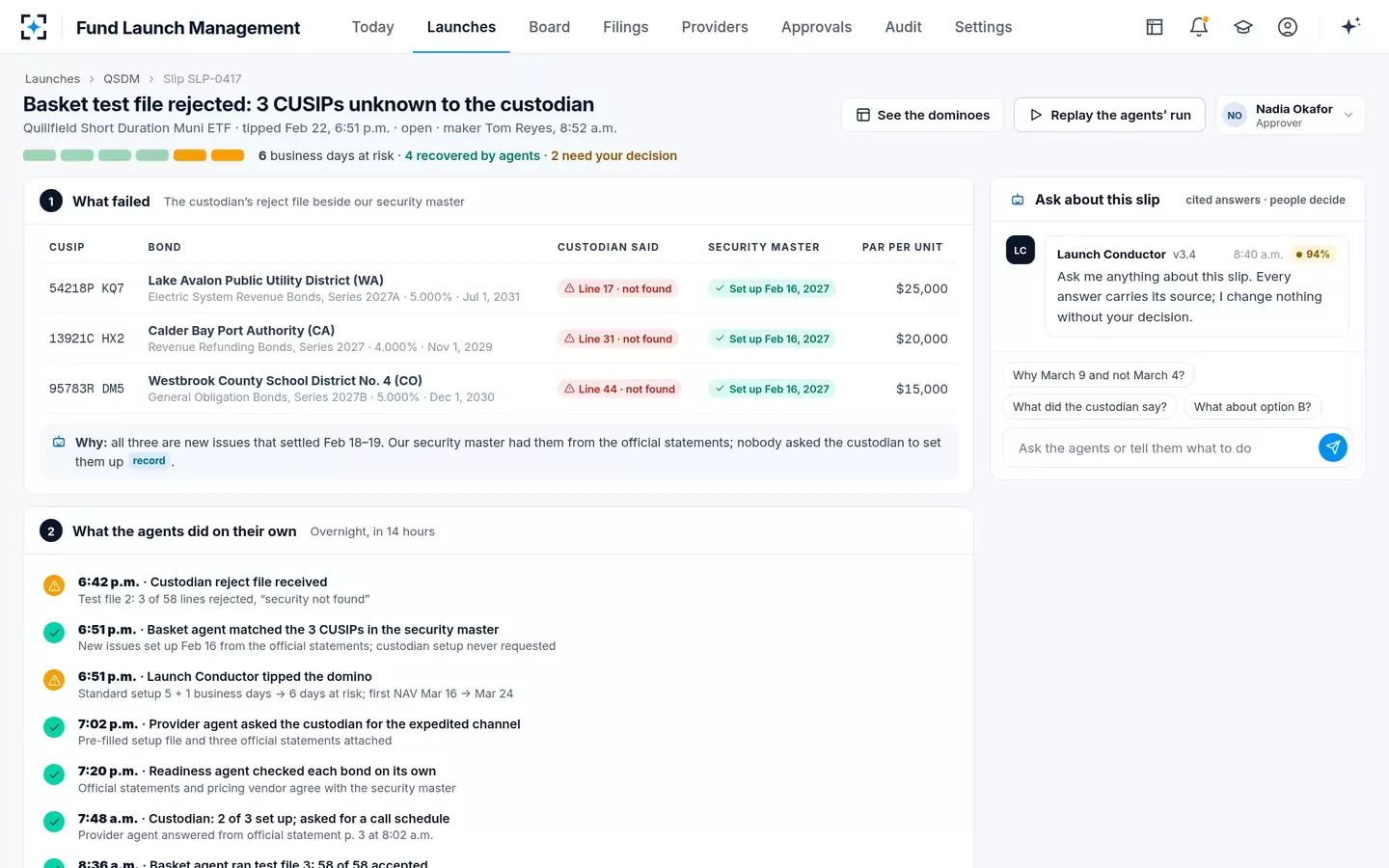
What the file cannot show is whether the receiving systems know each identifier. The rule allows a CUSIP "or other identifier," and for municipal bonds the CUSIP is the identifier. A custodian that has not set up a security cannot accept it, and in the sample the reason was mundane: three new issues settled on February 18 and 19, the sponsor's security master had them from the official statements on February 16, and the request to the custodian was never made. The custodian's reject file named them by line: 17, 31 and 44.
Quantities fail differently. A par amount below a bond's minimum denomination, or not in an allowed increment, cannot be delivered even if the security is known. A basket built by scaling the portfolio down to one creation unit produces odd lots the bond market will not deliver, which is one reason a bond fund's basket rarely mirrors its portfolio exactly.
What is a cash balancing amount?
The cash balancing amount is the cash that makes the basket equal the creation unit's NAV. Rule 6c-11 defines it as "an amount of cash to account for any difference between the value of the basket and the net asset value of a creation unit" (Rule 6c-11(a)).
How the cash in a basket file is worked out
Value of the basket
Σ (quantity per creation unit × price) over every line
Prices from the same source the administrator uses for NAV.
NAV per creation unit
NAV per share × shares per creation unit
In the sample at launch: $25.00 × 50,000 = $1,250,000.
Cash balancing amount
NAV per creation unit − value of the basket
Positive: the authorized participant pays cash in. Negative: the fund pays cash out. It also absorbs accrued interest and any cash held in place of a security.
For a launch, the cash balancing amount is also a test of the plumbing. If the administrator's NAV and the basket's prices come from different pricing sources, the cash absorbs the difference without anyone noticing, and the first creation transfers value between the authorized participant and the fund. Checking that the two sources match is part of the fund's NAV error policy as much as of the launch.
Is the PCF the same as the holdings on the ETF's website?
No. The website shows the whole portfolio behind the next NAV; the basket file shows what one creation unit requires today. They are often close, but the rule treats them as different documents with different audiences.
Two daily documents, two jobs
Portfolio composition file (the basket): The securities and cash an authorized participant delivers or receives for one creation unit
Website holdings disclosure: Every holding that forms the basis of the next NAV, as of the prior close
Portfolio composition file (the basket): Authorized participants, the clearing corporation, hedging institutions through intermediaries
Website holdings disclosure: Anyone: it must be public, free and prominent
Portfolio composition file (the basket): Not published; each basket exchanged must be recorded and kept five years
Website holdings disclosure: Yes, every business day before the open
Portfolio composition file (the basket): Yes: baskets need not be a pro rata slice, and custom baskets are allowed under written policies
Website holdings disclosure: No: it is the portfolio
Portfolio composition file (the basket): A creation fails, or settles at the wrong value
Website holdings disclosure: The fund fails a condition of the rule it relies on
The SEC proposed publishing one basket a day on the website and dropped it, because the people who use baskets already receive them; it also declined to require publication of every basket exchanged, after commenters warned that publishing each one "could raise the risk that market participants front-run trades in basket securities" (84 FR 57162). What is on the website, and how to test it before launch, is covered in the Rule 6c-11 website requirements.
ETF basket meaning: why a basket is not a pro rata slice
An ETF basket is the set of securities and cash exchanged for one creation unit, and it need not be the portfolio in miniature. The SEC's release said so plainly: "The basket might not reflect a pro rata slice of an ETF's portfolio holdings," and an ETF "may substitute other securities or cash in the basket for some (or all) of the ETF's portfolio holdings" (84 FR 57162).
For bond funds this is the normal case. A short-duration municipal fund may hold 212 bonds; a creation unit sized at $1.25 million cannot hold a sensible amount of each. The representative basket is a sample the portfolio manager designs to track the portfolio's risk, and its composition is the portfolio manager's decision, which is why the Basket agent in the solution may build and test the file but never change what is in it.
Custom in-kind baskets: when the file differs from the portfolio
A custom basket is either "a basket that is composed of a non-representative selection of the exchange-traded fund's portfolio holdings" or "a representative basket that is different from the initial basket used in transactions on the same business day" (Rule 6c-11(a)). Swapping the three rejected bonds for cash in the sample's first creation would have made it a custom basket.
Custom baskets are allowed only under written policies that set "detailed parameters for the construction and acceptance of custom baskets that are in the best interests of the exchange-traded fund and its shareholders," including how deviations are handled, and that name the titles or roles of the adviser's employees who review each one (Rule 6c-11(c)(3)). In the sample, the custom-basket option also failed on time: the authorized participant needed two business days to load a custom basket, so it could not save the original seed date. The option went to the Head of Product as one of three, and was not chosen.
Fund Launch Management: the custodian's reject file beside the security master
How a portfolio composition file fails, and what each failure blocks
Most basket failures are setup failures, not calculation errors. The file can be arithmetically perfect and still be rejected, because the systems that receive it do not recognise something in it.
Basket file failures before a first creation, and what each one stops
| Failure | Usual cause | What it blocks |
|---|---|---|
| Security not found at the custodian | New issue or new market set up in-house but never requested | The test file, then the authorized participant's creation test, the seed and NAV dry runs |
| Undeliverable quantity | Par below minimum denomination or off-increment; odd lots from scaling | The authorized participant's ability to source the basket |
| Fund identifier unknown | Clearing eligibility not yet confirmed for a new fund | Any creation, test or real |
| Cash does not reconcile | Basket priced from a different source than NAV | Value transfers between the fund and the authorized participant |
| Custom basket without approval | A substitution made without the reviewer the policy names | Compliance with Rule 6c-11(c)(3) for that basket |
| Stale file | Yesterday's basket reused after a corporate action or a trade | Accurate delivery; possible failed settlement |
What Rule 6c-11 makes the fund keep about every basket
For each basket exchanged with an authorized participant, the fund must keep "the ticker symbol, CUSIP or other identifier, description of holding, quantity of each holding, and percentage weight of each holding composing the basket," whether it was a custom basket with a record that it complied with the policies, the cash balancing amount, and the "identity of authorized participant transacting with the exchange-traded fund" (Rule 6c-11(d)(2)). The records are kept at least five years, the first two in an easily accessible place.
Before the first creation: checks on the basket file
- Every identifier set up at the custodian
Not just in your security master; new issues settled days before launch are the usual gap.
- Every quantity deliverable
Minimum denominations and increments for bonds; lot sizes for foreign shares.
- Basket priced from the NAV source
So the cash balancing amount is the true difference, not a pricing mismatch.
- Fund identifier eligible to clear
Confirmed by the clearing setup, not assumed from the CUSIP assignment.
- Custom basket parameters approved and reviewers named
Rule 6c-11(c)(3), before any substitution is offered.
- Record of the test and the first creation kept
Holdings, custom flag, cash balancing amount and the authorized participant, for five years.
Those records are close to a basket file with a name on it, which suggests the simplest control: keep the file that was actually exchanged, with the authorized participant's identity and the custom flag, as the record, rather than rebuilding it later from emails.
Where Fund Launch Management fits in basket testing
The Basket agent builds the creation basket file and its test files from the portfolio manager's basket and the administrator's prices, runs them with the custodian, and reads every reject file, matching each rejected line to the security master. It never changes basket composition, and cash in lieu needs the portfolio manager. When a line fails, the Launch Conductor tips the basket step and shows what it knocks over; the Provider agent asks the custodian to set up what is missing; the Readiness agent re-checks the fix against the official statements and the pricing vendor without reading the Basket agent's working.
In the sample, that sequence took the file from three rejected lines at 6:42 p.m. to 58 of 58 accepted at 8:36 a.m., and recovered four of six business days at risk; the ETF basket creation process, step by step with the agent follows it hour by hour. The authorized participant who runs the creation test on that file is introduced in lead market maker vs authorized participant, and the solution is at Fund Launch Management.
Questions people ask
What does PCF stand for in ETFs?
Portfolio composition file: the daily file listing the securities, quantities and cash an authorized participant exchanges for one creation unit. The SEC's 2019 release describes authorized participants receiving it as the daily portfolio composition file provided to the clearing corporation.
Who receives an ETF's portfolio composition file?
Authorized participants, through the clearing corporation, and institutions that use baskets for hedging, through the clearing corporation, an intermediary or the fund. It is not a public document; the public website shows full holdings instead.
Is a cash-only creation basket allowed under Rule 6c-11?
Yes. The rule's definition of an ETF covers creations against a basket and a cash balancing amount, and the SEC's release notes an ETF may substitute cash for some or all of its holdings, subject to its basket policies. Substitutions that make a basket non-representative are custom baskets and need the custom-basket procedures.
How long must an ETF keep its basket records?
At least five years, the first two in an easily accessible place. For each basket exchanged the fund keeps the holdings detail, any custom-basket flag with its compliance record, the cash balancing amount and the authorized participant's identity.
Why would a custodian reject a basket test file?
Usually because a security in it is not set up in the custodian's systems, as with newly issued bonds, or because a quantity cannot be delivered. In the fictional sample, three of 58 lines failed as "security not found" although the sponsor's own security master had all three.