SEC filing software is the layer that turns a finished document into an accepted EDGAR filing: it converts files to EDGAR's formats, applies Inline XBRL tags to the risk/return summary, validates the submission, sends it and records the acceptance. Fund groups run it themselves or buy it as a service from a filing agent. What it does not do is decide what the document should say. For a mutual fund's annual update, the hard work sits upstream: finding every reason the prospectus, summary prospectuses and SAI must change, drafting each change, checking every number and deciding the filing path. Botminds' Annual Prospectus Update does that upstream work with agents and people, and hands a clean, marked and tagged amendment to whatever filing software or filing agent the fund already uses.
Two layers of the same filing, row by row
SEC filing software: Finished, approved documents.
Drafting agents in Annual Prospectus Update: Last year’s filing and the systems of record: minutes, fund accounting, performance, rules, roster, supplements.
SEC filing software: Convert, tag, validate, submit, confirm acceptance.
Drafting agents in Annual Prospectus Update: Find each reason to change, draft it, check every number, test the filing path.
SEC filing software: That the submission is well formed: format, tags, required fields, file types.
Drafting agents in Annual Prospectus Update: That the content is current and consistent: every number against its source, every shared passage across funds.
SEC filing software: Applies and validates the tags.
Drafting agents in Annual Prospectus Update: Supplies the values the tags carry, already checked against their sources.
SEC filing software: Records who submitted.
Drafting agents in Annual Prospectus Update: Enforces who may approve each change and when signing may open.
SEC filing software: EDGAR acceptance and the filing receipt.
Drafting agents in Annual Prospectus Update: A signed amendment handed to the filing manager to send.
What SEC filing software does
It meets EDGAR's technical requirements so the filing team does not have to. Every fund filing goes through EDGAR, which "accepts new filer applications, new filings, and changes to filer data each business day, Monday through Friday, from 6:00 a.m. to 10:00 p.m., ET", and filings that begin after 5:30 p.m. may be disseminated the next business day (SEC, Accessing EDGAR Data). Filing software prepares the submission in the formats EDGAR accepts, attaches the exhibits, applies the Inline XBRL tags, runs validation, submits and collects the acceptance message.
EDGAR acceptance: why the filing layer matters on the last day
The acceptance matters legally as well as practically. Rule 485(f) warns that "electronic filers should not presume a registration statement has been accepted until notice of acceptance has been received from the Commission" (17 CFR 230.485(f)). A 485(b) amendment designed to go effective on filing is not effective until EDGAR has accepted it, so a rejected submission on the last day of the 120-day window is a problem the filing layer exists to prevent.
The tagging work is substantial. Form N-1A requires an Interactive Data File for any amendment that "includes or amends information provided in response to Items 2, 3, or 4", and for any 497 filing that varies that information (Form N-1A, General Instruction C.3(g)). The SEC's estimate for all fund interactive data across its forms is about 323,724 hours a year (88 FR 17900). Our colleagues compare tagging tools for shareholder reports in XBRL tagging software providers.
What filing software does not check
It checks the container, not the contents. A validator will reject a missing tag, a malformed value or a file in the wrong format. It will pass a fee table whose waiver line expires three days after the effective date, a Class I return carried from last year, a portfolio manager named in Item 5 and missing from the SAI, or a definition that turns a 485(b) amendment into a 485(a) one. Each of those is a well-formed value in a well-formed filing.
Inline XBRL makes the point sharper. The tag says what a number is: the net expense ratio of Class A, the one-year return of Class I. It says nothing about whether the number is right. A stale return, correctly tagged, goes to EDGAR as structured data that anyone can pull into a comparison; the error is easier to find after filing, not before. Our guide to what a blackline misses sets out the check that does look at the contents.
Four layers of one filing, and who works in each
Evidence and drafting
Drafting agents, fund legal, fund administration
Find every reason to change, draft each change, check every number, test the filing path, get approvals
Documents
Document system, typesetter
Hold the versions; set the pages; produce the clean and marked copies
Filing
SEC filing software or a filing agent
Convert to EDGAR format, tag Inline XBRL, validate, submit, receive acceptance
Publication
Fund website, intermediaries
Post the summary and statutory prospectus and SAI under Rule 498; send on request
Where the two layers meet: a clean, marked and tagged amendment
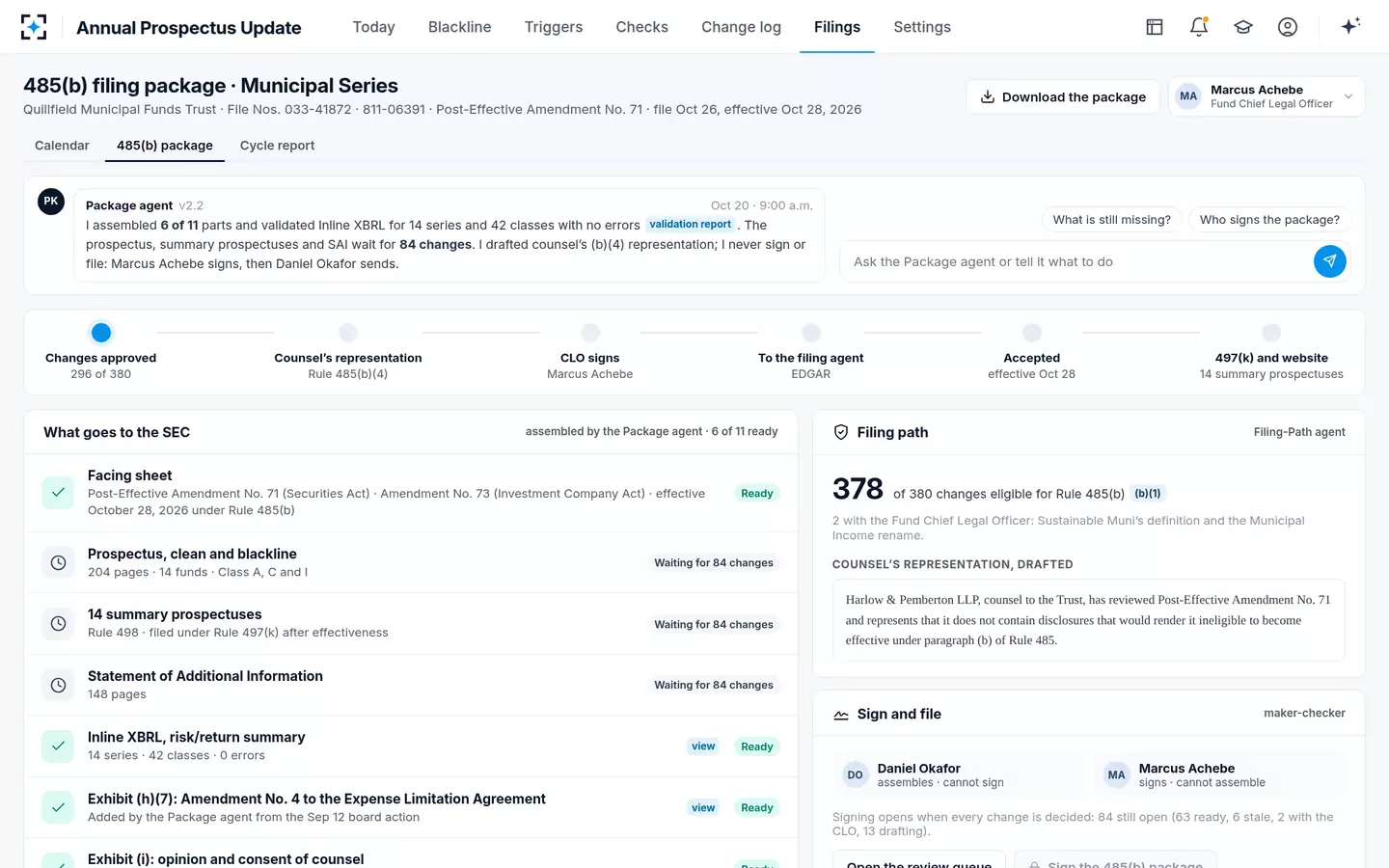
The hand-off between drafting and filing is a set of finished parts. For a Rule 485(b) annual update that means the facing sheet; the clean and marked prospectus, summary prospectuses and SAI; the Part C exhibits; the Inline XBRL values for Items 2 to 4; the powers of attorney; and counsel's representation under Rule 485(b)(4). The marking has its own rule: on EDGAR, the requirement to mark changed material is met by inserting tags "before and ... following a paragraph containing changed material", and "Financial statements and notes thereto need not be marked" (17 CFR 232.310).
Everything in that set is decided before the filing software sees it. If the set is wrong, the filing layer files it faithfully. That is why the useful question for a buyer is not which tool files better, but which tool makes the set right, and how the two connect.
The hand-off: the filing set, assembled and waiting for every change to be decided
Where the work actually sits: our estimate by layer
Most of an annual update's time sits above the filing layer. Our estimate for one registration statement's update in a mid-size complex is about 22 working days by hand, of which about two go on exhibits, Inline XBRL and assembling the filing; the other twenty go on collecting changes, re-keying tables, drafting, review rounds and the filing-path test. With agents in the first layer, we estimate the update at about 8.5 days, one of them on the filing layer.
Most of the update happens before the filing software is opened
By hand · 22 days
- Evidence and drafting · 91%
- Exhibits, XBRL, assembly · 9%
With agents · 8.5 days
- Evidence and drafting · 88%
- Exhibits, XBRL, assembly · 12%
The implication for a buyer is direct. A better filing tool can save part of the smaller share. A better drafting and checking layer works on the larger one, and it also reduces what the filing layer has to redo, because a set that is right the first time is tagged and validated once. Our guide to mutual fund filing requirements, priced puts wages on those days.
SEC filing services or software: who presses submit?
Fund groups split the filing layer in two ways. Some run filing software in-house, with their own filer codes and a regulatory reporting team that submits. Others use a filing agent, a service that converts, tags and submits on the fund's behalf, sometimes together with typesetting. Either way, the submission is the fund's: in the sample cycle the Chief Legal Officer signs, and then the filing manager sends the signed set to the filing agent.
The choice between them is about volume, control and the calendar. A complex that files several hundred amendments, supplements and summary prospectuses a year, with peaks such as the April surge when 1,773 485BPOS amendments were filed in 2025 by our count of the SEC's EDGAR indexes, needs capacity on the busiest days. The season guide shows that peak month by month.
EDGAR’s rules the filing layer exists to meet
16
hours a business day when EDGAR accepts filings: 6 a.m. to 10 p.m. ET
SEC, Accessing EDGAR Data
5:30 p.m.
ET: submissions begun later may be disseminated the next business day
SEC, Accessing EDGAR Data
Items 2–4
of Form N-1A must be filed as Inline XBRL whenever an amendment or 497 filing changes them
Form N-1A, C.3(g)
Suspended
the 485(b) path, automatically, if a required Interactive Data File is not submitted
Rule 485(c)(3)
The last of those is the filing layer's sharpest risk. Rule 485(c)(3) suspends a registrant's ability to file under paragraph (b) automatically "if a registrant fails to submit any Interactive Data File" the form requires, and the suspension lasts until the file is submitted. Every later amendment would wait sixty days under Rule 485(a) in the meantime, which is why Inline XBRL belongs in the filing set and not in a follow-up.
What to ask each layer before the season
The questions differ by layer, and a single vendor that claims both should answer both sets. Ask to see each answer on one of your own registration statements.
Questions for the filing layer and for the drafting layer
- Filing: what does validation reject?
Format, tags, required fields. Ask for an example of a well-formed filing it passed that later needed a supplement.
- Filing: how are summary prospectuses filed and posted?
Rule 497(k) requires each one filed no later than first use, and Rule 498 requires the documents online with working links.
- Filing: what happens on the last day?
Capacity on peak days, the 5:30 p.m. cut-off and how acceptance is confirmed.
- Drafting: where does each change come from?
A system of record and a cited passage, not a template field.
- Drafting: are unchanged numbers checked?
Stale numbers are the ones nobody edited; ask for coverage of the whole prospectus, summaries and SAI.
- Drafting: who decides the filing path and signs?
Named people, with the tool enforcing who may approve; never the tool.
- Both: how do the two connect?
The drafting layer should hand over a complete set the filing layer can tag and submit without re-keying.
Where Annual Prospectus Update fits, beside the filing tool you have
Annual Prospectus Update works in the first layer and connects to the others. The Trigger agent reads the systems of record, the Drafting and Rule agents draft, the Stale-Data agent checks every number, the Series Consistency agent keeps shared wording alike, and the Filing-Path agent tests each change under Rule 485(b). The assembling agent puts together the clean and marked documents, the Inline XBRL for the risk/return summary, the Part C exhibits and the cited change log. In the sample cycle, the Inline XBRL covered 14 series and 42 classes and validated with no errors before the set was handed over.
A change log closed in Annual Prospectus Update: every change approved and cited
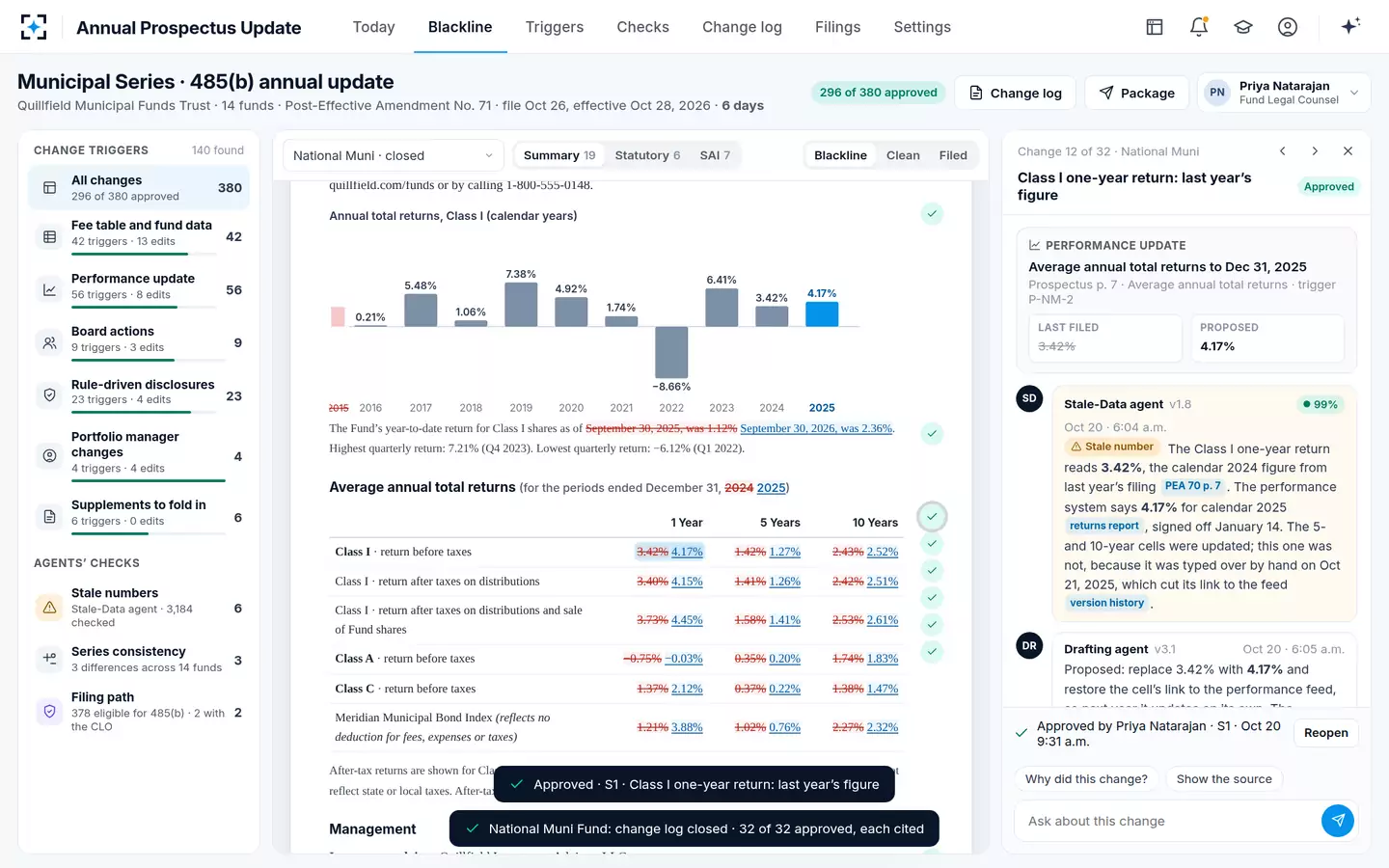
It does not replace the filing software or the filing agent, and it never signs or sends: once the Chief Legal Officer has signed, the filing manager sends the set to the filing agent. After acceptance, the assembling agent files the summary prospectuses under Rule 497(k) (17 CFR 230.497(k)) and posts the documents online for Rule 498 (17 CFR 230.498), the two steps that most often fall between teams. For the document system on the other side of the agents, see keeping the document system.
Questions people ask
What does EDGAR filing software do?
It prepares a filing in the formats EDGAR accepts, attaches exhibits, applies and validates Inline XBRL tags, submits the filing and records the acceptance. It works on documents that are already final; it does not decide their content.
Does filing software check the numbers in a prospectus?
It checks that values are well formed and tagged, not that they are current. A stale return or an expired waiver date passes validation. Checking the numbers needs a comparison with their sources, such as fund accounting and the performance system, before the filing is assembled.
What is the difference between a filing agent and filing software?
Filing software is a tool the fund's own team uses to submit. A filing agent is a service that converts, tags and submits on the fund's behalf. In both cases the registrant signs and is responsible for the filing.
What happens if a fund misses the Inline XBRL for its prospectus?
Rule 485(c)(3) automatically suspends its ability to file post-effective amendments under Rule 485(b) until the required Interactive Data File is submitted, so later amendments would go under Rule 485(a) and wait sixty days.
When does EDGAR accept filings?
Each business day from 6:00 a.m. to 10:00 p.m. Eastern time. Some submissions begun after 5:30 p.m. are disseminated the next business day, and filers should not presume acceptance until EDGAR's acceptance notice arrives.