The Names Rule compliance date is 11 June 2026 for fund groups with net assets of $1 billion or more at the end of their most recent fiscal year, and 11 December 2026 for groups below $1 billion. Neither is the day most funds actually switched. When the SEC extended the dates in March 2025, it tied each existing open-end fund's compliance to the effective date of its first on-cycle annual prospectus update filed on or after its group's date, so a fund's real date follows its fiscal year-end and can fall close to a year later. When that update falls is its own question, answered in how often a mutual fund prospectus must be updated. Only one piece moved again: the Form N-PORT names items now apply from 17 November 2027 for groups of $10 billion or more and 18 May 2028 for the rest, and a February 2026 SEC proposal would remove them. For a CCO the practical answer is a list of funds, each with its own date. Botminds' Fund Names Rule Compliance keeps that list, tests funds on the amended rule from the day they switch, and shadow-tests the rest until their update.
What changed on the Names Rule compliance date: the rule before and after
The 2001 rule, as applied before: Types of investment, industries, countries and regions; the Commission had treated "growth" and "value" as strategies outside the 80% requirement.
Rule 35d-1 as amended in 2023: Also names suggesting investments with "particular characteristics", including "growth", "value" and ESG terms.
The 2001 rule, as applied before: At the time of each investment.
Rule 35d-1 as amended in 2023: At the time of each investment, plus a review of every holding's inclusion "at least quarterly".
The 2001 rule, as applied before: Future investments must move the fund back toward the policy; no time limit.
Rule 35d-1 as amended in 2023: Back within "90 consecutive days" of identifying the shortfall, or of an other-than-normal departure.
The 2001 rule, as applied before: No valuation method in the rule.
Rule 35d-1 as amended in 2023: Notional amount, with rate derivatives restated as 10-year bond equivalents and options adjusted by delta.
The 2001 rule, as applied before: Not addressed by the rule's text.
Rule 35d-1 as amended in 2023: Terms must match their "plain English meaning or established industry use", and the prospectus must define them.
The 2001 rule, as applied before: None specific to the rule.
Rule 35d-1 as amended in 2023: Basis for each inclusion, reviews, departures and notices, kept six years.
The 2001 rule, as applied before: Nothing about names.
Rule 35d-1 as amended in 2023: Three names items, deferred to 2027–28; removal proposed.
When is the Names Rule compliance date? Two dates, then your own calendar
The dates in the rule are 11 June 2026 and 11 December 2026, set by fund group size. The release defines a larger entity as a fund that, together with other investment companies in the same "group of related investment companies", had net assets of $1 billion or more at the end of its most recent fiscal year (SEC, 90 FR 13076, n.13). On the SEC's own count most funds are in the larger tier: when the rule was adopted it estimated that 77% of registered investment companies would be larger entities, as of December 2022, and 48% of business development companies, as of March 2023.
The amendments themselves took effect on 11 December 2023. That is the "effective date" people search for, and it is not a compliance date: it is the day the amended text became law, with compliance deferred. The March 2025 release confirms that the effective date for the amendments, "as adopted September 20, 2023, remains December 11, 2023".
The Names Rule calendar in four SEC figures
77%
of registered investment companies were larger entities, on the SEC's December 2022 count
6months
added in March 2025; the industry had asked for at least 18
~70%
of funds have fiscal year-ends from August to December, the SEC notes ("nearly 70%")
17–23months
more for the Form N-PORT names items, depending on fund group size
Why the SEC extended the Names Rule compliance date in March 2025
The SEC extended the dates by six months because the systems funds needed were not ready. The original dates were 11 December 2025 for larger groups and 11 June 2026 for smaller ones. In March 2025 the Commission wrote that "some technological systems and service providers' analysis to support these functions are still in development", that some legacy systems could not support the enhanced recordkeeping, and that the problems were "compounded for funds with subadvisers and derivatives holdings" (90 FR 13076).
Industry groups had asked for at least 18 months. The Commission gave six, plus something worth more to most funds: compliance tied to each fund's own disclosure cycle. Without it, a fund whose annual update fell before its compliance date had two bad options, which the release describes as "complying earlier than the initial compliance dates permitted, or taking the full compliance period but incurring the expense of an 'off-cycle' amendment". The Commission's example was a fund with a 31 December year-end that would have had to file its annual 485(a) amendment by 2 March 2025 to be effective on 1 May 2025.
On-cycle compliance: how a fiscal year-end sets a fund's real date
Under the modified dates, an existing open-end fund must comply "at the time of the effective date of its first 'on-cycle' annual prospectus update that the fund files on or following" its group's compliance date. Other fund types have their own trigger, set out below. The SEC expected the effect to be large: "most funds effectively will have additional time to comply", it wrote, "with some funds having close to an additional year to comply, depending on the timing of their fiscal year-ends".
Which event switches each kind of fund to the amended Names Rule
| Fund | Must comply at | On or after |
|---|---|---|
| New fund | The effective date of its initial registration statement | The filing date falls on or after the group's date |
| Existing open-end or continuously offered fund | The effective date of its first on-cycle annual prospectus update | The update is filed on or after the group's date |
| Existing registered closed-end fund relying on rule 8b-16(b) | Transmittal of its first annual report to shareholders | The group's date |
| Existing BDC not in a continuous offering | Filing of its first annual report on Form 10-K | The group's date |
| Fund registered only under the Investment Company Act, not relying on 8b-16(b) | Filing of its annual update under rule 8b-16(a) | The group's date |
| Privately offered BDC | Effectiveness of its Form 10, or filing of Form N-54A | The group's date |
Two funds, one fund group, six months apart
Two illustrations show the spread, assuming a 485(a) amendment, which takes effect 60 days after filing. A fund in a larger group with a 30 June year-end must update within 120 days of year-end under rule 8b-16, so it files in late August 2026 and switches when that update takes effect, around the end of October 2026. A fund in the same group with a 31 December year-end had already filed its 2026 update before 11 June; its first update filed after that date is the one for 2027, effective around 1 May 2027. Same group, same rule, six months apart. A smaller group's December year-end fund also switches in spring 2027, since its first update filed after 11 December 2026 is the 2027 one.
The spread is why a single date on a project plan misleads. Because "nearly 70% of funds have fiscal year-ends between August and December", in the SEC's words, most funds' first updates under the amended rule cluster in a few months, and in a complex with several year-ends, compliance arrives fund by fund across most of a year.
What moved to 2027 and 2028: only the Form N-PORT names items
On 18 February 2026 the SEC extended one part of the 2023 amendments and left the rest alone. The Form N-PORT names items, which would report each fund's term definitions, its 80% basket as a share of assets and whether each holding is in the basket, now apply from 17 November 2027 for fund groups with net assets of $10 billion or more and 18 May 2028 for groups below $10 billion. The release is explicit that the compliance dates "for all other amendments to rule 35d-1 ... remain June 11, 2026" and "December 11, 2026" (91 FR 8379).
The same day, in a separate release, the Commission proposed removing the N-PORT names items altogether; comments were due by 24 April 2026 (91 FR 8582; SEC press release 2026-19). At the end of October 2026 the removal was still a proposal. If it is not adopted, a fund starts reporting the items with its first fiscal quarter-end after its compliance date: for a large-group fund with a December quarter-end, that is the N-PORT report for December 2027. Costs, the $10 billion threshold and what a small complex should build now are in the N-PORT names rule cost guide.
The Names Rule compliance date in months: two extensions, then each fund's own cycle
- Original period, Sep 2023 to Dec 202527 months
- Extension to 11 Jun 2026+6
- Until the first annual update filed after the dateup to ~11
- Original period, Sep 2023 to Jun 202633 months
- Extension to 11 Dec 2026+6
- Until the first annual update filed after the dateup to ~11
- Adoption to the old date, 11 Jun 202633 months
- Deferred to 17 Nov 2027+17
- Adoption to the old date, 11 Jun 202633 months
- Deferred to 18 May 2028+23
Is the Names Rule in effect in 2026?
Yes. The amended rule has been in force since 11 December 2023, larger fund groups have been switching since 11 June 2026 and smaller groups follow from 11 December 2026, each fund at its own trigger. The only parts not yet operating are the N-PORT items. The staff's 2025–26 FAQs, last updated on 18 February 2026, are written for funds applying the amended rule now, with answers on "growth", "income", "merger arbitrage" and unfunded commitments (SEC staff FAQs).
"Not yet switched" is not the same as "unregulated". Until its trigger, a fund remains subject to the rule as it stood before the amendments, and every fund remains subject to section 35(d)'s ban on materially deceptive or misleading names. A fund cannot drift during the gap and expect the switch to wipe the slate.
The months after the switch: what a fund on the amended rule must show
From its trigger, a fund needs four things it may not have had: a prospectus that defines each term in its name, including "the criteria the fund uses to select the investments that the term describes"; a dated quarterly review of every holding's inclusion in the basket; a written basis for including each new investment, made at the time of investment; and a departure process with a 90-day clock (90 FR 13076, n.4; Rule 35d-1(b)). Who should hold each duty is set out in the Names Rule compliance requirements guide.
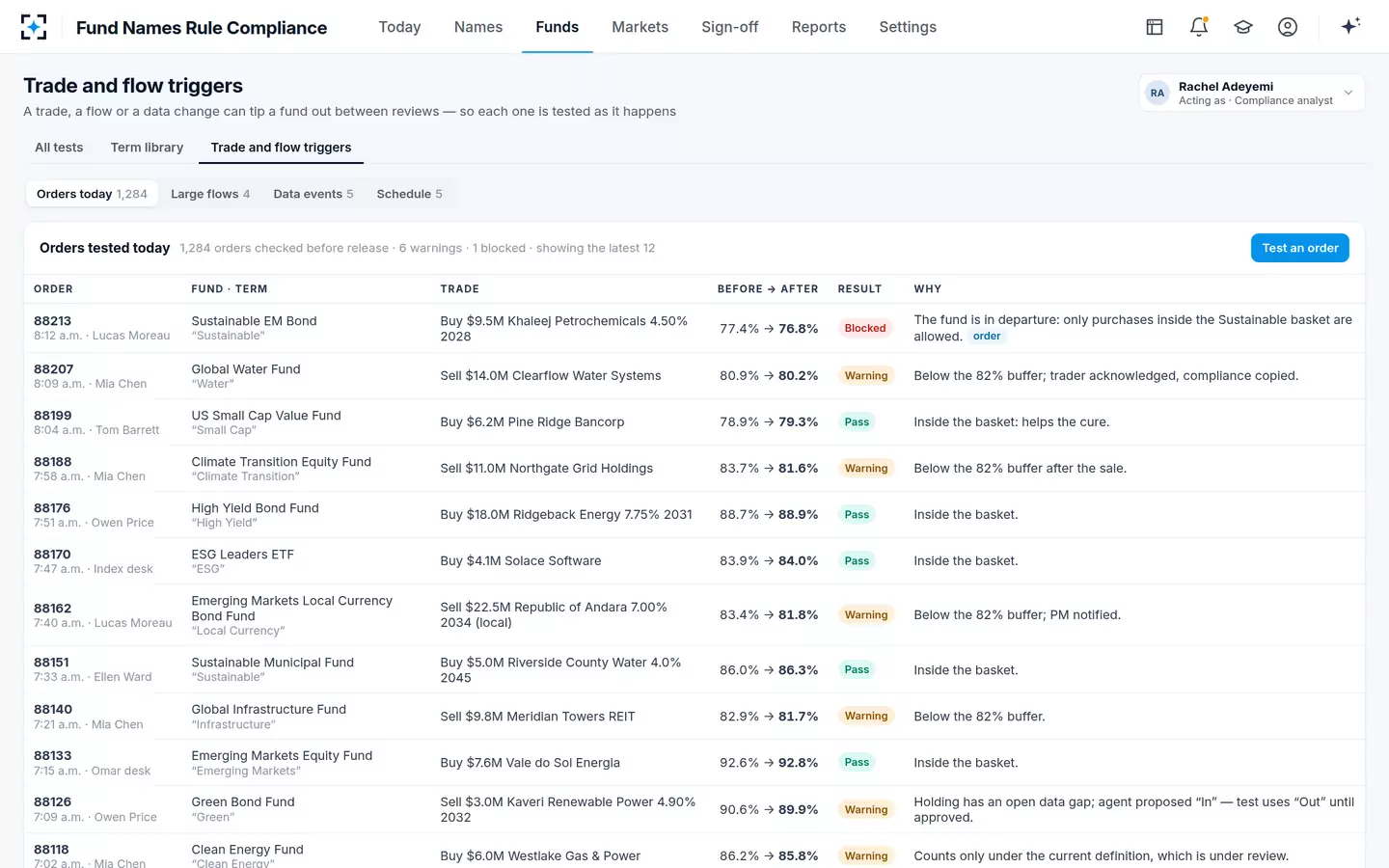
The first quarter-end after the switch is the first review an examiner can ask for. In the fictional sample firm in Fund Names Rule Compliance, a bond fund that moved to the amended rule with its July 2026 update had its first formal review due on 30 October, 30 days after the September quarter-end, and on 19 October it was already 12 days into a departure.
From the switch onward, every order is tested against the name
A readiness check for funds whose date has not arrived
For a smaller group with December year-ends, the switch is in spring 2027, and the work before it is mostly the same as a larger group's was. The difference is that the hard questions are now answered in public: the staff FAQs, the N-PORT deferral and a year of larger funds' prospectus definitions on EDGAR to compare against.
Before a fund's switch date: what should already be done
- Map every fund to its trigger and its date
Group net assets at the last fiscal year-end, fiscal year-end, filing path and the expected effective date of the first update after the group's date.
- Decide each name before drafting the update
Keep and comply, adjust the portfolio, or rename with notice. A rename decided late becomes an off-cycle amendment.
- Write each definition so data can test it
Every criterion in the prospectus definition should map to a field or a document; check it against the staff FAQs for the terms they cover.
- Back-test the basket on recent quarter-ends
Run the amended test on the last four quarters with derivatives at notional, so the first real review is not the first measurement.
- Set the departure procedure
Who identifies, who plans the cure, who decides trades, who releases, who signs, and the firm's milestones inside the 90 days.
- Start the records from day one
The basis for each inclusion is required at the time of investment; a file reconstructed later is weaker evidence.
- Keep N-PORT data in reach, not in production
Definitions, basket share and holding-level flags will exist anyway; whether they are filed depends on the SEC's decision on the proposal.
Fund Names Rule Compliance holds each fund's trigger and date, shadow-tests a fund under the amended rule until its update takes effect, and then switches it to live testing with the records the rule requires. The program, with its screens, is on the Fund Names Rule Compliance page.
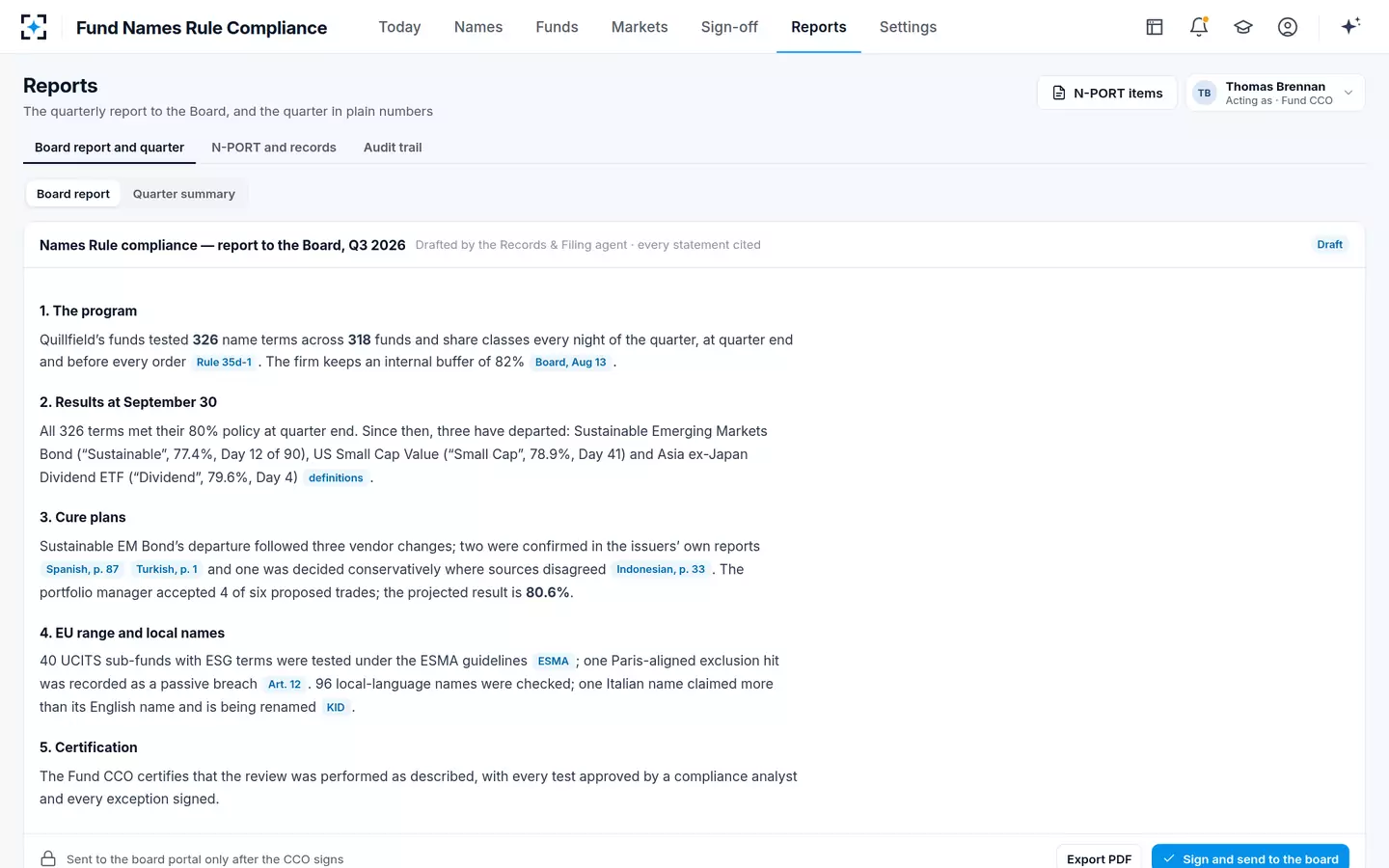
The board hears the quarter in plain numbers, every statement cited
Questions people ask
When is the SEC Names Rule compliance date?
11 June 2026 for fund groups with net assets of $1 billion or more at the end of their most recent fiscal year, and 11 December 2026 for smaller groups. An existing open-end fund complies from the effective date of its first on-cycle annual prospectus update filed on or after its group's date.
What is the Names Rule effective date?
11 December 2023. That is when the amendments adopted on 20 September 2023 took effect; compliance was deferred, first to December 2025 and June 2026, then, in March 2025, to June and December 2026.
Was the Names Rule compliance date extended again in 2026?
Only for Form N-PORT. On 18 February 2026 the SEC moved the N-PORT names items to 17 November 2027 ($10 billion or more) and 18 May 2028, and proposed removing them. Every other part of the amendments kept the June and December 2026 dates.
How is a "larger" fund group defined for the Names Rule?
By the net assets of the fund together with the other investment companies in its group of related investment companies at the end of the most recent fiscal year: $1 billion or more is larger. For the N-PORT items alone the SEC used a $10 billion threshold, under which it estimated 22.9% of registered investment companies are smaller, holding about 2.13% of assets.
Does a new fund get the on-cycle extra time?
No. A new fund must comply from the effective date of its initial registration statement filed on or after its group's date. Only existing funds can wait for their first annual update after that date.