The Names Rule compliance requirements come from one SEC rule, Rule 35d-1 under the Investment Company Act, as amended in 2023. A fund whose name suggests a focus must adopt a policy to invest at least 80% of its assets in that focus, use each term in its plain English meaning or established industry use, define it in the prospectus, review the 80% basket at least quarterly, get back to 80% within 90 consecutive days of identifying a shortfall, give shareholders 60 days' notice before changing a non-fundamental policy, value derivatives at notional and keep written records for six years. Larger fund groups' compliance date was 11 June 2026 and smaller groups' is 11 December 2026, with each existing fund switching at its first annual update after its date. The duties fall on different desks, which is where programs break: the words belong to counsel, the test and the clock to compliance, the cure to the portfolio manager, the signature to the chief compliance officer. Botminds' Fund Names Rule Compliance runs the testing and the paperwork between those desks with agents, and leaves each decision and signature with the person who owns it.
The Names Rule duty chain: seven steps, and four belong to people
A person decides
Fund counselWrites the 80% policy, the plain-English definition of every term in the name, and any 60-day notice before a policy or name changes.
Never: Lets one word mean three things in three trusts
Agent
Term MapperSplits each name into terms, finds each definition in the prospectus or SAI, and turns it into a data rule that quotes the sentence it came from.
Never: Changes a definition or a name
Agent
Holdings Tester and Check agentCompute each term's basket every night, at quarter end and before every order; a second agent recomputes failing and near-line results by a different method.
Never: Marks a test approved
A person decides
Compliance analystApproves each test with its evidence, and opens a departure on the day the fund is found below 80%, with the date and the reason.
Agent
Cure PlannerRuns the 90-day clock and proposes trades from the portfolio manager's approved buy list, each checked against every other limit.
Never: Sends an order
A person decides
Portfolio managerAccepts or declines each proposed trade, with a reason; compliance then checks the decisions and releases the orders.
A person decides
Fund CCOSigns the departure, every data override and definition change, and the quarterly certification, each with the evidence attached.
Never: Signs anything he or she prepared
What are the Names Rule compliance requirements? Seven duties in one rule
The amended rule asks for seven things of a fund whose name suggests a focus, and an eighth, Form N-PORT reporting, that the SEC has deferred to 2027 and proposed to remove. The scope widened in 2023: alongside names suggesting a type of investment, an industry or a region, the rule now reaches names suggesting investments with "particular characteristics", and its own examples are "growth" or "value" and terms indicating that investment decisions "incorporate one or more environmental, social, or governance factors" (17 CFR 270.35d-1(a)(2)). The SEC estimated that the amendments would take the share of funds needing an 80% policy from about 60% to about 76%, roughly 10,300 funds (adopting release, 2023).
The seven duties, where each sits in the rule, and the desk that usually holds it
| Duty | What the rule says | Usually held by | What proves it |
|---|---|---|---|
| 1. Adopt the 80% policy | "at least 80% of the value of its assets" in the focus the name suggests, "under normal circumstances" — (a)(2)(i) | Fund counsel, adopted by the board | The policy text in the prospectus |
| 2. Make it fundamental, or promise notice | A fundamental policy, or "at least 60 days' prior notice" of a change — (a)(2)(ii), (d) | Fund counsel | The policy wording; any notice sent |
| 3. Use words as investors read them | Each term used in its ordinary sense or its settled industry meaning — (a)(2)(iii) | Fund counsel and the product team | The prospectus definition of each term |
| 4. Review the basket each quarter | Review each investment's inclusion in the 80% basket "at least quarterly" — (b)(1)(i) | Compliance | A dated review, investment by investment |
| 5. Get back to 80% in time | "within 90 consecutive days" of identifying a shortfall, or of an other-than-normal departure — (b)(1)(i)–(ii) | Portfolio manager, run by compliance | The date found, the reason, the trades |
| 6. Count derivatives at notional | Each derivative valued "using the instrument's notional amount" — (g) | Compliance and operations | The calculation, with its adjustments |
| 7. Keep the records | Written records kept "for a period of not less than six years", the first two "in an easily accessible place" — (b)(3) | Compliance | The file an examiner asks for |
One more sentence in the rule changes how the other seven should be read. Paragraph (c) says a fund name "may be materially deceptive or misleading" under section 35(d) of the Act "even if the fund adopts and implements" the policy and otherwise complies. Passing 80% is necessary and not sufficient, which is why the words in duty three matter as much as the arithmetic in duty four; the 80% test and where it stops works through that gap.
Who is responsible for Names Rule compliance at a fund?
The fund is, and in practice four desks share it. The rule writes every duty as an obligation of "the fund"; it names no officer. The fund's board adopts the policies and its compliance program covers them (the rest of a fund board's year is laid out in the fund governance board calendar), but day to day the work splits across legal, compliance, portfolio management and operations, and the SEC has said so itself: in extending the compliance date in March 2025 it noted that "the development of a names rule compliance plan requires coordination among a fund's legal, compliance, and operations departments", and that an industry letter listed "compliance, legal, portfolio management, reporting, distribution, and technology" among the teams involved (SEC, 90 FR 13076).
The same release explains why the split is hard. A fund with several subadvisers may find that each "may initially define differently the same term used in the fund's name", and agreeing one approach "can be time-consuming". Every hand-off in the chain above is a place where a term can drift: counsel's definition, the data rule coded from it, the vendor field the data rule reads, the trade that cures a shortfall.
Four seats carry the Names Rule; each keeps a different decision
Today
Drafts definitions trust by trust and learns of a data change when the test fails.
With agents
Sees every term's definition beside the data rule coded from it, and every local name aligned with the English.
Still theirs: What each word means, and any name or policy change
Today
Hand-codes baskets, re-runs them after vendor changes and keeps the 90-day clock in a calendar.
With agents
Starts from the overnight results and the items that need a person, and approves each test with its evidence.
Still theirs: Approving a test; calling a data dispute
Today
Hears about a shortfall by email and is asked to fix it without a list of trades.
With agents
Gets cited trades from the approved buy list with their effect on every limit.
Still theirs: Which trades, if any, to make
Today
Signs a quarterly certification over spreadsheets he cannot trace.
With agents
Signs each exception from one queue, with the evidence behind it, never a file he made.
Still theirs: The signature on every exception
Counsel owns the words: the policy, the definition and the 60-day notice
Counsel's first job is the choice between a fundamental policy and a 60-day notice policy, and the staff's 2025–26 FAQs make it cheaper than many funds assumed. Adopting a new fundamental 80% policy needs no shareholder vote unless it deviates from an existing fundamental policy; a fund that tightens a broad "equity" policy to "equity investments with growth characteristics" would generally not be deviating, in the staff's view (SEC staff, 2025–26 Names Rule FAQs). A February 2026 answer adds that the staff would not object if a fund gave no 60-day notice for non-material changes made solely to comply with the amended rule, or to make the policy more stringent.
The definitions are the harder half. The SEC chose not to prescribe them: the amended rule gives managers "flexibility to ascribe reasonable definitions for the terms used in a fund's name", and the adopting release accepts that "different funds and various third-party data providers may use different definitions for the same term" (88 FR 70436). That flexibility is also counsel's exposure. A definition that a data vendor's field cannot express, or that means one thing in the US prospectus and another in a Luxembourg sub-fund, is a definition no test can prove.
When a name or policy does change, the notice is prescriptive. It goes out in plain English, separately from other documents, under the bold-face heading "Important Notice Regarding Change in Investment Policy [and Name]", which also goes on the envelope or in the email subject line, and it must describe the policy, the change, the old and new names and the effective date (Rule 35d-1(d)). A fund deciding whether to rename at all should read the rename, re-basket or relabel decision first.
Compliance owns the clock: the quarterly review and the 90-day return
Compliance owns the two dates the rule counts. The basket review is "at least quarterly", investment by investment, with the basis for each inclusion written down. The 80% requirement itself applies "at the time a fund invests its assets", so a fund that falls below 80% through market moves is not in breach on that day; it must make future investments that bring it back "as soon as reasonably practicable, and in all circumstances within 90 consecutive days of the fund's identification" of the shortfall (Rule 35d-1(b)(1)(i)).
The clock starts on identification, which makes the identification date the most important fact in the file. A fund that tests quarterly can sit below 80% for weeks before it identifies anything; a fund that tests nightly starts the clock the morning after. The rule allows three other temporary departures: in other-than-normal circumstances (again 90 consecutive days, from the initial departure), to reposition or liquidate for a reorganization, and during a launch, defined as up to 180 consecutive days from the start of operations.
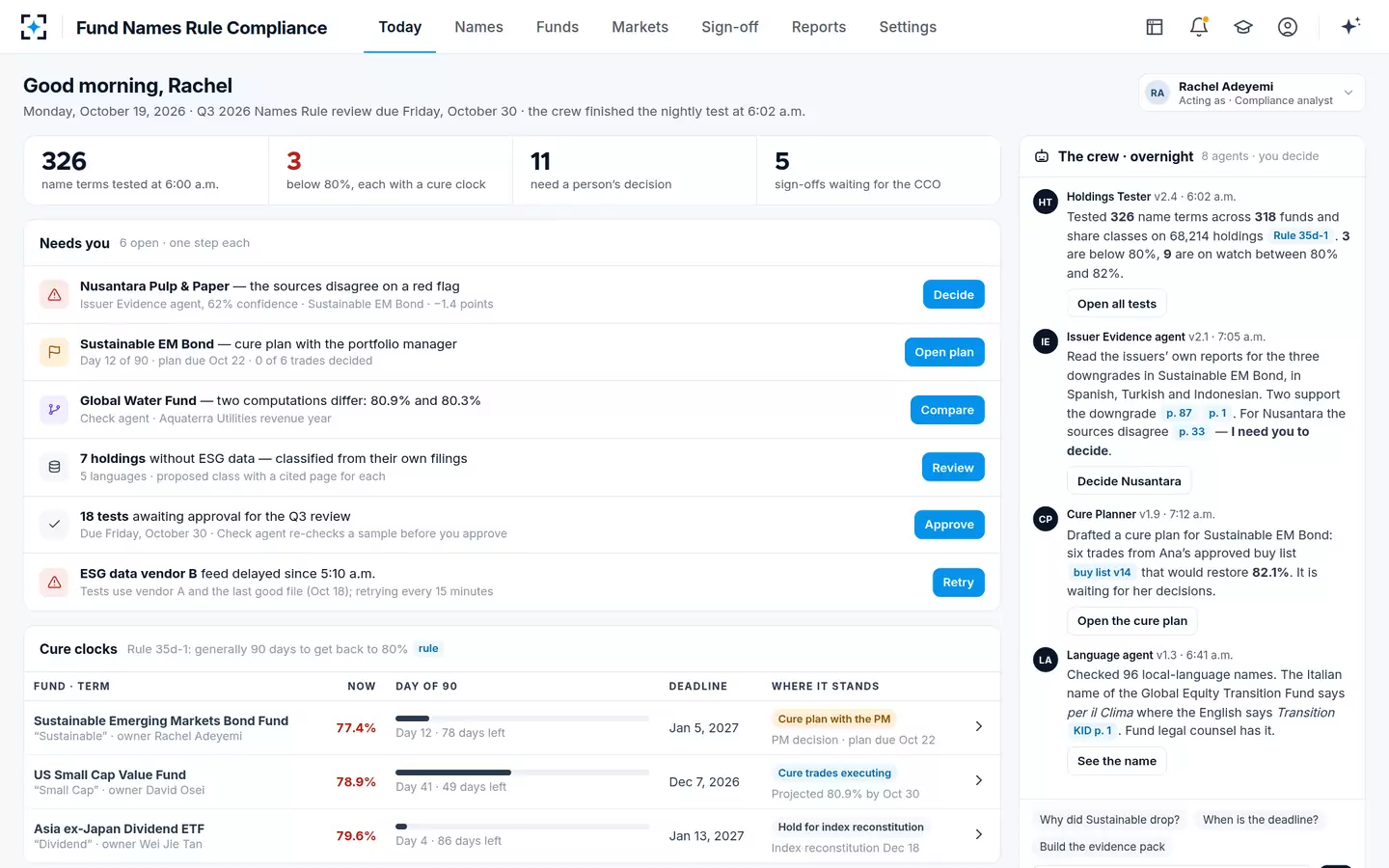
The rule does not require a fund to tell its board about a departure. Commenters asked the SEC to adopt board reporting instead of fixed time limits, and the Commission chose time limits, reasoning that a prolonged drift "would be inconsistent with the investor protection concerns that underlie the names rule" (88 FR 70436). A fund can still add board reporting by policy. Quillfield Capital, the fictional firm in the Fund Names Rule Compliance sample, sets milestones inside the 90 days: a cure plan by day 15, CCO review by day 30, a firm target of day 60 and board notice by day 75.
Every open departure on one screen, each with its clock
The portfolio manager owns the cure, and only the cure
The rule tells the fund to "make future investments" that restore 80%; it does not say which. That choice belongs to the portfolio manager, because a cure trade has to respect everything else the fund promises: duration, liquidity, issuer limits, the cash it needs for redemptions. A compliance team that picks the trades has taken over the portfolio; a portfolio manager who releases his own cure orders has marked his own homework.
The sample shows the split. Quillfield's Sustainable Emerging Markets Bond Fund was at 81.9% on the quarter-end test; three ESG vendor changes later it stood at 77.4%. The Cure Planner proposed six trades from the manager's approved buy list, each with its effect on "Sustainable" (one point of the meter was $14.86 million) and on every other limit. The portfolio manager accepted four and declined two, one for liquidity and one to keep cash for an expected $41.0 million redemption; the projected result was 80.6%. A compliance analyst then checked the decisions against the plan and released seven orders. Nobody did both jobs.
Records: the duty nobody owns until an examiner asks
Records are the duty most likely to be treated as a by-product, and the one the SEC found hardest to automate. The rule asks for written records of each investment's place in the 80% basket and the reason for it, made when it is bought; the basket's value as a share of assets; each quarterly review; the date any shortfall was identified and its reason; why circumstances were judged other-than-normal; and every notice sent (Rule 35d-1(b)(3)).
The SEC's own estimates show what that means. It put recordkeeping at $30,450 per fund a year, internal time plus set-up spread over three years, and conceded that "some records, such as those documenting the reasons for any departures from the 80% investment policy, are unlikely to be easily automated" (88 FR 70436). Eighteen months later it reported, from staff discussions with the industry, that the basis for one inclusion "could include up to 50 data points" and that "current common software recordkeeping solutions are ill-equipped to capture such a high number of data points" (90 FR 13076, n.11).
What each signature in a Names Rule program should attest to
- Counsel, on a definition: the words can be tested
Each criterion in the definition maps to a data field or a document a reviewer can open, and the same term means the same thing in every trust and market.
- Analyst, on a test: the basket matches the definition
The data rule quotes the definition it implements, the inputs are dated, and a second computation agrees, or the difference is explained.
- Analyst, on a data dispute: the evidence was read
Where vendors disagree, the issuer's own document was read and cited, and the choice made is the conservative one or says why not.
- Portfolio manager, on a cure: each trade was decided
Every proposed trade is accepted or declined with a reason, and the accepted set restores 80% inside every other limit.
- Compliance, on release: the orders match the decisions
Only accepted trades are staged, each passes the pre-trade names test, and the person releasing them did not choose them.
- CCO, on an exception: the file is complete
Identification date, reason, plan, decisions and evidence are attached, and the CCO prepared none of it.
What the 2025–26 Names Rule FAQs settle, and what they cannot
The staff's 2025–26 FAQs answer the term questions most programs stalled on, and they bind nobody. The page says so plainly: the answers "are not rules, regulations, or statements of the Commission", and they "have no legal force or effect" (SEC staff FAQs, updated 18 February 2026). They are still the best evidence of how examiners will read a name, and counsel should keep a dated copy of the version relied on.
What the staff's Names Rule FAQs say about common terms
| Term or situation | The staff's view | Answer dated |
|---|---|---|
| "High-yield" | Needs an 80% policy. Paired with "municipal" or "tax-exempt", the staff would not object to less than 80% in bonds meeting the high-yield criteria. | 8 Jan 2025 |
| "Municipal" vs "tax-exempt" | Both are tax-exempt names; a "municipal" fund may count income subject to the alternative minimum tax, a "tax-exempt" fund may not. | 8 Jan 2025 |
| "Tax-sensitive", "tax-managed" and similar | No 80% policy: the term describes the portfolio's overall characteristics. | 8 Jan 2025 |
| "Income" alone | Generally no 80% policy, unless it means fixed income. | 8 Jan 2025 |
| "Growth" or "value" | An 80% policy, except where a modifying term shows they are not the predominant component; "income" with "growth" needs none for "growth". | 18 Feb 2026 |
| "Merger" or "merger arbitrage" | No 80% policy: an investment technique or portfolio-wide result. | 18 Feb 2026 |
| Cash held for unfunded commitments | May count toward the 80% policy where it covers commitments to basket investments the fund expects to be called, with disclosure. | 18 Feb 2026 |
What the FAQs cannot settle is a fund's own definition. Two funds may both call themselves "Sustainable" and define it differently, as the SEC intended; the FAQs only tell you whether the word needs a policy at all. The definition, the data rule and the evidence remain each fund's work.
Where Fund Names Rule Compliance fits the chain
Fund Names Rule Compliance takes the repeatable work between the signatures. Eight agents split names into terms, find each definition, test every term nightly, before orders and after large flows, recompute near-line results independently, read issuers' own reports when vendor data moves a meter, plan cures, apply ESMA's tests to EU sub-funds, check local-language names and draft the board report. The people in the chain do what the rule and good governance reserve for them: counsel defines, the analyst approves, the portfolio manager decides, compliance releases, the CCO signs.
The CCO's queue: every exception, who prepared it and what it rests on
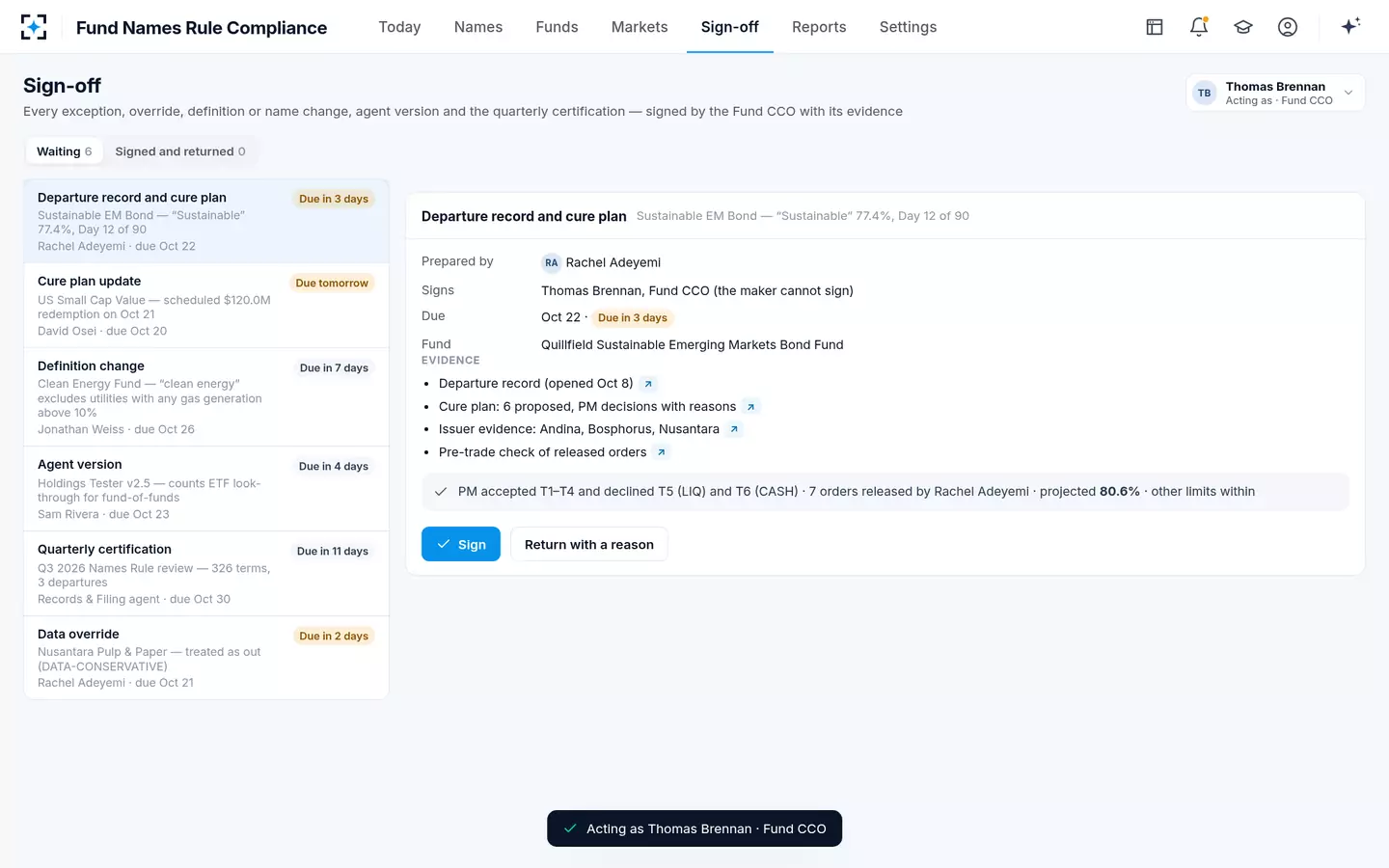
What it does not do is as important. The agents never trade, file, rename a fund, change a definition, approve a test or settle a disagreement between data sources; below their confidence threshold they ask a person. The dates that start each fund's obligations are in the Names Rule compliance date guide, and the whole program, screen by screen, is on the Fund Names Rule Compliance page.
Questions people ask
Who is responsible for Names Rule compliance?
The rule puts every duty on the fund itself and names no officer. In practice fund counsel owns the policy and definitions, compliance owns the quarterly review, the 90-day clock and the records, the portfolio manager owns the cure trades, and the chief compliance officer signs exceptions under the fund's compliance program.
Does the Names Rule require board reporting of a departure?
No. Commenters proposed board reporting in place of fixed time limits, and the SEC adopted the 90-consecutive-day limits instead. A fund may still report departures to its board by policy; the sample firm in the solution gives the board notice by day 75 of the 90.
What records does the amended Names Rule require?
A note made with each purchase saying whether it counts toward the 80% basket and why; the basket's value as a share of assets; each quarterly review; the date and reason for any shortfall or other-than-normal departure; and any shareholder notice. They are kept at least six years, the first two in an easily accessible place.
Are the SEC's 2025–26 Names Rule FAQs binding?
No. The staff states that the FAQs are not rules or Commission statements and have no legal force or effect. They are the staff's view on terms such as "high-yield", "municipal", "growth" and "merger arbitrage", last updated on 18 February 2026.
Does a fund need shareholder approval to adopt an 80% policy?
Not usually. In the staff's view the Investment Company Act requires a vote only to deviate from an existing fundamental policy, so adopting a new fundamental 80% policy, or tightening one to match the amended rule, generally needs none. State law or the fund's charter may still require one.
How often must the 80% basket be reviewed?
At least quarterly, investment by investment, with the basis for each inclusion recorded. The rule also applies the 80% test at the time of each investment, which is why many funds test before every order and nightly as well.