The Names Rule 80% test asks one question: does the fund invest, under normal circumstances, at least 80% of the value of its assets in investments that match the focus its name suggests? Rule 35d-1 under the Investment Company Act requires that policy of every fund whose name suggests a type of investment, an industry, a region or a characteristic such as "growth", "value" or an ESG factor, and since the 2023 amendments the test is reviewed at least quarterly, measured with derivatives at notional and read against the plain English meaning of each word. The trouble is that the test a compliance engine runs is not the rule's test. An engine checks the basket it was coded with, from whatever data field someone mapped; the rule checks the name. In most programs an analyst hand-codes each basket from the prospectus, and every step between the prospectus sentence and the engine's field is a place where a basket can be valid and still inaccurate. Botminds' Fund Names Rule Compliance keeps each term's data rule beside the sentence it came from and recomputes near-line results by a second method.
Valid is not accurate: the four outcomes of a Names Rule 80% test
Passes the engine, matches the name
Compliant and provable: the basket follows the prospectus definition, the data behind each holding is dated and a second computation agrees.
Passes the engine, does not match the name
Valid, not accurate. The engine tested a vendor field, an old classification or a market value, and the name promises something else. Nobody is alerted.
Fails the engine, matches the name
A false alarm: holdings with no data, a definition coded too narrowly, a late feed. Costly in time, but visible.
Fails the engine, does not match the name
A real shortfall. Record the date it was identified and the reason, and start the 90-day clock.
What is the Names Rule 80% test?
It is a policy test, applied at the time of each investment and reviewed at least quarterly. A fund whose name suggests a focus must adopt "a policy to invest, under normal circumstances, at least 80% of the value of its assets in investments in accordance with the investment focus that the fund's name suggests" (17 CFR 270.35d-1(a)(2)(i)). "Assets" means net assets plus borrowings for investment purposes, with derivatives at notional; for a name suggesting a country or region, qualifying investments are those "tied economically" to it. Tax-exempt names can use an income test instead: 80% of distributed income exempt from tax, under a fundamental policy.
The 2023 amendments widened who must pass. The SEC estimated that about 8,100 funds, 60%, were subject to the 80% requirement before the amendments and about 10,300, 76%, after, mainly because names suggesting investments with "particular characteristics" were brought in (88 FR 70436). The statute behind it is short: section 35(d) of the Investment Company Act makes it unlawful for a registered fund to use "any word or words that the Commission finds are materially deceptive or misleading", and authorises the SEC to define them by rule (15 U.S.C. 80a-34(d)).
Who the Names Rule 80% test reaches, by the SEC's estimates
60%→ 76%
of funds subject to the 80% requirement, before and after the 2023 amendments
~10,300
funds with an 80% policy once the amendments apply
up to 50
data points behind the basis for one holding's inclusion, the SEC heard from the industry
What counts toward the 80% basket?
The basket is the investments "invested in accordance with the investment focus that the fund's name suggests", on the fund's own definition of each term. Three kinds of position need care. Derivatives count at notional, and may join the basket if they give exposure to the focus or to "one or more of the market risk factors associated with" it (Rule 35d-1(b)(2)); the calculation is worked in the SEC Names Rule derivatives guide. Cash is outside the basket, except that the staff would not object to counting cash held to meet unfunded commitments to basket investments a fund expects to be called, with disclosure (staff FAQs, February 2026). And a name with several terms needs a basket for each: "Sustainable Emerging Markets Bond" is three tests, not one.
Each inclusion also needs a reason on file. The rule requires written records, at the time of each investment, of whether it is in the basket "and, if so, the basis for including such investment", and the quarterly review must record the same for every holding (Rule 35d-1(b)(3)). That record is where valid and accurate part company: a basket can be at 85% in the engine and still have no basis on file that matches the prospectus.
Valid is not accurate: four ways a basket passes the engine and fails the name
A compliance engine is valid when its output follows its configuration; it is accurate only if the configuration follows the name. Four gaps open between the two, and none of them raises an alert on its own.
What a compliance engine checks, and what the Names Rule 80% test asks
What the engine checks: A data rule an analyst coded from the prospectus, months ago.
What the rule asks: The prospectus definition in force today, in plain English or established industry use.
What the engine checks: One vendor's field: a sector code, a rating band, a country of incorporation.
What the rule asks: Whatever evidence shows the holding meets the definition, including the issuer's own reports.
What the engine checks: Often at market value, or left out.
What the rule asks: At notional, converted or delta adjusted; in the basket only if they give the focus or its risk factors.
What the engine checks: The English name in the fund database.
What the rule asks: The name investors see, including each registered local-language name.
What the engine checks: A percentage.
What the rule asks: A percentage, the basis for each holding and the date of any shortfall.
The first gap is definitional drift. A definition changes in an annual update and the coded rule does not, or the rule was coded from one trust's prospectus and applied to another's. The SEC described the subadvised version of this problem in 2025: each subadviser of one fund may start with its own definition of the same word in the fund's name, and agreeing a single one takes time (90 FR 13076, n.12). The second is the proxy field: "Emerging Markets" tested by country of incorporation when the definition says organized, headquartered or earning at least half its revenue there.
The third is stale data. A vendor's classification is a view, and views change; the basket is accurate only as of the data's date. The SEC's WisdomTree order shows the extreme case, where vendor data used for an ESG screen did not screen out all the companies the funds had promised to exclude (SEC press release 2024-173). The fourth is translation: a German or Italian name that claims more than the English, tested by an engine that only knows the English.
Plain English or established industry use: the test behind the test
Every term in a name that suggests a focus must be "consistent with those terms' plain English meaning or established industry use" (Rule 35d-1(a)(2)(iii)). It is the provision that makes the 80% test about the name rather than the code: a fund cannot pass 80% by defining "technology" to include banks. The SEC gave funds room, but bounded it; the amended rule is meant to leave funds "reasonable discretion in establishing their 80% investment policies", and different funds with "growth" in their names will naturally define it differently (88 FR 70436).
The staff's FAQs show the test in practice. "High-yield" is generally understood to mean bonds below certain creditworthiness standards, so a high-yield fund needs an 80% policy on that basis; paired with "municipal", the staff would not object to less, because the market for below-investment-grade municipal bonds is smaller and less liquid (staff FAQs, January 2025). In each answer the question is what the word means to an investor, not what a vendor field can deliver.
When 80% is not enough: section 35(d) still applies
Passing 80% does not make a name safe. Paragraph (c) of the rule says a name "may be materially deceptive or misleading under section 35(d) of the Act even if the fund adopts and implements a policy" and otherwise complies (Rule 35d-1(c)). The SEC gave an example of its own in the adopting release: a fund's name may mislead even when it meets the 80% requirement using notional amounts as the rule requires (88 FR 70436, n.237).
The practical cases are the remaining 20% and the shape of the 80%. Take a hypothetical "Clean Energy" fund at 82% whose other 18% is in gas-fired generation: it is within the policy and may still mislead. So may a "Sustainable" bond fund whose 80% rests on one vendor's rating band for issuers its own prospectus would not call sustainable. An accurate test reports the percentage and shows what the rest of the portfolio is.
Which fund names need no 80% policy at all?
Names that describe how a fund invests, or a result for the whole portfolio, rather than what it holds. The staff's FAQs put "merger" and "merger arbitrage" with techniques such as "long/short" or "hedged" and results such as "real return", none of which needs an 80% policy; "tax-sensitive" and similar terms, and "income" used alone to mean current income, also need none (staff FAQs). "Growth" and "value" do need one, except where a modifying term shows that growth or value investments are not the predominant component.
A name with no 80% term is still a name. The staff reminds funds in the same answers that such names "will continue to be subject to section 35(d)'s prohibition on materially misleading or deceptive names". The test for these funds is the plain-English one, without the arithmetic.
How to prove a basket is accurate, not just valid
Accuracy is shown, not asserted, and the evidence is the chain from the name to the holding. A reviewer, internal or an examiner, should be able to start at any word in the name and walk to any holding, seeing at each step the sentence, the rule coded from it, the data the rule read, the date of that data and who approved the result.
Six checks that turn a valid 80% basket into an accurate one
- Quote the definition in the data rule
Each term's rule carries the prospectus sentence it implements, with the page, and is re-checked whenever the prospectus changes.
- Test every name investors see
Every registered local-language name, aligned with the English word by word, makes no stronger claim.
- Recompute independently near the line
A second method on a separate data snapshot for every failing or near-line result; a disagreement is never a pass.
- Date every input
Positions, vendor data and classifications carry their as-of time, and a late feed is reported, not hidden.
- Explain holdings with no data
A holding without vendor coverage is classified from the issuer's filings with a cited page, not dropped or assumed in.
- Look at the other 20%
Report what the rest of the portfolio holds, so a name that passes the arithmetic can still be judged against section 35(d).
The 80% test in Fund Names Rule Compliance
In Fund Names Rule Compliance each fund name is split into its terms, and each term carries its type, its prospectus definition with the page, the data rule written from that sentence and a meter against the 80% line and the firm's buffer. Take a sample fund as it runs through the solution, fictional Quillfield's Sustainable Emerging Markets Bond Fund: "Emerging Markets" at 91.3%, "Bond" at 96.8% and "Sustainable" at 77.4%, 168 of 214 positions, below the line after three vendor changes. "Quillfield" is marked as a brand, which needs no policy.
One name, four terms, four tests, each tied to its definition
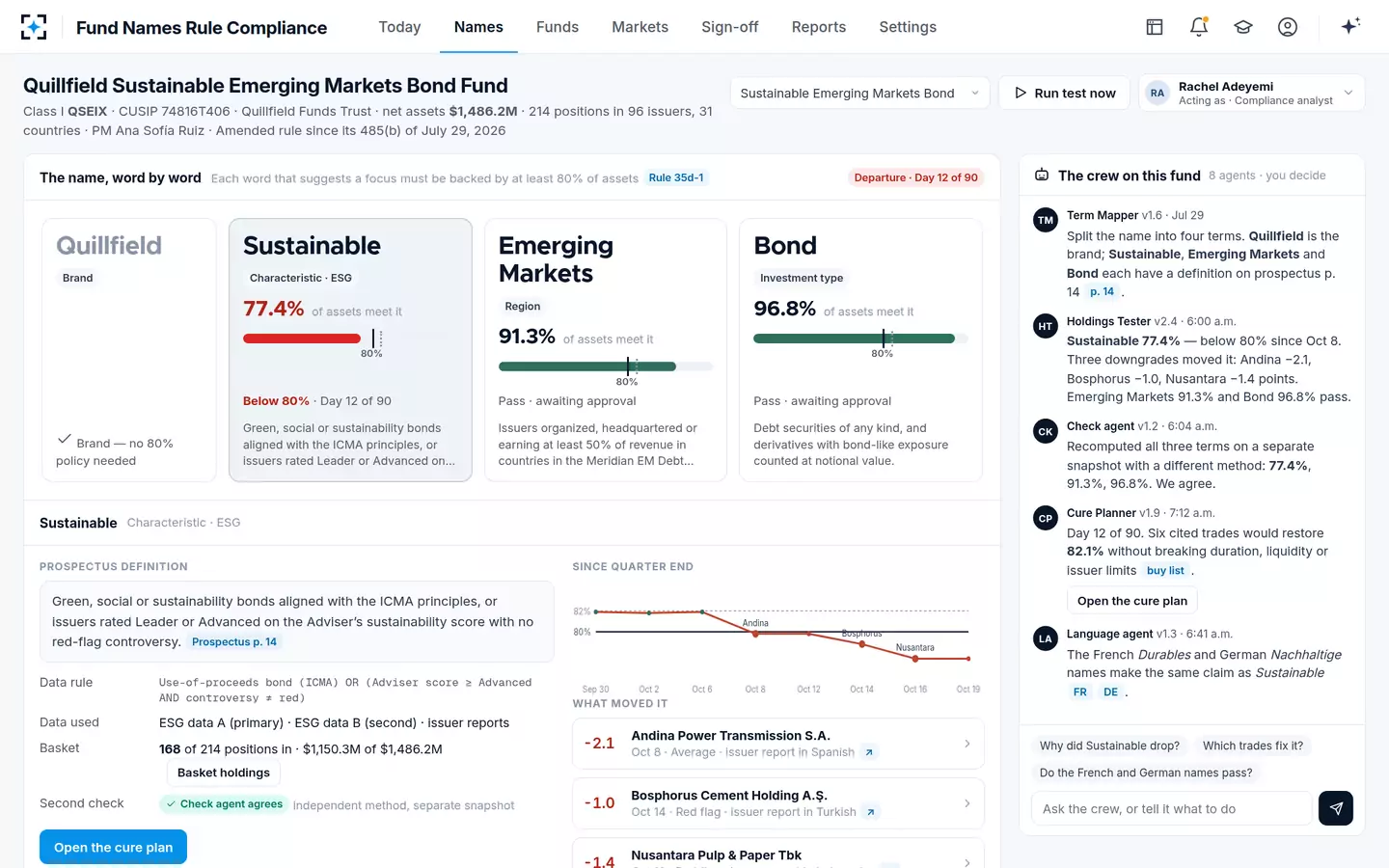
The Check agent recomputed all three terms by a different method on a separate snapshot and agreed. The same test runs before every order: an order that would take a term below the buffer raises a warning, one below 80% is blocked, and while a fund is in departure any purchase outside the basket is blocked too.
The 80% test, applied at the time of each investment
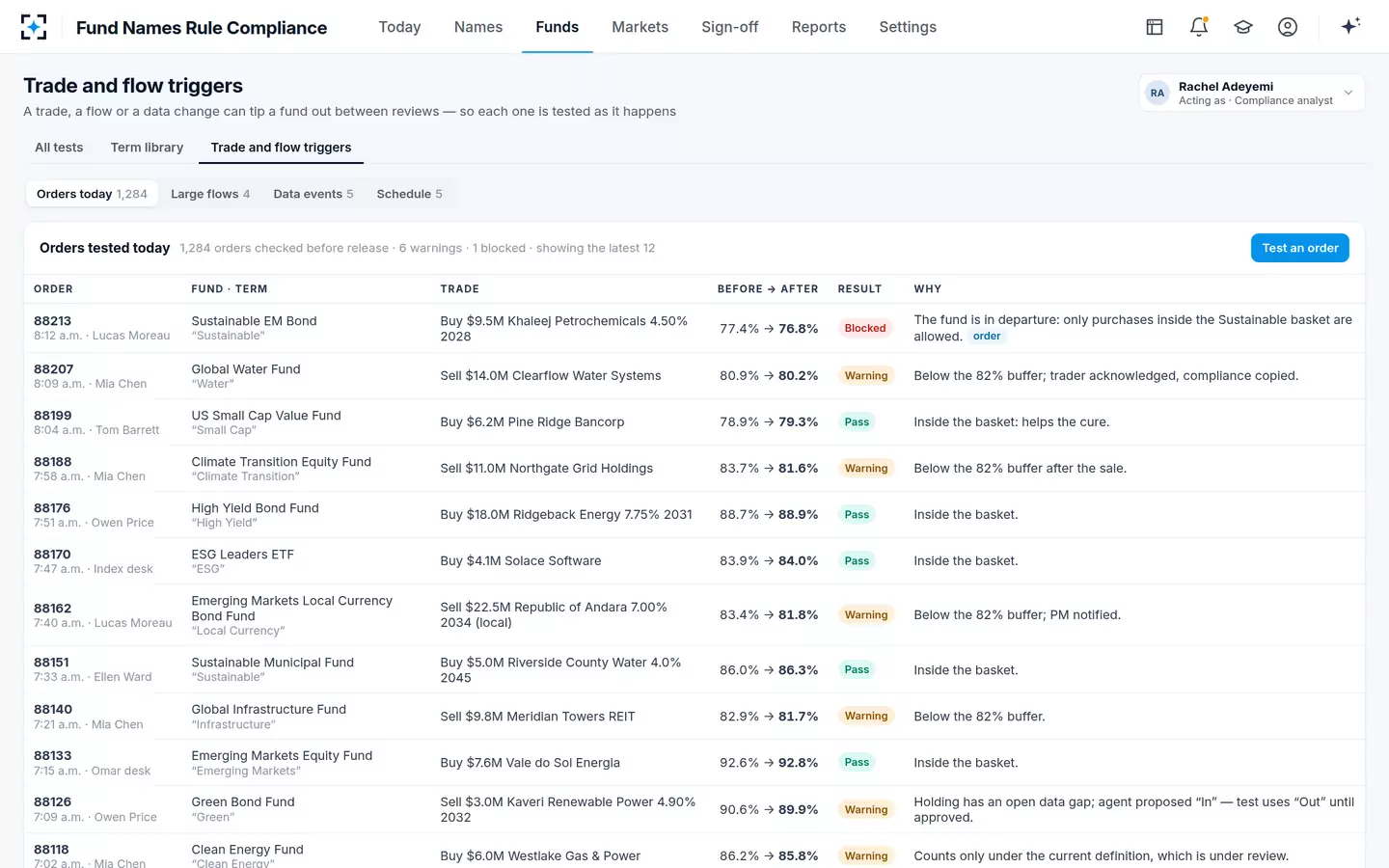
The agents never approve a test; a compliance analyst does, with the evidence attached, and the Fund CCO signs every exception. Who owns each step is set out in the Names Rule compliance requirements guide, and the program is on the Fund Names Rule Compliance page.
Questions people ask
What is the 80% rule for mutual fund names?
Under SEC Rule 35d-1, a fund whose name suggests a focus on a type of investment, an industry, a region or a characteristic must adopt a policy to invest at least 80% of the value of its assets in line with that focus, under normal circumstances. It applies to registered funds and business development companies.
Is the 80% test based on net assets?
On assets as the rule defines them: net assets plus any borrowings for investment purposes, with derivatives valued at notional. A fund may leave out cash, cash equivalents and Treasuries due within a year, but no more than the combined notional of its derivatives and value of its short positions.
Does the 80% policy apply to the investment objective?
No. It applies to the investment focus the name suggests. Terms describing an objective or a portfolio-wide result, such as "real return", "tax-managed" or "income" used alone, do not require an 80% policy in the staff's view, though the name must still not be materially misleading.
What happens if a fund falls below 80%?
Its next investments must close the gap as soon as reasonably possible, within 90 consecutive days of spotting it, and the date and reason go on file. In other-than-normal circumstances the 90 days run from the initial departure, and launches and reorganizations have their own allowances.
Can a fund pass the 80% test and still break the Names Rule?
Yes. Rule 35d-1(c) says a name may be materially deceptive or misleading under section 35(d) even if the fund adopts and implements its 80% policy, and every term must also match its plain English meaning or established industry use.