ESMA's fund naming guidelines tell EU fund managers when a name using ESG or sustainability terms is unfair, unclear or misleading. Every fund with such a term must meet an 80% threshold of investments used to meet its environmental or social characteristics or sustainable objective, as its SFDR disclosures define them, and then apply exclusions that depend on the word: Climate Transition Benchmark exclusions for transition, social and governance terms, Paris-aligned Benchmark exclusions for environmental, impact and sustainability terms, with extra conditions for "transition", "impact" and "sustainable". The guidelines applied to new funds from 21 November 2024 and to existing funds from 21 May 2025. ESMA's Q&As of 13 December 2024 answered the three questions managers asked most: how green bonds are treated, which weapons are "controversial", and how much is "meaningfully" invested. Botminds' Fund Names Rule Compliance runs the test for every EU sub-fund and share class beside the SEC test for US funds, so one strategy sold on both sides is checked against both.
ESMA fund naming guidelines: from the word in the name to the test it brings
Transition
Words that trigger it"transition", "improve", "progress", "evolution", "transformation", "net-zero"
ExclusionsClimate Transition: (a)–(c)
Also requiredInvestments on a clear and measurable path to transition
Social, governance
Words that trigger it"social", "equality"; "governance", "controversies"
ExclusionsClimate Transition: (a)–(c)
Also required—
Environmental
Words that trigger it"green", "environmental", "climate"; may include "ESG" and "SRI"
ExclusionsParis-aligned: (a)–(g)
Also required—
Impact
Words that trigger it"impact", "impacting", "impactful"
ExclusionsParis-aligned: (a)–(g)
Also requiredPositive, measurable impact alongside a financial return
Sustainability
Words that trigger it"sustainable", "sustainably", "sustainability"
ExclusionsParis-aligned: (a)–(g)
Also requiredMeaningful investment in sustainable investments; below 50% may not be, per the Q&A
What the ESMA fund naming guidelines require, term by term
The guidelines rest on one threshold and two exclusion lists. Every fund using any of the listed terms should reach an 80% threshold measured on the share of its investments that serve the environmental or social characteristics, or the sustainable objective, it promotes, as fixed by the binding elements of the investment strategy in its SFDR annexes (ESMA guidelines, paras. 16–18). Transition, social and governance names then exclude companies in points (a) to (c) of Article 12(1) of the Paris-aligned benchmark regulation: controversial weapons, tobacco cultivation and production, and violators of the UN Global Compact principles or the OECD Guidelines. Environmental, impact and sustainability names exclude points (a) to (g), adding companies over revenue thresholds from hard coal and lignite (1%), oil fuels (10%), gaseous fuels (50%) and high-carbon electricity (50%) (Delegated Regulation (EU) 2020/1818, Art. 12).
The word lists are broader than they look. Environmental terms mean "any words giving the investor any impression of the promotion of environmental characteristics", and they "may also include 'ESG' and 'SRI' abbreviations", which puts the most common ESG label in the Paris-aligned tier. Sustainability terms are only those derived from the base word "sustainable". The test of each exclusion, and the evidence it needs from an issuer, is the subject of the Paris-aligned benchmark exclusions guide from Botminds' ESG Exclusion Screening; this page stays with the name.
Three refinements change outcomes. Funds whose names combine terms from more than one category apply both sets of criteria, except where one is a transition term, in which case only the transition rules apply. Index funds may use the terms only if the fund itself meets the criteria; designating an index is not enough. And transition and impact names must also show, respectively, a "clear and measurable path" to transition or a "positive and measurable" impact alongside a financial return (paras. 19–21).
What do ESMA's Q&As on fund names say?
ESMA published three answers on 13 December 2024, each in identical UCITS and AIF versions, "to ensure a smooth application of the Guidelines through common understanding of key concepts" (ESMA, 13 December 2024). They cover the three points where the guidelines' text left managers guessing.
ESMA's three fund-name Q&As, December 2024
| Q&A | The question | ESMA's answer, in short |
|---|---|---|
| 2368 / 2370: green bonds | Can managers look at the project a use-of-proceeds bond finances, or must they judge the whole issuer? | European Green Bonds need no exclusion test. Other use-of-proceeds bonds are tested on a look-through to the activities financed, except that issuers excluded under point (c), norms violators, stay excluded. |
| 2371 / 2372: controversial weapons | Which weapons does the Article 12(1)(a) exclusion cover? | Supervisors may use the SFDR principal adverse impact indicator 14 list: anti-personnel mines, cluster munitions, chemical weapons and biological weapons. |
| 2373 / 2374: "meaningfully" | Is there a minimum for "sustainable" funds to be investing meaningfully in sustainable investments? | Case by case, but funds investing less than 50% in sustainable investments may be found not to be investing meaningfully; the bar could be higher. |
Green bonds and the look-through
The green bond answer matters most to bond funds. Bonds issued under the European Green Bonds Regulation "do not need to be assessed under the exclusions", ESMA says, because the guidelines are read with that regulation's "high level of protection". For any other use-of-proceeds instrument the exclusions apply "on a look-through basis to the economic activities financed", which means a green bond from a utility that would fail the revenue test can still qualify if the activities it funds are clean (ESMA Q&A 2368).
The look-through has a hard edge. "Investments in companies excluded under Article 12(1)(c)", the norms violators, "would not be able to benefit from this look-through approach"; they are always excluded. For a portfolio team that means two data points per green bond, the use of proceeds and the issuer's conduct, and a written basis for each. ESMA's December 2025 study also followed this approach when it measured funds' fossil-fuel exposure, leaving green bonds out "in line with the December 2024 Q&As" (ESMA TRV, December 2025).
How much is "meaningfully"? The 50% line for sustainable names
A sustainability name must also "commit to invest meaningfully in sustainable investments referred to in Article 2(17) of the SFDR" (para. 18). ESMA had consulted on a fixed 50% minimum and dropped it from the final guidelines after stakeholders argued that the SFDR definition left too much to managers' discretion to work as a hard threshold (final report, May 2024). The Q&A brought the number back as a supervisory benchmark: national authorities "may find that investment funds with 'sustainable' terms in their names investing less than 50% of the proportion of investments in sustainable investments are not 'meaningfully investing in sustainable investments'", and "that amount could be higher, subject to the circumstances of the case" (ESMA Q&A 2373).
For a test, that is two numbers per sustainability-named fund: the 80% share and the sustainable-investment share, with 50% as the line below which a person should be asked whether the name still stands. A fund whose SFDR annex commits to 40% sustainable investments and holds 46% meets its annex and may still fall short of the name.
ESMA's name guidelines in four numbers
80%
threshold for every ESG or sustainability term, read from the SFDR binding elements
50%
sustainable investments, below which a "sustainable" name may not be meaningful
125
responses to ESMA's consultation, 27 of them confidential
~4,900
EU funds used ESG terms in their names in May 2024, before the guidelines applied
When did the ESMA fund naming guidelines apply, and does every country follow them?
The guidelines applied three months after ESMA published them in all EU languages on 21 August 2024: from 21 November 2024 for funds created after that date, and from 21 May 2025 for funds that already existed (ESMA, 21 August 2024). Guidelines are not regulations. Under Article 16(3) of the ESMA Regulation, national authorities and market participants "must make every effort to comply", and each authority tells ESMA whether it will (paras. 9–11).
ESMA's fund naming guidelines, from consultation to supervision, in months
- Consultation to final report, 14 May 202418 months
- To translations, 21 Aug 20243
- To application for new funds, 21 Nov 20243
- New funds only; Q&As on 13 Dec 20246
- All funds, from 21 May 2025; ESMA study Dec 2025; thematic notes Oct 202617+
Almost every authority said yes. ESMA's compliance table, updated on 16 July 2025, records the Czech National Bank as the one that does not comply, because Czech law "lacks a sufficient legal basis" for the numerical thresholds, while adding that compliance "will be considered a safe harbour" there; Bulgaria and Hungary recorded an intention to comply once national measures were in place (ESMA34-1592494965-690). Luxembourg's CSSF applies them through Circular CSSF 24/863 and the Central Bank of Ireland through a notice of intention, both listed in the table.
Passive breaches: what ESMA allows when a fund slips
ESMA treats the threshold and the exclusions as continuing obligations, but it distinguishes drift from choice. Its supervisory paragraph asks national authorities to consider the criteria "throughout the life of the Fund" and lets a temporary deviation that the manager did not choose be handled as a passive breach, corrected in investors' best interest (para. 22). It sets no number of days. The same paragraph points investors to the SFDR periodic disclosures to check the figures, which ties the name to the fund's annual report; how those reports are built is covered in Botminds' SFDR Reporting guides.
What ESMA tells national supervisors to look for
- The criteria, throughout the life of the fund
Not only at launch or at the annual report: the threshold and the exclusions are tested continuously.
- Deviations that are not passive
Discrepancies in the 80% level that the manager chose are a reason for supervisory dialogue.
- Too little to justify the word
A fund that does not show a sufficiently high level of investments to use transition, ESG, impact or sustainability terms.
- Names that mislead anyway
Any case where the term would give investors unfair or unclear information, even if the numbers pass.
Because ESMA sets no deadline, the correction period is the management company's to write down. In the Fund Names Rule Compliance sample, the fictional Quillfield Capital's policy is to correct an EU passive breach within 30 business days, against 90 consecutive days under the SEC rule for its US funds.
Two regimes, two clocks, one settings page
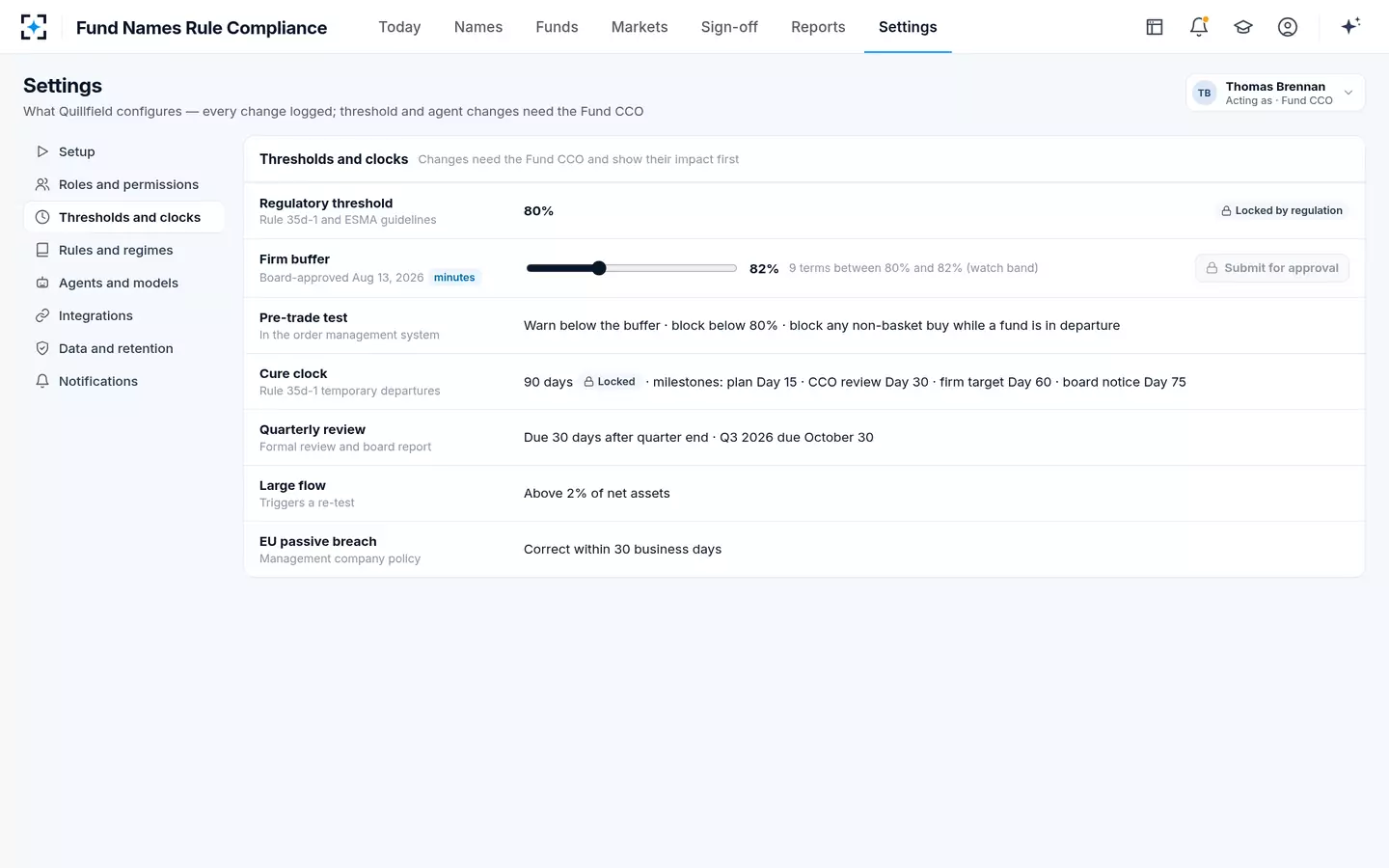
The UK and the US beside ESMA: one name, three tests
A strategy sold in Europe, the UK and the US meets three different name rules. The UK's anti-greenwashing rule applies to any firm communicating with UK clients about a product or service: any reference to a product's sustainability characteristics must be consistent with them and "fair, clear and not misleading" (FCA Handbook, ESG 4.3.1R). On top of that, the naming and marketing rules list the terms that trigger them, from "ESG" and "climate" to "transition", "impact", "responsible" and "Paris-aligned", and a manager without a UK sustainability label may not use "sustainable", "sustainability" or "impact" in a product's name at all (ESG 4.3.2R, 4.3.5R).
One fund name, three regimes: ESMA, the FCA and the SEC
| ESMA guidelines (EU) | FCA naming and marketing (UK) | SEC Rule 35d-1 (US) | |
|---|---|---|---|
| Legal force | Guidelines; authorities and firms "make every effort to comply" | Handbook rules (R) and guidance (G) | A rule under the Investment Company Act |
| Words caught | Transition, social, governance, environmental (incl. ESG, SRI), impact, sustainability terms | A listed set from "ESG" to "Paris-aligned", plus any term implying sustainability characteristics | Any term suggesting a focus, including ESG factors, "growth" and "value" |
| Threshold | 80% of investments meeting the E/S characteristics or objective | Without a label, characteristics should be material, "for example, at least 70%" | 80% of assets, with derivatives at notional |
| Exclusions | Climate Transition (a)–(c) or Paris-aligned (a)–(g), by term | None set in the naming rules | None |
| Strongest words | "Sustainable": plus meaningful sustainable investment, 50% per the Q&A | "Sustainable", "sustainability", "impact": only with a label | None reserved; plain English meaning or industry use |
| When it slips | Passive breach, corrected in investors' best interest | Not set in ESG 4.3 | Back to 80% within 90 consecutive days |
The practical difference is the order of the tests. In the EU the word picks the exclusions; in the UK the word decides whether a label is needed; in the US the word needs a definition and an 80% policy, and nothing is excluded by law. Where a US fund and its UCITS sibling share a strategy, the derivatives are counted differently too; that calculation is in the SEC Names Rule derivatives guide.
Running the EU test beside the US one
In Fund Names Rule Compliance the EU Names agent applies the 80% threshold, the exclusions each term category brings and the sustainable-investment test to every EU sub-fund and share class, and the FCA rules to UK registrations. An exclusion hit is shown with the issuer's own evidence in its own language, and EU product compliance, not the agent, records any passive breach and decides on a rename. In the sample range, the EU test across 40 sub-funds found one Paris-aligned exclusion hit: a Chilean transmission company whose own annual report put 54% of its revenue in thermal generation.
Every local name of a sub-fund, checked for the same claim as the English
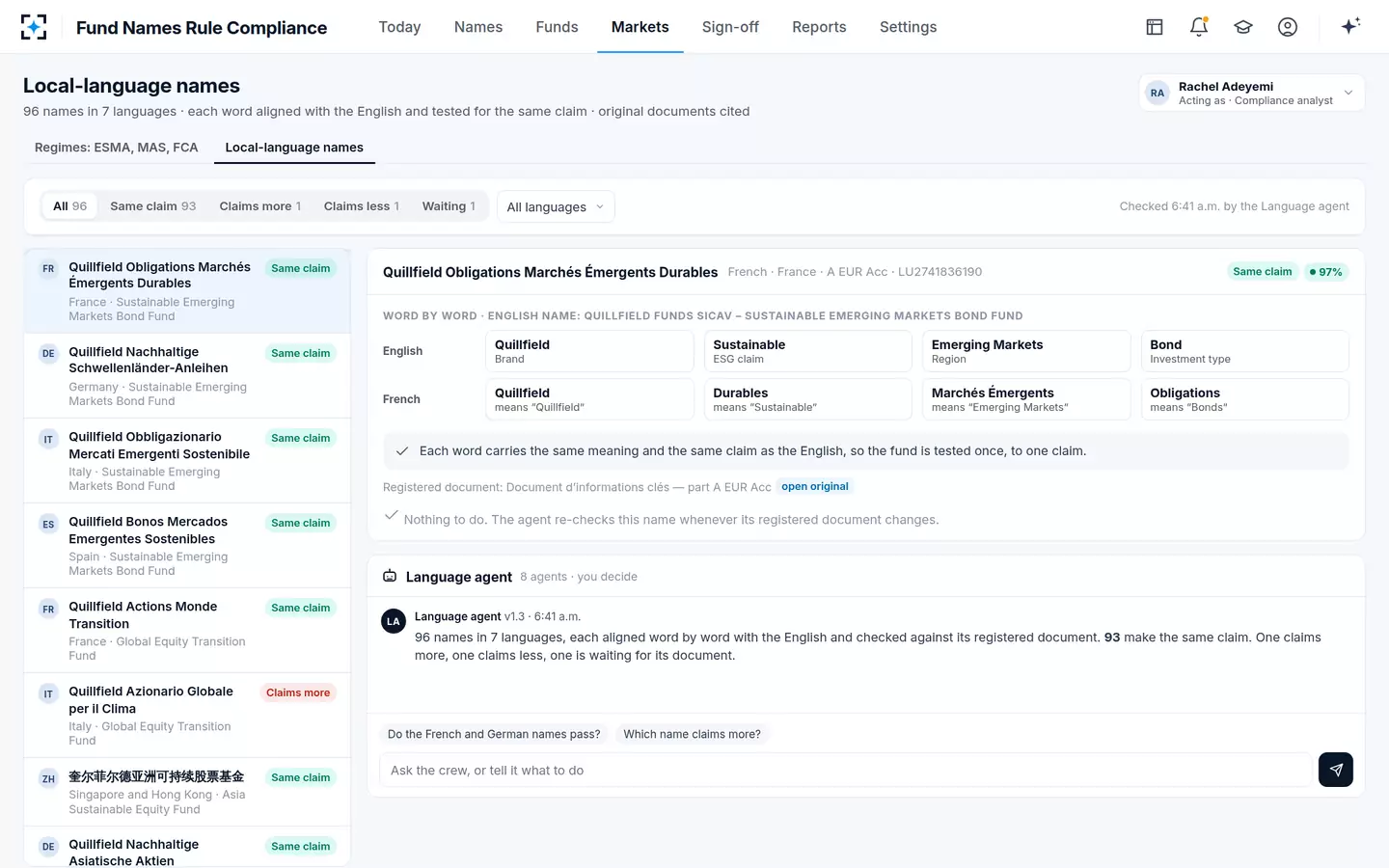
The Fund Names Rule Compliance page shows the EU test and the US test side by side for one strategy; for the choice a manager faces when a sub-fund cannot meet its term, see the ESG fund name change guide.
Questions people ask
Do ESMA's fund name guidelines apply to all EU funds?
They apply to UCITS management companies, AIFMs including internally managed AIFs, and the managers of EuVECAs, EuSEFs, ELTIFs and money market funds, for funds whose names use ESG or sustainability-related terms. A fund with no such term in its name is outside the 80% and exclusion criteria.
What are the PAB exclusions in ESMA's guidelines?
Points (a) to (g) of Article 12(1) of Delegated Regulation (EU) 2020/1818: controversial weapons, tobacco cultivation and production, UN Global Compact or OECD Guidelines violators, and companies with 1% or more of revenue from hard coal and lignite, 10% from oil fuels, 50% from gaseous fuels or 50% from electricity above 100 g CO2e/kWh. Environmental, impact and sustainability names apply all seven.
Does "ESG" in a fund name count as an environmental term?
It can. ESMA's guidelines say environmental-related terms "may also include" the abbreviations ESG and SRI, which brings the Paris-aligned exclusions. ESMA's 2025 study found that "ESG" was also the term many funds moved to when they dropped "sustainable".
Can a fund named "sustainable" hold green bonds from fossil-fuel issuers?
Possibly. European Green Bonds need no exclusion test, and other green bonds are judged on a look-through to the activities they finance, so a bond funding renewable capacity can qualify even if its issuer would fail the revenue thresholds. Issuers excluded as UN Global Compact or OECD Guidelines violators stay excluded.
What is the FCA's anti-greenwashing rule?
ESG 4.3.1R requires a firm referring to the sustainability characteristics of a product or service, when communicating with UK clients or making financial promotions, to make those references consistent with the product's characteristics and fair, clear and not misleading. It sits alongside the separate naming and marketing rules for sustainability products.