ESG compliance software for an asset manager has one job that the name rules made urgent: proving that every holding counted toward an ESG term in a fund's name belongs there. Under the SEC's amended Names Rule, a US fund with an ESG term needs an 80% investment policy and records of "the basis for including" each investment; under ESMA's guidelines, an EU fund needs an 80% threshold and benchmark exclusions. Most tools meet the job by trusting a data vendor's score or controversy flag. That works until a vendor changes its view overnight, or two vendors disagree, and the fund's meter moves with nobody checking why. The SEC's own ESG cases turn on exactly that gap. Botminds' Fund Names Rule Compliance takes the other road: when a vendor change moves a fund, an agent reads the issuer's own report in its own language, and when the sources still disagree it asks the compliance analyst rather than deciding. The analyst decides; an override of a vendor is signed by the chief compliance officer.
Three vendor changes, one fund: found the next morning, or at the quarterly review
- Oct 8: first downgrade; departure opened6
- Oct 14 and 16: two red flags5
- Oct 19: issuers' reports read; analyst decides
- To Oct 21: the CCO's sign-off is due2
- Below 80% and unknown, to Dec 3184 days
- Quarterly review, due 30 days after quarter end30
What ESG compliance software has to do for a fund name
For a name test, ESG compliance software has to answer one question per holding, every day the fund trades: is this investment in the basket for this term, on this fund's definition, and why? The amended rule leaves the definition to the fund, and the SEC's adopting release accepts that funds and outside data providers will often define the same term in different ways (SEC, 88 FR 70436). So the software is not checking a vendor's opinion; it is checking the fund's own promise, using vendor data as one input.
That distinction decides the design. A screening engine that maps "Sustainable" to a vendor's "Leader or Advanced" rating has turned the fund's definition into the vendor's methodology. When the vendor re-rates an issuer, the fund's compliance changes, and the software reports it as fact. Rule 35d-1 asks for more than that: the record of each inclusion must state its basis, and the quarterly review must look at each holding again. Software that can only say "the vendor said so" has kept half the record.
Where ESG data goes wrong: one vendor's flag, another's silence
ESG data differs by design, because each provider measures something slightly different, and it changes on news. For a name test the second problem is the sharper one. A controversy flag raised after an NGO report can move a holding out of a fund's basket overnight; a second vendor may not follow, or may follow a week later. The fund now has two answers, and the rule needs one, with a reason.
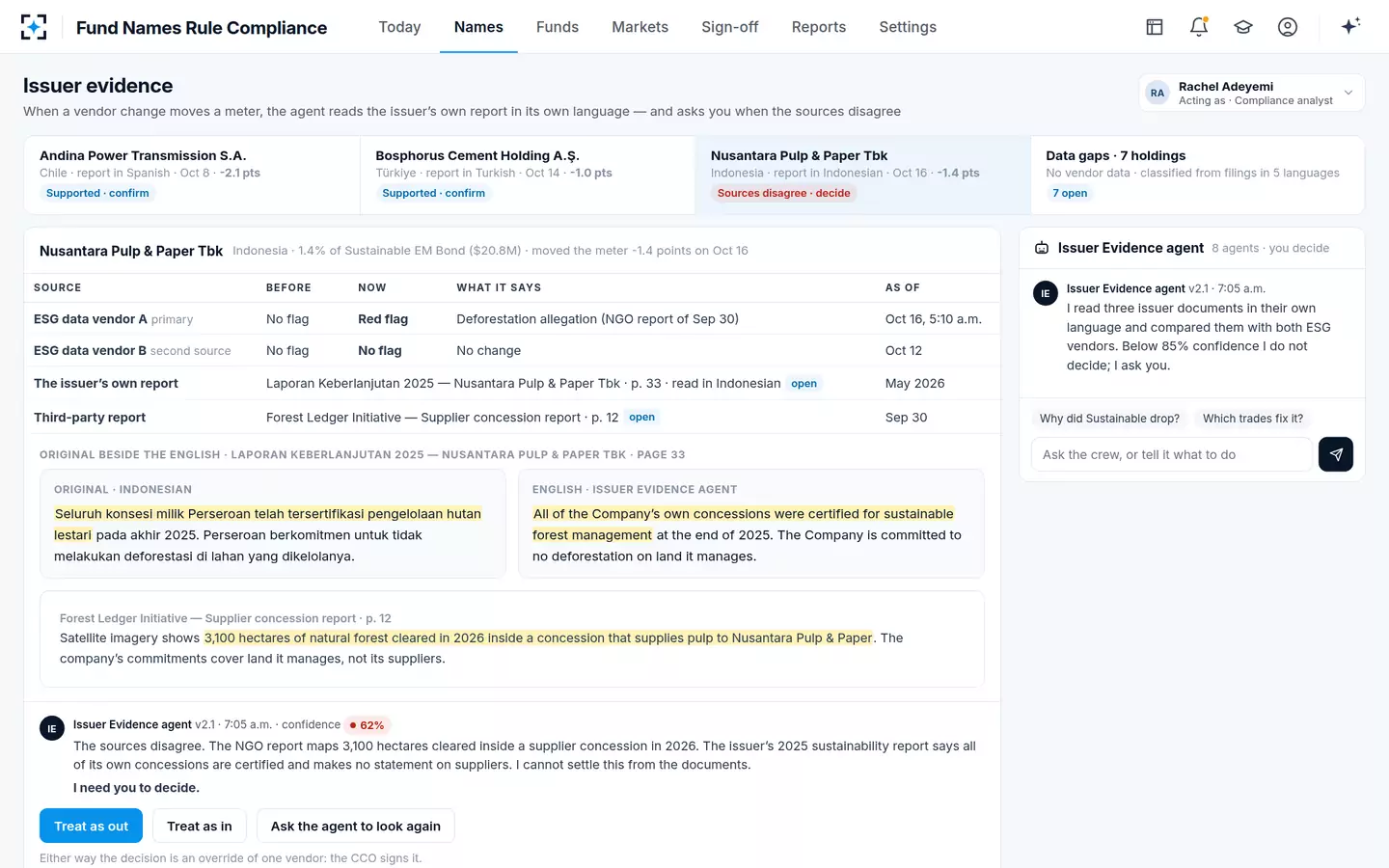
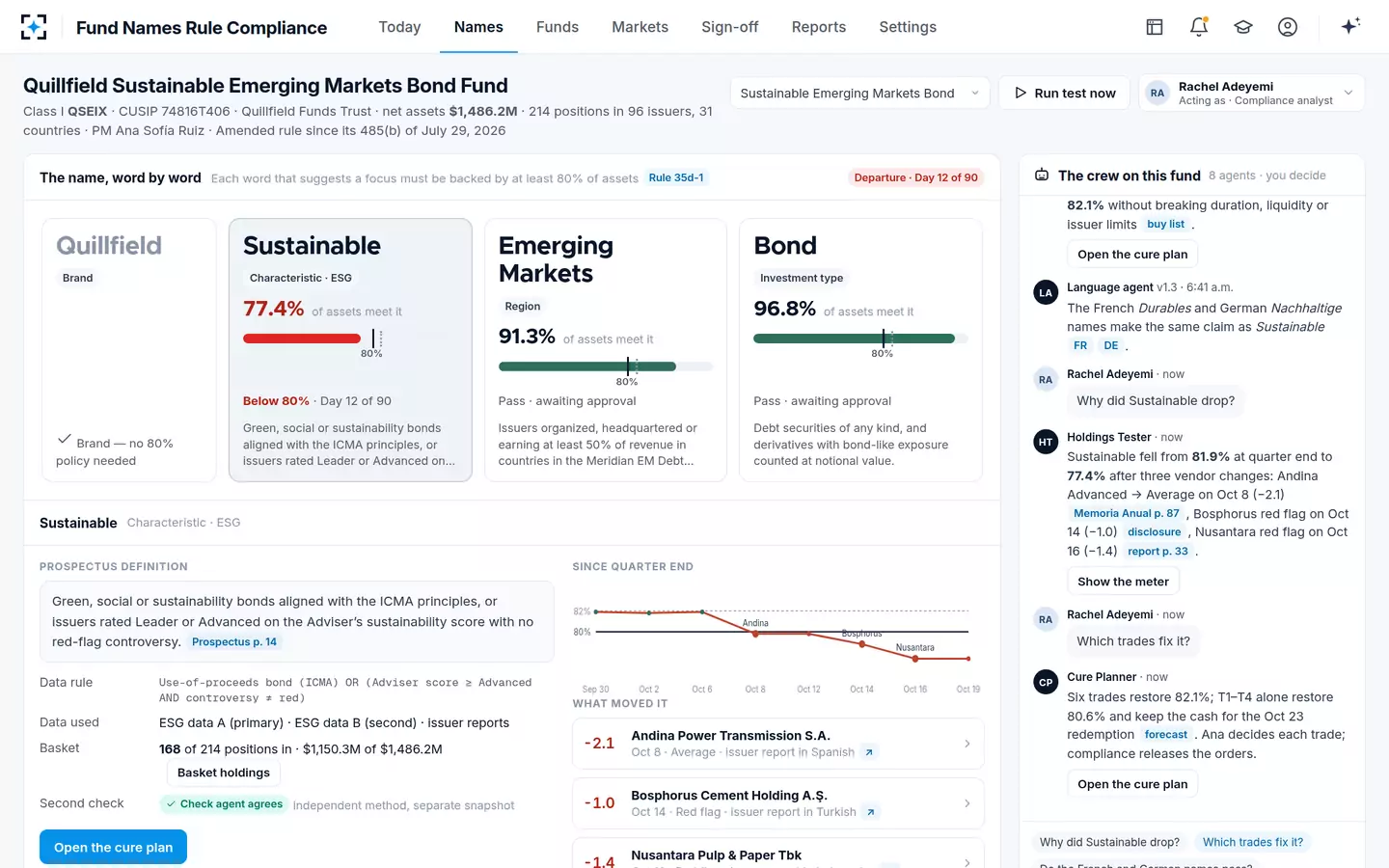
The sample case shows the pattern. Quillfield's fictional Sustainable Emerging Markets Bond Fund stood at 81.9% on "Sustainable" at quarter end. Three vendor changes took it to 77.4%: a Chilean transmission company downgraded from Advanced to Average on 8 October, a red flag on a Turkish cement maker on 14 October, and a red flag on an Indonesian pulp and paper company on 16 October. The first two were confirmed by the issuers' own reports, in Spanish and Turkish. The third was not: vendor A flagged deforestation after an NGO report; vendor B had no flag; the company's own sustainability report said its concessions were certified at the end of 2025, and a third-party report mapped 3,100 hectares cleared inside a supplier's concession in 2026.
When vendors disagree, the issuer's own report goes beside them, in its own language
What the SEC's ESG cases say about relying on vendor data
None of the SEC's ESG orders against advisers was brought under the amended Names Rule; they predate it. They are still the best evidence of what examiners look for when a fund's ESG promise rests on data. In October 2024 the SEC found that WisdomTree had told investors three ESG-marketed ETFs would not invest in companies involved in fossil fuels and tobacco, that the third-party vendor data it used did not screen all such companies out, and that it had no policies and procedures over the screening process; it paid a $4 million penalty (SEC press release 2024-173).
The earlier cases point the same way. BNY Mellon Investment Adviser implied that every investment in certain funds had undergone an ESG quality review when many had no review score at the time of investment, for a $1.5 million penalty (2022-86); Goldman Sachs Asset Management's teams completed many ESG questionnaires after securities had already been selected, for $4 million (2022-209). Each case is worked through, with its bill, in the SEC ESG enforcement actions guide from Botminds' ESG Exclusion Screening. The lesson for software is narrow and practical: the control that failed was the check between the data and the promise.
An agent that asks: the issuer's own report, in its own language
The design that closes that gap is simple to state. When a vendor change or a data gap moves a term's meter, an agent reads the issuer's own annual or sustainability report in the language it was published in, sets the passage it relies on beside an English reading with the page, and compares it with each vendor. If the issuer's document settles the question, the analyst confirms with the citation in hand. If it does not, the agent says so and stops.
When an ESG data change moves a fund's name test: four questions before anyone acts
1Did the change move a fund toward its line?
YesRe-test the term now, and before the next order.
NoLog it; the nightly test will carry it.
2Do the two data vendors agree?
YesConfirm against the issuer's own report, cited by page.
NoGo to the issuer's own report before anyone acts.
3Does the issuer's report settle it?
YesThe analyst confirms, with the original passage beside the English.
NoThe agent states what each source says and stops.
4Is the agent above its confidence line?
YesIt proposes a classification for the analyst to approve.
NoA person decides, with a reason code; an override of a vendor goes to the CCO.
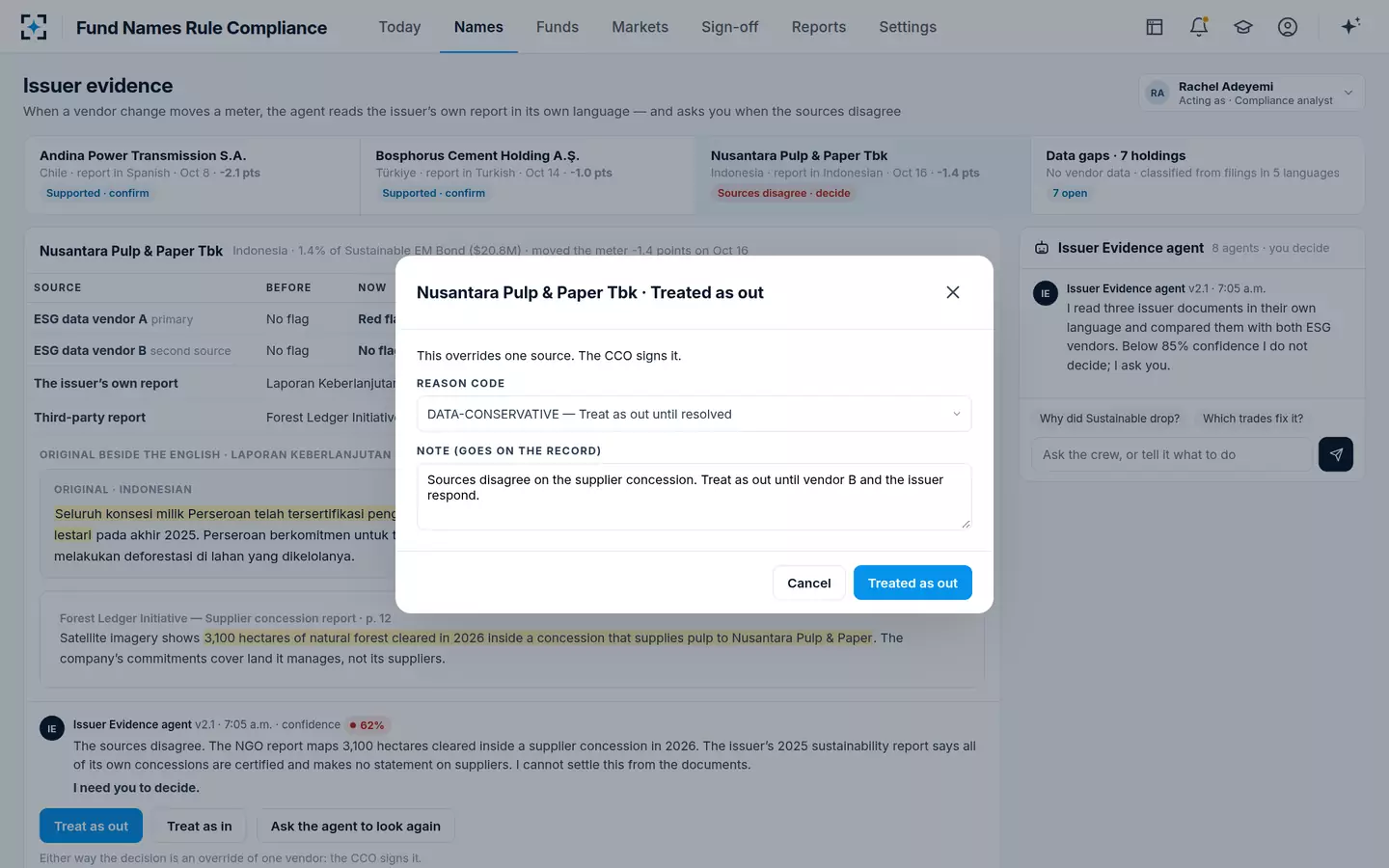
In the sample case the agent was 62% sure about the Indonesian holding, below the 85% line the firm set for it, and its message was plain: "The sources disagree. … I cannot settle this from the documents." The analyst treated the holding as out of the basket until the second vendor and the issuer responded, the conservative choice, with the reason code DATA-CONSERVATIVE and a note. Because that decision overrides a vendor, it went to the Fund CCO's queue with the issuer's page and the NGO report attached.
A person decides, picks a reason, and the CCO signs the override
What happens when ESG data changes for a holding in an ESG-named fund?
The fund's basket changes, and with it possibly its compliance. Under Rule 35d-1 the 80% requirement applies when the fund invests, so a data change does not put the fund in breach on the day; but once the fund identifies that it is below 80%, its next investments must restore the 80% as soon as it reasonably can, and never later than 90 consecutive days (Rule 35d-1(b)(1)(i); who owns each step of that cure is in the Names Rule requirements and their owners). Two things follow for software. The data change has to reach the test the same day, or the clock starts late. And while the fund is below 80%, a purchase outside the basket is a purchase below the policy, so the pre-trade check has to know.
In the sample, the nightly test caught each change the next morning, the pre-trade test blocked a non-basket bond purchase while the fund was in departure, and the cure plan, decided by the portfolio manager, projected the fund back to 80.6%. A data change that the software confirms in hours costs a cure plan. One that waits for the quarter costs a quarter of purchases made on the wrong side of the line.
Greenwashing in mutual funds: the control examiners will look for
Examiners will look at whether what a fund does matches what it says. The SEC's fiscal 2027 examination priorities, published on 23 October 2026, single out two things for registered fund examinations: fees, and whether a fund's actual portfolio management matches the strategy described in its filings and its marketing (SEC, Fiscal Year 2027 Examination Priorities). The same document notes that registrants are using what the SEC calls "super intelligence (SI)" tools in compliance monitoring and surveillance, and that it will check whether firms still meet existing obligations that do not depend on the technology.
The broader ESG disclosure rule that would have set specific ESG fund requirements is gone: the SEC withdrew its 2022 proposal on 17 June 2025, saying it "does not intend to issue final rules" on it (90 FR 25531). That leaves the Names Rule as the main specific test of an ESG fund's name in the US, alongside the anti-fraud provisions. For ESG compliance software, a name test without evidence is the weak point; an exclusion screen without evidence is the other, and Botminds covers it separately in ESG Exclusion Screening.
ESG compliance solutions compared: what to test in a demonstration
The difference between ESG compliance tools shows only on a hard case, so bring one. Take a holding where your two vendors disagree, or one with no vendor coverage at all, in a fund near its line, and watch what each tool does with it. A good one tells you what it knows, what it does not and who must decide; a weak one gives you a number.
A rules engine that trusts the feed, beside software that asks
Screening on one vendor's field: The basket changes at the next run; no one is told why.
Testing with issuer evidence and a person: The term is re-tested at once and the change is shown with its source.
Screening on one vendor's field: The primary vendor wins by configuration.
Testing with issuer evidence and a person: The issuer's own report is read; if it does not settle the point, a person decides.
Screening on one vendor's field: Out of scope, or a vendor translation.
Testing with issuer evidence and a person: The original passage beside an English reading, with the page.
Screening on one vendor's field: Excluded or included by default.
Testing with issuer evidence and a person: Classified from the issuer's filings with a cited page, for approval.
Screening on one vendor's field: A vendor field and a date.
Testing with issuer evidence and a person: The definition, the data, the evidence, the decision and who made it.
Screening on one vendor's field: The configuration.
Testing with issuer evidence and a person: The analyst; any override of a vendor is signed by the CCO.
Questions to put to any ESG compliance software before you buy
- Show me a holding where our two vendors disagree
Does the tool notice, and what does it do next: pick one, average them, or read the issuer and ask?
- Read me the issuer's own page, in its language
The original passage beside the translation, with the page number, not a summary.
- Tell me when you are not sure
Is there a confidence line below which the software asks a person, and can we set it?
- Test our definition, not your rating
Can each term's data rule quote the prospectus sentence it implements?
- Re-test on the event, not on the calendar
Vendor changes, large flows and orders should each trigger a test before the next trade.
- Show who decided, and who signed
Every override of a vendor carries a reason code, a note and a signature by someone who did not make it.
- Survive a late feed
If a vendor file is late, the test should use the last good file and say so, not stop or guess.
Where Fund Names Rule Compliance fits, and where it does not
Fund Names Rule Compliance is the name test and its evidence. Eight agents split each name into terms, test every term nightly, before orders and after large flows, recompute near-line results by a second method, read issuers' reports in their languages, plan cures, apply ESMA's tests and check local names. Below its confidence line each agent asks the analyst. It works with the ESG data you already buy: it reads two vendors' scores, flags and exclusion revenues, and it is not itself a ratings provider.
Ask the agents why a meter moved; every answer opens its source
It is not an exclusion screening system for the whole firm, a portfolio management system or an order system, and its agents never trade, change a definition, approve a test or settle a disagreement between sources. For the inputs a pilot needs, see what you bring to fund compliance software; for the choice between data feeds, engines and evidence tools, the ESG tool comparison for a fund name test. The program is on the Fund Names Rule Compliance page.
Questions people ask
What is ESG compliance software for funds?
Software that tests whether a fund's holdings meet the ESG promises in its name, prospectus and marketing: in the US the Names Rule's 80% policy for ESG terms, in the EU ESMA's 80% threshold and benchmark exclusions. The useful kind keeps, for each holding, the basis for counting it, which Rule 35d-1 requires a fund to record.
How should ESG compliance software handle conflicting vendor data?
By reading the issuer's own report before anyone acts, and asking a person when that does not settle it. Picking a primary vendor by configuration hides the disagreement; an override of either vendor should carry a reason and a signature from someone other than the person who made it.
Does the SEC require funds to verify ESG vendor data?
No rule names vendors, but the SEC's cases show the expectation. In October 2024 it found that WisdomTree used third-party data that did not screen out all fossil-fuel and tobacco companies its ETFs promised to exclude, and had no policies over the screening process; the firm paid a $4 million penalty.
Can ESG compliance software prevent greenwashing?
It can stop the commonest form, a fund holding what its name or prospectus says it will not, by testing every holding against the fund's own definition before trades and every night. It cannot make a vague definition honest; that work belongs to counsel, and the Names Rule allows a name to be misleading even when the 80% test is met.
What should an ESG compliance tool do when a vendor feed is late?
Keep testing on the last good file and say so on every result, then re-test when the feed arrives. In the sample firm's setup the tests ran on vendor A and the previous day's file from vendor B while vendor B's feed was delayed, retrying every 15 minutes.