The SEC Names Rule counts derivatives at their notional amount, not their market value. Since the 2023 amendments, Rule 35d-1 requires a fund to "value each derivatives instrument using the instrument's notional amount", converting interest rate derivatives to 10-year bond equivalents and delta adjusting options, and the same values go into both sides of the 80% test: the basket of investments that match the name, and the fund's assets it is divided by. A derivative that provides exposure to the fund's focus, or to a market risk factor of that focus, can count toward the basket; one that does not still swells the denominator. The result surprises funds used to market values: a fund can fall below 80% because an option's delta moved, without trading at all. Botminds' Fund Names Rule Compliance computes every term's basket nightly with derivatives at adjusted notional, and a second agent recomputes near-line results by a different method.
One option overlay, three answers: the same fund at market value and at notional
How the SEC Names Rule treats derivatives: notional, not market value
The rule's definition of assets does the work. "Assets" means net assets plus borrowings for investment purposes, and in valuing them a fund "must value each derivatives instrument using the instrument's notional amount (which must be converted to 10-year bond equivalents for interest rate derivatives and delta adjusted for options contracts) and must value each physical short position using the value of the asset sold short" (17 CFR 270.35d-1(g)). The 80% basket, in turn, holds the investments that match the focus the name suggests, so a derivative in the basket counts at the same adjusted notional.
In the overlay above, the fund's US stocks never moved. At market value the options are $3.0 million of a $500.0 million fund and the name is comfortably met at 96.0%. At notional with a delta of 0.25 they count as $50.0 million; after the non-US index rallies and the delta rises to 0.65 they count as $130.0 million, and the fund's US large-cap basket is 78.7% of its assets. Under the amended rule that is a shortfall, and from the day the fund identifies it, the 90-day clock runs.
"In determining the value of a fund's assets for purposes of this section, a fund must value each derivatives instrument using the instrument's notional amount."
Rule 35d-1(g), definition of assets
Why notional? The SEC's case against market values
The SEC chose notional because market values hide exposure. Its adopting release grants that "derivatives' market values can often be quite low, such that the use of their market values would be functionally equivalent to excluding these derivatives from a names rule compliance calculation", but notes that there are circumstances where a derivative's market value "could be large", which would make outcomes inconsistent (SEC, 88 FR 70436). Its central worry was the opposite case: market values "could result in a fund being in compliance with the fund's 80% investment policy despite the fund having significant exposure to investments that are not suggested by the fund's name".
Notional cuts both ways, which is why the rule also lets derivatives into the basket. The release gives the example of "ABC Bond Fund", with $100 in bonds and $100 in interest rate swaps and nothing else: if the swaps were left out of the basket, the fund would be at 50%, "$100 in bonds/$100 in bonds + $100 in swaps". A bond fund using swaps to manage duration is doing what its name says, and the basket rule lets it count them.
Interest rate derivatives: the 10-year bond equivalent, worked
A 10-year bond equivalent scales an interest rate derivative to the exposure it actually creates. The SEC's suggested method: "multiply the derivative's unadjusted notional amount by the ratio of the derivative's duration and the duration of the reference security", that is, a 10-year bond. The reason is stated just as plainly: "Absent this adjustment, short-term interest rate derivatives can produce large unadjusted notional amounts that may not correspond to large exposures to interest rate changes" (88 FR 70436).
The Names Rule calculation for one bond fund, step by step
| Step | Calculation | Result |
|---|---|---|
| 1. Positions at value | Bonds $410.0M + preferred stock $30.0M + cash and Treasury bills under one year $60.0M | $500.0M net assets |
| 2. 2-year Treasury futures, long | Unadjusted notional $150.0M × (duration 1.9 ÷ 10-year duration 8.0) | $35.6M |
| 3. Investment-grade credit default swap index, protection sold | Notional, no conversion: credit, not an interest rate derivative | $40.0M |
| 4. Euro forwards hedging euro bonds | Notional $44.0M against $41.0M par of the hedged bonds: 7.3% over, within the 10% limit, so excluded | $0 |
| 5. Assets before the cash exclusion | $500.0M + $35.6M + $40.0M | $575.6M |
| 6. Exclude cash and short Treasuries | Up to the derivatives' notional ($75.6M): all $60.0M | $515.6M |
| 7. The 80% basket | Bonds $410.0M + futures $35.6M + swap index $40.0M; preferred stock is not "bonds" on this fund's definition | $485.6M |
| 8. Basket as a share of assets | $485.6M ÷ $515.6M | 94.2% |
Each choice in that table moves the answer. Count the futures at their unadjusted $150.0 million and the basket rises to 95.2%, because short-dated futures look like a lot of bonds. Skip the cash exclusion and it falls to 84.4%. Leave the swap index out of the basket and it is 86.4%. Let the currency forwards drift to $46.0 million against $41.0 million of hedged par, 12.2% over, and they can no longer be excluded: the denominator grows by $46.0 million and the basket falls to 86.5%. None of those changes involves a trade in the bonds the name promises.
Options: delta, and a fund that fails without a trade
Options are delta adjusted: the fund multiplies "the option's unadjusted notional amount by the option's delta", which the release defines as "the ratio of change in the value of the option to the change in value of the asset into which the option is convertible", so that the notional "better reflects the exposure that an option creates to the underlying reference asset" (88 FR 70436). The consequence is that the denominator breathes with the market. A deep out-of-the-money call barely counts; the same call deep in the money counts at nearly its full notional.
That is what happened to the fictional Halyard fund in the opening chart. Its options were outside the name's focus, so they could not join the basket; as their delta rose from 0.25 to 0.65 they added $80.0 million to the denominator, and the fund went from 90.6% to 78.7% while its managers did nothing. The rule's answer to a shortfall of this kind is in paragraph (b)(1)(i): the 80% requirement applies when the fund invests, so the fund is not in breach the moment the market moves, but once it identifies the shortfall its future investments must restore 80% "within 90 consecutive days". A fund running option overlays needs a nightly test, because a quarterly one can find the shortfall weeks late.
Which derivatives count in the 80% basket?
Two kinds count. The first is a derivative that gives exposure to the investments the name suggests, such as a total return swap on the index a fund is named after; the release notes that such a swap "can provide a return that is the economic equivalent of a direct investment in the derivative's reference asset". The second, under paragraph (b)(2), is a derivative "that provides investment exposure to one or more of the market risk factors associated with the investment focus that the fund's name suggests", the SEC's examples being "interest rate risk and credit spread risk" for a bond fund (Rule 35d-1(b)(2); 88 FR 70436).
Everything else counts only in the denominator: an equity index future in a bond fund, a commodity swap in a technology fund, options on a market the name does not mention. The SEC explained why it let risk-factor derivatives in: funds use them "to hedge exposures or to obtain exposure to market risk factors", and because "those instruments may have very high notional amounts", leaving them out of the basket "could cause a fund to fall out of compliance". The basket, the definition and what counts toward it are taken further in the Names Rule 80% test guide.
The denominator: cash, short Treasuries, closed-out positions and currency hedges
Four adjustments keep notional from overstating a fund's assets, and each has a condition. A fund "may reduce the value of its assets by excluding any cash and cash equivalents, and U.S. Treasury securities with remaining maturities of one year or less", but only "up to the notional amount of the derivatives instrument(s) and the value of asset(s) sold short". It may also exclude "any closed-out derivatives positions if those positions result in no credit or market exposure to the fund"; the SEC did not require the offsetting trade to be with the same counterparty (Rule 35d-1(g)).
Currency hedges are different: excluding them is required, not optional. A fund "must exclude" derivatives used to hedge the currency risk of specific foreign-currency equity or fixed-income holdings, provided they are held for hedging and their notional does not exceed the hedged investments' value, or par for bonds, "by more than 10 percent". A hedge that grows past that line, through a lagging roll or a sale of the hedged bond, stops being excluded and starts counting, as the bond fund example shows. Physical short positions count at the value of the asset sold short.
How does ESMA treat derivatives in a fund name test?
It does not set a method. ESMA's fund-name guidelines link the 80% threshold to the share of investments a fund commits to use for its environmental or social characteristics in its SFDR disclosures, and ESMA's final report says it "has decided not to include any indication about provisions related to derivatives", so that "the calculations for derivatives, or any other asset classes, would follow the decisions made by the fund manager under the SFDR disclosures" (ESMA34-472-440, May 2024).
Derivatives in a name test: the SEC prescribes, ESMA defers
SEC, Rule 35d-1: Notional amount, required.
ESMA, guidelines on fund names: No method; follows the manager's SFDR calculation.
SEC, Rule 35d-1: Converted to 10-year bond equivalents.
ESMA, guidelines on fund names: Not addressed.
SEC, Rule 35d-1: Delta adjusted.
ESMA, guidelines on fund names: Not addressed.
SEC, Rule 35d-1: Direct exposure to the focus, or to its market risk factors.
ESMA, guidelines on fund names: Investments used to meet the fund's environmental or social characteristics or sustainable objective.
SEC, Rule 35d-1: Cash may be excluded up to notional; qualifying currency hedges must be.
ESMA, guidelines on fund names: Not addressed in the guidelines.
For a manager running a US fund and a UCITS sibling on one strategy, the practical effect is two numbers for one portfolio, each defensible under its own regime. The EU test, with its exclusions and term categories, is set out in the ESMA fund naming guidelines Q&A.
The data a derivatives-aware names test needs every night
The calculation is simple; the inputs are not. When it extended the compliance dates in 2025, the SEC reported that funds and their service providers were struggling with "the multiple necessary systems modifications--including those for funds that hold derivatives--that must be made at the same time" (SEC, 90 FR 13076, n.12). Most of what is missing is data that sits in the derivatives system, not in the holdings file a compliance engine normally reads.
Inputs for a names test with derivatives at notional
- Unadjusted notional and underlying for every derivative
From the derivatives or collateral system, not the accounting market value.
- Duration of each interest rate derivative and of the 10-year reference
To convert to 10-year bond equivalents the same way every night, with the method written down.
- Delta for every option, as of the test date
A stale delta is the quickest way to a wrong denominator on a volatile day.
- Hedge links for currency forwards
Which holdings each forward hedges, their value or par, and whether the notional is within 10% of it.
- Cash, cash equivalents and Treasury maturities
To apply the exclusion up to the derivatives' notional and short positions' value.
- Closed-out pairs
Offsetting positions with no remaining credit or market exposure, which may be excluded.
- A basket decision for each derivative, with its reason
Direct exposure, market risk factor, or neither; the rule's records include the basis for each inclusion.
In Fund Names Rule Compliance the Holdings Tester reads positions from portfolio accounting and derivatives terms from the security master, computes each term's basket with derivatives at adjusted notional every night, before every order and after large flows, and the Check agent recomputes failing and near-line results on a separate snapshot with a different method. A disagreement between the two is never treated as a pass; it goes to a person.
A term's definition can name its derivatives, and the meter counts them at notional
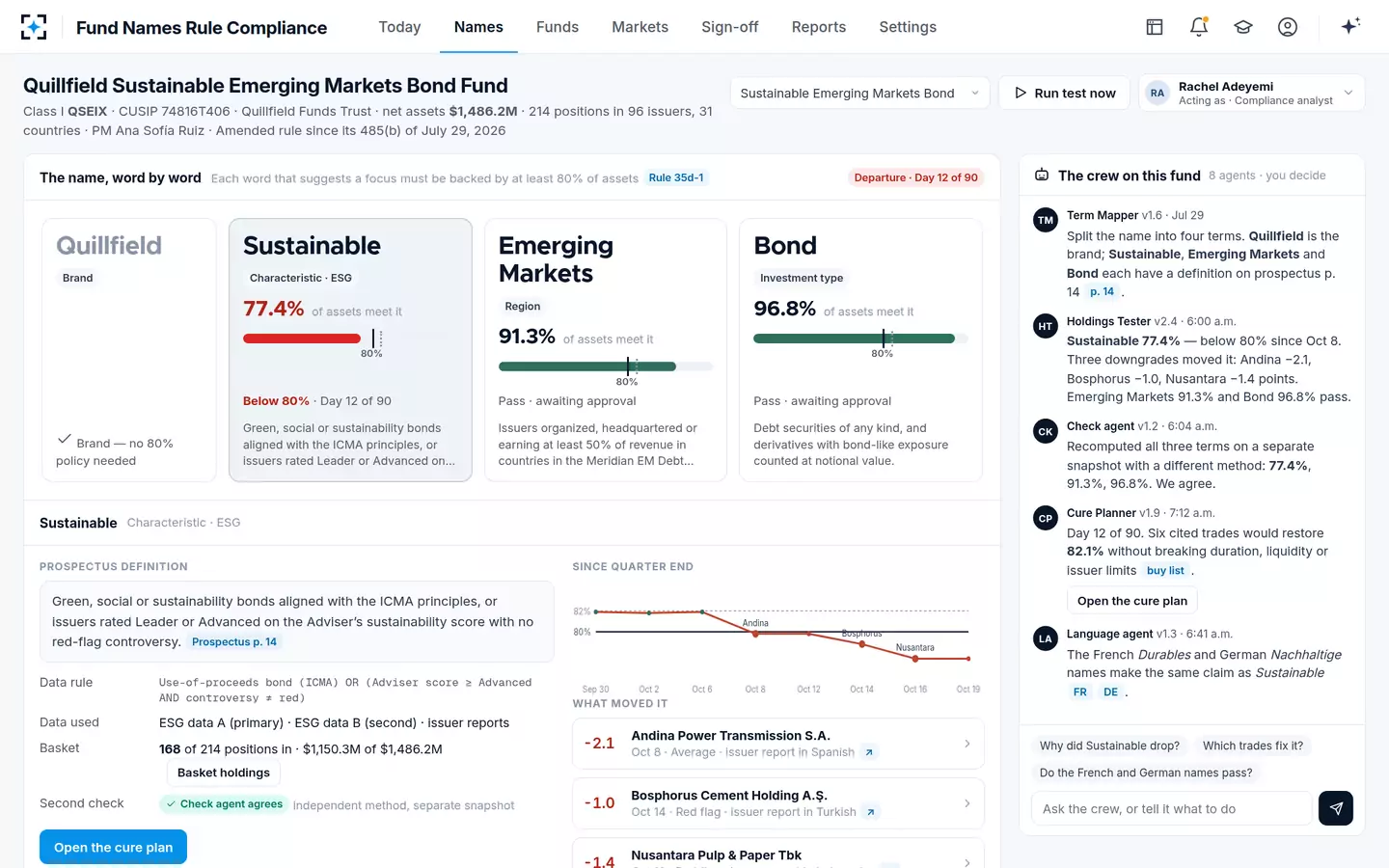
The same nightly figure feeds the pre-trade test, so an order that would push a term below 80% is stopped before release. The full program is on the Fund Names Rule Compliance page.
Questions people ask
How are derivatives valued under the SEC Names Rule?
At their notional amount, not their market value. Interest rate derivatives are converted to 10-year bond equivalents and options are delta adjusted, and physical short positions count at the value of the asset sold short. The same values apply in the 80% basket and in the assets it is measured against.
What is the notional amount of a derivative?
It is the face amount on which a derivative's payments are calculated, such as the principal of a swap or the value of the index units under a future, and it is usually far larger than the derivative's market value. The Names Rule uses it, with adjustments, because it better reflects the fund's exposure.
What is a 10-year bond equivalent?
It restates an interest rate derivative as the amount of 10-year bonds with the same interest rate sensitivity. The SEC's suggested method multiplies the unadjusted notional by the derivative's duration divided by the 10-year bond's duration, so $150 million of 2-year futures with a duration of 1.9 against 8.0 counts as about $35.6 million.
Can a fund exclude cash from the Names Rule calculation?
Yes, but only up to the notional amount of its derivatives and the value of assets sold short. The exclusion covers cash, cash equivalents and US Treasury securities with a year or less to maturity; it is optional, and leaving it out lowers the basket's share.
Are currency hedges counted under the Names Rule?
No, if they qualify: a fund must exclude derivatives that hedge the currency risk of specific foreign-currency holdings, held for hedging, whose notional does not exceed the hedged value or par by more than 10%. Past that line they count in the denominator like any other derivative.