An ESG fund name change is one of three answers to the same problem: a name that suggests more than the portfolio can prove. Under the SEC's amended Names Rule, a US fund whose name includes ESG terms must invest at least 80% of its assets in line with them; under ESMA's guidelines, an EU fund with ESG or sustainability terms must meet an 80% threshold and apply benchmark exclusions. A fund that falls short can re-basket (change the portfolio until it earns the word), relabel (move to a term with lighter criteria) or rename (drop the term). Europe has already run the experiment: of 924 funds named in the largest EU managers' shareholder notifications, 600 changed their names, and 61% of those removed every ESG term. Botminds' Fund Names Rule Compliance tests every term against its policy and holdings nightly, which gives the product committee the numbers each option rests on before counsel drafts a notice.
ESG fund name change: the three ways out, and what each one costs
Can the portfolio meet the name's 80% test, and in the EU its exclusions, without becoming a different product?
Re-basket
Fits when
The portfolio can reach 80% (and, in the EU, clear the exclusions) without becoming a different product.
What it costs
Turnover and a narrower universe; possibly a policy amendment and a tighter definition.
What the rules ask
US: a non-fundamental policy change needs 60 days' notice, unless, in the staff's view, it only tightens the policy. EU: a material prospectus change is notified to investors.
Relabel
Fits when
The strategy is real but lighter than the term implies: an ESG-integrated fund named "Sustainable".
What it costs
A new word and its definition; investors' reaction to a weaker-sounding name.
What the rules ask
US: the new term still needs an 80% policy if it suggests a characteristic. EU: a lower term category brings lighter criteria but the same 80% threshold.
Rename
Fits when
Meeting the term would change what investors bought, or the portfolio is far from it.
What it costs
The name's marketing value and possible outflows; every document and local name.
What the rules ask
US: the notice covers the policy change and any name change that accompanies it. EU: the new name must still be fair, clear and not misleading.
ESG fund name change: the three choices a product head faces
The choice is between the portfolio, the word and the name, and the rules shape it differently on each side of the Atlantic. In the US, the amended Rule 35d-1 brings names with terms indicating that investment decisions "incorporate one or more environmental, social, or governance factors" into the 80% requirement, and each term must be used in line with its "plain English meaning or established industry use" (17 CFR 270.35d-1(a)(2)). There is no list of permitted words: a fund defines its own term, and the SEC expects the definition to be reasonable.
In the EU, the words come in tiers. ESMA's guidelines sort terms into transition, social and governance terms, which carry Climate Transition Benchmark exclusions; environmental and impact terms, which carry the stricter Paris-aligned exclusions; and sustainability terms, which add a commitment to invest meaningfully in sustainable investments. Moving down a tier lightens the test without dropping ESG language altogether, which is why relabelling is a real option in Europe and a narrower one in the US. The tiers themselves are set out in the ESMA fund naming guidelines Q&A.
What did EU funds do? Two thirds renamed, most dropped every ESG term
ESMA counted. In a study published on 17 December 2025, its economists read the shareholder notifications that the 25 largest EU managers, with €7.5 trillion under management, published between the guidelines' final report on 14 May 2024 and the deadline for existing funds on 21 May 2025. The notifications covered 924 funds with about €840 billion of assets. ESMA's summary: "two thirds of the funds reacting to the guidelines changed their name and more than half updated their investment policy" (ESMA TRV, December 2025). In exact terms, 600 funds changed their names, which ESMA's announcement gives as 64%, and 530 updated their investment policies (ESMA, 17 December 2025).
How 924 EU funds answered ESMA's name guidelines
The renames went mostly one way. "61 % of the funds changing name removed all ESG terms and an additional 21% of funds moved to using an ESG term with less stringent criteria attached (e.g. from 'Sustainable' to 'ESG')", ESMA found. Index funds tended to drop ESG terms altogether, often because the index they tracked had been renamed; actively managed funds were more likely to step down a tier and to change their policies. The fossil-fuel side of the same study, and what it meant for exclusion lists, is covered in the Paris-aligned benchmark exclusions guide from Botminds' ESG Exclusion Screening.
Where the 600 renamed EU funds went
Renamed funds
- Removed every ESG term · 61%
- Moved to a lighter ESG term · 21%
- All other changes · 18%
The decision was not random. ESMA modelled it and found that funds holding any fossil-fuel issuers above the Paris-aligned revenue thresholds were "about 60% more likely to change name", that each extra percentage point of that compliance gap raised the probability of a name change "by around two percentage points", and that a comparable exposed fund run by a US-headquartered manager was "about 65% more likely to rebrand". The further a portfolio was from its name, the more likely the name was what changed.
Why the name is worth fighting for: names move money
A name is not a label on the box; it moves flows, and the evidence for that is old and consistent. Studying US funds, Cooper, Gulen and Rau found that "the year after a fund changes its name to reflect a current hot style, the fund experiences an average cumulative abnormal flow of 28%, with no improvement in performance", and that the increase was similar whether or not the holdings matched the new name (Journal of Finance, 2005, peer reviewed). That is the investor-protection case for name rules in one sentence.
The evidence that fund names move money
28%
average cumulative abnormal flow in the year after a US fund renamed to a hot style, with no better performance
1,834
EU funds added an ESG-related term to their names between 2018 and 2024
<3%→ 9%
share of EU funds with ESG-related names, before 2015 and by mid-2024
ESMA found the same pull in Europe: adding an ESG term "can significantly boost fund inflows, especially in the immediate quarter following the name change", with environmental terms showing the largest effect (ESMA, April 2025). The flip side is the cost of a rename. A product committee dropping a term is giving up some of that pull, and the honest comparison is between the flows the name earns and the cost of making the portfolio earn the name.
Re-basket: keep the name and make the portfolio earn it
Re-basketing is the only option that keeps both the word and the investors who bought it, and it is a portfolio decision before it is a legal one. The first question is the gap: how many points below 80% the term sits on the fund's own definition, measured the way the rule measures it, with derivatives at notional. The second is whether the trades that close it fit the mandate. A bond fund that needs ten points of green, social or sustainability bonds in a market where few are issued may be choosing between liquidity and its name.
The legal side can be lighter than it looks. If the fund tightens a non-fundamental 80% policy to match the amended rule, the SEC staff would not object to skipping the 60-day notice, and a fundamental policy can generally be narrowed without a shareholder vote (staff FAQs, January 2025 and February 2026). In the EU, ESMA's study shows many funds took this road: 475 added explicit references to exclusions and 179 updated their minimum thresholds. Re-basketing needs evidence that the gap is closable, which is what a nightly test against the fund's own definition provides; the 80% test guide covers why that test must follow the name, not the screen.
What notice is required to change a fund name?
In the US, the Names Rule requires notice when a fund changes a non-fundamental 80% policy, and the notice must also cover "any change in the fund's name that accompanies the change". It goes out at least 60 days before the change, "in plain English separately from any other documents", under the bold heading "Important Notice Regarding Change in Investment Policy [and Name]", repeated on the envelope or in the email subject line (Rule 35d-1(a)(2)(ii) and (d)). Unlisted closed-end funds and BDCs face more: their policies can change only with a shareholder vote, unless they first run a tender or repurchase offer under conditions the rule lists.
What a US Names Rule change notice must contain
- Delivered separately, in plain English
Not buried in another document; a paper notice may share the envelope with other mail.
- The prescribed bold heading
"Important Notice Regarding Change in Investment Policy [and Name]", or a similarly clear statement, also on the envelope or the email subject line.
- The fund's 80% policy
As adopted under Rule 35d-1(a)(2)(i).
- The nature of the change
What is changing in the policy, in words a shareholder can act on.
- The old and the new names
Both, side by side.
- The effective date
Of the policy change, the name change or both, at least 60 days after the notice.
- A copy kept six years
Records of any notice are kept for six years from the date it was sent, the first two in an easily accessible place.
In the EU there is no Names Rule notice; ESMA's study notes that managers "must notify shareholders of any material changes to the prospectus by issuing notifications", under each UCITS or AIF regime's own rules. A rename decided late also costs money in the US: the SEC's 2025 extension was designed so that funds could make name and policy changes in their on-cycle annual updates rather than in off-cycle amendments, whose costs "may be borne by investors".
Relabel: the replacement words supervisors are watching
Relabelling swaps the term for one with lighter criteria, and supervisors have noticed where the words went. ESMA found that "almost half of the funds removing all ESG- terms replaced them with the following words: Scored, Screened, Select, Advanced, or Committed", and warned that such terms "could be problematic for supervisors if these terms are intended to signal ESG-related features"; it will "monitor evolving sustainability-related terminology in fund names" (ESMA TRV, December 2025). In October 2026 it added thematic notes on impact and transition claims, aimed at clear, fair and not misleading communication (ESMA, 12 October 2026).
In the US the escape route is narrower. A replacement word that still suggests a characteristic, "screened" or "responsible" for example, still needs an 80% policy, and paragraph (c) of the rule reminds every fund that a name can be misleading even with a compliant policy. The relabel that works is the one where the new word honestly describes the strategy: the staff's FAQs show the logic for terms such as "tax-sensitive", which describe a portfolio-wide approach rather than the holdings and need no 80% policy.
Every market, every language: the names a rename must reach
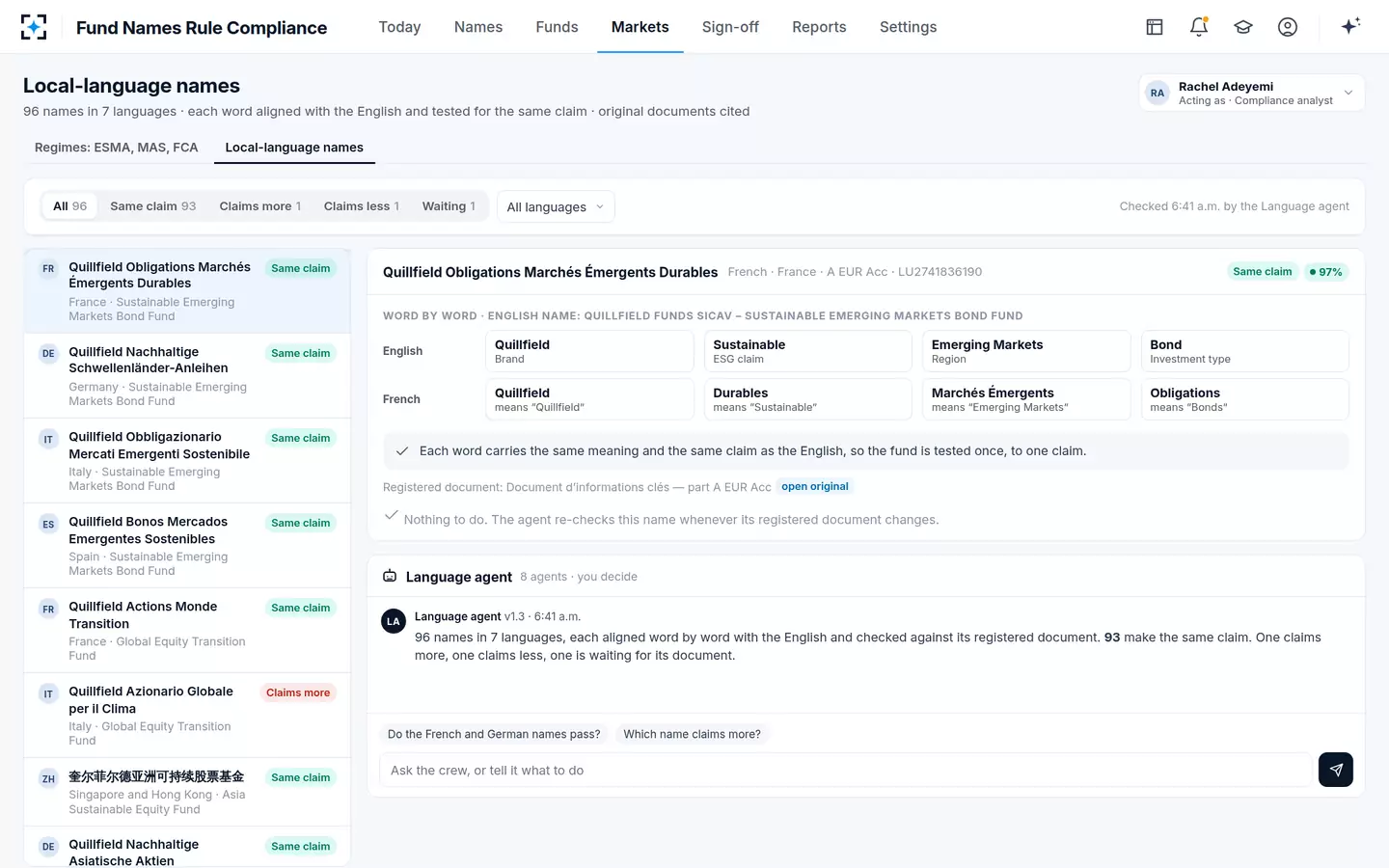
A cross-border fund has many names, and a rename that fixes the English can leave a translation claiming more. ESMA's guidelines reach "all fund documentation and marketing communications addressed to investors or potential investors", and the investor in Milan reads the Italian. In the fictional range in Fund Names Rule Compliance, the Language agent aligned 96 local names in seven languages with their English originals, word by word: 93 made the same claim, one was waiting for its document, one claimed less and one claimed more, an Italian name saying "per il Clima" where the English said "Transition", which is a stronger claim that fund counsel takes up before the chief compliance officer countersigns.
Local-language names, aligned word by word with the English
Deciding with evidence: what the product committee should see
The committee that chooses between the three options needs four numbers per fund: where each term in the name stands against 80% today, on the fund's own definition; how far the EU sibling sits from its exclusions; what closing the gap would cost in turnover and liquidity; and what flows the name has earned. It also needs the list of every document and local name a change would touch. None of those is a judgement call, and all of them are slow to assemble by hand.
Fund Names Rule Compliance supplies the first, second and fourth from its nightly tests: every term's meter, the ESMA test for each sub-fund and the full set of local names. The decision stays where it belongs. Counsel proposes a definition or name change, the chief compliance officer countersigns it, and no agent renames a fund. The program is described on the Fund Names Rule Compliance page, and the US notice clock that follows a decision runs inside each fund's compliance date.
Questions people ask
Why are so many ESG funds changing their names?
Because names now carry tests. ESMA's guidelines require an 80% threshold and benchmark exclusions for ESG-named EU funds, and the amended SEC rule requires an 80% policy for ESG terms in US names. In ESMA's sample of 924 funds, 600 changed their names, and the funds furthest from the exclusions were the likeliest to rename.
Does renaming an ESG fund need shareholder approval?
Not usually in the US. A name change that accompanies a change to a non-fundamental 80% policy needs 60 days' prior notice, not a vote; changing a fundamental policy needs a vote, and unlisted closed-end funds and BDCs need a vote unless they run a qualifying tender offer first. The prospectus then changes too, often first by a sticker supplement.
Which words did EU funds use after dropping ESG terms?
ESMA found that almost half of the funds removing every ESG term replaced them with Scored, Screened, Select, Advanced or Committed. It said such terms could be problematic if they are meant to signal ESG features, and that it will monitor them.
Is an ESG fund name change good or bad for investors?
ESMA concluded that the renaming improved the match between names and portfolios: the less ambitious funds dropped ESG terms, and funds that kept them cut fossil-fuel holdings by more than 40% from their pre-guidelines level. Research on US funds shows the risk on the other side: renames to a popular style drew 28% abnormal inflows with no better performance.
Can a US fund keep "ESG" in its name without an 80% policy?
Not if the term suggests that the fund's investment decisions incorporate ESG factors: the amended rule names that as a characteristic needing an 80% policy. The SEC did not adopt its 2022 proposal on ESG "integration" fund names, so the test is the 80% policy and the plain-English meaning of the term.