The Paris-aligned benchmark exclusions are seven exclusions that Article 12(1) of Commission Delegated Regulation (EU) 2020/1818 requires of every EU Paris-aligned Benchmark (PAB): companies involved in controversial weapons, companies that cultivate or produce tobacco, companies found in violation of the UN Global Compact principles or the OECD Guidelines for Multinational Enterprises, and companies over four revenue thresholds, 1% from hard coal and lignite, 10% from oil fuels, 50% from gaseous fuels and 50% from high-carbon electricity. Written for index administrators, they became a fund problem when ESMA's guidelines on fund names, applying since 21 November 2024, asked EU funds with environmental, impact or sustainability terms in their names to exclude the same companies. Each test needs a different kind of evidence, and that is where screens fail. Botminds' ESG Exclusion Screening runs the seven as versioned rules beside the manager's other policies, with each answer tied to the issuer's own filing.
The seven Paris-aligned benchmark exclusions, and the evidence each one needs
- (a) Controversial weapons: any activity related to them
Evidence: the issuer's and its subsidiaries' products, from filings, against the treaties your policy names. Any involvement, no threshold.
- (b) Tobacco: cultivation and production
Evidence: whether the issuer grows or makes tobacco products. Distribution and retail are not in the words.
- (c) Violations of the UN Global Compact principles or OECD Guidelines
Evidence: a finding the administrator (or fund manager) makes and documents, for example from a norms data feed reviewed by a person, with the incident and the principle.
- (d) Hard coal and lignite: 1% of revenue
Evidence: the coal mining, distribution or refining line of the segment note, coking coal included.
- (e) Oil fuels: 10% of revenue
Evidence: exploration, extraction, distribution or refining revenue, read from the segment note.
- (f) Gaseous fuels: 50% of revenue
Evidence: exploration, extraction, manufacturing or distribution revenue; utilities with gas networks need a line-by-line read.
- (g) Electricity above 100 g CO2e/kWh: 50% of revenue
Evidence: generation revenue and the emission intensity of that generation, from the issuer's generation mix and reported emissions.
What are the Paris-aligned benchmark exclusions?
They are the minimum exclusions for an index to carry the EU Paris-aligned Benchmark label, set in 2020 under the EU Benchmarks Regulation. Article 12(1) says administrators "shall exclude all of the following companies", then lists points (a) to (g) (Delegated Regulation (EU) 2020/1818, Art. 12). The same article adds two more duties: paragraph 2 excludes companies found or estimated "to significantly harm one or more of the environmental objectives" of the EU taxonomy, and paragraph 3 makes administrators disclose any additional ESG-based exclusion criteria in their methodology.
The exclusions sit beside a carbon target, not instead of one. A Paris-aligned index must have a GHG intensity at least 50% lower than its investable universe; a Climate Transition Benchmark (CTB), at least 30% lower (Arts. 11 and 9). For a fund manager borrowing only the exclusion list, those targets do not apply, which makes the seven tests the whole of the obligation and puts all the weight on getting each one right.
PAB vs CTB exclusions: three tests or seven
A Climate Transition Benchmark applies the first three tests and a Paris-aligned Benchmark applies all seven. The regulation's CTB article says administrators "shall comply with the requirements set out in Article 12(1), points (a), (b) and (c), and Article 12(2)" by 31 December 2022 (Art. 10(2)). So a CTB excludes controversial weapons, tobacco producers and norms violators, plus companies found to do significant environmental harm, but keeps fossil-fuel revenue that a PAB would exclude.
PAB vs CTB exclusions: what each label and each fund-name category excludes
Climate Transition: CTB, and funds with transition, social or governance terms: Excluded: Art. 12(1)(a) to (c)
Paris-aligned: PAB, and funds with environmental, impact or sustainability terms: Excluded: Art. 12(1)(a) to (c)
Climate Transition: CTB, and funds with transition, social or governance terms: Not excluded
Paris-aligned: PAB, and funds with environmental, impact or sustainability terms: Excluded: Art. 12(1)(d) to (g)
Climate Transition: CTB, and funds with transition, social or governance terms: Benchmarks: excluded (Art. 12(2)). Funds: not in ESMA's guidelines
Paris-aligned: PAB, and funds with environmental, impact or sustainability terms: Benchmarks: excluded (Art. 12(2)). Funds: not in ESMA's guidelines
Climate Transition: CTB, and funds with transition, social or governance terms: Benchmarks: 30% below the universe. Funds: none
Paris-aligned: PAB, and funds with environmental, impact or sustainability terms: Benchmarks: 50% below the universe. Funds: none
Climate Transition: CTB, and funds with transition, social or governance terms: 80% of investments meeting the fund's characteristics; "transition" terms need a measurable path
Paris-aligned: PAB, and funds with environmental, impact or sustainability terms: 80% threshold; "sustainable" terms must also invest meaningfully in sustainable investments
Why fund managers now apply them: ESMA's fund-name guidelines
ESMA chose the PAB and CTB lists as the floor for ESG-named funds. Funds using transition-, social- or governance-related terms should exclude the companies in points (a) to (c) of Article 12(1); funds using environmental-, impact- or sustainability-related terms should exclude those in points (a) to (g), and sustainability-related names must also commit to invest meaningfully in sustainable investments (ESMA guidelines, paras. 16–18). The guidelines applied to new funds from 21 November 2024 and to existing funds from 21 May 2025.
The industry argued for less. In the consultation, many industry respondents said that if ESMA insisted on exclusions, only points (a) to (c) should be used (ESMA final report, May 2024). ESMA kept the fossil-fuel thresholds for environmental and sustainability names, and said environmental terms may also include the abbreviations ESG and SRI. By ESMA's own count, about nine in ten EU funds with ESG terms in their names fell into the categories that apply all seven tests.
Most EU funds with ESG terms in their names fell into the seven-test categories
Managers responded by changing names more often than portfolios. In ESMA's review of 924 funds named in shareholder notifications from the 25 largest EU managers, 600 changed their names and 530 updated their investment policies; of those, 475 added exclusions, most of them the PAB list (ESMA, January 2026). The funds with the largest exposure to companies over the PAB fossil-fuel thresholds were the likeliest to drop ESG terms, and ESMA estimated that each extra percentage point of that exposure raised the chance of a name change by about 1.8 points. For a fund that kept its name, the seven tests are now part of the promise.
What ESMA's naming guidelines did to EU funds
4,000→ 3,300
funds in ESMA's sample with ESG terms in their names, 1Q24 to 3Q25
475
of 924 funds in notifications added exclusions, mostly the PAB list
€17bn→ €6bn
fossil-fuel exposure over PAB thresholds of funds with sustainability or environmental terms, after renaming alone
The three involvement tests: weapons, tobacco, norms
The first three tests have no revenue threshold: any involvement excludes. That makes them look simpler than the revenue tests and makes them harder to evidence, because "involvement" and "violation" are judgments about a company's products and conduct, not numbers in a segment note.
Controversial weapons (a) is defined by reference, not by a list: the weapons named in international treaties and conventions, in UN principles and, where it applies, in national law. The policy has to say which treaties, and whether a parent is excluded for a subsidiary's products; the controversial weapons list guide follows that ownership chain. Tobacco (b) covers cultivation and production only. A tobacco retailer or distributor is outside the PAB words; a fund policy can add a distribution threshold of its own, as the sample manager's newer fund policy does at 5% of revenue.
Norms (c) excludes companies that administrators "find in violation" of the UN Global Compact principles or the OECD Guidelines. The Ten Principles cover human rights, labour, environment and anti-corruption and derive from four UN instruments, among them the Universal Declaration of Human Rights and the UN Convention Against Corruption (UN Global Compact). The word "find" puts the decision on the user of the list: a fund applying the test needs a documented finding per company, usually from a norms data feed reviewed by a person. Monitoring those violations as they happen is the work of Botminds' ESG Risk Monitoring, and what counts as a UN Global Compact violation is set out in its own guide.
The four revenue tests: coal, oil, gas and power
The last four tests are revenue shares, each with its own activities and threshold, and each must be computed from the issuer's revenue, not from a sector code. A sector code puts a diversified miner, a utility with a gas network or a chemicals group with a refinery in one bucket; the test asks what share of revenue each activity earns.
The four PAB revenue tests, activity by activity
| Test | Threshold | Activities counted | Where screens go wrong |
|---|---|---|---|
| (d) Hard coal and lignite | 1% of revenue | Exploration, mining, extraction, distribution, refining | Coded as thermal coal only, missing coking coal; lignite mined by a utility for its own plants |
| (e) Oil fuels | 10% of revenue | Exploration, extraction, distribution, refining | Fuel distribution inside a retailer or chemicals group read as "not an oil company" |
| (f) Gaseous fuels | 50% of revenue | Exploration, extraction, manufacturing, distribution | Gas networks inside multi-utilities split across segments the screen does not add up |
| (g) Electricity generation above 100 g CO2e/kWh | 50% of revenue | Generation with that GHG intensity | Applying a coal-fired share instead of a generation-intensity test, or the reverse |
Coal is where a fund's older policy and the PAB list are most likely to part company, because a policy that says thermal coal and a test that says hard coal and lignite read different coals. The coal exclusion policy guide works through a steelmaking-coal miner that passes one test and fails the other.
What counts as evidence for each PAB exclusion?
The best evidence for a revenue test is the issuer's own segment note, reconciled to its income statement, for a fiscal year the policy accepts. For an involvement test it is the issuer's own description of its products and subsidiaries, and for the norms test it is a dated finding that names the incident and the principle. A vendor field is a reading of that evidence, not a substitute for it: useful for running the whole universe overnight, weak as the only support for excluding or keeping a specific name.
The regulation itself treats estimates as something to disclose. For estimates used under paragraph 2, administrators relying on an external data provider must make public "the name and contact details of the data provider" and "the methodology used and the main assumptions and precautionary principles, where available" (Art. 13(2)). A fund using vendor estimates for the seven tests has no such rule, but a supervisor asking how a holding passed (c) or (g) will want the same two answers: whose data, and how it was made.
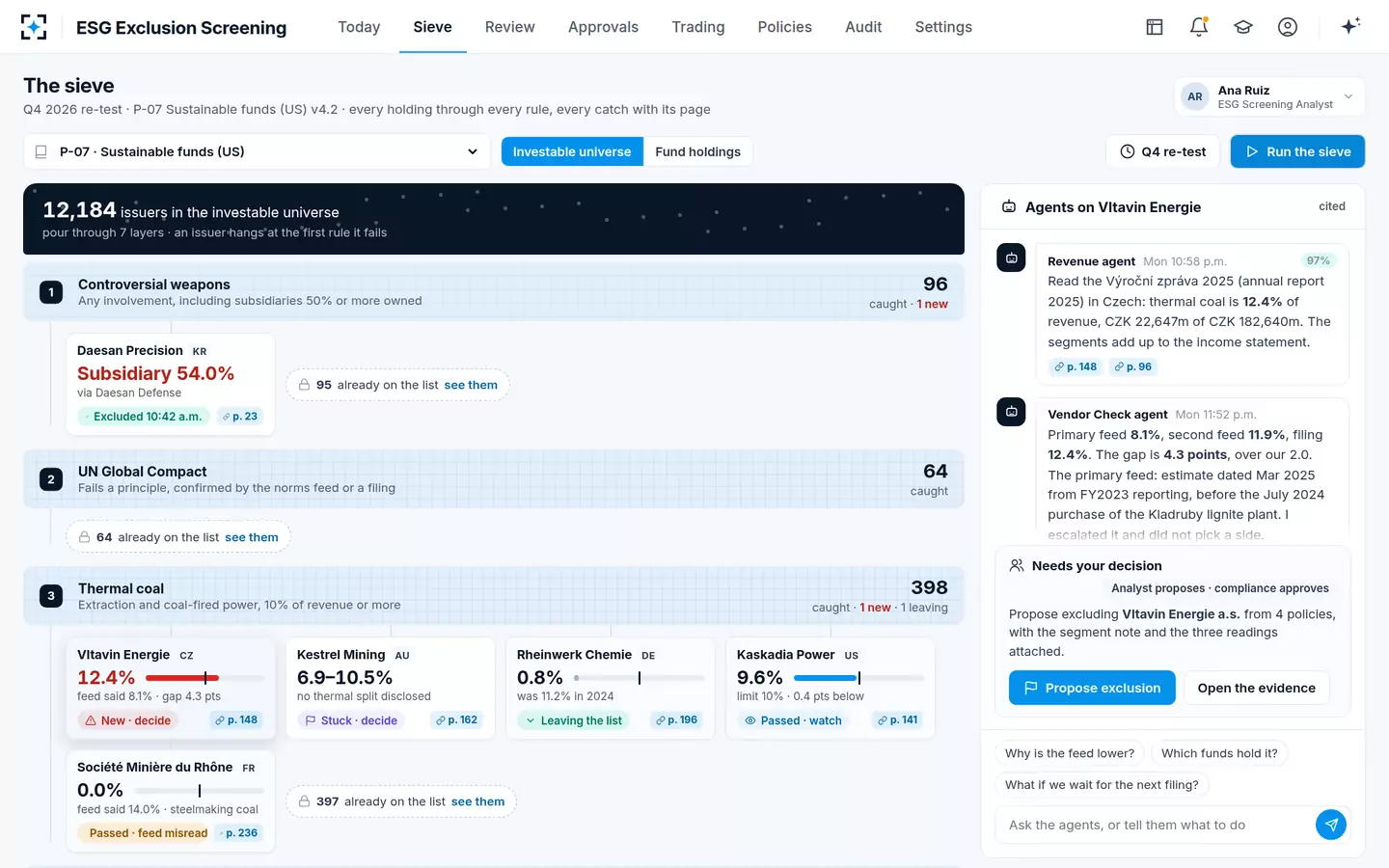
Every issuer through every rule, each catch with its page
What the regulation leaves to you
Article 12 sets thresholds and activities and stops there. It does not define hard coal, lignite, oil fuels or gaseous fuels; it does not say whose revenue counts when a company owns part of another; it does not say which fiscal year to test; and "find in violation" does not say how severe or how recent a violation must be. Each of those is a choice that a fund's policy must make and keep consistent, and each changes which companies are excluded.
The SFDR rules offer a neighbouring vocabulary that does not quite match. The principal adverse impact indicators in Delegated Regulation (EU) 2022/1288 measure exposure to companies "active in the fossil fuel sector", defined as any revenue from a long list of activities including transportation, storage and trade (Delegated Regulation (EU) 2022/1288, Annex I, definition (5)). A company can be excluded under that definition and pass every PAB revenue threshold. Botminds' SFDR Reporting handles the indicator (the PAI indicators, traced); the exclusion policy should say which definition it uses.
Is a temporary PAB breach a passive breach?
Yes, if it is not deliberate. ESMA's guidelines treat a temporary deviation from the 80% threshold or the exclusions as a passive breach, to be corrected in investors' best interest, as long as the fund manager did not choose it (ESMA guidelines, para. 22). A holding that crosses a threshold when an issuer publishes a new annual report, or when it buys a lignite plant, is the common case. Buying a name after it is known to fail is not.
The practical question is how fast "corrected" has to be. The guidelines set no deadline, so the manager's policy has to. In ESG Exclusion Screening the cure window is a setting per policy; the sample manager uses 30 business days from approval, with new buys blocked as soon as the exclusion is approved and sells that reduce the breach always allowed. How that cure is planned and tracked is in the fossil fuel exclusion list guide.
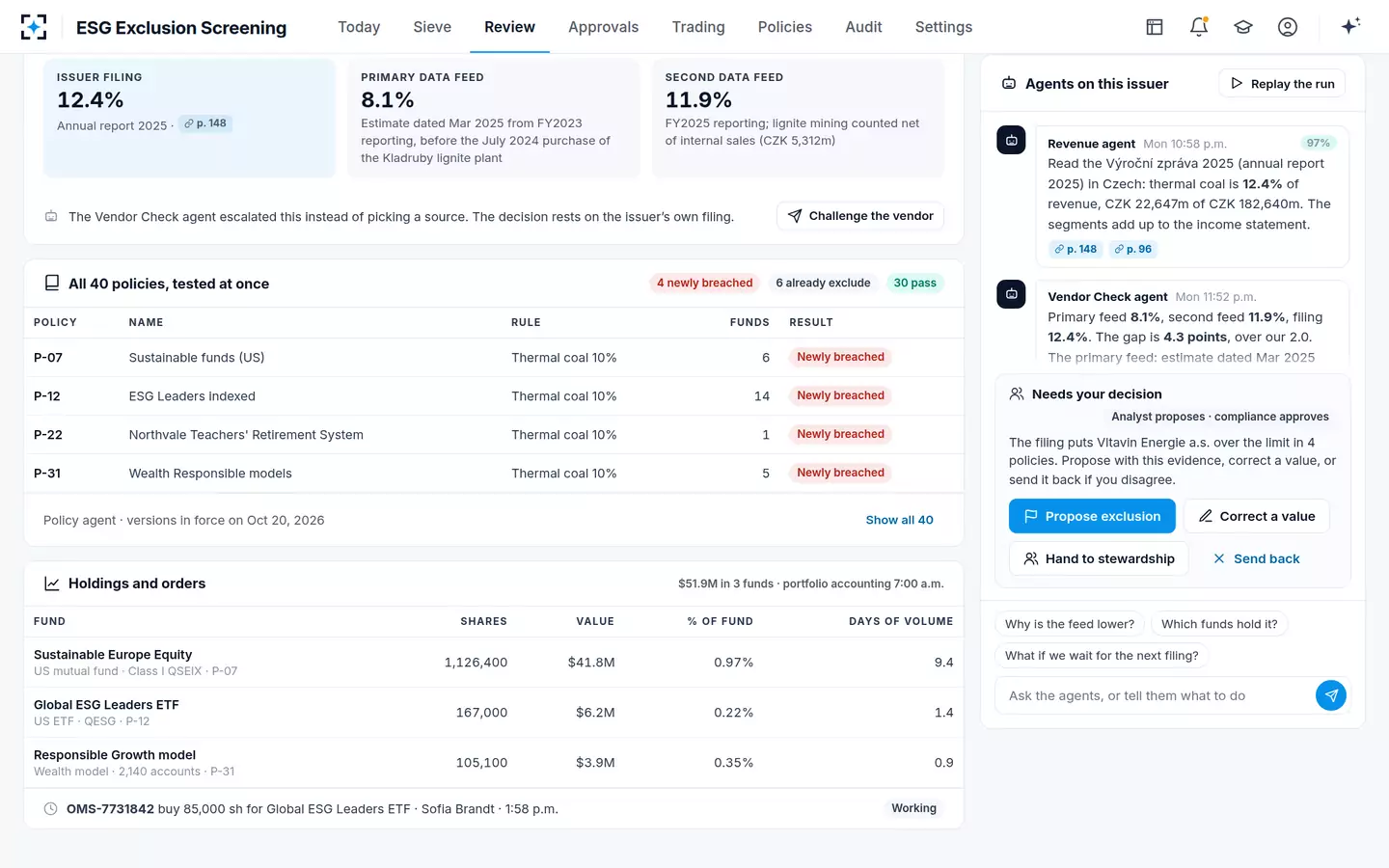
One filing, tested against every policy at once
Running the seven tests in ESG Exclusion Screening
In the solution, a Paris-aligned policy is seven versioned rules, one per point of Article 12(1), run with every other policy the manager has. The Revenue agent reads the segment note for tests (d) to (g) in the filing's own language and reconciles it to the income statement; the Weapons and Norms agent checks test (a) through ownership chains in filings and test (c) against the norms feed, and never excludes on news alone; the Vendor Check agent compares each reading with two data feeds and sends gaps over 2 points to a person. An analyst proposes each change, a compliance officer who did not propose it approves, and the list reaches the order system only after that.
It does not decide the questions the regulation leaves open. Which treaties define controversial weapons, whether sub-bituminous coal counts, how severe a violation must be: those are settings the head of sustainable investing fixes and compliance co-signs, and the agents apply them the same way to every issuer. The design is described on the ESG Exclusion Screening page; the US side of fund naming is handled by Botminds' Fund Names Rule Compliance.
Questions people ask
What is on the PAB exclusions list?
Seven categories, not company names: controversial weapons, tobacco cultivation and production, violators of the UN Global Compact or OECD Guidelines, and companies with 1% or more of revenue from hard coal and lignite, 10% from oil fuels, 50% from gaseous fuels or 50% from electricity generation above 100 g CO2e/kWh. Each user turns the categories into a company list with its own data and documents it.
When did the PAB exclusions start applying to EU funds?
Through ESMA's guidelines on fund names: from 21 November 2024 for funds created after that date, and from 21 May 2025 for funds that already existed. National supervisors apply the guidelines; fund managers do not report compliance to ESMA themselves.
Does a fund have to track a Paris-aligned index to use an ESG name?
No. The guidelines ask the fund itself to meet the 80% threshold and apply the exclusions. A fund that designates an index as its benchmark should use the terms only if the fund fulfils the guidance, so tracking a PAB-labelled index helps but does not replace the fund's own check.
Do the PAB exclusions cover tobacco retailers?
Not as written. Point (b) excludes companies involved in the cultivation and production of tobacco. Retail and distribution are outside it, so a fund that promises "no tobacco" needs its own distribution rule; the PAB test alone will not deliver that promise.
Do the exclusions apply to government bonds?
Article 12(1) is written about companies, and ESMA's guidelines ask funds to exclude investments in the companies it refers to, so sovereign issuers fall outside the seven tests. A fund's own policy can still add country-level exclusions; it should state them separately.
What is the difference between PAB and CTB exclusions?
A Climate Transition Benchmark excludes only the first three categories (weapons, tobacco and norms violators) plus, for benchmarks, companies doing significant environmental harm; a Paris-aligned Benchmark adds the four fossil-fuel and power thresholds. Fund names with transition, social or governance terms map to the CTB list; environmental, impact and sustainability terms map to the PAB list.