ESG screening tools test a portfolio's holdings against exclusion criteria and flag the companies that fail. Many do it on a data vendor's fields: product-involvement flags and revenue bands licensed for thousands of issuers and loaded into a screening module or an order management system's restriction list. What separates the tools is not the screen, which is simple arithmetic, but everything around it: where each issuer's figure came from, who decides the borderline cases, whether anyone can approve their own change, and whether the order system provably took the approved list. Botminds' ESG Exclusion Screening is built around those questions. Its agents read each issuer's own filing and compare it with two data feeds; an analyst proposes every change; a compliance officer who did not propose it approves; and the list counts only once the order system has read it back.
This guide is for teams choosing a tool. The product examples use the solution's sample data on a fictional manager with 286 funds and mandates and 40 policies; the regulatory points come from the SEC and ESMA.
Maker and checker in ESG Exclusion Screening: who proposes, who approves, who publishes
Agent
Revenue and Weapons and Norms agentsRead the issuer's segment note and ownership chain in its own language, compute the share in scope and cite the page.
Never: Never report an estimate as reported; below 90% confidence the analyst decides
Agent
Vendor Check agentPuts the filing beside two data feeds and explains each gap: an old year, a misclassified activity, a wrong parent.
Never: Never picks between sources; gaps over 2 points go to a person
Agent
Policy agentTests the issuer against all 40 policy versions and lists the funds and open orders affected.
Never: Never proposes or approves a list change
A person decides
ESG screening analyst (maker)Proposes the addition or removal with the evidence attached and a reason code.
A person decides
Compliance officer (checker)Questions the agents if needed, then approves, returns or rejects. Cannot approve their own proposal.
Agent
List Publisher and Pre-trade agentsPublish the approved version to the order system, read the entry count back, then block new buys in the name.
Never: Never publish before approval; never cancel or amend an order
What do ESG screening tools actually do?
An ESG screening tool takes three inputs, the holdings, the criteria and data about each issuer, and produces a pass or fail for every holding against every criterion. The holdings come from portfolio accounting, mapped from securities to issuers and their parents. The criteria come from the fund's prospectus, the client's mandate or the firm's policy. The issuer data is where tools differ, and it decides what the tool can catch.
The SEC's examiners described the gap a tool is meant to close. They found weaknesses in procedures for implementing and monitoring clients' and funds' ESG-related directives, and observed that "compliance programs were less effective when compliance personnel had limited knowledge of relevant ESG-investment analyses or oversight over ESG-related disclosures and marketing decisions" (SEC risk alert, April 2021). A tool that compliance can read, not only run, addresses the second half of that sentence.
ESG screening solutions: four kinds, and what each compares
Four kinds of product are sold as ESG screening solutions, and each compares a holding with something different. Knowing which you are looking at tells you, before a demonstration, which errors it can find: a tool that never opens an issuer's filing cannot find a vendor figure that is a year out of date.
Four kinds of ESG screening tools, and what each one checks a holding against
| Kind of tool | Compares each holding with | Strength | What it cannot see |
|---|---|---|---|
| Data provider's screening module | The provider's own involvement flags and revenue estimates | Covers thousands of issuers on day one | Its own gaps, estimates and old fiscal years; other providers' readings |
| Order system or compliance rules engine | A restricted list loaded from elsewhere | Enforces the list before every trade | Whether the list itself is right |
| Spreadsheets and in-house scripts | Vendor fields plus the names analysts have checked by hand | Fully under the manager's control | The names nobody had time to check; who changed what |
| Agents reading filings | The issuer's segment note and ownership disclosures, beside vendor feeds | A cited reading for every issuer, in any language | What the issuer never discloses; it still needs feeds for norms violations |
The categories are layers, not rivals. The order system has to enforce the list whatever produced it, and data feeds remain the fastest way to cover the universe and the only practical source for some judgments, such as UN Global Compact assessments. The question for a buyer is which layer settles a disagreement. In the WisdomTree case, a vendor's documented limits on its tobacco and fossil-fuel coverage became the funds' limits, and nobody between the vendor and the prospectus checked one against the other (SEC order IA-6753).
The ESG screening process as maker and checker
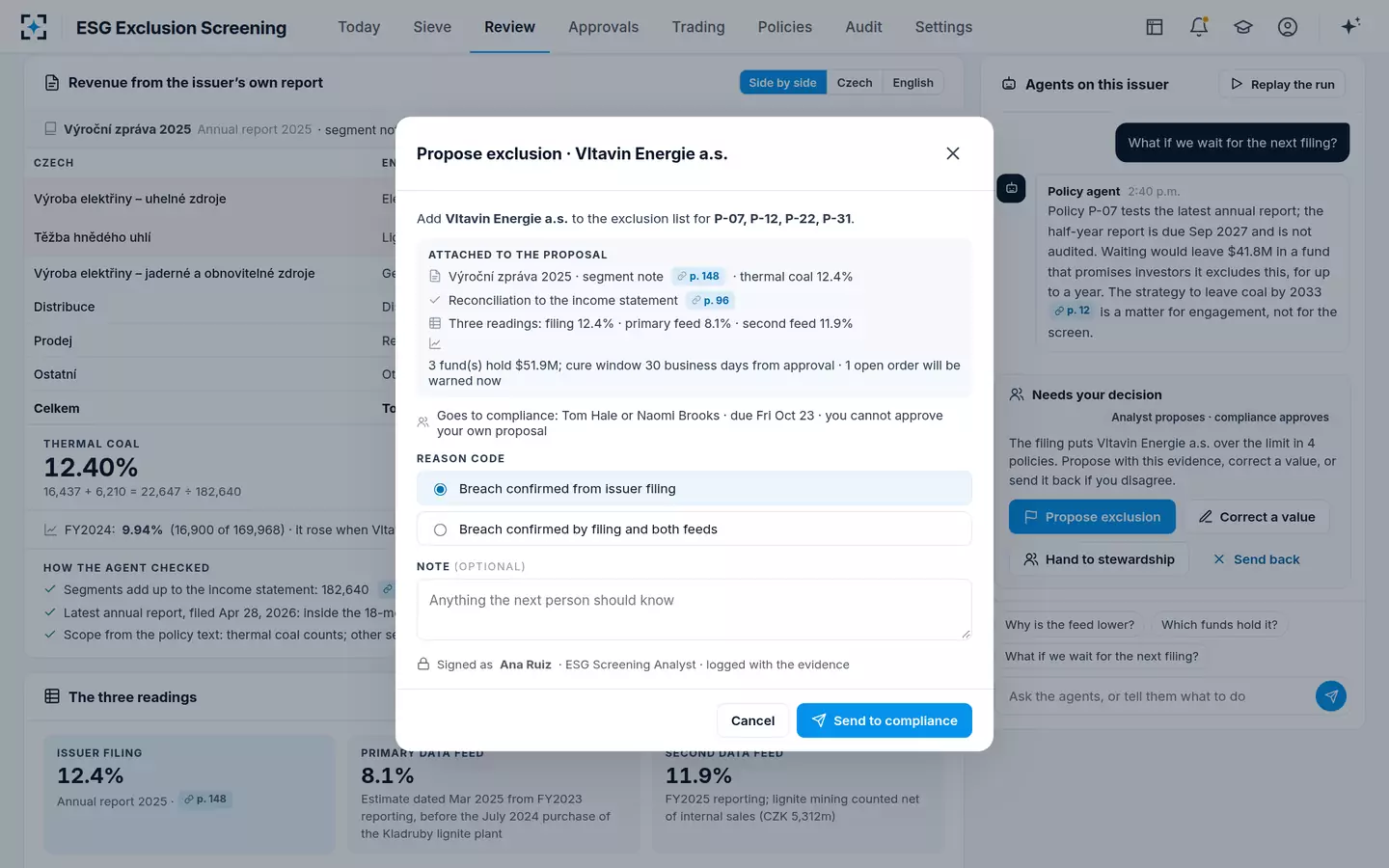
The ESG screening process works best as a maker-checker system: one party prepares a change with its evidence, a second, independent party approves it, and the system that enforces it confirms it took effect. Applied to exclusions, the maker is the analyst who reads the evidence and proposes adding or removing an issuer; the checker is a compliance officer who did not make the proposal; and the confirmation is the order system's read-back of the approved list.
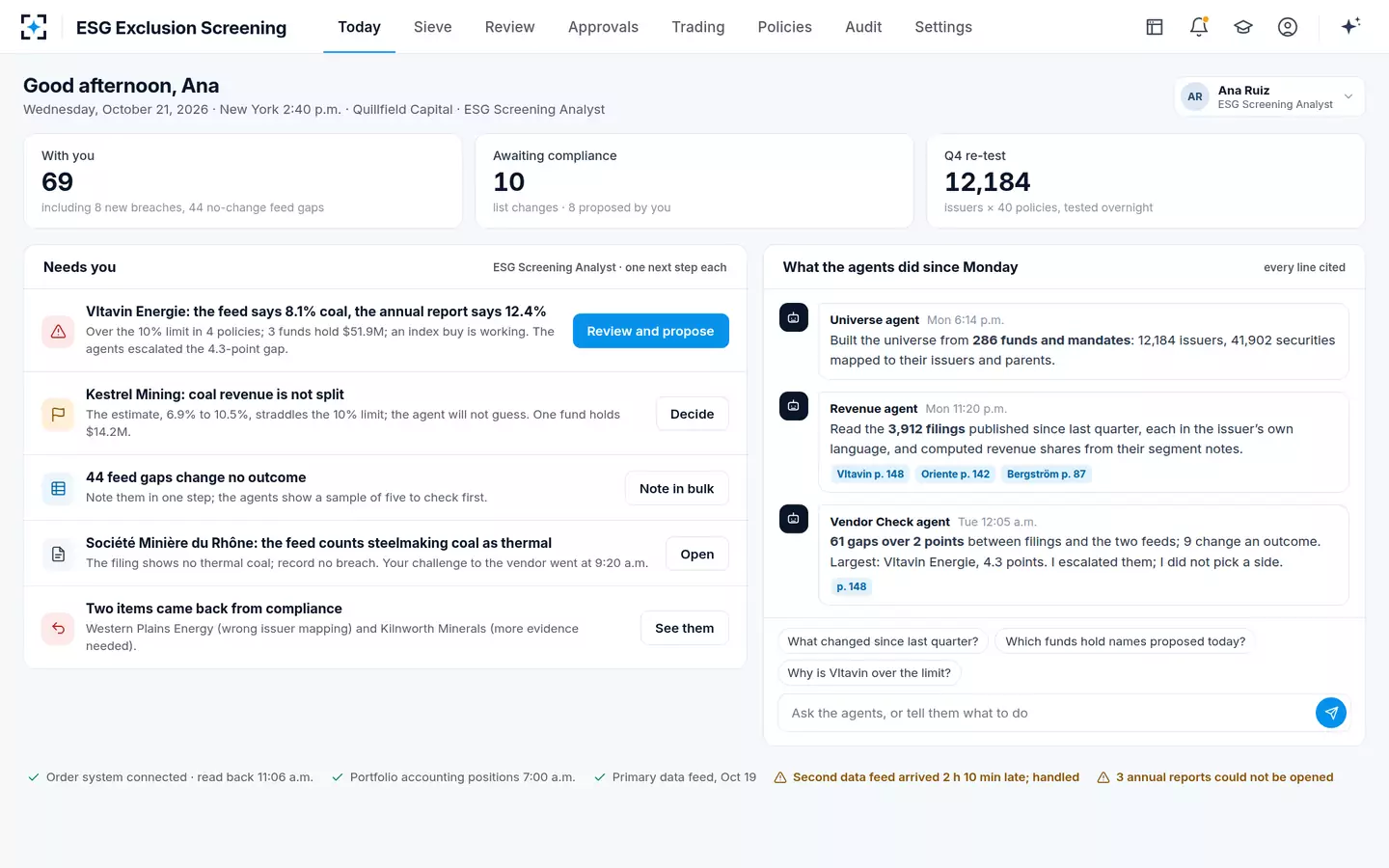
Agents change who does the reading, not who decides. In ESG Exclusion Screening the agents assemble the evidence the maker needs: the segment note, the reconciliation to the income statement, the two feeds and the policies and holdings affected. They do not propose. That keeps the maker a person who has looked at the page, and keeps the checker able to ask what the maker saw. At the sample manager, one overnight re-test of 12,184 issuers against 40 policies, 487,360 tests in all, left 142 issuers for a person.
The analyst proposes, with the evidence attached and the approver named
Why the proposer never approves the change
The proposer never approves because an exclusion decision is a judgment, and a judgment checked only by the person who made it has not been checked. The borderline cases are exactly where this matters: a revenue share inside the range of two estimates, a filing that does not split thermal from metallurgical coal, a subsidiary bought or sold during the year. In those cases the analyst's reading is a reasonable choice among several, and the second person's job is to ask whether it is the one the policy intends.
The enforcement cases show what the absence of a second line costs. At BNY Mellon's adviser, "compliance personnel were unaware before mid-March 2020 that quality reviews were not prepared for all Overlay Fund investments, and thus lacked pertinent facts" when checking the funds' disclosures (SEC order IA-6032). At DWS, "internal analyses showed DIMA research analysts having inconsistent levels of documented compliance" with the firm's ESG policy, while the policy stayed on the website (SEC order IA-6432). In both, the people who could have challenged the work did not see it.
Independence also has to survive volume. At the sample manager, bulk approval is allowed only where the filing and both feeds agree within half a point; anything else is decided item by item, and an approval left for two business days is escalated to the head of sustainable investing. The settings themselves need compliance's co-signature to change, so the threshold for "easy" cannot be loosened by the people who benefit from it.
What the agents may never do
A tool that uses AI agents should be able to state, for each agent, what it is never allowed to do, and show the limit enforced rather than described. In ESG Exclusion Screening no agent may change a policy, propose or approve a list change, cancel or amend an order, or present an estimate as a reported figure. The Revenue agent below 90% confidence hands the decision to the analyst; the Vendor Check agent never picks between sources; the Weapons and Norms agent never excludes on news alone.
Regulators frame the risk the same way. ESMA, writing about AI in retail investment services, named over-reliance on AI at the expense of human judgment as a risk, and expected firms to keep documentation of how their AI tools make decisions, what data they use and how they change over time (ESMA public statement, May 30, 2024). The SEC's examination priorities for fiscal 2027, which use the term super intelligence for these tools, list compliance surveillance among the work firms now give them and say the Division is checking that the existing rules, which do not depend on the technology, are still met (SEC Division of Examinations, October 23, 2026). A screen run by agents is held to the same rules as one run by people.
The read-back: proving the order system took the list
An exclusion is enforced only when the order system holds the approved version, and most firms cannot prove that it does. The usual hand-off is a file upload to the order management system's restriction list, followed by an assumption. A read-back closes the loop: after publishing, the tool asks the order system how many entries it now holds and which version, and compares them with what it sent.
Approved, published, read back, and the open buy blocked
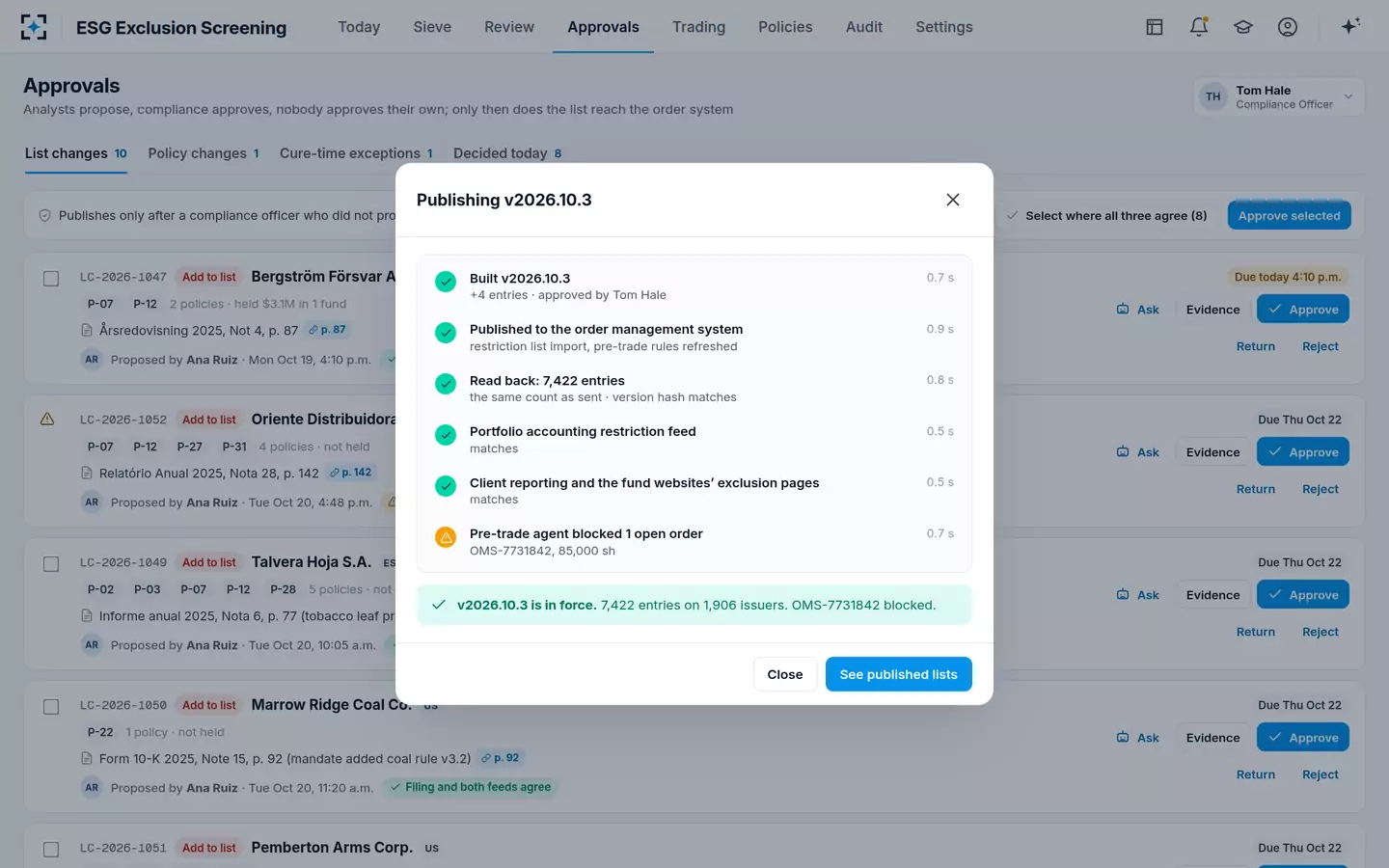
The same read-back extends to every place the list is published: the portfolio accounting restriction feed, client reporting and the exclusion pages on the funds' websites. Each is a place an investor or an examiner can compare with the holdings. A mismatch between the website's list and the order system's list is a misstatement waiting for someone to notice it.
Where the days go in a quarterly re-test
Most of a hand-run re-test goes on reading reports and reconciling vendors, not on deciding. Botminds' estimate for one quarterly re-test of every issuer against every policy at a large global manager puts it at about 19 business days by hand and 3 with the solution, with the reading and reconciling done by agents and the remaining days spent on decisions, approvals and evidence.
A quarterly ESG screening re-test, by hand and with agents reading the filings
| Step | By hand, on vendor data | With ESG Exclusion Screening | Who does the remaining work |
|---|---|---|---|
| Build the universe and map securities to issuers and parents | 2 days | 0.1 day | Universe agent; a person checks exceptions |
| Run every policy | 3 days | 0.2 day | Policy agent |
| Read annual reports and check exceptions | 7 days | 1 day | Analyst, on the cases the agents send |
| Reconcile vendor disagreements | 3 days | 0.5 day | Analyst, with the reason for each gap |
| Approve and load the list into the order system | 2 days | 1 day | Compliance approves; the agent publishes and reads back |
| Assemble evidence for the board, auditors and exams | 2 days | 0.2 day | Exported from the trail |
| Total | About 19 business days | About 3 business days |
An ESG screening checklist for the demonstration
Ask any vendor to show each of the following on your own policies and a sample of your holdings, not on its prepared data. The best single test is a back-test: give the tool last quarter's universe without your decisions, then score its output in three columns: issuers you both flagged, issuers only the tool caught, and issuers only your team caught.
Ten things to see an ESG screening tool do before you buy it
- Open the page behind any figure
The segment note in the issuer's own language, with the figure highlighted and the filing date.
- Show two vendors disagreeing
And what the tool does: average, pick one, or send it to a person with the reason for each reading.
- Show an issuer with no data
Missing coverage must go to a person, never default to eligible.
- Reject a self-approval
Try to approve your own proposal. The tool should refuse, not warn.
- Change a setting
The escalation gap or ownership threshold should wait for a second signature before it applies.
- Publish and read back
Show the order system's entry count and version after publishing, and what happens when it differs.
- Run every policy at once
One issuer tested against all your policies, with funds held and orders in flight.
- Walk an ownership chain
A subsidiary's activity attributed to its parent under your ownership rule, with the filing that proves the stake.
- State each agent's limits
What each agent may never do, and the evidence that the limit is enforced.
- Export one decision's full file
Rule version, readings, pages, reason, proposer, approver and read-back, ready for an exam request.
Where ESG Exclusion Screening fits, and where it does not
ESG Exclusion Screening fits where the policies are numerous, the issuers are many and the borderline decisions must be defended issuer by issuer: a manager with fund ranges, model portfolios and client mandates on different thresholds, holding companies that report in many languages. It sits between the data feeds and the order system: it reads the feeds, it does not replace them, and it publishes to the order system's restriction list, it does not replace that either.
It is not a data provider and it does not produce ESG ratings; norms assessments still come from a feed, checked by a person. It cannot read what an issuer never discloses, which is why it reports a range and hands the decision over when a filing does not split an activity. And it does not write policy: the thresholds, the treaties that define controversial weapons and the cure window are the manager's settings. Teams that need only a firmwide weapons screen over a few hundred issuers may find their data provider's module enough. Where the policy wording is the weak point, start with who writes, codes and signs the exclusion policy; where the data is, buying, building or reading a fossil fuel exclusion list compares the sources. The agents and their limits are on the ESG Exclusion Screening page.
The analyst's day starts with the decisions only a person can make
Questions people ask
Do we still need an ESG data vendor if a tool reads the filings?
Yes, for two reasons. Feeds cover the whole universe overnight and supply judgments a filing cannot, such as UN Global Compact assessments. And a second reading is what makes a disagreement visible: in the sample re-test the Vendor Check agent found 61 gaps of more than 2 points between filings and feeds, 9 of which changed an outcome.
Can an agent approve a low-risk exclusion change?
Not in ESG Exclusion Screening: every change to the list is approved by a compliance officer who did not propose it. What the tool allows is bulk approval by that person where the filing and both feeds agree within a setting, half a point at the sample manager, so routine cases do not take the same time as contested ones.
How does an ESG screening tool connect to the order management system?
Usually through the order system's restricted-list import and its pre-trade rules. The important part is the return path: after publishing, the tool should read back the entry count and version the order system holds, and stop if they differ. The same applies to portfolio accounting and any published exclusion pages.
What does an ESG screening tool cost?
Price lists are rarely public, so measure the tool against the analyst hours it would save you. Botminds' estimate for a large manager is about 19 business days per quarterly re-test by hand against 3 with agents reading the filings; price those days at your own rates, then add the integration with the order system and portfolio accounting.
What does the SEC expect from firms using AI in compliance work?
The same as from firms that do not: the Division of Examinations' fiscal 2027 priorities, published on 23 October 2026, say it is checking whether firms using super intelligence continue to comply with existing, technology-neutral obligations. For an exclusion screen that means written procedures, a second line that actually checks, and documentation of every decision.
How should we test an ESG screening tool before relying on it?
Run it on a quarter you have already screened, with your own decisions held back, and compare: issuers it excluded that you did, issuers it excluded that you missed, and issuers it missed. Then have compliance try to break the controls: approve its own proposal, publish without approval, change a setting alone.