Negative screening in ESG is the practice of excluding companies from a portfolio because of what they make or how they behave: weapons, tobacco, thermal coal above a revenue threshold, serious breaches of international norms. It sounds like the simplest ESG approach, and that familiarity hides how often it fails in practice. The SEC's examiners define it as excluding "issuers that are deemed to have negative ESG characteristics" and treat norms-based screening as a sub-category of it (SEC Division of Examinations, April 2021). Six beliefs about it keep weak screens in place, and each is contradicted by a regulator's finding, a rule text or a measured result. Botminds' ESG Exclusion Screening is designed around the corrections: it reads each issuer's own filing, keeps the vendor readings beside it, and leaves every exclusion to two people.
Six myths about negative screening, and what the evidence says
Myth 1
The data vendor's list is the screen.
A vendor's documented limits become the fund's limits unless someone checks them against the promise. In the SEC's WisdomTree order, they did.
SEC order IA-6753, 2024
Myth 2
A revenue band settles the borderline cases.
Near a threshold, estimates disagree with each other and with the filing. In one sample re-test, 9 of 61 large gaps changed an outcome.
Sample data, ESG Exclusion Screening
Myth 3
The index provider has already screened it.
About 74% of an "ethical" index fund's securities by market value were never screened, the Federal Court of Australia found.
ASIC 24-213MR, 2024
Myth 4
Negative screening costs a lot of return.
Norway's ethical exclusions left its equity benchmark 0.03 percentage points a year behind since 2006, by its manager's own measure.
Norges Bank Investment Management, 2025
Myth 5
Excluding the worst makes the portfolio, and the companies, better behaved.
Peer-reviewed studies disagree on the portfolio, and one finds funds did not measurably change how firms behave.
Review of Accounting Studies 2022; Review of Finance 2023
Myth 6
A public exclusion list is a ready-made screen.
The best-known one stopped taking new exclusion decisions in November 2025, and its thresholds are its own.
Norges Bank Investment Management, 2026
What is negative screening in ESG?
Negative screening, also called exclusionary screening, removes companies from the investable universe when they fail a stated test, so a fund never buys them and sells them if they start to fail. The test can be a product (tobacco, cluster munitions), a revenue share (thermal coal above 10%), a conduct standard (UN Global Compact violations) or a named list. In the SEC's 2021 review the examples of industries were alcohol, tobacco and firearms; in EU fund-name rules the tests are the seven Paris-aligned benchmark exclusions.
What makes it negative is that it only subtracts. It says nothing about which of the remaining companies a fund should prefer, which is the job of other ESG approaches, and it is judged on a simple question: does the portfolio hold anything the fund said it would not? That simplicity is why breaches are easy for a regulator to find and hard for a manager to explain.
Positive vs negative screening in ESG
Positive screening picks companies for good characteristics; negative screening removes companies for bad ones; and norms-based screening, a form of negative screening, removes companies that fail international standards (how a norms screen runs on its own clock is a separate guide). The SEC's examiners set out all three in one footnote, and the definitions are useful precisely because they are plain.
Positive, negative and norms-based screening, in the SEC examiners' terms
| Approach | What it does | Typical test | What a breach looks like |
|---|---|---|---|
| Negative (exclusionary) screening | Excludes issuers deemed to have negative ESG characteristics | Product, revenue share or named list | A holding the fund said it would not hold |
| Norms-based screening | A sub-category of negative screening: excludes issuers that fail minimum standards based on international norms | UN Global Compact principles, OECD Guidelines | A holding in a company found in violation |
| Positive (best-in-class) screening | Selects issuers deemed to have positive or best-in-class ESG characteristics | A rating or score above a cut-off | A portfolio whose holdings do not match the stated selection |
Myth 1: The data vendor's list is the screen
The vendor's list is an input to the screen, and its limits become the fund's limits unless someone compares them with the fund's promise. Data providers document the scope of each data set; the failure is not reading that scope against the prospectus. In the WisdomTree case the vendor had sent the adviser its methodology, including the scope and limits of each data set, before the funds launched (SEC order IA-6753, para. 23), and the funds still promised exclusions the data could not deliver.
The UK regulator's guidance states the duty that follows: where a claim relies on data with limitations, those limitations should be disclosed clearly and prominently (FCA FG24/3). A manager can use a vendor's list and keep its promise, but only by knowing what the list leaves out and either filling the gap or narrowing the promise. ESG exclusion criteria that hold up turns that into four tests.
Myth 2: A revenue band settles the borderline cases
A revenue band settles the easy cases and hides the hard ones. Many companies are far from any threshold, and for them any reasonable estimate gives the same answer. The companies that matter are the ones near the line, and there two estimates of the same company, or an estimate and the company's own filing, can sit on opposite sides.
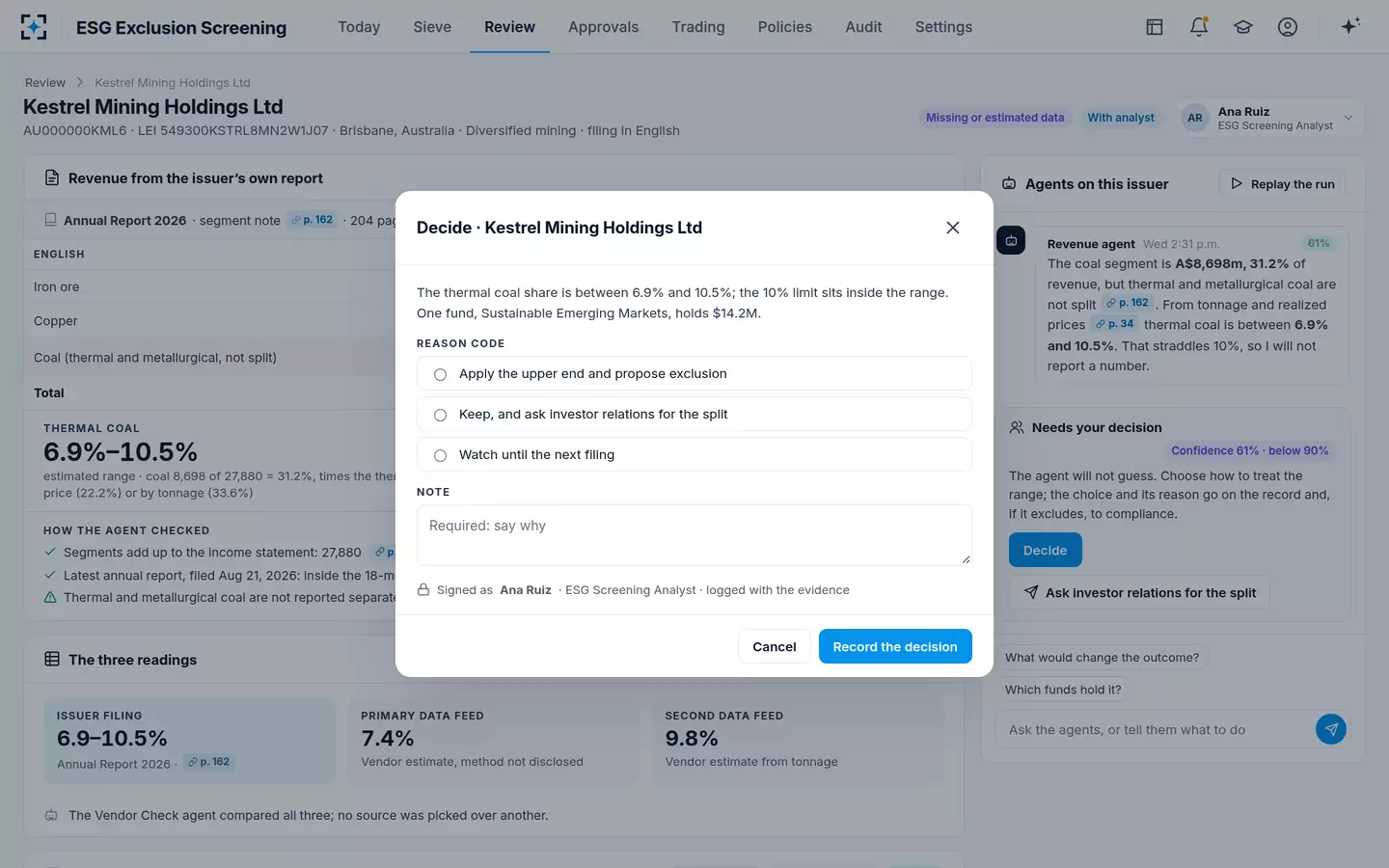
Take the solution's sample re-test on a fictional manager's universe of 12,184 issuers. Comparing each issuer's filing with two vendor feeds, the Vendor Check agent found 61 gaps of more than 2 percentage points, and 9 of them changed whether a company passed a policy. One fictional miner, Kestrel Mining Holdings, reports coal as 31.2% of revenue without splitting thermal from coking coal; its thermal share is somewhere between 6.9% and 10.5%, the two feeds say 7.4% and 9.8%, and the fund's limit is 10%. No band settles that. A person does, with a reason.
A borderline case the band cannot settle: the agent gives a range, a person decides
Myth 3: The index provider has already screened it
An index's exclusions are only as good as the index provider's coverage, and a fund that promises them owns the promise. Vanguard Investments Australia's Ethically Conscious Global Aggregate Bond Index Fund followed an index that was described as excluding companies with significant business activities in industries including fossil fuels. The Federal Court found that about three-quarters of the fund by market value had never been researched or screened against its ESG criteria, and ordered a A$12.9 million penalty in September 2024 (ASIC 24-213MR).
EU rules put the duty in the same place. ESMA's fund-name guidelines say that funds designating an index as a reference benchmark should use ESG terms in their names only if the guidance "are fulfilled by the Fund" (ESMA guidelines on funds' names, para. 20). Tracking a screened index helps; it does not transfer the check.
Myth 4: Negative screening costs a lot of return
The best long public measurement of exclusion costs says the cost has been small. Norway's sovereign wealth fund reports that since 2006 its equity benchmark index "has returned 2.42 percentage points less than it would have done without any ethical exclusions", and that on an annualised basis "the return has been 0.03 percentage points lower" (Norges Bank Investment Management, Responsible investment 2025). The split matters: product-based exclusions cost about 3.51 points cumulatively, mainly through weapons manufacturers and also tobacco, while conduct-based exclusions added about 1.10 points, led by companies excluded for severe environmental damage.
"It is mainly the exclusion of weapons manufacturers that has reduced returns, but the absence of tobacco companies has also played a role."
Norges Bank Investment Management, Responsible investment 2025
Norway's ethical exclusions and its benchmark's return since 2006
That is one fund's measurement, over one period and one set of exclusions, not a law of markets. It does show what the question turns on: which exclusions, in which sectors, over which years. A policy that excludes a handful of weapons and tobacco makers from a global universe is a different bet from one that excludes a whole sector, and the honest answer to "does negative screening hurt returns?" is to measure your own policy's effect on your own benchmark, as Norway does.
Myth 5: Excluding the worst makes the portfolio, and the companies, better behaved
The research does not support either half with confidence. On the portfolio, two peer-reviewed studies point in different directions. One, on US mutual funds from 2010 to 2018, found that self-labelled ESG funds held firms with worse records of compliance with labour and environmental laws than other funds run by the same managers, and that ESG scores tracked the quantity of voluntary disclosure rather than compliance (Raghunandan and Rajgopal, Review of Accounting Studies, 2022). Another found that socially responsible funds do select firms with lower pollution and better workplace safety (Heath, Macciocchi, Michaely and Ringgenberg, Review of Finance, 2023).
On the companies, the second study found no significant change in the behaviour of firms after socially responsible funds invested, and little sign that the funds tried to change it through shareholder proposals; its authors call the gap between promise and effect impact washing rather than greenwashing. For an exclusion policy that is not an argument against screening, which is a promise about what a fund holds, not about what companies do. It is an argument against selling a screen as impact. Changing behaviour is the work of engagement, and the sample manager's agents say so: a utility's plan to leave coal by 2033 is treated as a matter for engagement, not for the screen.
Myth 6: A public exclusion list is a ready-made screen
A public list is someone else's screen, run on their criteria, on their schedule. The best-known one, Norway's sovereign wealth fund's, shows both problems. Its coal criterion is written on thermal coal at 30% of income or operations, not the 1% hard coal test EU funds with ESG names apply. And since November 2025, under temporary ethical guidelines, Norges Bank may revoke earlier exclusions but may not decide new ones (Norges Bank Investment Management), so the list is not taking on new names.
That does not make the list useless. It is a well-documented set of decisions with reasons, and a useful cross-check for a manager's own screen. It is not a substitute for testing your holdings against your own promise. Norway's exclusion list and the 2025 pause looks at what is on it and how to use it.
Four numbers behind the six corrections
74%
of an index fund's securities by value never screened, despite its exclusion claims
Federal Court of Australia, 2024
0.03pts
a year: the return gap from Norway's ethical exclusions since 2006
NBIM, 2025
9of 61
large filing-versus-feed gaps that changed an outcome in one sample re-test
fictional sample data
Nov 2025
since when Norges Bank has taken no new exclusion decisions for its fund
NBIM, 2026
What the six myths have in common
Each myth moves the responsibility for a fund's promise to somebody else: the vendor, the index provider, the estimate, the public list. The regulators' answer, in every case above, is that it stays with the manager. The practical consequence is a screen whose every exclusion can be traced to the issuer's own evidence and to the two people who decided it, which is how ESG Exclusion Screening is built: agents read the filing and the feeds, an analyst proposes, and a compliance officer who did not propose approves.
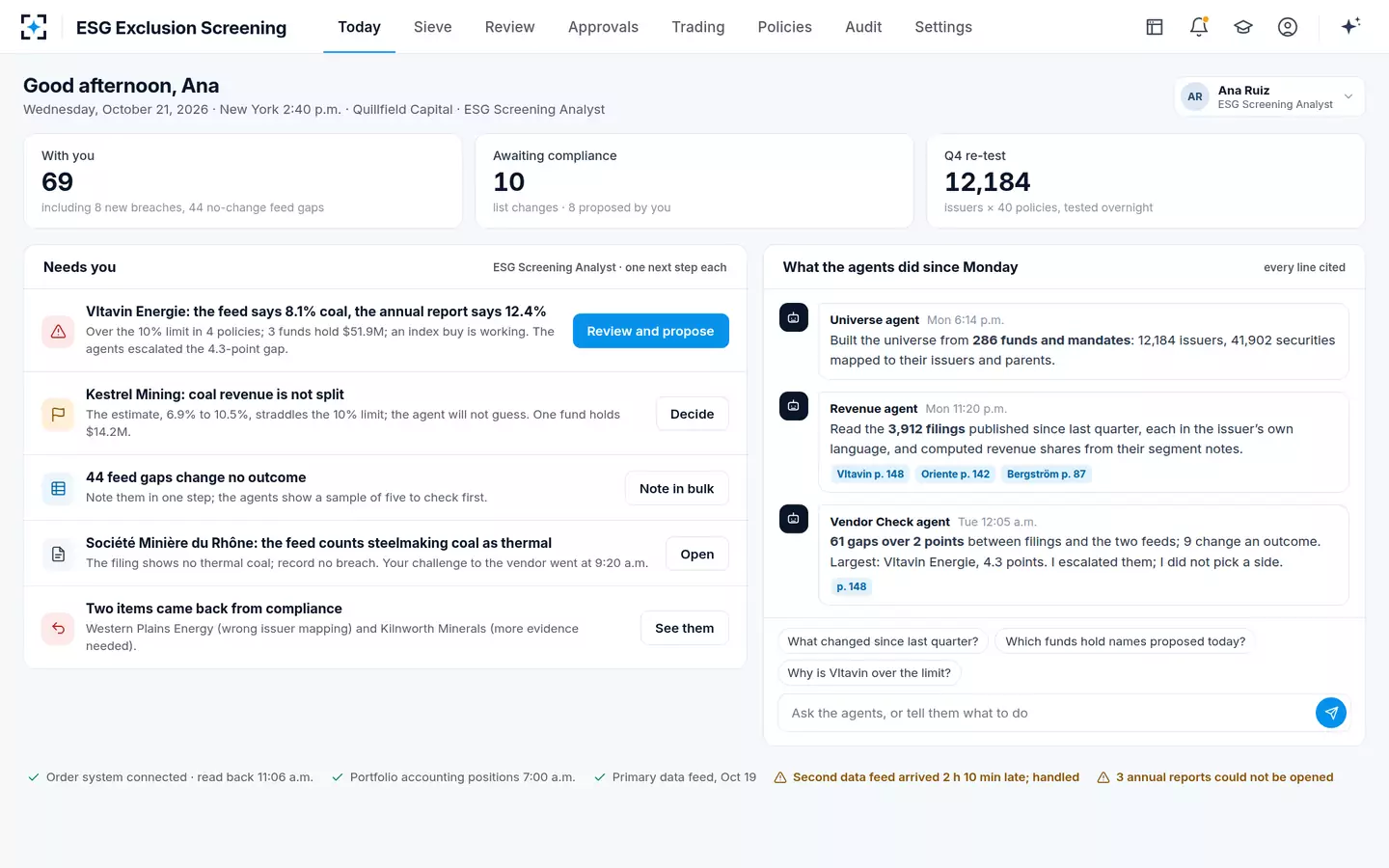
The overnight run makes that affordable. In the sample re-test, 12,184 issuers were tested against 40 policies, and 142 needed a person: the borderline revenue shares, the disagreements between filing and feed, the ownership questions. The rest of the universe was cleared or left unchanged with its evidence attached. Which seven tests EU funds now run, and what each needs, is in the Paris-aligned benchmark exclusions; the design is on the ESG Exclusion Screening page.
After the overnight run, the analyst sees only what needs judgment
Questions people ask
What are sin stocks?
"Sin stocks" is an informal name for shares in companies selling products some investors avoid on moral grounds, such as tobacco, alcohol, gambling and weapons. The SEC's 2021 ESG review gave alcohol, tobacco and firearms as examples of industries that clients' negative screens prohibit.
Is exclusionary screening the same as negative screening?
Yes. Both terms describe removing issuers from a portfolio because they fail a stated test. Norms-based screening is a sub-category, using international standards such as the UN Global Compact principles as the test.
What is an ESG negative screening list?
It is the list of issuers a fund may not hold once its exclusion criteria are applied to the investable universe. It changes whenever companies report new figures or data is corrected, so each entry needs the evidence and date that put it there; at the sample manager the list in force covers 1,906 issuers across 40 policies.
Does negative screening hurt returns?
Not much, on the longest public measurement: Norway's fund reports its ethical exclusions left its equity benchmark 2.42 percentage points behind cumulatively since 2006, or 0.03 points a year, with weapons exclusions the main cost and conduct-based exclusions adding return. The effect of any one policy depends on what it excludes.
Does negative screening change company behaviour?
The evidence says not by itself. A 2023 Review of Finance study found that socially responsible funds select firms with better conduct but found no significant change in firm behaviour. Exclusion keeps a fund's promise; engagement is the tool aimed at changing companies.
Is negative screening required by law?
Not in general. It becomes binding when a fund promises it, in a prospectus, a name or a mandate. In the EU, ESMA's guidelines expect funds with ESG or sustainability terms in their names to apply the Paris-aligned or Climate Transition benchmark exclusions, which makes negative screening part of using those names.