Norway's sovereign wealth fund exclusion list is the list of companies that Norges Bank has excluded from, or placed under observation in, the Government Pension Fund Global, the fund its investment arm, Norges Bank Investment Management (NBIM), manages for the Norwegian state. As last updated on 11 August 2026 it holds 201 entries: 183 exclusions and 18 observations, for products such as coal, tobacco and nuclear weapons and for conduct such as severe environmental damage and human rights violations. Since November 2025, under temporary ethical guidelines, Norges Bank may revoke earlier decisions but not make new ones, pending a review of the ethical framework that was due to report by 15 October 2026. For an asset manager the list is a valuable reference and a poor screen: it applies Norway's criteria, on Norway's schedule, and right now it cannot grow. Botminds' ESG Exclusion Screening tests holdings against the manager's own policies, where a public list can be one input but never the answer.
Every figure about the list comes from NBIM's own pages and reports and from Norway's Council on Ethics; the product examples use the solution's sample data on a fictional manager.
Norway's exclusion list: who decided, and the pause, 2016 to 2026
- From 2016: 30% of income or operations from thermal coal44 mo
- From Sept 2019: 20 Mt a year and 10,000 MW added74 mo
- From Nov 2025: temporary guidelines, no new decisions12 mo
- To Oct 2025: decided by Norges Bank's Executive Board118 mo
- Five decisions in hand published, Nov 2025 to Feb 2026
- Mar to Oct 2026: revocations only; last update 11 Aug 20268 mo
What is on Norway's sovereign wealth fund exclusion list?
The list holds 201 companies as of its 11 August 2026 update: 183 excluded and 18 under observation. NBIM publishes it as an alphabetical table with five columns: company, category (product-based or conduct-based), criterion, decision (exclusion or observation) and publishing date (NBIM, Observation and exclusion of companies). The oldest entries date from 2006; the most recent publishing dates are from February 2026.
Coal dominates. Sixty-six of the 183 exclusions, and 11 of the 18 observations, are under the criterion for production of coal or coal-based energy. Tobacco accounts for 19 exclusions and production of nuclear weapons for 14; conduct-based criteria account for 78 exclusions, led by severe environmental damage and serious violations of individuals' rights in situations of war or conflict.
What Norway's fund excludes: 183 exclusions by criterion
Who decided, until November 2025? The Council on Ethics and Norges Bank
Until November 2025 the Executive Board of Norges Bank decided whether a company should be excluded or placed under observation, under guidelines set by Norway's Ministry of Finance. Its decisions were based on recommendations from the Council on Ethics, which the Ministry appoints; for the product-based coal criterion, recommendations came from NBIM itself (NBIM). Coal decisions came in batches: 54 of the coal entries on today's list carry 2016 publishing dates, 38 of them the same day, 14 April 2016, in the year the criterion entered into force.
The Council on Ethics now has a different job. Under the interim ethical guidelines adopted on 7 November 2025, it "shall inform Norges Bank about companies whose activities fall within specified criteria", and the guidelines' purpose is "to identify companies for potential exercise of ownership" (Council on Ethics for the Government Pension Fund Global). The criteria are the same families as before: product-based ones for tobacco, cannabis, coal and certain weapons, conduct-based ones for economic crime, weapons sales to certain states, human rights violations and environmental damage. What changed is the consequence.
Why did Norway pause exclusions? What changed in November 2025
In November 2025 the Norwegian Government appointed a committee to review the fund's ethical framework, due to report by 15 October 2026, and the Ministry of Finance set temporary ethical guidelines until a new framework is in place (NBIM, Responsible investment 2025). The official texts give the review as the reason; they do not say what the new framework will contain, and NBIM's page still describes the temporary guidelines as in force.
"Under the temporary ethical guidelines, Norges Bank shall not decide on observation or exclusion, but may revoke previous decisions on observation and exclusion."
Norges Bank Investment Management, Observation and exclusion of companies
The pause caught decisions already under way. NBIM reports that in 2025, under the old guidelines, it announced 10 exclusions and 3 observations and reversed one exclusion and one observation; and that when the temporary guidelines took effect it was still implementing decisions to exclude four companies on the Council's recommendation and one under the coal criterion. Five exclusions on the list carry a publishing date of 26 February 2026, after the pause, which matches those five. Since then the list has only shrunk: the August 2026 update removed two exclusions, revoked during the first half of 2026, and ended two observations.
The paused list in four numbers
201
companies excluded (183) or under observation (18) at the 11 August 2026 update
5
exclusions published in February 2026, decided before the pause took effect
4
names removed in 2026: two exclusions revoked, two observations ended
0
new exclusion or observation decisions possible under the temporary guidelines
Why does Norway exclude a company? The criteria
Norway excludes for what a company makes and for how it behaves. The product-based criteria cover tobacco, cannabis, coal and certain weapons; the conduct-based criteria named on the list cover violation of human rights, serious violations of individuals' rights in situations of war or conflict, sales of weapons to certain states, severe environmental damage, unacceptable greenhouse gas emissions, gross corruption or other serious financial crime, and other particularly serious violations of fundamental ethical norms. Each entry on the published list names the criterion it was decided under.
Those criteria overlap with, but are not the same as, the tests an EU or US fund promises its investors. The closest match is between Norway's conduct-based criteria and the norms test in the EU's Paris-aligned benchmark rules, which excludes companies found in violation of the UN Global Compact principles or the OECD Guidelines (Delegated Regulation (EU) 2020/1818, Art. 12(1)(c)). The furthest apart is coal.
Norway's criteria against the tests a fund's own policy usually runs
| Norway's criterion | Nearest test in an EU or US fund policy | Where they differ |
|---|---|---|
| Production of coal or coal-based energy (thermal coal, 30% of income or operations; 20 Mt; 10,000 MW) | Paris-aligned: 1% of revenue from hard coal and lignite; or a fund's own thermal coal revenue share | Norway's test is on thermal coal, at a much higher share, with absolute size tests the EU rules lack |
| Production of tobacco | Paris-aligned: cultivation and production of tobacco | Close; neither covers retail unless the fund's own policy adds it |
| Production of nuclear weapons; cluster munitions | SFDR indicator 14: mines, cluster munitions, chemical and biological weapons | Nuclear weapons are on Norway's list but not among indicator 14's four types |
| Conduct-based criteria | Paris-aligned: UN Global Compact or OECD Guidelines violations | Norway's decisions are case by case with published reasons; a norms feed scores many companies at once |
| Cannabis; unacceptable greenhouse gas emissions | Not among the Paris-aligned or indicator 14 tests | Specific to Norway's framework among the sources compared here |
The coal criterion: thermal coal, through entities they control
Norway's coal criterion is the one most often borrowed, and it is precisely written. Observation or exclusion may be decided for "mining companies and power producers which themselves or through entities they control" derive 30% or more of their income from thermal coal, base 30% or more of their operations on it, produce more than 20 million tons of thermal coal a year or have more than 10,000 MW of thermal coal power capacity; forward-looking plans to change those shares are also weighed (Norges Bank, grounds for decision, 13 May 2020). The absolute thresholds took effect on 1 September 2019, and applying them led to five exclusions and four observations in May 2020.
Two features matter for anyone copying it. It covers thermal coal only, so a company mining only coking coal falls outside it, while it would fail the EU's 1% hard coal test; writing a coal exclusion policy explains the gap. And it counts entities a company controls, which makes it an ownership test as well as a revenue test. Decisions also change: one of the five companies excluded under the new thresholds in May 2020, RWE AG, appears on the current list under observation, with a 2025 publishing date.
What did exclusions cost Norway's fund?
Very little, by NBIM's own measurement. Since 2006 the fund's equity benchmark index has returned 2.42 percentage points less than it would have without any ethical exclusions, or 0.03 percentage points a year; product-based exclusions, mainly weapons manufacturers and tobacco, reduced cumulative return by about 3.51 points, while conduct-based exclusions added about 1.10 (NBIM, Responsible investment 2025). The same report shows that ethical exclusion is not the fund's only way out of a company: on risk grounds, NBIM decided to divest from or not invest in 58 companies in 2025.
That measurement is often cited in arguments about whether exclusions hurt returns. Six myths about negative screening puts it beside the other evidence; the short version is that the cost depends on what is excluded, and is worth measuring for your own policy.
Why a public list lags: decision, implementation, publication
A public exclusion list trails the decisions behind it, because an exclusion is published once it has been carried out. The five exclusions published in February 2026 were decisions Norges Bank was still implementing when the temporary guidelines took effect in November 2025. A manager that waits for a name to appear on the list before acting will always be a step behind the decision, and behind the evidence that drove it.
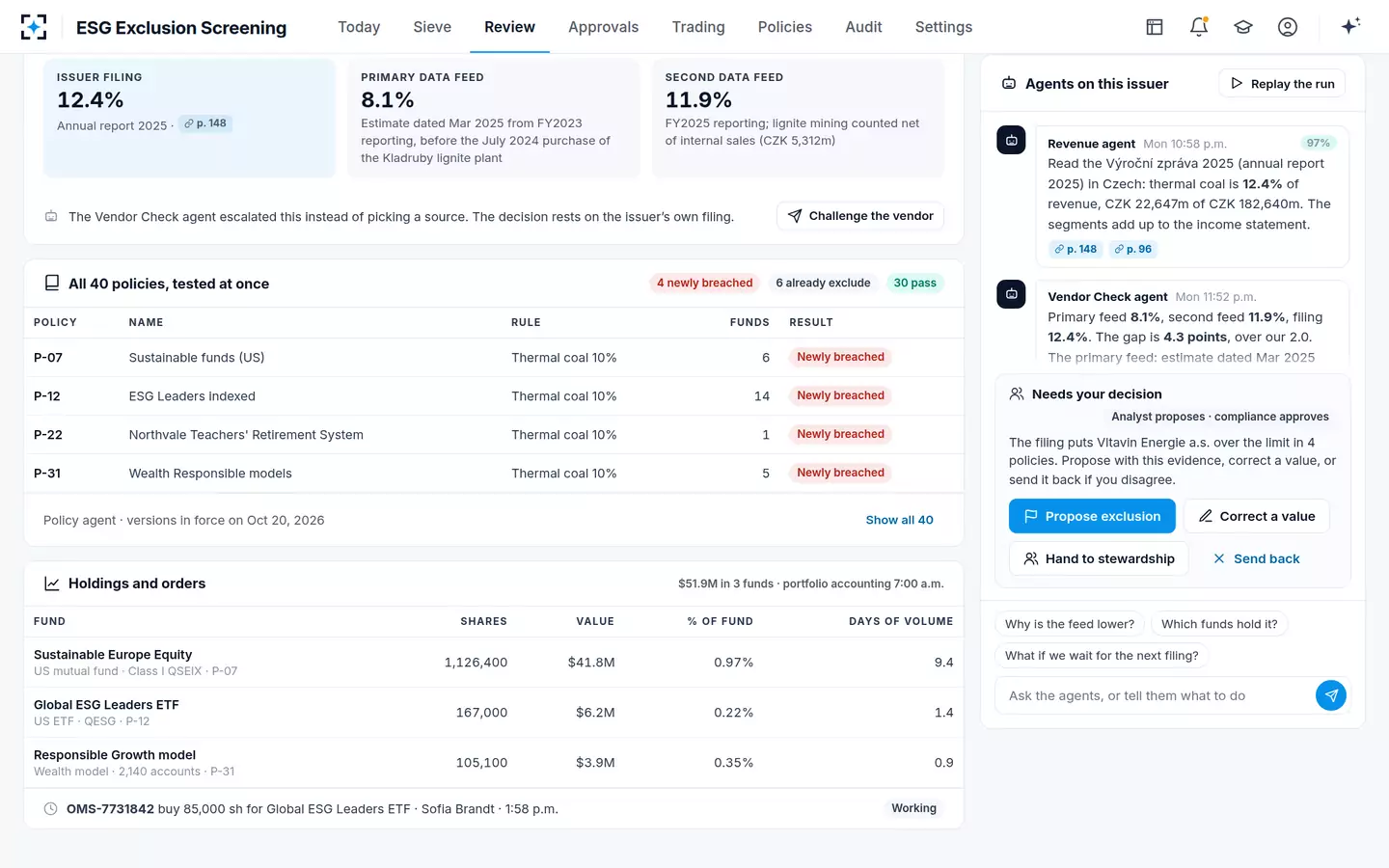
The list also trails the companies. Revenue shares change when a company buys or sells assets, and conduct cases develop for years before a decision. In the solution's sample data a fictional Czech utility moved from 9.94% to 12.40% of revenue from coal mining and coal-fired power after buying a lignite plant; its own annual report showed it six months before the manager's quarterly re-test read it. A list compiled by someone else would show it only when its owner had reviewed the company, and Norway's 30% income test would not have caught it.
Using the Norwegian government pension fund exclusion list in your own screen
Use it as a named list inside a policy, with its own version and date, not as the policy. A client may write the list into its mandate, or a manager may want it as a cross-check. Either way it needs work before a screen can use it: the page gives company names, not ISINs or legal entity identifiers, so each name has to be mapped to issuers and securities, and a parent excluded for a subsidiary's activity, or the reverse, has to be handled under the manager's ownership rule.
Before you load Norway's exclusion list into a screen
- Note the version you used
The page states its last update; keep that date with every decision made from it.
- Map names to issuers and securities
The list has no ISIN or LEI column, and former names are given for some companies.
- Keep exclusions and observations apart
An observation is not an exclusion; a mandate should say whether it means both.
- Decide how parents and subsidiaries map
Apply your ownership rule to listed parents of excluded entities, and to excluded parents' listed subsidiaries.
- Watch for removals
Under the temporary guidelines the list can only shrink; a revocation should reach your screen too.
- Do not treat it as complete
No new names since November 2025, and its thresholds are not your fund's.
- Run your own tests alongside it
Your policy's criteria, on the issuers' own filings, are what investors were promised.
In ESG Exclusion Screening a client's named list is one of the manager's policies, versioned like the rest. At the sample manager, 40 policies run side by side, from US sustainable fund ranges to a teachers' retirement system's own mandate, and every issuer is tested against all of them at once. A name on a public list that the manager's own tests would not exclude is a question for an analyst, with the evidence for both views on one screen.
A client's list is one more policy, tested with the other 39
What a frozen list means for managers who copied it
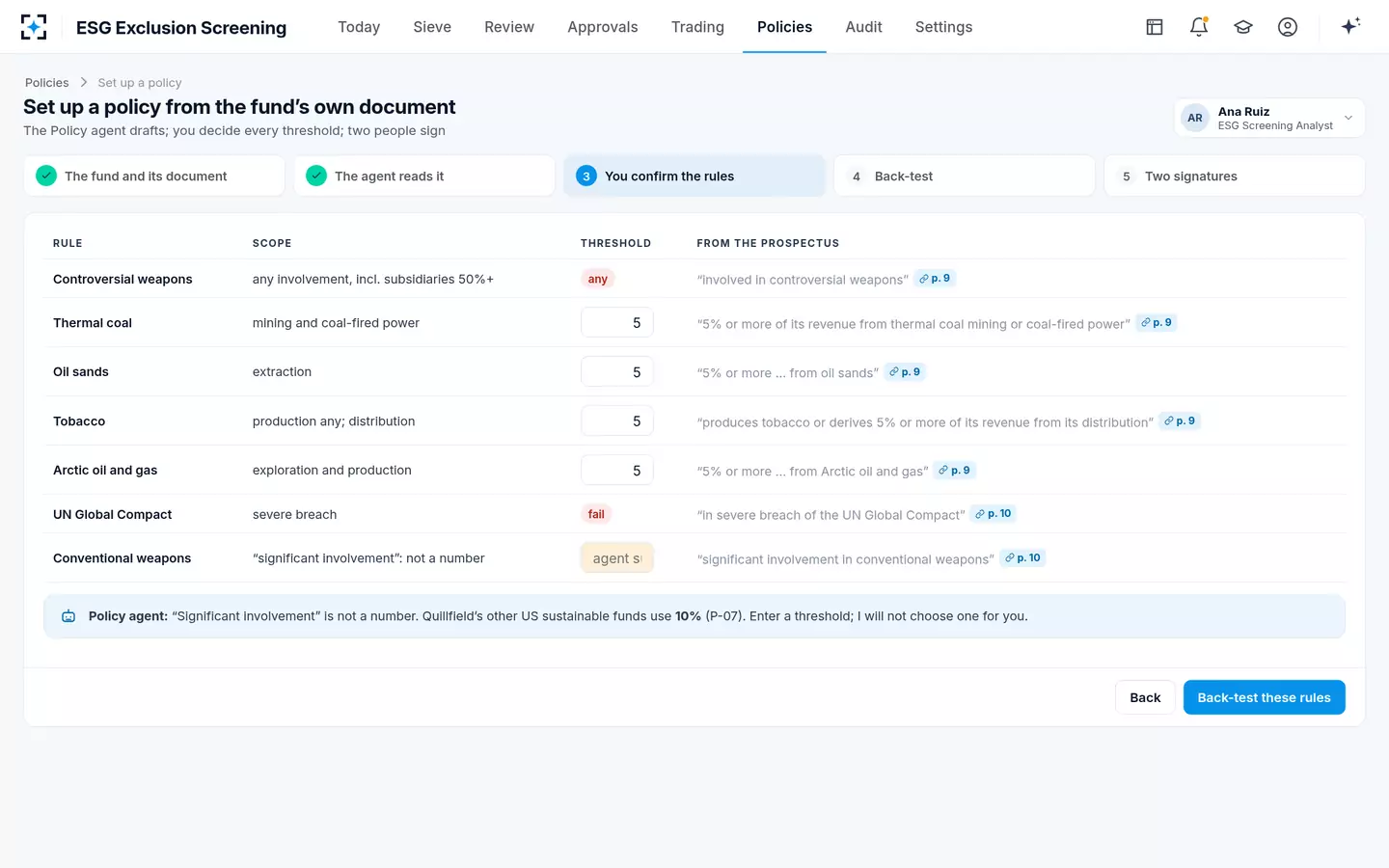
A manager whose policy says "companies excluded by Norway's fund" now has a policy that cannot add a name until Norway decides on a new framework, whatever happens in the meantime. If that was the intent, nothing needs to change. If the intent was "companies that fail the criteria Norway uses", the policy should say so, and the manager has to apply those criteria itself, from the issuers' own filings, starting now.
The pause makes a general point visible. A public list is somebody else's decisions, made for their reasons, on their timetable; it can stop, shrink or change course for reasons unrelated to any fund that copied it. Investors are promised a test, not a list. How to write that test is in who writes, codes and signs an ESG exclusion policy, and the agents that apply it are described on the ESG Exclusion Screening page.
Writing the test, not borrowing the list
Questions people ask
Is there an NBIM exclusion list in Excel?
NBIM publishes the list as a table on its website, with company, category, criterion, decision and publishing date; the page offers no spreadsheet download, so users copy the table. It has no ISIN or LEI column, so mapping names to securities is the user's work.
What is the Council on Ethics?
It is an independent body appointed by Norway's Ministry of Finance that assesses the companies in the Government Pension Fund Global against the ethical criteria. Until November 2025 its recommendations were the basis for most of Norges Bank's exclusion decisions; under the interim guidelines it informs Norges Bank about companies for possible ownership action instead.
How many companies has Norway's fund excluded?
183 companies were excluded and 18 under observation at the list's 11 August 2026 update, 201 in all. Coal accounts for 66 exclusions, the largest single criterion, followed by severe environmental damage with 29.
Can Norway's fund still exclude companies?
Not under the temporary ethical guidelines in force since November 2025: Norges Bank may revoke earlier decisions but may not decide new exclusions or observations. A committee reviewing the ethical framework was due to report by 15 October 2026; any new framework would follow from the Government's response.
Does Norway's coal criterion match the EU's Paris-aligned coal test?
No. Norway's covers thermal coal at 30% of income or operations, plus 20 million tons a year or 10,000 MW of capacity; the EU test covers hard coal and lignite, including coking coal, at 1% of revenue. A company can pass Norway's criterion and fail the EU test by a wide margin.
Should a fund copy Norway's exclusion list?
It can use it as a cross-check or as a client's named list, kept with its version date. As the whole policy it is weak: it reflects Norway's criteria and timing, can take no new exclusion decisions since November 2025, and does not test the thresholds your own fund promises.