ESG exclusion criteria hold up when the screen behind them reaches every issuer the promise covers, when the manager knows what its data does and does not capture, when the procedures for applying the criteria are written and followed, and when the board and investors are told the limits. Those four tests are not a theory. They are what went wrong, one by one, in the SEC's October 2024 order against WisdomTree, which cost the adviser a $4 million penalty and its three ESG funds, and in the Australian regulator's case against Vanguard, where the Federal Court found that about 74% of an "ethically conscious" bond fund had never been screened. Botminds' ESG Exclusion Screening tests every holding against every policy and keeps, for each decision, the issuer's own page, the data feeds beside it and the two people who signed it.
The cases are taken from the regulators' own orders and releases; the product examples use the solution's sample data on a fictional manager and fictional issuers.
Two enforcement cases scored against the four tests for ESG exclusion criteria
WisdomTree: No. Where the first vendor had no research on a company, the model treated it as eligible unless a sector code flagged it.
Vanguard: No. About 74% of the fund's securities by market value were never researched or screened.
Holds up: Coverage counted by issuer and by market value, with unknowns sent to a person, never defaulted to eligible.
WisdomTree: No. Three fossil-fuel data sets bought out of five offered; a tobacco data set that missed small retailers.
Vanguard: No. The screen relied on an index whose exclusions did not reach every issuer in it.
Holds up: A written map from each policy term to the data that tests it, and what that data does not cover.
WisdomTree: No written policies or procedures for the exclusion process at all.
Vanguard: Claims made in 12 product disclosure statements and elsewhere without the screening behind them.
Holds up: Procedures for each step, with documentation made at the time of the decision, not afterwards.
WisdomTree: Board told the funds excluded any involvement; no limitations described until November 2022.
Vanguard: Investors told the bond issuers were screened; the limits were admitted in court.
Holds up: Disclosures that state the data used, its gaps and how missing data is treated.
What makes ESG exclusion criteria hold up?
Criteria hold up when an outsider can take any holding, at any date, and see why it was allowed: which rule applied, what evidence the rule was tested on, who decided and when. Wording is the start, not the end. A criterion such as "no company with 10% or more of revenue from thermal coal" is precise on paper and indefensible in practice if the revenue figure came from a data set nobody checked, for a fiscal year nobody noted, on an issuer the data did not cover.
The SEC's examiners described the target in 2021. Among the effective practices they saw were detailed procedures that left a note, made at the time, of the ESG factors weighed in each investment decision (SEC Division of Examinations, April 2021). European supervisors list the same kind of control: managers keeping their funds' ESG descriptions consistent with the data through "pre-defined verifications, due diligence on data sources, ongoing monitoring, cooperation between internal teams, periodic checks on externally provided ESG data" (ESMA, June 2025). The four tests below turn those descriptions into questions a compliance officer can ask of any screen.
Test 1: does the screen reach every issuer it promises to?
A screen holds up only if it reaches every issuer the promise covers, and the commonest failure is a promise applied to part of a portfolio. Coverage gaps are invisible in a list of exclusions, because an issuer the screen never assessed does not appear on any list. They only show up when someone counts the holdings that were tested against the holdings that exist.
BNY Mellon's 2022 order is a coverage case. The adviser told investors that ESG quality reviews were part of the research process for its overlay funds; the SEC found that out of 185 investments made by one of those funds between January 2019 and March 2021, 67 had no ESG quality review score at the time of investment, "amounting to nearly 25 percent of the fund's net assets" (SEC order, Release IA-6032, May 23, 2022). The adviser paid a $1.5 million penalty.
The Vanguard greenwashing case: 74% never screened
Vanguard Investments Australia told investors that its Ethically Conscious Global Aggregate Bond Index Fund would exclude bond issuers with significant business activities in industries including fossil fuels. It admitted that this was not always so, and in September 2024 the Federal Court ordered a A$12.9 million penalty, which ASIC called the highest yet for greenwashing. The judge found the misrepresentations concerned "the principal distinguishing feature of the Fund, being its “ethical” characteristics", and that "Approximately 74% of the securities in the Fund by market value were not researched or screened against applicable ESG criteria" (ASIC 24-213MR).
Two details make it a test case for anyone who screens through an index. The fund followed a third-party index whose methodology was supposed to do the excluding, and certain securities in that index came from issuers that were never researched or screened. And the claims appeared in 12 product disclosure statements, a media release, the website, an interview and a presentation, for a fund with more than A$1 billion under management as of February 2021. A screen that is assumed rather than checked is repeated in every document that describes it.
Coverage is where ESG exclusion criteria fail first
74%
of an "ethical" bond fund's securities by market value never researched or screened
Vanguard, Federal Court of Australia, 2024
67of 185
investments by one BNY Mellon fund with no ESG review when bought, nearly 25% of net assets
SEC order IA-6032, 2022
35
WisdomTree positions sold at one rebalance once its vendor improved its tobacco research
SEC order IA-6753, 2024
A$12.9m
penalty for Vanguard, called by ASIC the highest yet for greenwashing
Test 2: do you know what your data does not cover?
A screen holds up only if the manager knows the scope of each data set and has mapped it to the words of the policy. Vendors document their scope; the failure is not reading it against the promise. The WisdomTree order shows exactly how a gap opens between a vendor's product list and a prospectus sentence.
The prospectuses promised to exclude companies involved in fossil fuels and tobacco. The first vendor did not sell a single "fossil fuels" data set; it offered five covering different activities, and the adviser bought three of them. To fill the gap it added a second vendor's sector classification and used only its energy sector, which left out, for example, utilities distributing natural gas to homes and industry (SEC order IA-6753, paras. 24–27). On tobacco, the vendor's methodology documents said it would not capture tobacco retail sales below 10% of a company's revenue, information the adviser had during due diligence and did not pass on (para. 34). In June 2020 the vendor added manual checks to its tobacco research; at the next quarterly rebalance, on 11 September 2020, the model directed the funds to sell 35 positions, most held since launch (para. 35).
What WisdomTree's prospectuses said, and what its data could test
The promise to investors: Companies involved in fossil fuels excluded, with no revenue threshold.
What the screen could actually see: Three data sets: Arctic oil and gas exploration, thermal coal, oil sands. No shale, oil and gas, or gas-distribution coverage beyond one sector code.
The promise to investors: Any tobacco involvement excluded.
What the screen could actually see: A data set documented as missing retailers with tobacco sales below 10% of revenue.
The promise to investors: Not mentioned.
What the screen could actually see: Treated as eligible unless the energy-sector code flagged them.
The promise to investors: Not expected by investors.
What the screen could actually see: Freight railroads hauling coal, gas distributors, a steelmaker with a 49% stake in a company holding oil and gas reserves.
What went wrong at WisdomTree?
All four tests failed at once. From March 2020 to November 2022, three ETFs marketed as ESG funds held companies involved in coal mining and coal transport, natural gas extraction and distribution, and tobacco retail, against prospectuses that said such companies were excluded. The data did not reach every issuer, its scope did not match the promise, the adviser "did not adopt and implement any written policies and procedures concerning the process for excluding the securities of certain companies" (para. 40), and neither the board nor investors were told the limits.
The remedy shows what disclosure the SEC expected. In November 2022, after an examination, the prospectuses were revised to define fossil-fuel activities as only the three data sets the adviser held, and to add a risk factor about its reliance on third-party data. The funds were liquidated on 5 February 2024, and in October 2024 the adviser was censured and paid a $4 million penalty. How that bill compares with the other SEC cases is in SEC ESG enforcement actions, case by case; the same order read from the order-entry side is in Pre-Trade Compliance Checks' guide to exclusion lists when the data feed and the filing disagree.
"In its representations to the Board and in the ESG Funds' Prospectuses, WisdomTree did not describe the limitations of the data sets it used from Vendor A and Vendor B in its screening process or otherwise define the term “fossil fuel.”"
SEC order, In the Matter of WisdomTree Asset Management, Inc., Release IA-6753, para. 29 (October 21, 2024)
Test 3: are the procedures written, and followed in the right order?
A screen holds up only if written procedures say who does each step and the steps happen in that order. Rule 206(4)-7 requires advisers to have written compliance procedures that can actually stop breaches, and to use them; each of the SEC's five ESG orders against advisers from 2022 to 2024 found a violation of it. The difference between having procedures and following them is the GSAM case: the procedures required an ESG questionnaire before each security was selected, and the SEC found the questionnaires were completed only after selection, relying on earlier research done in a different way (SEC order, Release IA-6189).
For an exclusion screen, the order of steps is concrete: the rule version is fixed before the re-test runs, the reading of each issuer is made before the decision, the decision is approved before the list is published, and the list is published before the order system enforces it. Evidence assembled after an exam request is not contemporaneous, however accurate it is.
Test 4: were the board and investors told the limits?
A screen holds up only if the people relying on it know what it cannot do. In the WisdomTree case the board was told, in several presentations, that the funds excluded companies with any involvement in fossil fuels and tobacco, and never told how the terms were interpreted or what the data missed. The UK regulator's guidance on its anti-greenwashing rule makes the same expectation general: where data or metrics have limitations, those limitations should be disclosed clearly and prominently alongside the claim (FCA FG24/3, April 2024).
Telling the limits does not mean writing a long disclaimer. It means stating, for each criterion, what data tests it, what fiscal year it reads, what happens to an issuer the data does not cover, and how disagreements between sources are settled. A board that has heard those four answers can approve a policy knowingly; a board that has heard only the promise cannot. Who writes, codes and signs the exclusion policy follows that chain of approvals.
ESG screening criteria that are numbers, not adjectives
The criteria themselves must be testable. "Significant involvement", "material exposure" and "low ESG rating" are adjectives until a threshold, a measure and a source are attached. The FCA gave an example in its 2024 guidance: a benchmark claiming to be sustainable by excluding companies with ESG ratings "lower than 3", without saying what the rating assesses, what scale it uses or why 3 was chosen. The regulator said users could be misled about what the benchmark achieves (FCA FG24/3, Example 6).
A rating can still be a criterion, but it then carries the rater's method, coverage and update cycle into the promise, and the policy should say so. Revenue-based criteria avoid that dependence only if the revenue is read from the issuer's own report. Where it comes from a vendor estimate, the criterion is as good as the estimate, and two vendors' estimates of one company can sit on opposite sides of a threshold. Six myths about negative screening covers the beliefs that keep weak criteria in place.
The defensible file, issuer by issuer
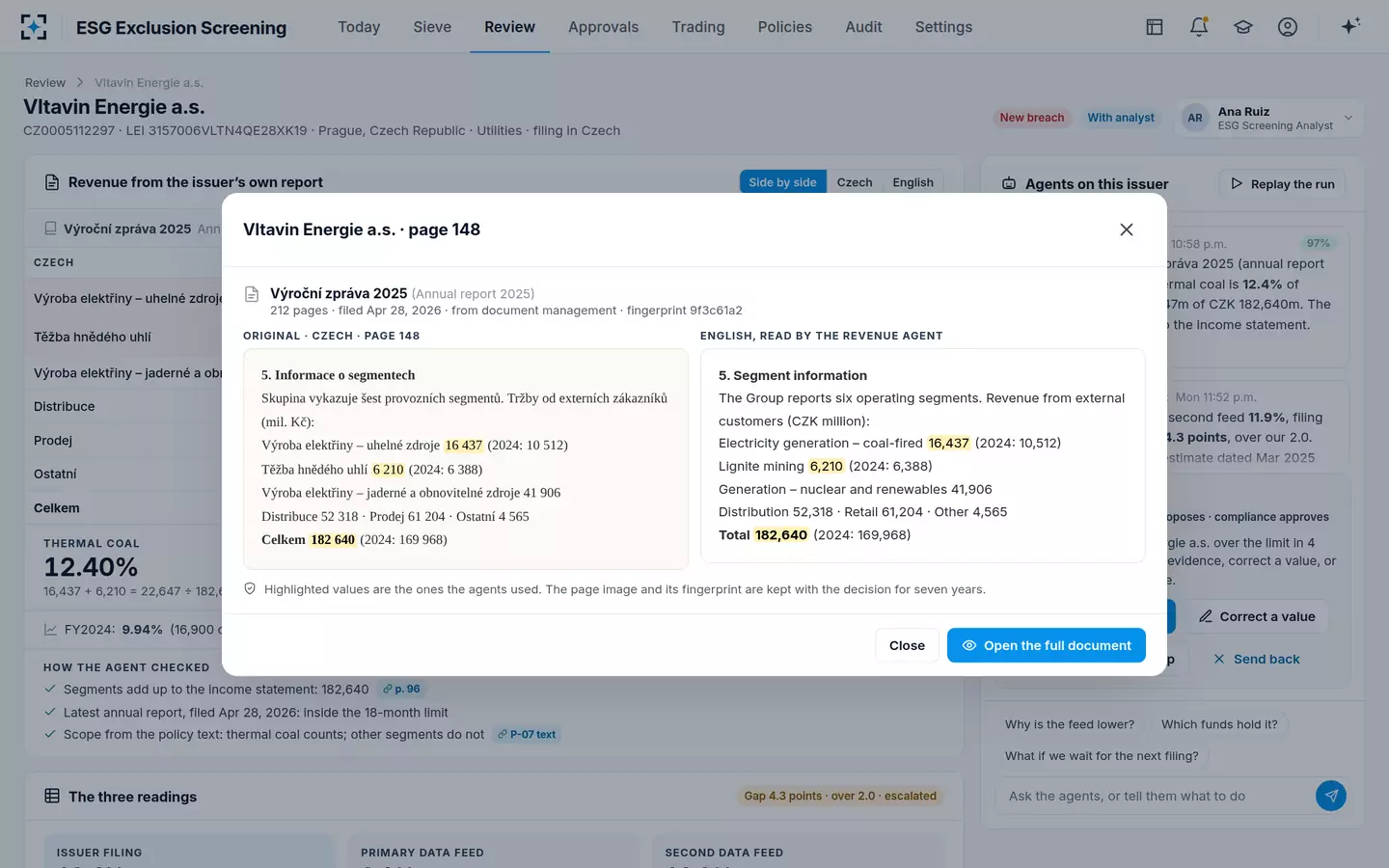
The defensible file is what passes all four tests for a single decision: the policy version, the reading of the issuer with its page, the other readings and why they differ, the decision with its reason, and the two names. In ESG Exclusion Screening each figure an agent uses links to the page of the issuer's own filing, shown in the original language beside the English, and the page image and its fingerprint stay with the decision for seven years.
Any figure opens the page it came from, in the original language
What the file for one exclusion decision should hold
- The policy and rule version in force
With the sentence in the prospectus or mandate it was coded from.
- The reading, with its page
Revenue share or involvement, from the issuer's filing, with the fiscal year and filing date.
- The reconciliation
Segments added up to the income statement, so the denominator is the issuer's own total.
- Every other reading, and why it differs
Each data feed's figure, its date and the reason for any gap: an old year, a misclassified activity, a wrong parent.
- Coverage
Whether the issuer was in each data set at all, and what the screen did when it was not.
- The decision and its reason code
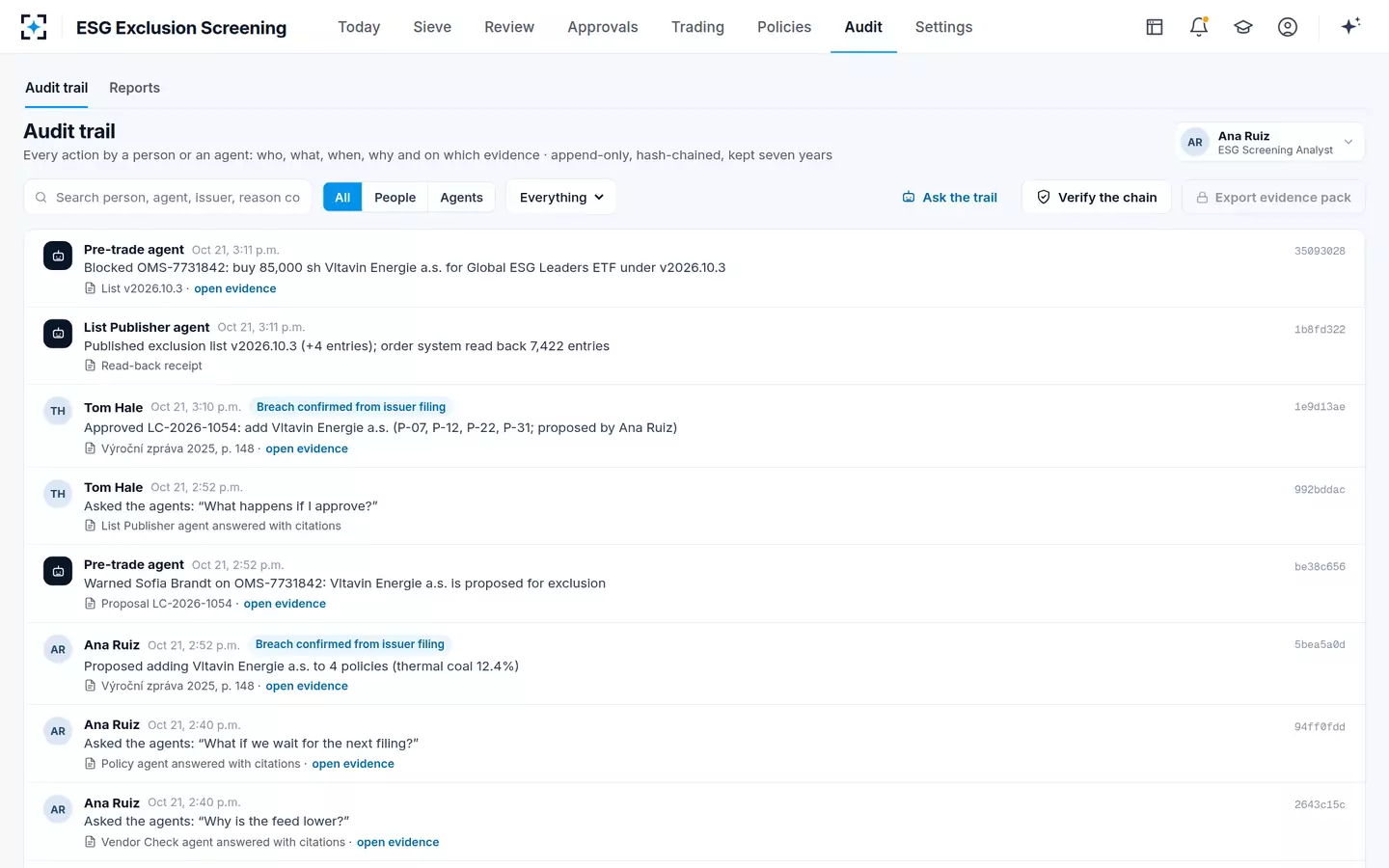
Proposed by one named person, approved by another, with the date of each.
- The effect
Funds and orders affected, the list version that took effect and the order system's read-back.
- Retention
Kept, unaltered, for as long as your record-keeping rules and exam cycle require.
Every question, proposal, approval and block on one trail
Questions people ask
What is an ESG exclusion list?
It is the set of issuers a fund or mandate may not hold, produced by applying its exclusion criteria to the investable universe. Unlike the criteria, it changes every time an issuer reports or the data changes, so each entry needs the reading and the date that put it there. At the fictional sample manager, the list in force covers 1,906 issuers across 40 policies.
Can an ESG rating be an exclusion criterion?
It can, if the policy says what the rating measures, whose it is, the scale and why the cut-off was chosen. The FCA's 2024 guidance gave a benchmark excluding ratings "lower than 3" without that information as an example of a claim that could mislead. A revenue or involvement criterion read from filings is easier to defend.
How do you document an exclusion decision?
Keep the rule version, the issuer reading with its page and filing date, the other sources and why they differ, the decision with a reason, and the proposer and approver, at the time the decision is made. The SEC's examiners counted documentation made at the time of each decision among the effective practices they saw in 2021.
What are the steps of an exclusion screening process?
Map holdings to issuers and parents; read each issuer's revenue and involvement from its filings and data feeds; test every issuer against every policy; send disagreements and borderline cases to an analyst; have a different person approve each list change; publish the approved list to the order system and confirm it was received; and plan the exit from any newly excluded holding.
Does disclosing data limitations protect a fund?
It changes what the fund has promised. WisdomTree's revised prospectuses, after the SEC's examination, defined fossil fuels by its three data sets and said the adviser did not independently verify vendor data; the earlier, unqualified promise was what the SEC found misleading. Disclosure that matches the screen is honest; disclosure that hides a promise the fund still makes is not.
What penalty did Vanguard pay for greenwashing?
A$12.9 million, ordered by the Federal Court of Australia in September 2024 after Vanguard Investments Australia admitted misleading investors about the ESG screens on its Ethically Conscious Global Aggregate Bond Index Fund. ASIC said it was the highest penalty yet for greenwashing conduct.