A controversial weapons list is a list of companies excluded because they make, or are involved with, weapons that international treaties ban or restrict: in EU disclosure rules, anti-personnel mines, cluster munitions and chemical and biological weapons, and in many policies nuclear weapons too. No regulator publishes an official list of such companies. Lists are compiled by data providers and by investors such as Norway's sovereign wealth fund, and each reflects choices that are easy to miss: which treaties define a controversial weapon, whether a parent is excluded for a subsidiary's products, whether components count. The answer for a specific holding usually turns on its ownership chain. Botminds' ESG Exclusion Screening follows that chain through the issuer's own filings, applies the manager's ownership rule, and never excludes on news alone.
The treaty and law texts on this page are cited from the UN, the EU and national legislation; the worked case uses the solution's sample data on a fictional Korean group.
One controversial weapons decision, three ownership questions
What are controversial weapons? It depends which treaties your policy names
Controversial weapons are weapons whose use, production or transfer international law bans or restricts because they are indiscriminate or cause unnecessary suffering. EU rules do not list them. The Paris-aligned benchmark rules define them by reference: "controversial weapons as referred to in international treaties and conventions, United Nations principles and, where applicable, national legislation" (Delegated Regulation (EU) 2020/1818, Art. 12(1)). The SFDR disclosure rules name four types for principal adverse impact indicator 14: anti-personnel mines, cluster munitions, chemical weapons and biological weapons (Delegated Regulation (EU) 2022/1288, Annex I, Table 1).
The treaty texts are precise, and the precision matters for screening. The Convention on Cluster Munitions defines a cluster munition as "a conventional munition that is designed to disperse or release explosive submunitions each weighing less than 20 kilograms", and then excludes munitions that meet five conditions together, among them fewer than ten submunitions, each over four kilograms and each with electronic self-destruction and self-deactivation (Convention on Cluster Munitions, Art. 2, as laid before the UK Parliament, Cm 7816). A manufacturer of a munition outside that definition is not a cluster munitions maker under the treaty, whatever a headline calls it. Nuclear weapons are the other open question: not among the four types in indicator 14, but on many exclusion lists, including Norway's.
Is there an official controversial weapons list?
No regulator in the EU or the US publishes an official list of controversial weapons companies. Investors who need one buy it from a data provider, build it, or adopt another investor's. The best-known public list belongs to Norway's sovereign wealth fund: as last updated on 11 August 2026, it shows 14 companies excluded for production of nuclear weapons and 2 for production of cluster munitions, among about 200 exclusions and observations (Norges Bank Investment Management).
Any such list is a set of decisions made under someone else's definitions. Norway's includes nuclear weapons and names few cluster munitions producers; a data provider's may include anti-personnel mine makers that Norway's does not, or exclude parents that Norway's lists. Before relying on any of them, a manager has to know which treaties, which ownership rule and which date each entry reflects.
Four definitions of controversial weapons involvement, side by side
| Source | Weapons covered | What counts as involvement | Ownership and components |
|---|---|---|---|
| EU Paris-aligned benchmark rules, Art. 12(1)(a) | As referred to in treaties, UN principles and, where applicable, national law | Any activities related to controversial weapons | Not specified |
| SFDR principal adverse impact indicator 14 | Anti-personnel mines, cluster munitions, chemical and biological weapons | Manufacture or selling | Not specified |
| Ireland, Cluster Munitions and Anti-Personnel Mines Act 2008, Part 4 | Cluster munitions, explosive bomblets, anti-personnel mines | Manufacture of prohibited munitions or components | Components specifically designed for prohibited munitions; direct and indirect investment |
| Norway's sovereign wealth fund list (as at Aug. 2026) | Entries for nuclear weapons and cluster munitions production | Production | Criteria published separately; its coal criterion counts entities a company controls |
The treaties are moving: withdrawals since 2025
A policy that defines controversial weapons by "international treaties" now has to say whose ratifications count, because the treaties are losing parties. The UN Treaty Collection records that Lithuania's withdrawal from the Convention on Cluster Munitions took effect on 6 March 2025 (UN Treaty Collection, Chapter XXVI-6). For the Anti-Personnel Mine Ban Convention it records withdrawals by Estonia, Latvia and Lithuania, effective 27 December 2025, Finland, effective 10 January 2026, and Poland, effective 20 February 2026 (UN Treaty Collection, Chapter XXVI-5).
For an exclusion screen the conventions' text does not change; the prohibited weapons are the same. What changes is the argument a portfolio manager may hear: that a producer selling to a state no longer bound by the treaty is no longer "controversial". A policy that names the treaties as the definition of the weapon, not as a list of states, settles that argument before it starts. If the policy means something else, it should say so.
The treaty base behind controversial weapons screening, as of October 2026
112
states parties to the Convention on Cluster Munitions
in force since 1 August 2010
162
states parties to the Anti-Personnel Mine Ban Convention
in force since 1 March 1999
5
withdrawals from the mine ban convention taking effect between December 2025 and February 2026
1
withdrawal from the cluster munitions convention, effective March 2025
PAI 14 controversial weapons: what the SFDR indicator counts
Principal adverse impact indicator 14 measures what share of a portfolio is invested in companies that manufacture or sell controversial weapons, for the four weapon types the rules name (Delegated Regulation (EU) 2022/1288, Annex I, Table 1). It is a disclosure, not an exclusion: a fund can report a non-zero share and break no rule, unless its own policy or its name promises otherwise. But it adds a word the PAB test does not use. "Selling" reaches distributors and traders that "manufacture" alone would not.
The indicator and the exclusion should come from one reading of each issuer. If the exclusion list is built on a vendor's "involvement" flag and the indicator on another vendor's revenue field, the fund can report exposure to companies its own screen says it does not hold. At the sample manager, the indicator showed 0.001% of assets in the one newly excluded weapons name while its cure plan ran, and will show nil once the cure period ends.
Involvement is a chain, not a name
A fund holds the securities of a listed parent; the weapons may be made by a subsidiary, an associate or a joint venture several steps away. A list that names companies answers "is this company on the list?". A policy that names involvement asks "does this company, through anything it owns, make or sell these weapons?", and only the issuer's own filings, with their lists of subsidiaries, associates and segment descriptions, answer that.
The SEC's WisdomTree order shows a regulator reading ownership as involvement. Against prospectuses that promised no fossil-fuel involvement, the SEC listed among the funds' holdings a steelmaker that owned a 49% stake in a company with oil and gas reserves, and a firm holding a 25% stake in an oil refining, distribution and marketing company (SEC order IA-6753, para. 30). Neither parent was an oil company by sector code. An "any involvement" weapons promise invites the same reading.
"Nothing in any enactment that authorises the investment of public moneys shall be taken to authorise any investment, direct or indirect, in a munitions company."
Cluster Munitions and Anti-Personnel Mines Act 2008 (Ireland), section 12(1)
Parents, subsidiaries and minority stakes: where to draw the line
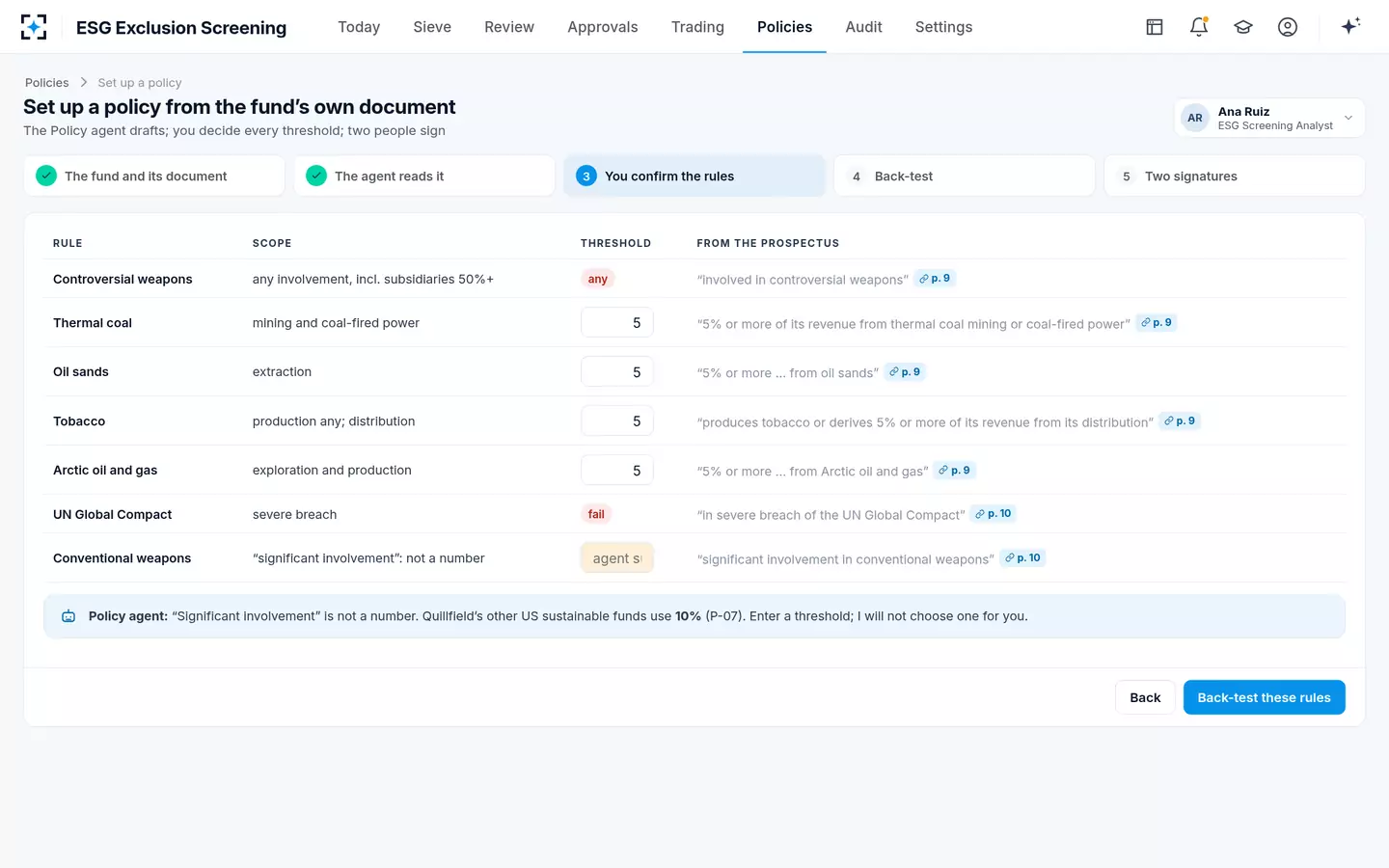
Draw it in writing, in both directions, before the first case. Downward, the common choice is to count subsidiaries the issuer consolidates, often expressed as 50% or more owned; some policies count any stake. Upward, the question is whether a holding company that owns part of a weapons maker's parent is itself excluded. Norway's coal criterion is an example of a written line: it applies to companies which "themselves or through entities they control" meet the thresholds (Norges Bank, May 2020). Control, not a percentage, is the test.
Ireland's statute shows a line drawn for public money. Its "munitions company" is "a company involved in the manufacture of prohibited munitions or components", and public investors must avoid investment "direct or indirect" in one; for pooled funds, they must be satisfied there is "not a significant probability" the money will reach one, while derivatives on a financial index are expressly allowed (Irish Act 2008, ss. 11–15). Each of those words would be a setting in a screen.
Components and dual-use products
Components are where weapons lists disagree most, because a part can be specific to a prohibited weapon or used in many products. The Irish Act draws the line at components "specifically designed for use in prohibited munitions" (s. 11). A fuse made only for a cluster munition is in; a general-purpose electronic part sold to the same factory is not. The Convention on Cluster Munitions itself forbids states to "Assist, encourage or induce anyone" to engage in a prohibited activity (Art. 1(1)(c)), and Ireland's Act, which gives effect to the convention, carries that into the investment of public money.
A screen cannot settle "specifically designed" from a revenue line. It needs the issuer's product description, a contract notice or a government procurement notice, and a person who decides. That is why the solution's Weapons and Norms agent needs a filing or the norms feed to confirm involvement, never a news story alone, and why the decision goes to an analyst and a compliance officer.
What to ask before you buy a controversial weapons exclusion list
Ask questions that expose the definition and the ownership rule, then test them on cases you know. Vendors rarely publish prices, and the list itself is not the expensive part: the expensive part is defending a decision the list made under rules you never chose.
Nine questions for a controversial weapons list or data feed
- Which treaties define the weapons?
Cluster munitions, anti-personnel mines, chemical and biological weapons; nuclear weapons in or out; any others.
- What counts as involvement?
Production, sale, maintenance, components, delivery systems: one by one.
- How are components treated?
Only parts specifically designed for prohibited weapons, or any supply to their makers.
- Which ownership rule, downward?
Consolidated subsidiaries, a percentage, or any stake, and whether associates and joint ventures count.
- Which ownership rule, upward?
Whether shareholders of a weapons maker's parent are flagged.
- What evidence stands behind each entry?
A filing, a procurement notice or a news report, with its date.
- When was each company last checked?
And how fast a disposal or acquisition reaches the list.
- Does the list follow your policy or its own?
Can it apply your treaty set and ownership line, or only its standard ones?
- Does it feed your PAI 14 figure too?
The indicator and the exclusion should rest on the same reading.
How ESG Exclusion Screening walks the chain
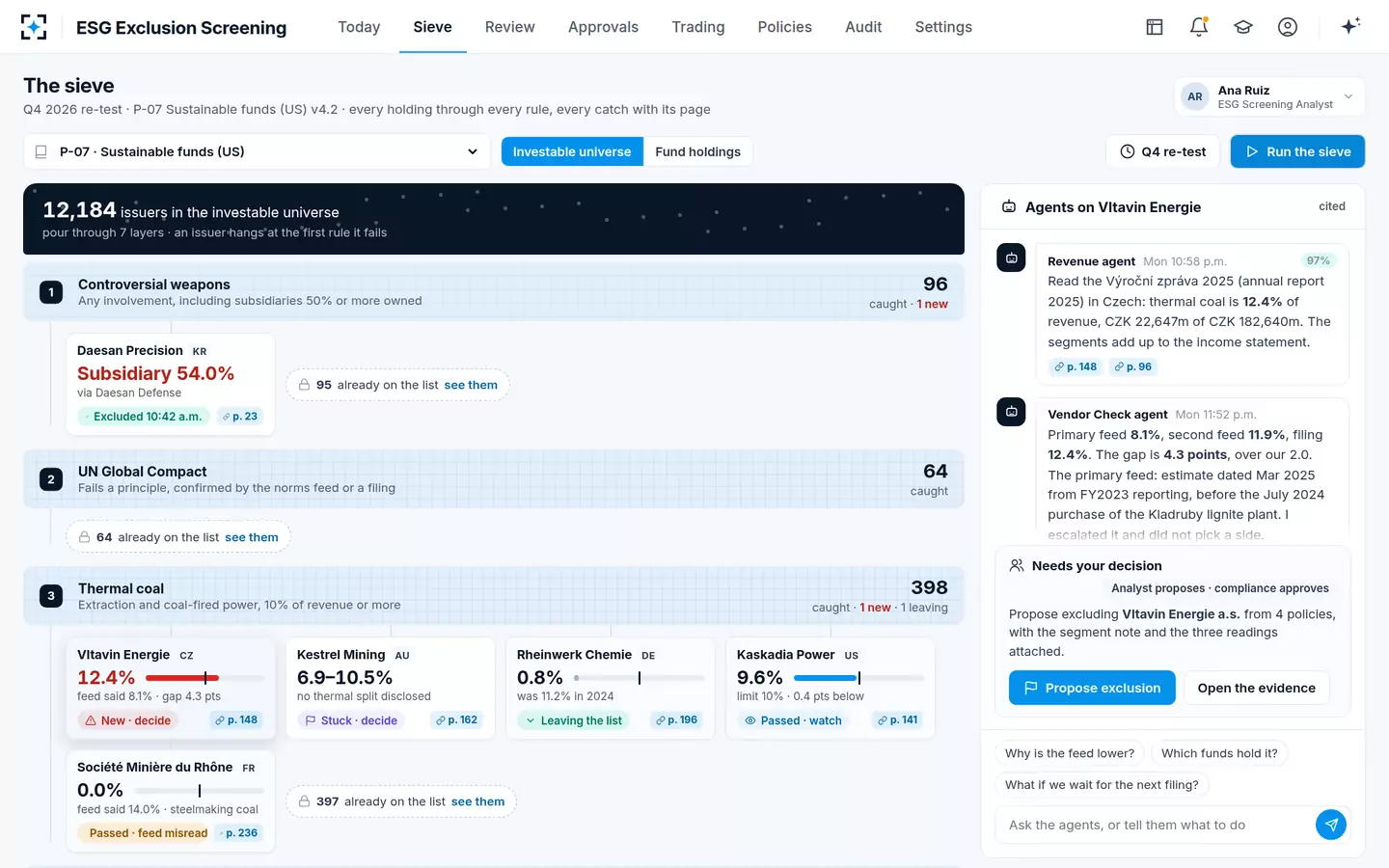
In the solution, the Universe agent maps every security a fund holds to its issuer and ultimate parent. The Weapons and Norms agent then reads the parent's filings, including subsidiary lists and segment descriptions in their own language, and checks each entity it finds against the policy's weapons and ownership rules. At the sample manager the rule counts subsidiaries owned 50% or more; the setting can be changed to any ownership share, with compliance's co-signature.
Take a fictional Korean group from the sample data. Daesan Precision, held by the manager's funds, owns 54.0% of Daesan Defense, which makes cluster munitions; the agent found the stake and the product in the parent's Korean business report, page 23. Under the 50% rule the parent fails the weapons layer of the screen; once an analyst's proposal, with the page attached, was approved by compliance, the $9.4 million held by the manager's funds went onto a cure plan.
The weapons layer catches the parent through its 54.0% subsidiary
The ownership line is written into the rule, beside the prospectus sentence
The agent does not decide the hard cases for the manager. A 25% associate making components, a holding company above the parent, a product that may fall outside the treaty definition: each is shown to the analyst with the evidence, under the settings the policy owner chose. What the agents add is that the chain is read for every issuer, not only for the names a vendor flags. How the same evidence discipline applies to revenue tests is in the seven Paris-aligned tests; how the proposal and approval are separated is in why the proposer never approves the change. The agents' limits are on the ESG Exclusion Screening page.
Questions people ask
Which weapons are on a controversial weapons list?
It depends on the policy. EU disclosure rules name four types for indicator 14: anti-personnel mines, cluster munitions, chemical weapons and biological weapons. The EU Paris-aligned rules refer to weapons covered by treaties, UN principles and national law, and many investors add nuclear weapons; Norway's fund lists 14 exclusions for nuclear weapons production.
Does a subsidiary put the parent on a controversial weapons list?
Under a control-based ownership rule, yes, if the parent controls the subsidiary; the sample manager counts subsidiaries owned 50% or more. Minority stakes and associates are a policy choice that should be made in advance. The SEC's WisdomTree order counted a 49% stake and a 25% stake as fossil-fuel involvement against an "any involvement" promise.
Are nuclear weapons controversial weapons?
Not under SFDR indicator 14, which names only four types. Whether they fall under the Paris-aligned exclusion depends on which treaties a policy treats as defining controversial weapons, so the policy should say. Norway's sovereign wealth fund excludes nuclear weapons producers as a separate criterion.
Do treaty withdrawals change what counts as a controversial weapon?
Not the weapons themselves: the conventions' definitions are unchanged. They change which states are bound, and five states' withdrawals from the mine ban convention took effect between December 2025 and February 2026. A policy that names the treaties as the definition of the weapon applies the same test whoever the buyer is.
Is a company that makes components for cluster munitions excluded?
Under Ireland's 2008 Act, a company making components specifically designed for prohibited munitions is a munitions company. Under the EU Paris-aligned wording, "any activities related to" controversial weapons is broad enough to reach it. General-purpose parts sold to a weapons maker are a different question, and the policy should say how it treats them.
Can a fund hold an index derivative that includes a weapons maker?
Ireland's Act expressly allows public investors to use derivatives based on a financial index, while requiring due diligence on pooled funds. EU fund rules do not address the point directly, so a fund's own policy should state how index derivatives and funds of funds are treated.