A coal exclusion policy is the written rule an asset manager uses to keep coal companies out of a fund, and to hold up in front of a regulator it has to settle six things: which coal (thermal, metallurgical, lignite), which activities (mining, distribution, coal-fired power), what measure (usually a share of revenue), what threshold, which entities count (subsidiaries and parents) and what happens when the issuer's filing does not answer the question. The choice of coal is the one most often left implicit, and it changes the result: a policy excluding "thermal coal above 10% of revenue" keeps a pure steelmaking-coal miner, while the EU's Paris-aligned test, now the floor for EU funds with ESG or sustainability terms in their names, excludes any company earning 1% or more from hard coal or lignite, coking coal included. Botminds' ESG Exclusion Screening reads each issuer's segment note to see which coal it actually sells and tests that reading against every policy the manager runs.
This guide is for the people who own the policy: the head of responsible investment who drafts it, the analysts who code it into the screen and the compliance officer who answers for it. Definitions come from the US Energy Information Administration, Eurostat and the EU regulation itself; the worked cases use the solution's sample data on fictional issuers.
Four coal thresholds in force, from 1% to 50% of revenue
1%
of revenue from hard coal and lignite: the EU Paris-aligned exclusion, coking coal included
10%
of revenue from thermal coal mining and coal power: a common fund threshold, used by the sample manager
30%
of income from thermal coal: one of four tests in Norway's sovereign fund criterion
50%
of revenue from power generation above 100 g CO2e/kWh: the Paris-aligned utility test
What does a coal exclusion policy have to decide?
A coal exclusion policy has to decide six things in writing, and every one it leaves open is decided later by whoever codes the screen or whichever data set the firm happens to license. The six are the coal types in scope, the activities in scope, the measure, the threshold for each issuer type, the entity rule and the rule for an undecidable issuer.
Six decisions a coal clause makes, and what goes wrong when it does not
| Decision | The usual choices | What happens if the clause is silent |
|---|---|---|
| Coal types | Thermal (steam) coal only; thermal and metallurgical; all coal including lignite named | The screen follows the vendor field, which is usually "thermal coal" |
| Activities | Mining and extraction; distribution and transport; trading; coal-fired generation | Railroads, ports and traders fall through, or are caught inconsistently |
| Measure | Share of revenue; share of generation or capacity; tonnes produced; expansion plans | Utilities are tested on a revenue share that understates their coal use |
| Threshold | One figure for all, or one for miners and another for utilities | A single figure is too loose for one group and too tight for the other |
| Entities | The issuer alone; plus controlled subsidiaries; plus a minimum ownership share | Two analysts consolidate the same group two ways |
| Undecidable issuers | Apply the upper end; ask the issuer; watch to the next filing | Each analyst improvises, and the file shows no reason |
The first two decisions carry most of the risk, because they are where a policy's words and its data diverge. A clause that says only "coal" is usually coded as thermal coal, because that is the field the vendor sells. A clause that says "thermal coal" may or may not be read to include coal-fired power. Neither reading is wrong; the failure is not writing it down, so that the reading changes when the analyst or the vendor does. Who drafts, codes and signs the policy, and the hand-offs between them, are set out in ESG exclusion policy: who writes it, codes it and signs it.
Which coal is in scope: thermal, metallurgical or both?
Thermal coal is coal burned for power and heat; metallurgical coal is coal turned into coke to make steel; and a policy must name each one it means. The EIA defines steam coal as coal "burned, primarily in boilers, to generate steam for the production of electricity or for process heating purposes", adding that steam coal, "also known as thermal coal, refers to all coal not classified as coking (or metallurgical) coal" (EIA glossary). Metallurgical coal is "Coking coal and pulverized coal consumed in making steel" (EIA glossary).
Two consequences follow for the policy owner. Thermal coal is the residual class, so a "thermal coal" clause covers lignite, which the EIA says is "used almost exclusively as fuel for steam-electric power generation" (EIA glossary), whether or not the clause names it, and covers no coking coal at all. And the categories are defined by use and grade, not by the mine: one mine can ship both, and a miner's annual report may or may not split them.
Where US coal went in 2022: almost all of it to power, a sliver to steel
The domestic split explains why thermal coal became the first target of climate exclusions: it is where coal's emissions are, and utilities report it plainly. The export figure explains the gap. Metallurgical coal accounted for about 54% of US coal exports in 2022 (EIA), and in the EU, coke ovens in 12 countries consumed 36 million tonnes of coking coal in 2024 (Eurostat). A screen that reads only thermal coal will clear a large steelmaking-coal exporter. Whether that is the right answer depends on what the fund promised, which is why it belongs in the policy and not in the vendor's field definition.
What thresholds do coal exclusion policies use?
Coal thresholds are usually a share of revenue, and the share is the policy's choice unless a regulation or a benchmark sets it. The thresholds in public use run from 1% to 30% of revenue for miners, with separate generation or capacity tests for power producers, and most of them name thermal coal, not coal.
Coal thresholds in public rules, and the coal each one actually covers
| Rule | Who it reaches | Threshold | Coal covered |
|---|---|---|---|
| EU Paris-aligned benchmark, Art. 12(1)(d) | Any company | 1% of revenue from exploration, mining, extraction, distribution or refining | Hard coal and lignite, so coking coal is in |
| EU Paris-aligned benchmark, Art. 12(1)(g) | Power producers | 50% of revenue from generation with intensity above 100 g CO2e/kWh | Any fuel above the intensity line |
| Norges Bank coal criterion | Miners and power producers, and entities they control | 30% of income or operations; 20 million tonnes a year; 10,000 MW of capacity | Thermal coal only |
| Sample US sustainable fund policy | Miners and utilities | 10% of revenue from thermal coal mining and coal-fired power | Thermal coal only |
| Sample fund in set-up | Miners and utilities | 5% of revenue, same activities | Thermal coal only |
Norway's criterion is the clearest published example of a multi-measure test. Observation or exclusion may be decided for mining companies and power producers which "themselves or through entities they control" derive "30 per cent or more of their income from thermal coal", base 30% of their operations on it, "produce more than 20 million tons of thermal coal per year", or have "a power capacity of more than 10 000 MW from thermal coal" (Norges Bank, May 2020). The absolute tests catch the very large diversified groups whose coal is a small share of a large revenue line; a revenue test alone would not.
A fund policy sets its own number, and the number should follow from the promise in the prospectus. A fund that tells investors it holds no coal companies cannot defend 10%; a fund that promises to avoid companies "significantly involved" in thermal coal can, if it says what significant means.
The Paris-aligned coal test: why EU-named funds now exclude steelmaking coal
The EU's Paris-aligned benchmark rules exclude companies that "derive 1 % or more of their revenues from exploration, mining, extraction, distribution or refining of hard coal and lignite" (Delegated Regulation (EU) 2020/1818, Art. 12(1)(d)). Three words in that list change a coal clause. It covers coking coal, because coking coal is hard coal in Eurostat's classification. It covers distribution as well as mining. And its threshold is a tenth of the common 10% fund threshold.
The test became a fund problem through ESMA's guidelines on fund names, which apply the Paris-aligned exclusions to EU funds using environmental, impact or sustainability terms in their names; they applied to new funds from 21 November 2024 (ESMA guidelines on funds' names). A manager with one firmwide coal clause written on thermal coal therefore runs two coal policies whether it means to or not: its own, and the Paris-aligned one for each EU fund whose name brings it in. The second excludes every steelmaking-coal miner at 1%, and the first does not see them. The seven Paris-aligned tests and the evidence each one needs are set out in Paris-aligned benchmark exclusions: the seven tests, with evidence.
Hard coal, brown coal, steam coal: the words that do not line up
Policies borrow their coal words from two classifications that do not map onto each other, so the clause has to say which one it uses. US usage sorts coal by end use, steam or metallurgical, and by rank: anthracite, bituminous, subbituminous and lignite (EIA, Coal explained). European statistics sort it into hard coal (anthracite, coking coal and other bituminous coal) and brown coal (lignite and sub-bituminous coal) (Eurostat).
Coal types in the words exclusion policies use
| Coal | Mainly used for | Steam or metallurgical (EIA) | Hard or brown (Eurostat) | In the Paris-aligned coal test |
|---|---|---|---|---|
| Anthracite | Metals industry, heating | Steam unless sold for coking | Hard coal | Yes, as hard coal |
| Coking (bituminous) coal | Coke for steelmaking | Metallurgical | Hard coal | Yes, as hard coal |
| Other bituminous coal | Power and industrial heat | Steam (thermal) | Hard coal | Yes, as hard coal |
| Sub-bituminous coal | Power | Steam (thermal) | Brown coal | Not named: hard coal and lignite only |
| Lignite | Power, almost exclusively | Steam (thermal) | Brown coal | Yes, named |
Two cells need a written decision. Coking coal sits inside the Paris-aligned test and outside any thermal-only clause. Sub-bituminous coal, about 46% of US coal production in 2022 and mostly from Wyoming (EIA), is brown coal in Eurostat's terms but is not lignite, while the EU regulation names only "hard coal and lignite". A manager applying the Paris-aligned test to US miners has to decide whether sub-bituminous revenue counts, record the reading with its reason and apply it the same way every quarter, because an examiner comparing two quarters will notice if it moves.
Power producers: a different issuer, a different measure
Utilities need their own test, because coal-fired generation is a use of coal, not a sale of it, and a revenue share understates it. A utility that burns coal for a third of its output can report coal-fired generation as a modest slice of revenue once networks, retail and other plants are added in, and a 10% revenue test may pass it.
The rules in force handle this three ways. Norway adds an absolute capacity test, 10,000 MW from thermal coal. The Paris-aligned rules switch measure altogether: paragraph (g) excludes companies earning 50% or more of revenue from electricity generation above 100 g CO2e/kWh, whatever the fuel, so a utility is not caught by coal plants at 5% or 10% of revenue the way a thermal coal clause would catch it. It is caught under paragraph (d) only if it mines its own lignite. The sample manager's policy takes the third route and codes mining and coal-fired power as one combined revenue share. Each is defensible if it is written down; the policy owner's job is to make sure the clause, the coding and the fund documents describe the same one.
Three sample issuers: one filing, two policies, different answers
The same filing gives different answers under a thermal clause and the Paris-aligned test, and a manager running both needs to see both. Take three fictional issuers from the solution's sample re-test, each tested against the sample US sustainable fund policy (10% of revenue from thermal coal mining and coal-fired power) and against the Paris-aligned 1% test.
Three issuers, two coal policies: where the answers part
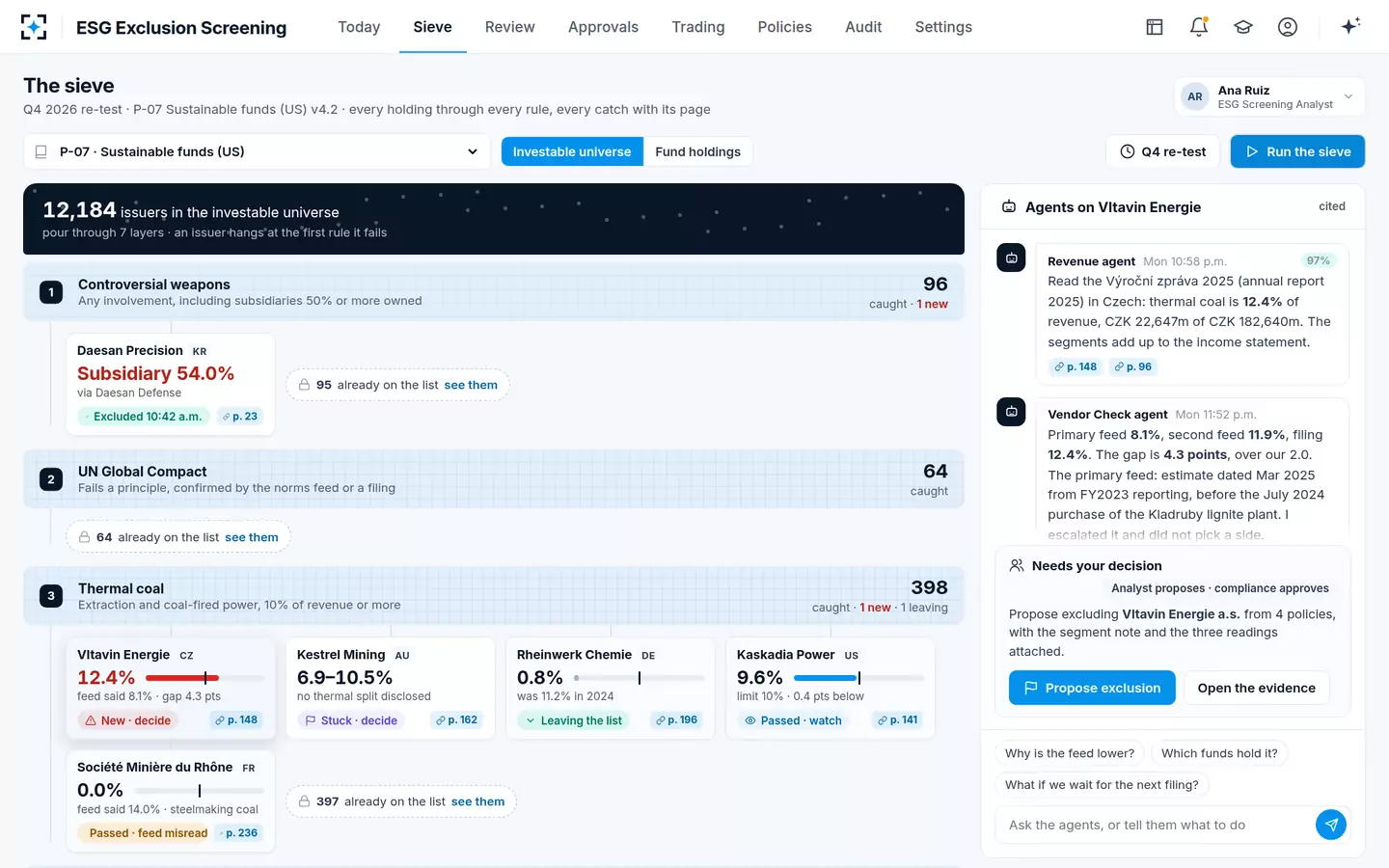
Fund policy: thermal coal, 10% of revenue: Passes at 0.0%. The data feed reported 14.0% coal revenue and counted it as thermal; the filing shows it is sold to steelmakers.
Paris-aligned test: hard coal and lignite, 1%: Excluded: if the 14% is revenue from mining coking coal, it is fourteen times the threshold.
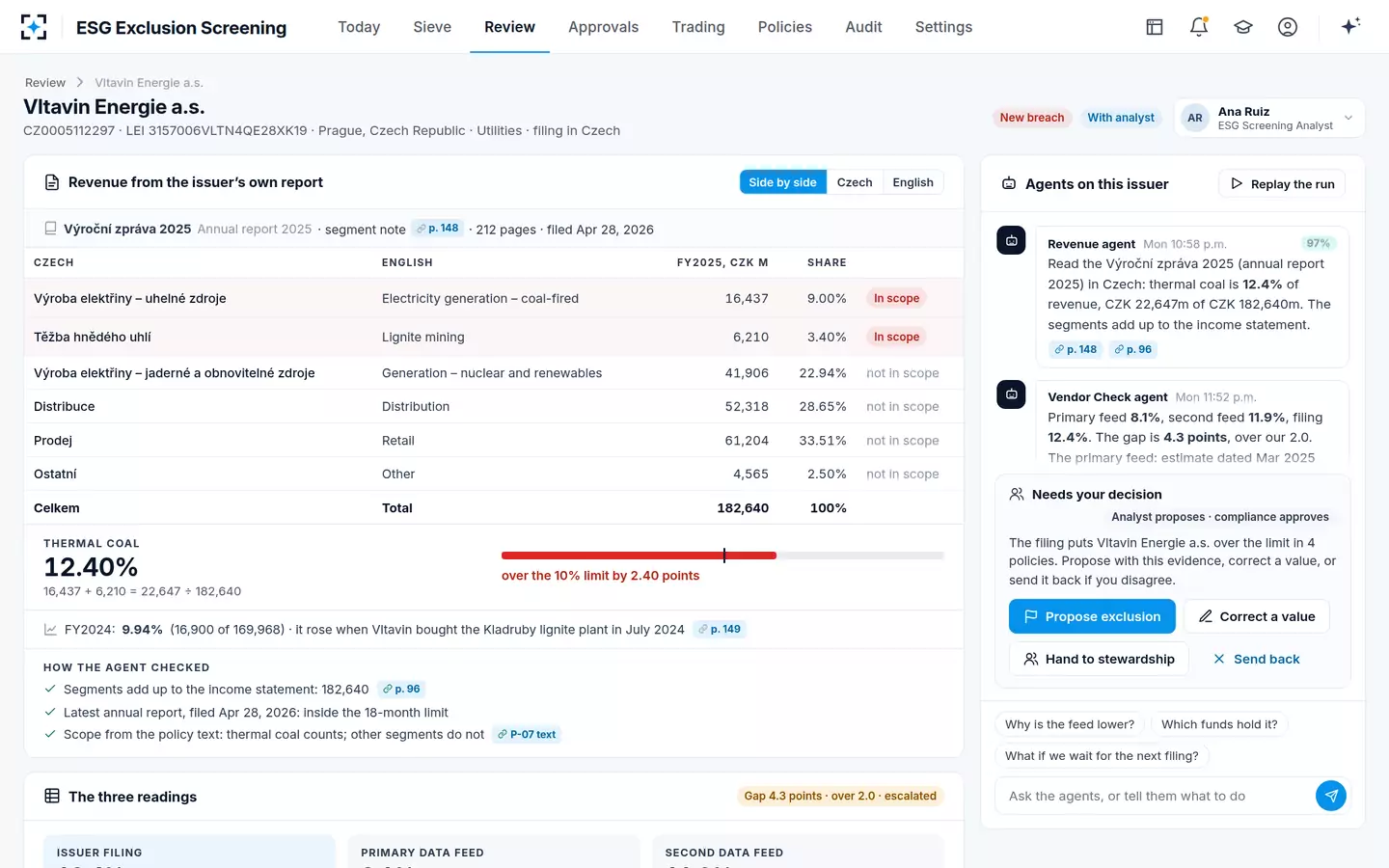
Fund policy: thermal coal, 10% of revenue: Excluded at 12.40%: CZK 16,437m of coal-fired generation and CZK 6,210m of lignite mining out of CZK 182,640m.
Paris-aligned test: hard coal and lignite, 1%: Excluded on the lignite mining alone, 3.40%. Its generation, at 9% of revenue, is irrelevant to this test.
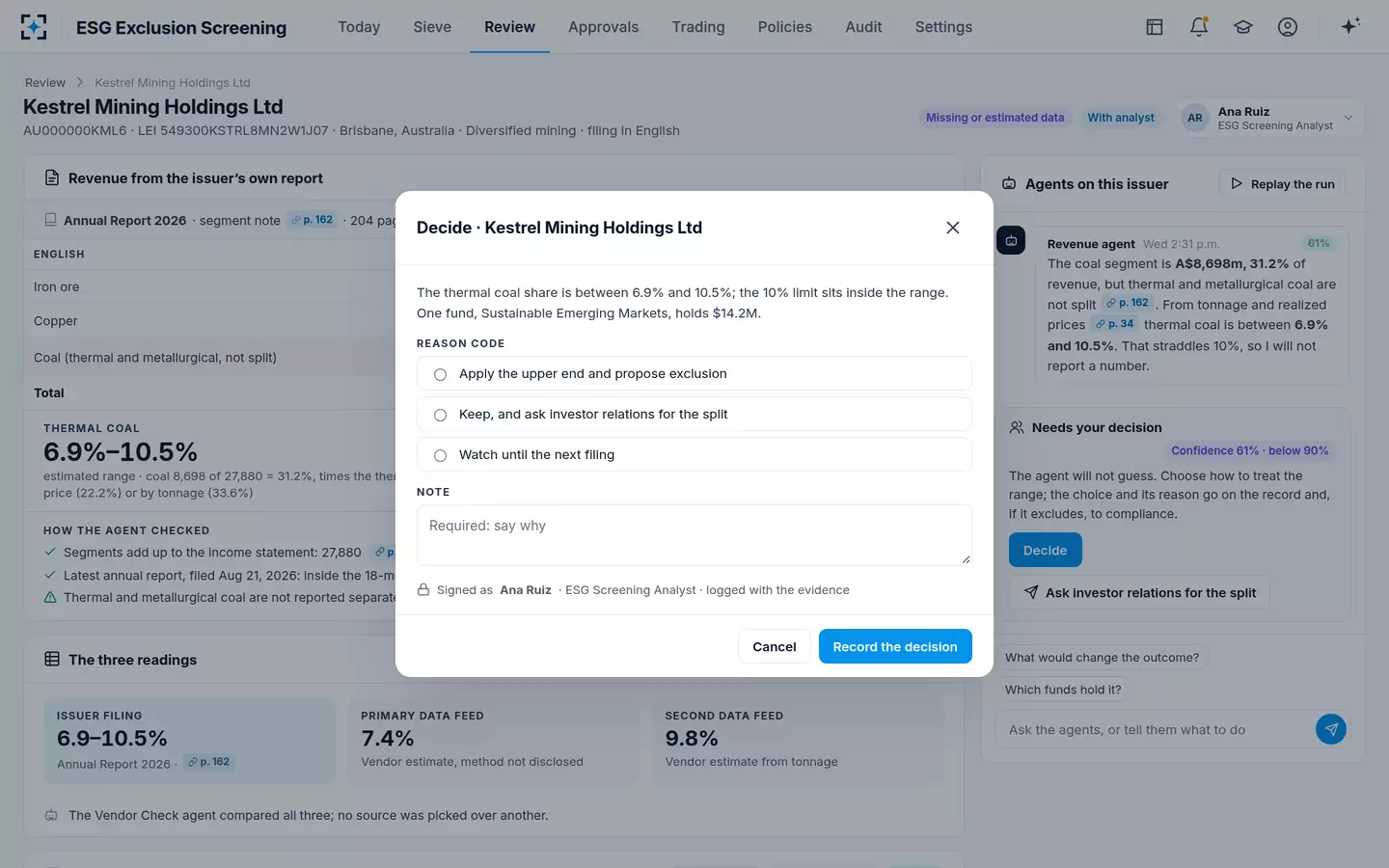
Fund policy: thermal coal, 10% of revenue: Undecidable from the filing: coal is 31.2% of revenue, but thermal and coking coal are not reported apart.
Paris-aligned test: hard coal and lignite, 1%: Excluded: the whole 31.2% is hard coal, whichever way it splits.
The first case is the one that reaches a regulator. When the feed called Société Minière's coal thermal, the fund's own rule would have excluded a company its policy does not cover, and the analyst sent the vendor a challenge with the page attached. Reverse the error and the fund holds a coal company its prospectus excludes. Either way, the evidence that settles it is the issuer's segment note, not the vendor's field.
The thermal coal rule in the screen: one issuer leaving, one misread, one undecidable
How should a policy treat a miner that does not split its coal?
A policy should decide in advance what happens when the filing does not split thermal from metallurgical coal, because no data set can answer that question honestly and a single vendor number hides the uncertainty. Kestrel's coal segment brought in A$8,698 million of A$27,880 million. The solution's Revenue agent estimated the thermal share two ways, from realised prices and from tonnage, which put thermal coal at 22.2% to 33.6% of coal revenue: 6.9% to 10.5% of total revenue. The fund's 10% limit sits inside that range. The two data feeds read 7.4% and 9.8%, both vendor estimates presented as single figures.
At 61% confidence, below the 90% floor the sample manager set, the agent would not report a point estimate. The analyst chose from three reason codes the policy defines: apply the upper end and propose exclusion; keep the issuer and ask its investor relations team for the split; or watch until the next filing. Each choice needs a written note. That is the shape a mixed-miner rule should take in the policy itself, with the default stated, so that the decision is the policy's and not the analyst's mood. It is also the strongest argument for the Paris-aligned framing, which needs no split: it is stricter, but it is simpler to evidence.
A miner that does not split its coal: the agent gives a range, the analyst decides
Where coal policies fail: the data set rewrites the clause
Coal policies rarely fail because the threshold was wrong; they fail because the data bought to apply them covers less than the policy promises. The SEC's 2024 order against WisdomTree Asset Management is the case that shows it. The adviser's first vendor sold separate data sets named "Arctic Oil and Gas Exploration", "Thermal Coal", "Oil Sands", "Shale Energy" and "Oil and Gas"; the adviser bought only the first three (SEC order IA-6753, para. 24), against prospectuses that promised no fossil-fuel involvement.
The order listed among the holdings involved in fossil-fuel activities a freight railroad that hauled coal. A thermal coal revenue test aimed at miners would never reach it; a clause that names distribution and transport would. The civil penalty was $4 million, and the order turned on the absence of written procedures over the screen as much as on the data, a sequence followed case by case in SEC ESG enforcement actions, case by case. For the coal clause the lesson is narrow and practical: map every activity the fund documents promise to a data field or a reading of the filing, and list the ones with no source.
Writing the coal clause so two analysts code it the same way
A coal clause is well written when two analysts given the same issuer and the same filing reach the same answer without asking anyone. That means naming each coal and each activity, saying which revenue counts and fixing the entity and undecidable-issuer rules before the first quarter's screen.
A coal exclusion clause that two analysts would code the same way
- Name each coal in scope
Thermal (steam) coal, coking (metallurgical) coal, lignite, sub-bituminous: in or out, one by one.
- Name each activity in scope
Mining and extraction, distribution and transport, coal-fired generation, coal trading: say which count.
- Say which revenue counts
Share of consolidated revenue, from external customers, gross or net of sales between group companies.
- Set separate tests for miners and utilities
A revenue share for mining, and a generation share or capacity test for power, if both are meant.
- Map the clause to the Paris-aligned test
For any EU fund whose name brings the test in, coking coal and lignite mining are excluded at 1%, whatever the thermal clause says.
- Decide the mixed-miner rule in advance
Upper end, lower end, or ask the issuer, and what the fund may hold while the question is open.
- Count subsidiaries the same way in every coal rule
Norway counts entities the company controls; state the firm's own ownership line.
- Keep the page
Tie each reading to the segment note and filing date it came from, beside the vendors' figures.
The clause then needs an owner and a cycle. A coal policy that names its thresholds is a commitment to re-test them when issuers file, typically once a year for the revenue split and more often for acquisitions, which can push a utility over a threshold overnight. The evidence a reviewer will ask for is short: the clause, the coding of it, the filing page behind each exclusion and each near-miss, and the signed decision on each undecidable issuer.
How ESG Exclusion Screening applies a coal policy
ESG Exclusion Screening tests each issuer against every coal clause the manager runs from the issuer's own annual report, not from a single vendor figure. The Revenue agent reads the segment note in its original language, works out the share for each coal and each activity the clause names, and shows it beside the two data feeds' figures. Where the readings disagree, the gap is escalated with the page; where the filing cannot settle the question, the agent gives a range and how it got there, and an analyst decides with a reason code.
One utility's coal revenue, read from its own filing in Czech
A proposed exclusion goes to compliance with the filing page, the reconciliation and the holdings it affects, and never to the analyst who proposed it. The choice of how to source the answer once the clause is fixed, whether to buy a list, build one or read the filings, is compared in fossil fuel exclusion list: buy, build or read. The screen, the agents and the approval path are on the ESG Exclusion Screening page.
Questions people ask
Does a thermal coal exclusion cover metallurgical coal?
Not by its words. The EIA defines thermal (steam) coal as all coal not classified as coking or metallurgical coal, so a clause written on thermal coal excludes no steelmaking coal. A manager that wants both must name both, and any EU fund whose name brings in the Paris-aligned test excludes coking coal mining at 1% of revenue regardless.
What revenue threshold do coal exclusion policies use?
It varies with the promise. The EU Paris-aligned test uses 1% of revenue from hard coal and lignite, many fund policies use 5% or 10% of revenue from thermal coal, and Norway's sovereign fund criterion uses 30% of income or operations, with absolute tests of 20 million tonnes a year and 10,000 MW of capacity.
Is lignite covered by a thermal coal policy?
Yes, unless the clause carves it out. Lignite is the lowest rank of coal and, in the EIA's words, is used almost exclusively for steam-electric power generation, which makes it steam coal. The Paris-aligned test names lignite explicitly alongside hard coal.
Should a coal policy count subsidiaries?
It should say so either way. Norway's criterion counts coal activity the company carries on "themselves or through entities they control", and a revenue test on consolidated accounts already includes controlled subsidiaries. The open question is minority stakes and parents, which the policy should settle with an ownership line.
Does coal transport count as coal involvement?
Under the Paris-aligned test, yes: it covers distribution of hard coal and lignite. In the WisdomTree order the SEC listed a freight railroad that hauled coal among holdings involved in fossil-fuel activities, against prospectuses promising no involvement. A thermal coal revenue test aimed at miners would not reach a railroad.
How often should coal exposure be re-tested?
At least when issuers publish annual reports, since the revenue split comes from the segment note, and whenever an issuer completes an acquisition or disposal that changes its coal business. The sample manager re-tests its whole universe overnight and flags any issuer whose share has crossed a threshold since the last approved list.