An ESG exclusion policy is the written promise that a fund, a mandate or a whole firm will not hold certain companies: makers of controversial weapons, tobacco producers, coal miners above a revenue threshold, companies in breach of the UN Global Compact. It is written by the head of sustainable investing or the product team, approved by compliance and, for a US fund, by its board, coded into rules by a screening analyst and enforced by the order management system. The hard part is not writing it. It is keeping the sentence investors read and the rule the system runs identical through every hand-off, across dozens of policies and thousands of issuers. Botminds' ESG Exclusion Screening is built for that chain: agents draft each rule with the sentence it came from, people set every threshold and sign every change, and the order system reads the approved list back before it counts.
The examples on this page use the solution's sample data on a fictional manager, Quillfield Capital, which runs 286 funds, ETFs, model portfolios and client mandates on 40 exclusion policies. The regulatory history comes from the SEC, ESMA and the FCA, linked where it appears.
The ESG exclusion policy chain: who writes, who signs, where it breaks
| Step | Who does it | Who signs | Where it breaks |
|---|---|---|---|
| Write the promise | Head of sustainable investing or the product team, in the prospectus, mandate or policy | Compliance; for a US fund, the board approves the strategy | Words such as "involved in" or "significant" with no definition |
| Define each term | Head of sustainable investing, with the screening analyst | Compliance | The definition is left to whatever the data set happens to cover |
| Code the rule | Screening analyst or investment compliance | Compliance, after a back-test | The same phrase coded with different thresholds in different funds |
| Decide each issuer | Screening analyst proposes an addition or removal | A compliance officer who did not propose it | One person proposes and approves; the evidence sits in email |
| Publish the list | Compliance or operations, to the order system and portfolio accounting | Nobody, unless the read-back is checked | A file upload with no proof the order system took it |
| Review the policy | Chief compliance officer, at least once a year | The board, for a US fund | The review tests the document, not the codes running in the system |
What is an ESG exclusion policy?
An ESG exclusion policy is a binding list of activities, conducts or named companies that a portfolio will not hold, with the threshold at which each applies. It differs from an ESG rating or a tilt: an excluded issuer may not be bought at any weight, and holding it is a breach of what the investor was told. The SEC's examiners call this negative screening, which "excludes issuers that are deemed to have negative ESG characteristics", and treat norms-based screening, against international standards, as a sub-category of it (SEC Division of Examinations, April 2021).
A large manager runs many at once. The sample manager's 40 include a firmwide baseline, US sustainable fund ranges with thermal coal at 10% of revenue, index funds, faith-based screens, the Paris-aligned benchmark exclusions that EU funds with ESG terms in their names now apply, and clients' own lists written into investment management agreements, each with its own version history, run over 12,184 issuers. The policy count is what makes the chain hard: every term must mean the same thing in every policy that uses it, or the firm is running forty slightly different promises.
Who writes the ESG exclusion policy, and who approves it?
The head of sustainable investing usually writes it, compliance approves it, and for a US registered fund the board approves the compliance policies that enforce it. The board step is a rule, not a courtesy. Rule 38a-1 requires the fund's board, with most of its independent directors in favour, to approve the compliance policies of the fund and of each of its advisers, and to find that they are fit to prevent breaches of the securities laws (17 CFR 270.38a-1(a)(2)). The adviser has its own duty under Rule 206(4)-7 to put written procedures in place, follow them and test them every year (17 CFR 275.206(4)-7).
So the approval is in three places: the product sentence (approved with the prospectus), the procedures that enforce it (approved by compliance and the board) and each decision about an issuer (approved by whoever the procedures name). A firm can have the first and lack the other two. That was the finding in the SEC's screening case against WisdomTree, and it is why the chain, not the data, is the place to start.
Five seats on one ESG exclusion policy, before and after
Today
Writes "significant involvement" into a prospectus and finds it coded by hand, fund by fund, drifting from what investors were promised.
With agents
Sets every threshold against the drafted rule and its source sentence, back-tests it on the universe and signs with compliance.
Still theirs: The wording and every threshold
Today
Runs the policies on vendor fields and reads annual reports by hand for the names a vendor flags.
With agents
Opens each flagged issuer with the segment note, the feeds and all 40 policy results, and proposes changes with a reason code.
Still theirs: The proposal and its reason
Today
Approves list changes from email, with the evidence in a shared drive and no proof the order system took the list.
With agents
Asks the agents about a change before deciding, approves or returns it, and sees the order system read the list back.
Still theirs: The approval, never on their own proposal
Today
Learns a name is excluded when a trader's order is stopped.
With agents
Sees a name proposed in a fund before approval, then gets a cure plan with shares, days of volume and a date.
Still theirs: The exit plan and its timing
Today
Rebuilds who decided what, on which evidence, for an exam request.
With agents
Filters a hash-chained trail of every action by people and agents and exports the evidence for the request.
Still theirs: The independent test
From sentence to restriction: the four hand-offs
Every exclusion passes through four hand-offs between people, and each hand-off can change what it means. The sentence goes from the product team to whoever defines its terms. The definitions go to whoever codes the rule. The rule's output, a list of issuers, goes to compliance for approval. The approved list goes to the order system. A policy can be right at every desk and still arrive at the order system meaning something else, because nobody owns the whole path.
The SEC's examiners saw this at firms with good intentions. In 2021 they reported weak controls for maintaining, monitoring and updating clients' ESG guidelines and restrictions, and screens that were hard to apply where the directives themselves were loosely worded: a hand-off failure between the person who writes and the person who codes (SEC risk alert, April 9, 2021). The practices the same alert praised included procedures naming the documentation due at each stage of the investment process, from research and due diligence to selection and monitoring. Documentation at each stage is what a hand-off leaves behind when it is done properly.
One prospectus sentence, coded, signed and enforced in ESG Exclusion Screening
Agent
Policy agentReads the prospectus or mandate and drafts each rule with the sentence and page it came from.
Never: Never chooses a threshold where the wording is not a number
A person decides
Head of sustainable investingConfirms each rule, enters the missing thresholds and back-tests the rules on the universe.
A person decides
ComplianceCo-signs the policy version; until then the old version stays in force.
Agent
Revenue, Vendor Check and Policy agentsRead each issuer's filing, compare it with two data feeds and test every issuer against every policy version.
Never: Never propose or approve a list change
A person decides
ESG screening analystProposes each addition or removal with the evidence and a reason code.
A person decides
A second compliance officerApproves, returns or rejects the change. Never their own proposal.
Agent
List Publisher agentPublishes the approved list to the order system and reads the entry count back.
Never: Never publishes before approval; stops if the read-back differs
Where an exclusion policy drifts: words that are not numbers
A policy drifts when a phrase that is not a number is turned into one differently in different places. "Significant involvement", "derives a material share of revenue", "involved in": each must become a threshold, a revenue definition and an ownership rule before a system can test it, and each of those choices is a policy decision made by whoever codes the rule, unless somebody else makes it first. Two fund ranges that copied the same sentence into their prospectuses at different times will often have been coded by different people.
The sample manager shows how quickly this happens. When its head of sustainable investing set up a new policy from a fund's own document, the Policy agent drafted seven rules. Five carried their numbers in the text, such as 5% of revenue from thermal coal mining or coal-fired power, and production of tobacco at any level. One said "significant involvement in conventional weapons". The agent's note was blunt: significant involvement is not a number, the manager's other US sustainable funds use 10%, and it would not choose a threshold. The person who signs the prospectus has to.
A policy drafted from the prospectus, one rule per sentence
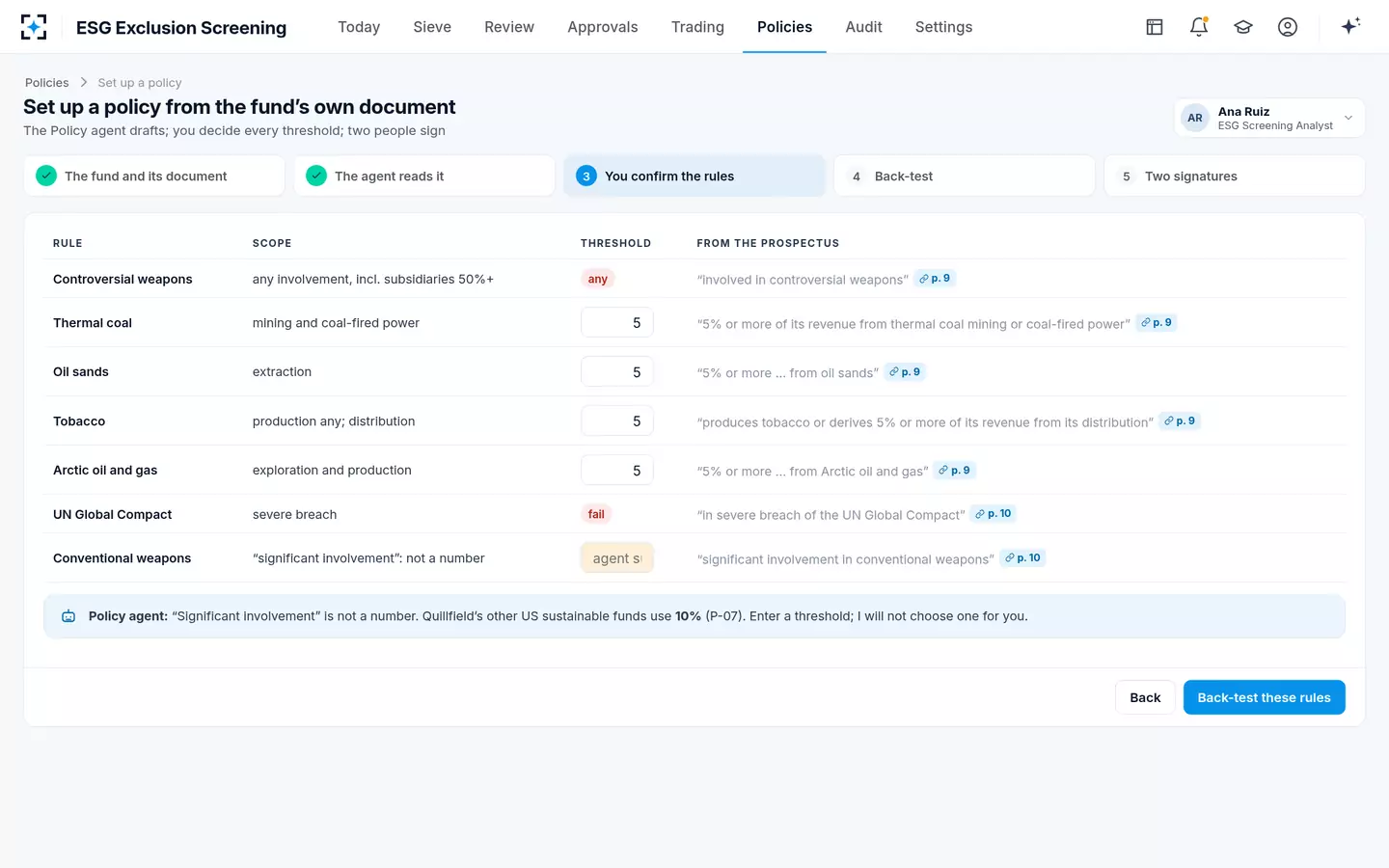
The drafting step is the cheap place to catch drift. Once a threshold is coded and running, a difference between two funds' readings of one phrase only shows up when an issuer lands between them, and then it shows up as a breach in one fund and not the other. Which coal a coal exclusion policy names is the most common example: one word in the policy decides whether a steelmaking coal miner is in or out.
What the WisdomTree board was never told
The clearest case of a broken chain is the SEC's October 2024 order against WisdomTree Asset Management, settled for a $4 million penalty without admitting or denying the findings. In September 2019 the adviser asked the board of three existing ETFs to approve a new ESG strategy. Its board materials said, in one slide, that it "screens companies with any involvement in" fossil fuels and tobacco, among other activities, and on 13 September 2019 the board approved the change, effective 16 March 2020 (SEC order, Release IA-6753, paras. 12–15).
The promise reached the board and the prospectus intact. The definition never did. The data sets the adviser had bought covered only some fossil-fuel activities, and it used a second vendor's energy-sector classification that left out gas-distribution utilities. When the SEC's examiners arrived, the prospectuses were rewritten in November 2022 to define "fossil fuels-related activities" as only "Arctic Oil Gas, Oil Sands, or Thermal Coal", which were the data sets it had subscribed to all along (paras. 24–27 and 37). The order also found no written procedures at all for the exclusion process (para. 40).
"Neither during any of these presentations to the Board nor in any other Board meetings did WisdomTree describe any limitations on its ability to conduct this exclusionary screening or otherwise describe its interpretation of terms such as “fossil fuels” or “tobacco.”"
SEC order, In the Matter of WisdomTree Asset Management, Inc., Release No. IA-6753, para. 18 (October 21, 2024)
Read as an accountability chain, the order names a gap at every hand-off: a promise with no definition, a definition set by a data subscription, no procedure for coding or checking it, and a board that approved the strategy without seeing the limits. On 5 February 2024, with the board's approval, the three funds were liquidated. The full story of what the data missed is in ESG exclusion criteria that hold up.
Exclusion policy in asset management: what the document itself must define
The document has to define enough that two analysts coding it separately would produce the same list. That means every term that will become a field: the activity, the revenue measure, the threshold and the date it is tested on, the ownership rule, the source of evidence and what happens when sources disagree. The UK regulator put the principle in one line in its anti-greenwashing guidance: "the limitations of any information, data or metrics used in a claim should be clearly and prominently disclosed" (FCA FG24/3, para. 2.29, April 2024). An exclusion policy that relies on a vendor's coverage is a claim with a limitation.
EU supervisors now expect the review to be regular. ESMA's 2025 review of sustainability disclosures counted as good practice a fund that writes down its screening criteria and exclusion lists and reviews them at least once a year, and treated as non-compliance engagement with an offending company that could run on with no time limit or materiality test before exclusion (ESMA common supervisory action report, June 30, 2025). For EU funds with ESG terms in their names, ESMA's naming guidelines add one more definition the policy needs: a temporary, non-deliberate deviation from the exclusions is a passive breach, to be corrected in investors' best interest (ESMA guidelines on funds' names, para. 22). That is a cure window, and the policy should say how long it is.
Eight things an ESG exclusion policy must define before anyone codes it
- The activity, in words a data set cannot rewrite
Thermal coal mining, coal-fired generation, coking coal: name each, and say which are out of scope.
- The revenue measure
Share of consolidated revenue, from which line of the segment note, gross or net of internal sales.
- The threshold, as a number
"Significant" and "material" are not thresholds. A 0% threshold is still a number.
- The ownership rule
Subsidiaries from what percentage; whether minority stakes or parents count.
- The evidence that settles a case
The issuer's latest audited filing, a vendor field, or both, and the oldest filing accepted.
- What happens when sources disagree
Escalate to a person above a set gap; never average two readings.
- Who proposes and who approves a change
Two different people, with reason codes, and a deadline for the approver.
- The cure window
How many business days a fund has to sell a newly excluded name, and who may extend it.
Who approves an exclusion list change, and who must never approve it
A compliance officer approves each change to the list, and never one they proposed. In a small screening team the analyst who read the annual report can easily be the same person who updates the restricted list, so the separation has to be built into the workflow rather than left to habit. It matters most where the evidence is a judgment: a revenue share read from a segment note that does not split thermal from metallurgical coal, or a subsidiary whose ownership changed during the year.
The GSAM order shows what happens when the order of steps is not enforced. Its procedures required an ESG questionnaire for every company before selection; the SEC found that investment teams "only completed the newly developed ESG questionnaires for all positions after securities were already selected for inclusion in the products' portfolios" (SEC order, Release IA-6189, November 22, 2022), and the adviser paid $4 million. A signature collected after the decision is a filing exercise, not a control.
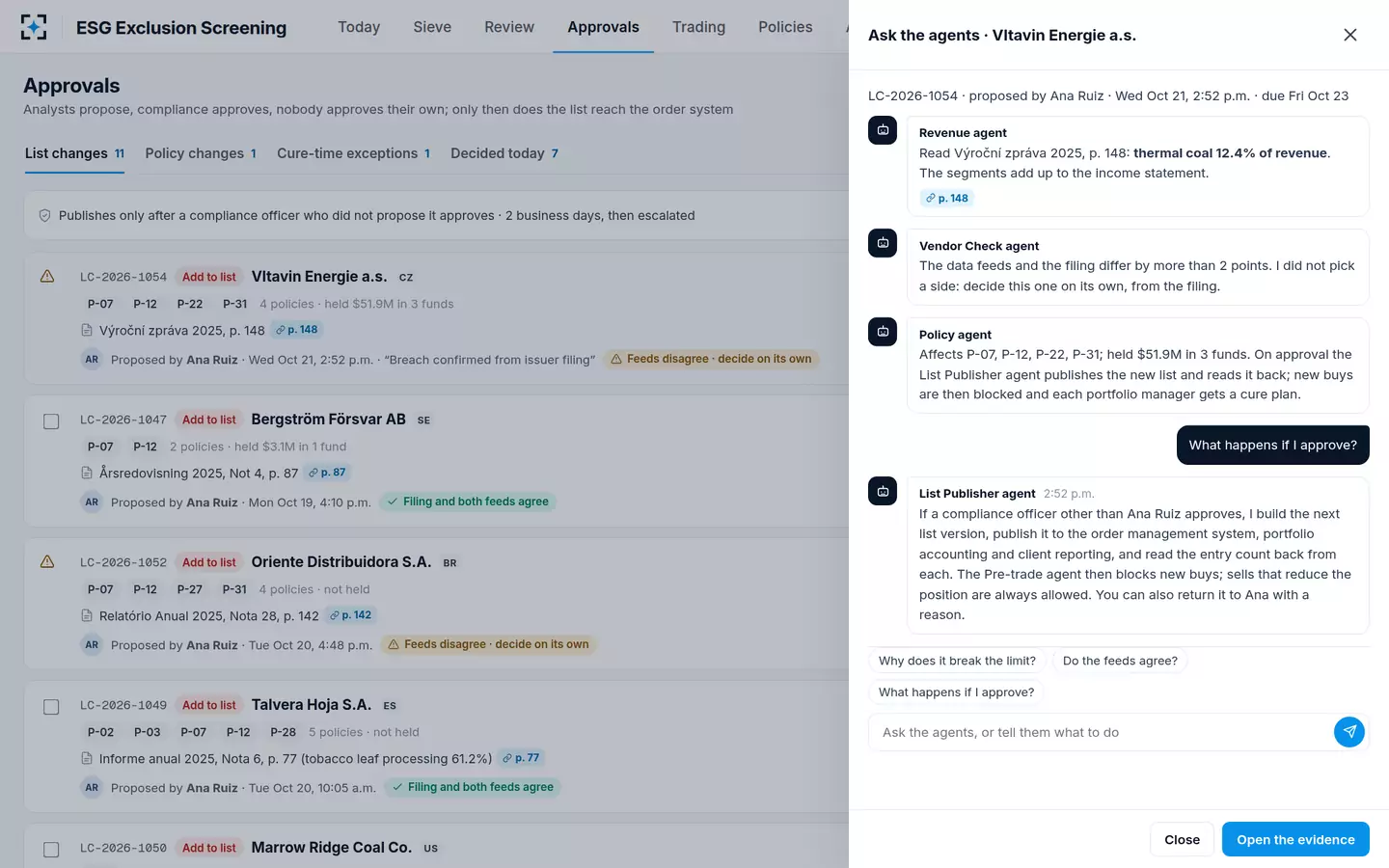
Compliance asks the agents before approving a list change
Policy changes need two signatures, and so do the settings
A change to the policy itself is a bigger decision than a change to the list, and it needs the owner of the promise and the owner of the control. At the sample manager, a client asked to tighten tobacco distribution and retail from 5% of revenue to 0% in its mandate. The Policy agent drafted the change from the client's letter and back-tested it: two more issuers excluded, neither held by that mandate. The head of sustainable investing signed; the change waited for compliance, and the agent could not sign it.
The same rule covers the screen's own settings, because they are policy in disguise. The gap between a filing and a data feed that triggers escalation, the near-limit band that puts an issuer on watch, the oldest filing accepted and the ownership share from which a subsidiary counts all change which companies end up on the list. In ESG Exclusion Screening each is versioned, and a change waits for compliance's co-signature before it applies. Why the proposer never approves sets out the maker-checker design in full.
What the ESG Exclusion Screening agents do in the chain, and what they may not
The agents do the reading and the arithmetic in the chain, and none of the signing. The Policy agent drafts rules from documents and tests every issuer against every policy version. The Revenue agent reads each issuer's segment note in its own language and computes the revenue share in scope. The Vendor Check agent compares that reading with two data feeds and escalates any gap over 2 points. The List Publisher agent publishes only after approval and reads the list back. None of them may change a policy, propose or approve a list change, or present an estimate as a reported figure.
What that buys the head of sustainable investing is a policy that can be read at any moment as the regulator would read it: the sentence, the rule coded from it, the version in force, every issuer decision under it and the names of the two people behind each one. What it does not do is write the promise. Choosing the activities, the thresholds and the evidence standard remains the policy owner's job, and the solution is built so that it cannot quietly be done by anyone else. How the agents divide the work is on the ESG Exclusion Screening page.
Questions people ask
What does ESG exclusion policy mean?
It means a written commitment not to hold companies involved in named activities or conduct, each with a threshold, for a fund, a mandate or a whole firm. The SEC's examiners describe the practice as negative screening, which excludes issuers with negative ESG characteristics. Because investors rely on it, a holding that breaks it is a misstatement, not a style choice.
Is a firmwide exclusion policy enough, or does each fund need its own?
Most managers need both: a firmwide baseline, usually on controversial weapons, and fund or mandate policies with their own thresholds. EU funds with environmental, impact or sustainability terms in their names are expected to apply all seven Paris-aligned benchmark exclusions, while funds using transition, social or governance terms apply the first three. Each policy needs its own version history.
Does the fund board have to approve the exclusion policy?
For a US registered fund, the board approves the strategy in the prospectus and, under Rule 38a-1, the compliance policies and procedures of the fund and its adviser, with a majority of independent directors. In the WisdomTree order the SEC stressed that the board was never told the screen's limitations or how terms such as "fossil fuels" were interpreted.
How often should an exclusion policy be reviewed?
At least once a year: Rules 206(4)-7 and 38a-1 require advisers and funds to review their procedures no less frequently than annually, and ESMA's 2025 review cited an annual review of screening criteria and exclusion lists as good practice. The list itself should be re-tested whenever issuers publish new annual reports.
Can a portfolio manager override an exclusion?
Not on a fund's own promise. A portfolio manager can ask compliance for more time to sell a newly excluded name, and ESMA treats a temporary deviation as a passive breach to be corrected, but buying an excluded issuer is a breach the moment the trade is made. A client's exclusion can only be waived by the client, in writing.
Who should code the exclusion rules?
Whoever codes them should not be the only person who reads the prospectus. A screening analyst or investment compliance usually does the coding, but the head of sustainable investing should set every threshold the wording leaves open, and compliance should sign the rule version after a back-test shows which issuers it catches.