A fossil fuel exclusion list is the set of companies a fund will not hold because of their coal, oil or gas activity, and no regulator publishes one for listed companies: the rules set categories and thresholds, and each manager has to turn them into names. There are three ways to do it. Buy a list from a data provider; build one by testing a vendor's revenue estimates against your own thresholds; or read each issuer's segment note and compute the share yourself. They can give different answers on the same company, notably after an acquisition or a change in a company's business, which is exactly when a fund is most exposed. Botminds' ESG Exclusion Screening is built on the third approach, with agents reading every filing in its own language, and keeps both vendor feeds beside each reading so that a gap becomes a question for a person rather than a silent answer.
The worked case on this page uses the solution's sample data on a fictional Czech utility and a fictional manager; the definitions and market evidence come from EU law, ESMA, the SEC and Norway's central bank.
Three ways to source a fossil fuel exclusion list, tested on one utility
Buy: A list of company names, refreshed on the provider's schedule
Build: Revenue bands or estimates per activity, which you test against your own thresholds
Read: The issuer's own revenue by segment, reconciled to its income statement
Buy: The provider's, which may not match your prospectus
Build: Yours for the threshold; the vendor's for what each activity field contains
Read: Yours, applied line by line to the segment note
Buy: Depends on when the provider last checked it
Build: 8.1%: an estimate dated March 2025 from fiscal 2023, before the plant was bought
Read: 12.40%: fiscal 2025, filed 28 April 2026, over the 10% limit
Buy: The provider's methodology document
Build: A field value and its date
Read: The page, the figures used and the reconciliation
Buy: Companies outside its scope; your thresholds if they differ from its own
Build: Old fiscal years, misclassified activities, subsidiaries mapped to the wrong parent
Read: Activities the issuer does not report separately: these need a range and a person
Is there a standard fossil fuel exclusion list?
No. The EU's Paris-aligned benchmark rules, the closest thing to a standard, define the exclusions as revenue thresholds by activity, not as names, and leave each user to apply them (Delegated Regulation (EU) 2020/1818, Art. 12). Public lists do exist, but each reflects one owner's criteria. Norway's central bank publishes the companies excluded from its sovereign wealth fund, including those excluded under its coal criterion (Norges Bank Investment Management), and non-governmental organisations publish lists of fossil-fuel companies; ESMA itself used one such list to estimate how far EU funds' portfolios were from the Paris-aligned thresholds (ESMA, January 2026).
A downloaded list is a starting point, not a screen. It answers its owner's question, on its owner's schedule, for the companies its owner chose to cover. The fund's prospectus answers a different question, and the gap between the two is where breaches live.
Four definitions of "fossil fuel" a list must choose between
A fossil fuel exclusion list is only as clear as its definition, and rule texts in force use at least four. They differ on which activities count, whether there is a revenue threshold, and how far down the value chain the test reaches.
Four definitions of fossil fuel involvement, from tightest to loosest
| Source | Activities counted | Threshold | What it catches that others miss |
|---|---|---|---|
| SFDR principal adverse impact indicator 4 (EU) | Exploration, mining, extraction, production, processing, storage, refining or distribution of fossil fuels, including transportation, storage and trade | Any revenue | Pipelines, storage, traders and shippers |
| A "no involvement" promise (as in the WisdomTree prospectuses) | Any involvement in fossil fuels, undefined | None: excluded whatever the revenue share | Everything, in theory; in practice whatever the data covers |
| Paris-aligned benchmark exclusions (EU) | Coal mining to refining; oil and gas exploration to distribution; high-carbon power | 1% coal, 10% oil, 50% gas, 50% power | Coking coal and lignite at very low shares |
| Norway's product-based coal criterion | Income, operations, output or capacity from thermal coal, including entities controlled | 30% of income or operations; 20 Mt a year; 10,000 MW | Very large coal companies below the revenue share, through the absolute tests |
The WisdomTree case shows how a definition gets chosen by default. Its prospectuses said companies involved in fossil fuels were excluded whatever their revenue from them, while the data it bought covered three fossil-fuel activities; after an SEC examination the prospectuses were revised to define fossil-fuel activities as those three (SEC order IA-6753, paras. 20, 24 and 37). The list was always going to be the data's list. The question was whether the investors knew.
SFDR fossil fuel exclusions: what the EU rules require, and what they only measure
SFDR itself requires no fossil fuel exclusion; it requires disclosure. Principal adverse impact indicator 4 measures the "Share of investments in companies active in the fossil fuel sector", using the any-revenue definition above (Delegated Regulation (EU) 2022/1288, Annex I). A fund can report a high share and break no rule. The exclusion duty for EU funds comes from ESMA's naming guidelines, which ask funds with environmental, impact or sustainability terms in their names to exclude the companies in Article 12(1)(a) to (g) of the Paris-aligned rules (ESMA guidelines on funds' names, paras. 17–18).
So an EU fund with "sustainable" in its name needs a list built on the PAB thresholds, and the same fund reports PAI 4 on a much wider definition. Running both from one reading of each issuer keeps the two consistent; running them from two different vendor fields does not. Botminds' SFDR Reporting produces the indicator (one PAI number, traced); the exclusion list needs the thresholds, which the seven Paris-aligned tests set out one by one.
What ESMA found when it measured EU funds against the PAB fossil fuel thresholds
>50%
of about 4,000 funds with ESG terms in their names held no companies over the PAB fossil fuel thresholds
€17bn→ €6bn
exposure over the thresholds of funds with sustainability or environmental terms, from renaming alone
40%
cut in that exposure by funds that kept ESG terms, since the guidelines were published
One utility, one acquisition, three answers
Take a fictional Czech utility from the solution's sample data, Vltavin Energie, tested by a fund whose policy excludes companies earning 10% or more of revenue from thermal coal mining and coal-fired power. In fiscal 2024 the share was 9.94%: CZK 16,900 million of CZK 169,968 million. In July 2024 the utility bought the Kladruby lignite plant, and in fiscal 2025 the share rose to 12.40%: coal-fired generation of CZK 16,437 million and lignite mining of CZK 6,210 million, out of CZK 182,640 million. The annual report with those figures was filed on 28 April 2026.
The three sources gave three answers in October 2026. The primary data feed showed 8.1%, an estimate dated March 2025 and built from fiscal 2023 reporting, before the plant was bought. The second feed showed 11.9% from fiscal 2025, but counted lignite mining net of CZK 5,312 million of sales inside the group. The filing showed 12.40%. One source said keep, two said exclude, and the reason was different in each case.
Two clocks: what the utility reported, and what the primary data feed showed
- Plant boughtJul–Dec 2024
- Fiscal 2025, the first full year with the plant2025
- Report in preparationJan–Apr 2026
- Report public: 12.40%May–Oct 2026
- Earlier figureto Feb 2025
- Estimate dated March 2025, from fiscal 2023: 8.1%Mar 2025 – Oct 2026
Under a Paris-aligned policy, the answer would have been the same in every year and from every source that separates mining from generation: lignite mining alone was 3.76% of revenue in fiscal 2024 and 3.40% in fiscal 2025, over the 1% threshold both times. The acquisition only mattered for the 10% thermal coal policy, which is the kind of policy most exposed to stale estimates, because its threshold sits where a single plant can move a company across it. Writing a coal exclusion policy explains why the two tests read different coal.
Option 1: buy a fossil fuel exclusion list
Buying a list is the fastest way to cover a large universe, and it hands the definition to the seller. A list provider decides which activities count, which revenue measure to use, how to treat subsidiaries and how often to review each company. If those choices match the prospectus, a bought list is efficient. If they do not, every name on it is defensible and the breach is a company that is not on it.
The checks are about fit and freshness: does the provider's definition match each policy you run, and when was each company last checked? The WisdomTree order is the cautionary case. The vendor documented the scope and limits of each data set it sold, including that its tobacco data would not capture small retail sales, and the adviser had that documentation before launch (SEC order IA-6753, paras. 23 and 34). Buying the list was not the failure. Not reading its scope against the promise was.
Option 2: build it from a vendor's revenue bands
Building the list from a vendor's revenue estimates lets the manager set its own thresholds, policy by policy, while still covering the universe, and screening modules and order-system rules engines are built for it. Its weakness is the estimate itself: a band or a point estimate for an activity, often derived from an older fiscal year or from sector averages where the company does not report the activity separately.
Near a threshold, that weakness decides outcomes. In the sample re-test, the Vendor Check agent found 61 gaps of more than 2 points between filings and the two feeds across the manager's universe, and 9 of them changed whether a company passed a policy. A list built only from one feed would have carried those nine errors without any sign of them. The reasons were ordinary: an old fiscal year, an activity classified differently, a subsidiary mapped to the wrong parent.
Option 3: read the issuer's segment note
Reading the filing gives the issuer's own figure for a stated fiscal year, which can be quoted, reconciled and shown to an examiner. It is how the manager's own definition gets applied line by line, and it is the only one of the three approaches that catches an acquisition the moment the annual report is published. Its costs are time and language: a large manager's universe includes thousands of issuers reporting in dozens of languages, which is why, done by hand, reading tends to be kept for the names a vendor flags.
The thermal coal share, from the utility's own segment note
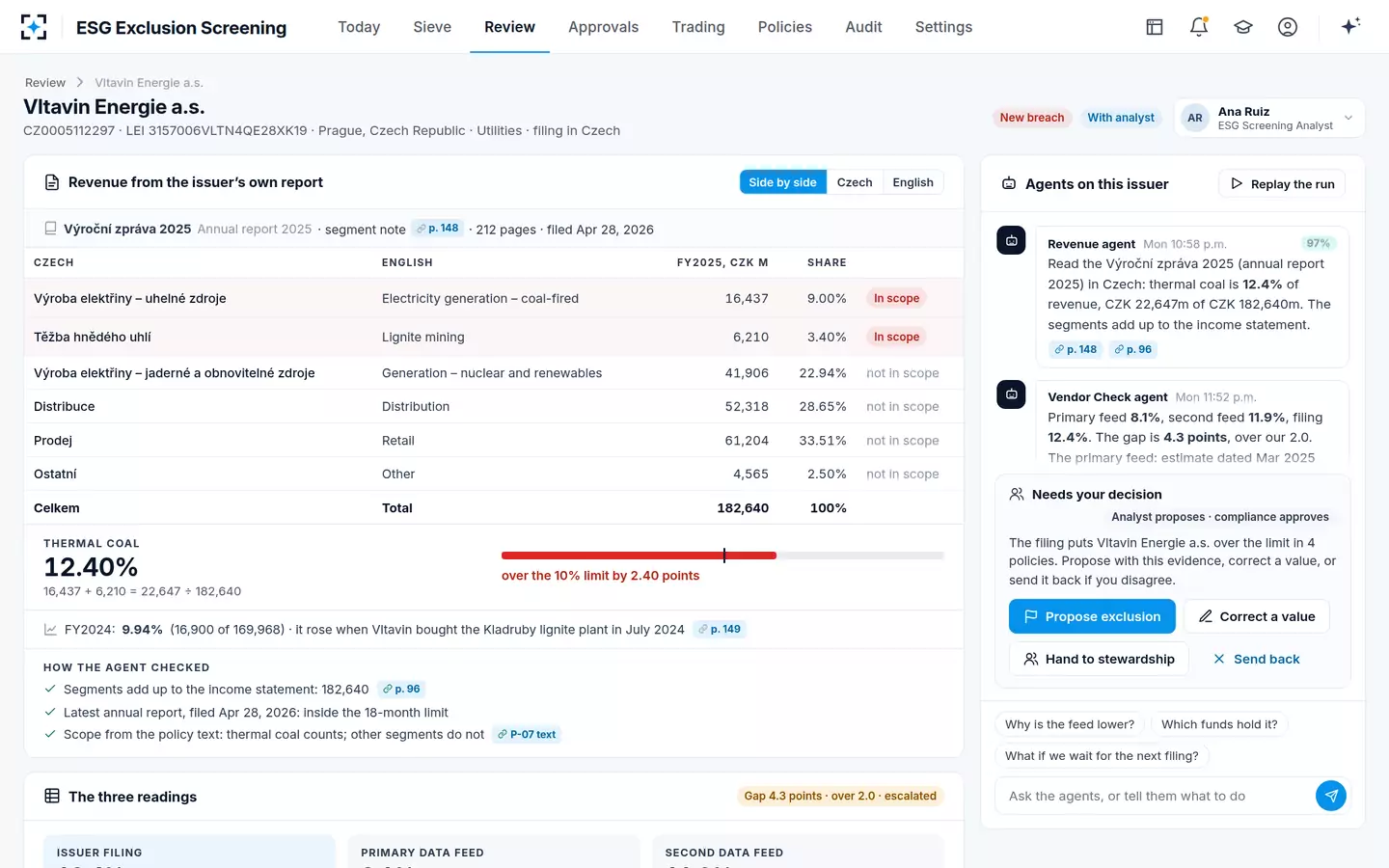
Agents change the cost side. In the sample manager's quarterly re-test, the Revenue agent read the 3,912 filings published since the previous quarter, in each issuer's own language, and the Policy agent tested 12,184 issuers against 40 policies overnight. Where a filing does not report an activity separately, the agent gives a range and hands the decision to an analyst rather than guessing. Reading does not remove the vendor feeds: they stay beside each reading, as the second and third opinions that make a disagreement visible.
How to build an exclusion list you can defend
Build it in the order an examiner will check it: the definition, the data that tests the definition, the reading for each issuer, the decision, and the proof that the order system enforces it. Most of the work is in the first two steps, and most failures come from skipping them. A list that is correct for a definition nobody wrote down cannot be defended, however accurate it is.
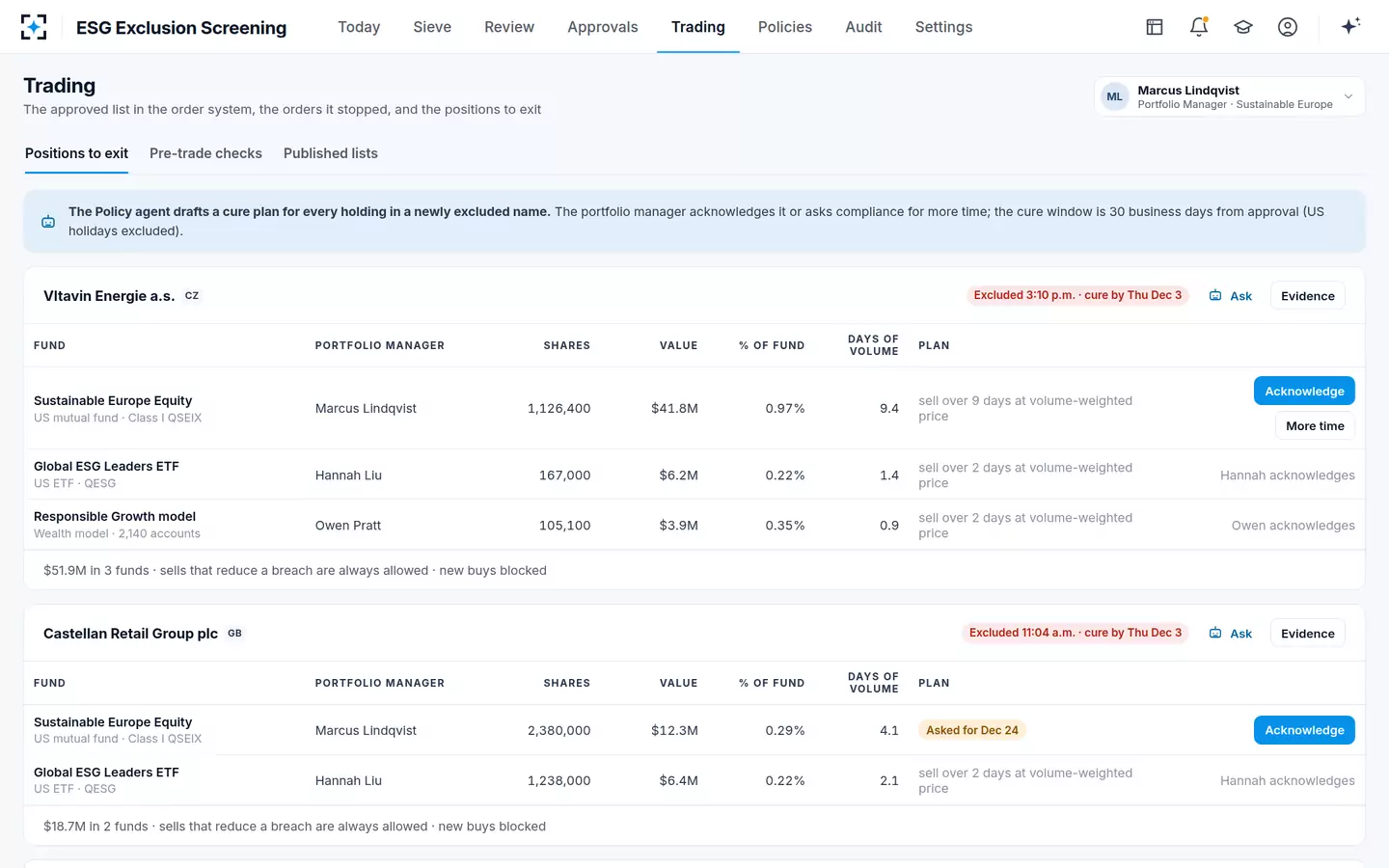
Then plan for the day the list changes. A company crosses a threshold when it publishes a new annual report, so the exit has to be planned the same day: which funds hold it, how many days of volume a sale takes, and the date by which it must be done. ESMA treats a temporary breach of the exclusions as a passive breach to be corrected in investors' best interest, provided it is not deliberate (ESMA guidelines, para. 22); the cure window is the manager's to set and to meet.
Once excluded, a cure plan for every fund that holds the name
What to ask before you buy any fossil fuel exclusion list
Ask questions that expose the definition, the coverage and the age of each answer. Vendors rarely publish prices, so the useful comparison is with the work the list replaces: the hours your analysts spend reading the names it flags, and the reconciliation when two sources disagree. The questions below apply to a bought list, a vendor's revenue fields and a tool that reads filings alike.
Nine questions for any fossil fuel exclusion list or data feed
- Which activities does each field cover?
Coking coal, lignite, coal-fired power, oil sands, shale, gas distribution, transport: one by one.
- Which revenue measure?
Consolidated revenue, external sales only, or net of sales inside the group.
- Which fiscal year, for each company?
And how quickly a new annual report changes the figure.
- Reported or estimated?
Each figure should say which, and how an estimate was made.
- How are subsidiaries and stakes treated?
Consolidated subsidiaries only, or minority stakes too, and from what percentage.
- What is not covered?
Companies, regions and activities outside the scope, and what your screen does with them.
- Can you see the page?
For any company near a threshold, the filing the figure came from.
- How are disagreements handled?
Between the list and the filing, or between two vendors: escalated to a person, or silently resolved.
- Does it match every policy you run?
PAB thresholds, your US fund thresholds and clients' mandates may each need a different reading.
For a large manager the practical answer is a combination: feeds to cover the universe overnight, the filing for every company the decision depends on, and a person for every disagreement. That is the design of ESG Exclusion Screening, described on the ESG Exclusion Screening page; the controls that keep its readings honest are in why the proposer never approves the change.
Questions people ask
Can I download a fossil fuel exclusion list?
Not an official one: no EU or US regulator publishes a list of excluded listed companies. Norway's central bank publishes the companies excluded from its sovereign wealth fund, including under its thermal coal criterion, and some non-governmental organisations publish fossil-fuel company lists. Each reflects its owner's criteria, so check them against your own thresholds before relying on them.
Does natural gas count as a fossil fuel in exclusion policies?
It does in EU rules, at different thresholds. The Paris-aligned test excludes companies with 50% or more of revenue from exploring, extracting, manufacturing or distributing gaseous fuels, while SFDR's indicator 4 counts any fossil fuel revenue, gas included. In the WisdomTree case, gas distributors held by funds that promised no fossil-fuel involvement were part of the SEC's findings.
How often should a fossil fuel exclusion list be updated?
At least whenever a company publishes a new annual report, because that is when its revenue mix changes, and on a fixed cycle for the whole universe. The sample manager re-tests every issuer quarterly and accepts filings up to 18 months old; in the worked case, a filing public since April 2026 was what revealed an acquisition the feed had missed.
What does a fossil fuel exclusion list cost?
Vendors do not publish prices, and costs vary with universe size and the activities covered. Measure the cost of each option in your own analysts' hours: the time to check the names a list flags, to reconcile two sources and to evidence each decision. Botminds estimates a large manager's quarterly re-test at about 19 business days by hand.
What happens when a company crosses a threshold through an acquisition?
It is usually visible first in the annual report covering the first full year after the deal, and in a vendor feed only later. A screen that reads new filings as they are published will catch it at that point; a near-limit watch band, one point at the sample manager, flags companies close enough for a single acquisition to cross the line.
Is a fossil fuel exclusion list enough for a fund named "sustainable" in the EU?
No. ESMA's guidelines ask such a fund to meet an 80% threshold of investments meeting its characteristics, apply all seven Paris-aligned exclusions, including weapons, tobacco and norms violators, and commit to invest meaningfully in sustainable investments. The fossil fuel thresholds are four of the seven exclusions.