The SEC's ESG enforcement actions against investment advisers come down to five settled orders between May 2022 and November 2024: BNY Mellon Investment Adviser ($1.5 million), Goldman Sachs Asset Management ($4 million), DWS Investment Management Americas ($19 million), WisdomTree Asset Management ($4 million) and Invesco Advisers ($17.5 million). None needed an ESG rule. Each found that an adviser said one thing about how ESG shaped its investments and did another, and each found a violation of the compliance rule, Rule 206(4)-7, because written procedures that would have caught the gap were missing or not followed. The penalty is the visible part of the bill; the rest includes rewritten prospectuses, remediation, and in one case three liquidated funds. Botminds' ESG Exclusion Screening exists for the kind of error at the centre of the screening case: a fund holding a company its prospectus excluded, because nobody checked the data against the promise.
Every figure here is from the SEC's own orders and releases, all settled without admitting or denying the findings, and from Australia's securities regulator for the one non-US case. The product examples use the solution's sample data on a fictional manager.
SEC ESG enforcement penalties against advisers, 2022 to 2024
What SEC ESG enforcement actions have there been?
Five settled orders against advisers make up the SEC's ESG cases from 2022 to 2024, brought after the SEC's Enforcement Division formed a Climate and ESG Task Force in March 2021 (SEC press release 2022-86). They fall into two kinds. Three are about a process the adviser described and did not run: an ESG review for every holding, a questionnaire before every selection, a global integration policy. Two are about a claim the adviser's data could not support: a screen that missed fossil-fuel and tobacco companies, and a firmwide percentage of "ESG integrated" assets.
Five SEC ESG enforcement actions: the promise, the finding, the bill
| Order | What was promised | What the SEC found | Penalty and other terms |
|---|---|---|---|
| BNY Mellon Investment Adviser (IA-6032, May 2022) | ESG quality reviews in the research process for its overlay funds | 67 of 185 investments by one fund had no review score when bought, nearly 25% of its net assets | $1.5m; censure; cease-and-desist |
| Goldman Sachs Asset Management (IA-6189, Nov. 2022) | An ESG questionnaire and materiality matrix for every selection | No written procedures for one strategy until mid-2018; questionnaires completed after selection | $4m; censure; cease-and-desist |
| DWS Investment Management Americas (IA-6432, Sept. 2023) | A global ESG integration policy followed by every analyst | Sampled 2020 research notes: about 54% of equity and 21% of fixed income notes mentioned ESG criteria | $19m; censure; cease-and-desist |
| WisdomTree Asset Management (IA-6753, Oct. 2024) | No fossil-fuel or tobacco involvement in three ESG ETFs | Data that covered part of the promise; no written procedures for the screen | $4m; censure; cease-and-desist; funds liquidated Feb. 2024 |
| Invesco Advisers (IA-6770, Nov. 2024) | 70% to 94% of the parent's assets "ESG integrated" | The figures counted passive ETFs that could not consider ESG; no written policy defining integration | $17.5m; censure; cease-and-desist |
BNY Mellon, 2022: a review that did not reach every holding
BNY Mellon Investment Adviser told investors in prospectuses, boards in meetings and other firms in proposal responses that its sub-adviser conducted ESG quality reviews as part of its research for six "overlay" funds with combined net assets of about $5.3 billion. The sub-adviser required those reviews for its sustainable funds, but not for the overlay funds, whose managers could and did buy securities nobody had reviewed. In one fund, 67 of 185 investments made between January 2019 and March 2021 had no review score at the time of investment, "amounting to nearly 25 percent of the fund's net assets as of March 31, 2021" (SEC order IA-6032).
The penalty was $1.5 million, the smallest of the five, and the order credits the adviser's prompt remedial steps and cooperation. The lesson for a screening team is coverage: a process applied to most holdings, described as if it applied to all of them, is a misstatement about the rest.
Goldman Sachs Asset Management, 2022: procedures followed too late
GSAM's case is about sequence. From April 2017 to February 2020 it advised an ESG strategy for separately managed accounts and two ESG mutual funds; the strategy had no written ESG procedures until some time after it launched, and once procedures existed they were not consistently followed. Investment teams relied on earlier research, done differently, and "only completed the newly developed ESG questionnaires for all positions after securities were already selected for inclusion in the products' portfolios" (SEC order IA-6189).
The products were small, about $103 million in the strategy and net assets of $127 million and $8 million in the two funds as of February 2020, and the penalty was $4 million. The charge was the compliance rule alone: no misstatement finding, only procedures that did not do what the firm said they did.
DWS, 2023: a policy on the website, not in the research notes
DWS's U.S. adviser marketed itself as an ESG leader and published its global ESG integration policy on its website. The SEC found that from August 2018 it did not adequately put parts of that policy into practice for its ESG integrated products, which had about $70 billion under management at the end of 2021, and lacked procedures to keep its public statements accurate (SEC order IA-6432). The firm's own quality checks on research notes written between January and November 2020 found that only about 54% of active equity notes and 21% of fixed income notes mentioned ESG criteria, and the policy stayed on the website.
The ESG penalty was $19 million, the largest of the five; the same day, a separate anti-money-laundering order added $6 million, for $25 million in total (SEC press release 2023-194). The firm's own checks had found the gap. What it lacked was a procedure that turned the finding into a correction of what it told clients.
WisdomTree, 2024: the screening case
WisdomTree is the order that maps directly onto exclusion screening. From March 2020 to November 2022, three ETFs marketed as ESG funds promised to exclude companies involved in fossil fuels and tobacco, and held companies in coal mining and coal transport, natural gas extraction and distribution, and tobacco retail. The adviser's data covered only part of what the promise required, the board was never told the limits, and there were no written procedures for the exclusion process at all (SEC order IA-6753).
The funds were small: about $27 million, $38 million and $73 million in assets as of March 2020. The penalty was $4 million, roughly 3% of those three funds' combined assets at launch, and by the time of the order the funds no longer existed: the board approved their liquidation on 5 February 2024. The criteria that would have held up are worked through in ESG exclusion criteria that hold up.
WisdomTree: five years from board approval to the SEC's order
- Approval6 mo
- Launch6 mo
- Holdings continue against the prospectus26 mo
- Prospectuses rewritten15 mo
- Funds closed8 mo
Invesco, 2024: a percentage nobody could support
Invesco's case is about a single number. Between about April 2020 and July 2022, it told boards, prospective clients and readers of its marketing that 70% to 94% of its parent's assets under management were "ESG integrated". The figures counted passive ETFs that tracked non-ESG indexes, including the firm's largest ETF, and the firm had no comprehensive written policy for how the percentage was determined (SEC order IA-6770). An internal analysis, the order notes, had put at least $370 billion of assets "at risk" of moving to another firm, prompting the push to claim integration.
The penalty was $17.5 million, and the order added a finding under the marketing rule to the compliance-rule and pooled-vehicle charges. For an exclusion screen the parallel is any firmwide claim built from fund-level work: the share of assets screened, the number of issuers excluded, the percentage of decisions backed by filings. Each is a claim the firm must be able to compute, from a definition it wrote down.
What do greenwashing fines add up to?
The five SEC penalties add up to $46 million; Australia's Federal Court added A$12.9 million against Vanguard Investments Australia in September 2024, which ASIC described as the highest greenwashing penalty yet (ASIC 24-213MR). Those numbers are small beside the firms that paid them: the advisers involved reported regulatory assets from about $73 billion (WisdomTree) to $1.5 trillion (GSAM) in their orders.
The bill that matters is the one measured against the product. For the three WisdomTree ETFs, the penalty was about 3% of the assets they launched with, and the funds were closed. For the Vanguard fund, ASIC's release reports that the court found the misrepresentations concerned the fund's principal distinguishing feature. When the promise is the product, a broken promise ends the product. The other costs do not appear in any order: the prospectus rewrites, the board time, the remediation work and the years between the first examination and the settlement.
The SEC's ESG cases against advisers, 2022 to 2024, in four numbers
5
settled orders against advisers, May 2022 to November 2024
$46m
in civil penalties across the five
5 of 5
found a violation of the compliance rule, Rule 206(4)-7
3
ESG ETFs liquidated by WisdomTree before its order was entered
What the SEC requires, without an ESG rule
None of these cases rested on an ESG-specific rule, because there is none for advisers. The SEC's 2022 proposal on ESG disclosures by advisers and funds was withdrawn on 17 June 2025, and the Commission said it would not finalise it (Federal Register, 90 FR 25531). The cases rested on the general antifraud provisions and the compliance rule, which makes an adviser put written procedures in place that are fit to stop breaches of the Act, follow them, and test them every year (17 CFR 275.206(4)-7).
The antifraud standard is low. Several of the orders state that Section 206(2) of the Advisers Act requires no intent and can rest on simple negligence, and that the pooled-vehicle rule, Rule 206(4)-8, likewise needs no proof of scienter. A manager does not have to mean to mislead investors about an exclusion; it only has to fail to take reasonable care that the exclusion is applied.
Does the SEC still bring ESG cases?
The five orders above run to November 2024, and the agenda has since moved away from ESG as a label. The fiscal 2027 examination priorities, published on 23 October 2026, do not mention ESG; they do say examiners of registered funds will test whether portfolio management practices match the funds' stated strategies, filings and marketing (SEC Division of Examinations, FY2027). An exclusion is a stated investment strategy, so the test applies to it whatever it is called.
The amended Names Rule adds a dated hook. Large fund groups, those with $1 billion or more in net assets, had to comply from 11 June 2026, and the rest have until 11 December 2026; and the fiscal 2026 priorities said examiners would look at the rule "(after the compliance date)" (SEC Division of Examinations, FY2026). A US fund whose name signals an ESG focus now has an 80% investment policy to meet as well as the exclusions it promises; Botminds' Fund Names Rule Compliance covers that test.
The cheapest error is the one found before the screen runs
Every order here describes an error that was knowable inside the firm before the SEC found it: a vendor's documented limits, a sub-adviser's process that skipped some funds, research notes that did not mention ESG, a percentage computed from the wrong assets. The cost of finding it rises at each step: before the policy is coded, it is a sentence to rewrite; before the screen runs, a data gap to fill; once a fund holds the name, a sale and a disclosure; after an examination, all of that plus a penalty.
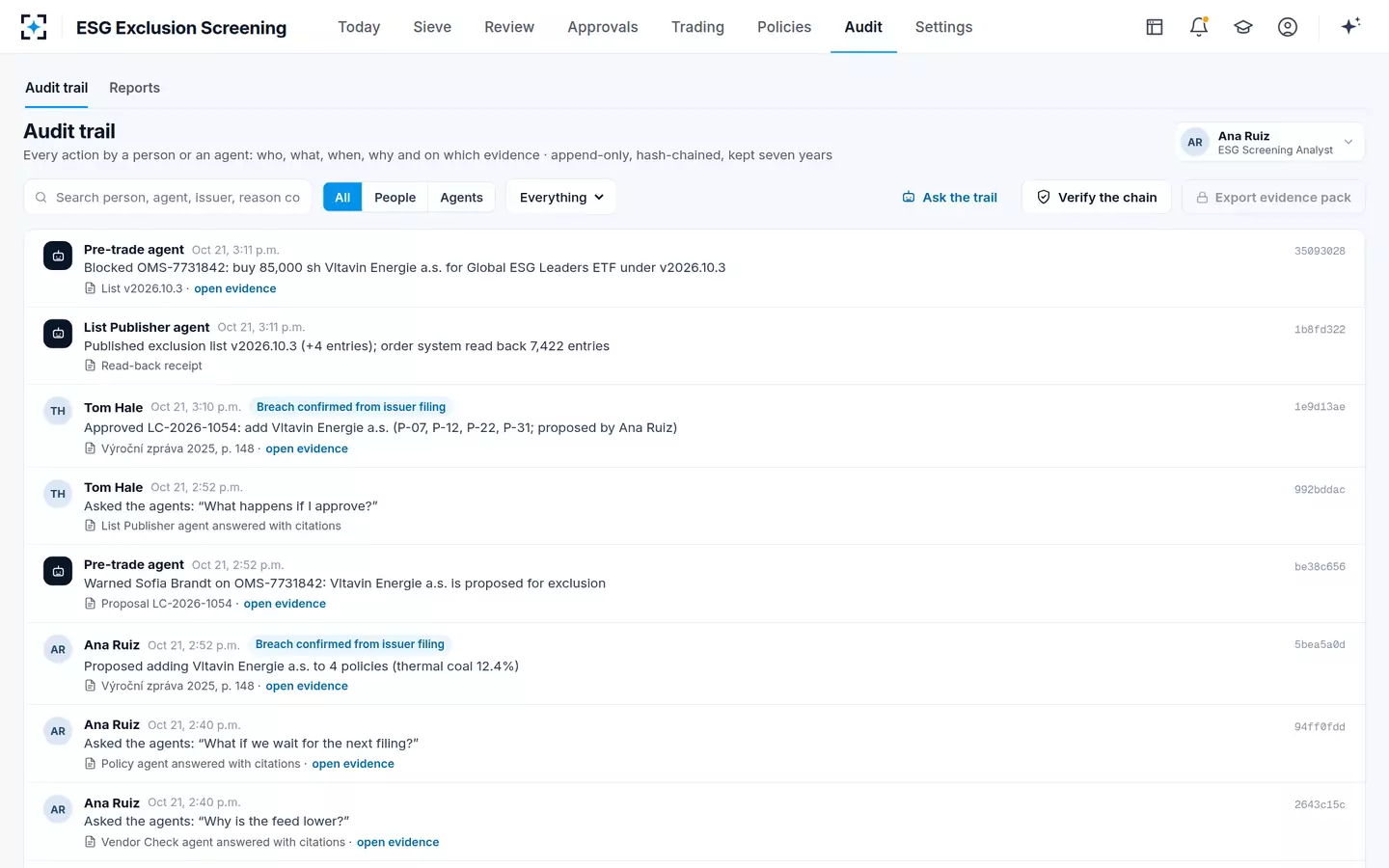
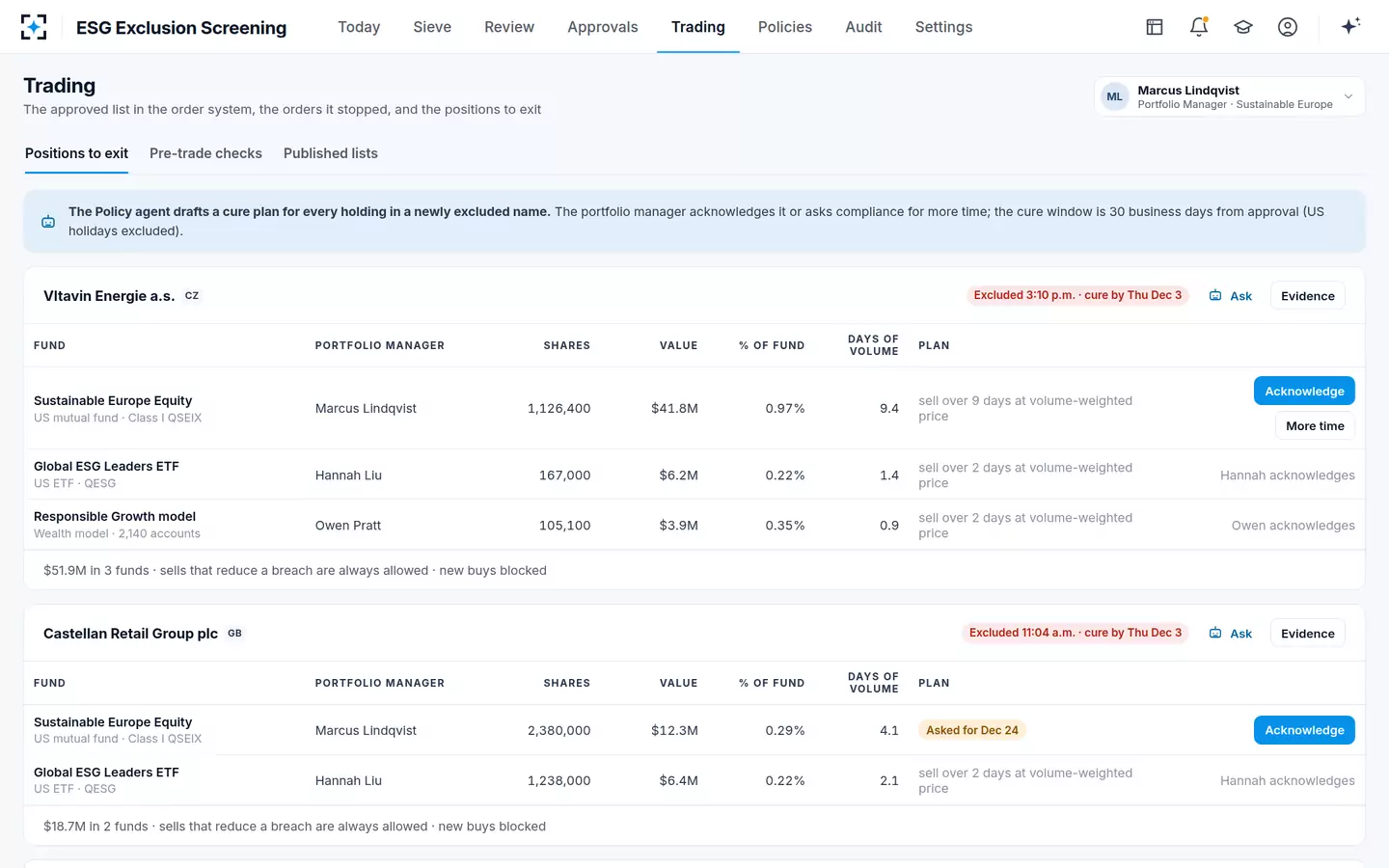
ESG Exclusion Screening is designed for the first two steps. Its agents read each issuer's own filing, compare it with two data feeds and send every material gap to a person before a decision is made; an analyst proposes each change and a compliance officer who did not propose it approves; and every action is kept on a hash-chained trail for seven years. When a holding does turn out to breach a newly tested policy, the exit is planned the same day. Why the proposer never approves the change describes those controls; who writes, codes and signs the policy covers the step before them.
The trail an examiner asks for: every proposal, approval, publish and block
When a holding breaches, the exit is planned the same day
Questions people ask
What was the largest SEC ESG penalty against an adviser?
$19 million, against DWS Investment Management Americas in September 2023, for misstatements about its ESG integration process. The same day DWS paid $6 million in a separate anti-money-laundering action. Invesco Advisers' $17.5 million penalty in November 2024 is the second largest.
Did the firms admit wrongdoing?
No. All five orders were settled, with each adviser consenting without admitting or denying the findings, except as to the SEC's jurisdiction. Each order says its findings rest on the firm's settlement offer and bind no one else.
Does the SEC have to prove intent in an ESG case?
Not for the charges used in these orders. The WisdomTree order states that a violation of Section 206(2) of the Advisers Act may rest on simple negligence, and that Rule 206(4)-8 and the compliance rule need no proof of scienter. Careless screening is enough.
What did the Vanguard greenwashing case cost?
A$12.9 million, ordered by the Federal Court of Australia on 25 September 2024 in a case brought by ASIC, after Vanguard Investments Australia admitted that about 74% of its ethically conscious bond fund, by market value, had not been screened as promised. It is an Australian case, not an SEC action, but turns on the same failure.
Did withdrawing the ESG disclosure proposal end ESG enforcement?
It ended the proposed ESG-specific disclosure rules, not the obligations the cases rested on. The antifraud provisions, the compliance rule and, for funds, the Names Rule all still apply, and the fiscal 2027 exam priorities test whether fund practices match their stated strategies and marketing.
What does an ESG enforcement action cost beyond the penalty?
The orders show censures, cease-and-desist orders, rewritten prospectuses and, at WisdomTree, the liquidation of three funds before the order was entered. The examination, investigation and remediation take years: WisdomTree's funds launched in March 2020 and its order came in October 2024.