Norms-based screening checks companies against international standards of conduct, such as the ten UN Global Compact principles and the OECD Guidelines for Multinational Enterprises, and excludes, watches or engages with those found to breach them. Negative screening excludes companies by what they make or earn: tobacco, controversial weapons, coal above a revenue threshold. The difference that matters in practice is time. A revenue figure changes once a year; a norms breach can happen, and be published in a local court registry, on any afternoon. Botminds' ESG Risk Monitoring is an agentic solution built for the second clock: it reads those sources as they appear and tests each event against each fund's written screen.
Many funds run both screens under one policy, and many supervisory findings come from treating them as one process. The figure below sets them side by side.
Norms-based screening and negative screening, side by side
Norms-based: Did the company breach an international norm?
Negative: Does the company make or earn money from something the fund avoids?
Norms-based: The ten UN Global Compact principles, the OECD Guidelines for Multinational Enterprises, ILO conventions
Negative: Activity and revenue thresholds: tobacco, controversial weapons, coal, oil, gas, power generation
Norms-based: An event: a judgment, a regulator’s order, a strike, a spill, a bribery charge
Negative: A new annual report, an acquisition, a change in revenue mix
Norms-based: Any day, without notice
Negative: Mostly once a year, when the figures are published
Norms-based: Incident reports from courts, regulators, NGOs and the press, often in the local language
Negative: Revenue and involvement data by activity, mostly from company disclosures and vendors
Norms-based: Heavy: severity, attribution, evidence standard, remediation
Negative: Light once the threshold is written: the figure is above it or not
Norms-based: Late: the event is in a local source nobody read
Negative: Incomplete: the data misses a business line the policy names
What is norms-based screening?
Norms-based screening is the test of a company's conduct against a published set of international norms, with a consequence written into the fund's rules when the company fails it. The norms most funds name are the UN Global Compact's ten principles on human rights, labour, environment and anti-corruption, and the OECD Guidelines for Multinational Enterprises. Some add the International Labour Organization's fundamental conventions and the UN Guiding Principles on Business and Human Rights, which EU disclosure rules mention alongside the OECD Guidelines when a product claims sustainable investments (Delegated Regulation (EU) 2022/1288).
The consequence varies by fund. Some policies exclude companies found in severe breach; some put them on a watchlist and engage; most do both in stages, with a first-instance finding leading to engagement and a final one to sale. That is also the answer to a question search engines suggest often, whether norms-based screening is exclusionary or inclusionary: it is a test, and the policy decides the consequence. What it never is, done properly, is a lookup of someone else's list. What counts as a UN Global Compact violation sets out how the finding is made.
How does a negative screen differ from a norms screen?
A negative screen excludes companies by activity or revenue, read from reported figures; a norms screen judges conduct, from events (six myths about negative screening covers the activity side in depth). The clearest legal example of a negative screen is the EU's list for Paris-aligned benchmarks: companies involved in controversial weapons or tobacco cultivation and production, and companies earning at least 1% of revenue from hard coal and lignite, 10% from oil fuels, 50% from gaseous fuels, or 50% from electricity generated at more than 100 g CO2e/kWh (Delegated Regulation (EU) 2020/1818, Article 12). Each test is a number against a threshold, read from reported figures.
The same article holds the norms test, point (c): companies the administrator itself judges to be in breach of the UN Global Compact principles or the OECD Guidelines. One list, two methods. Since ESMA's guidelines on fund names apply points (a) to (c) to every EU fund with a transition, social or governance term in its name, and (a) to (g) to environmental, impact and sustainability terms, any such fund now runs both screens (ESMA34-1592494965-657). How the activity side is built and tested is covered by Botminds' ESG Exclusion Screening, starting with the seven Paris-aligned benchmark tests.
Why the two screens run on different clocks
A negative screen's input arrives on a calendar; a norms screen's input arrives when something happens. Revenue by activity comes from annual reports, so a well-run activity screen reviews its universe on a schedule. ESMA's supervisors cited as good practice a fund that "sets out screening criteria and exclusion lists and performs a review (at least) on an annual basis" (ESMA common supervisory action report, June 2025). That cadence fits revenue data. It does not fit a court judgment published on a Monday afternoon.
Norms-based screening runs on days; negative screening runs on years
- Fiscal year12 months
- Report, data update, review~5 months
- Policy window90 days
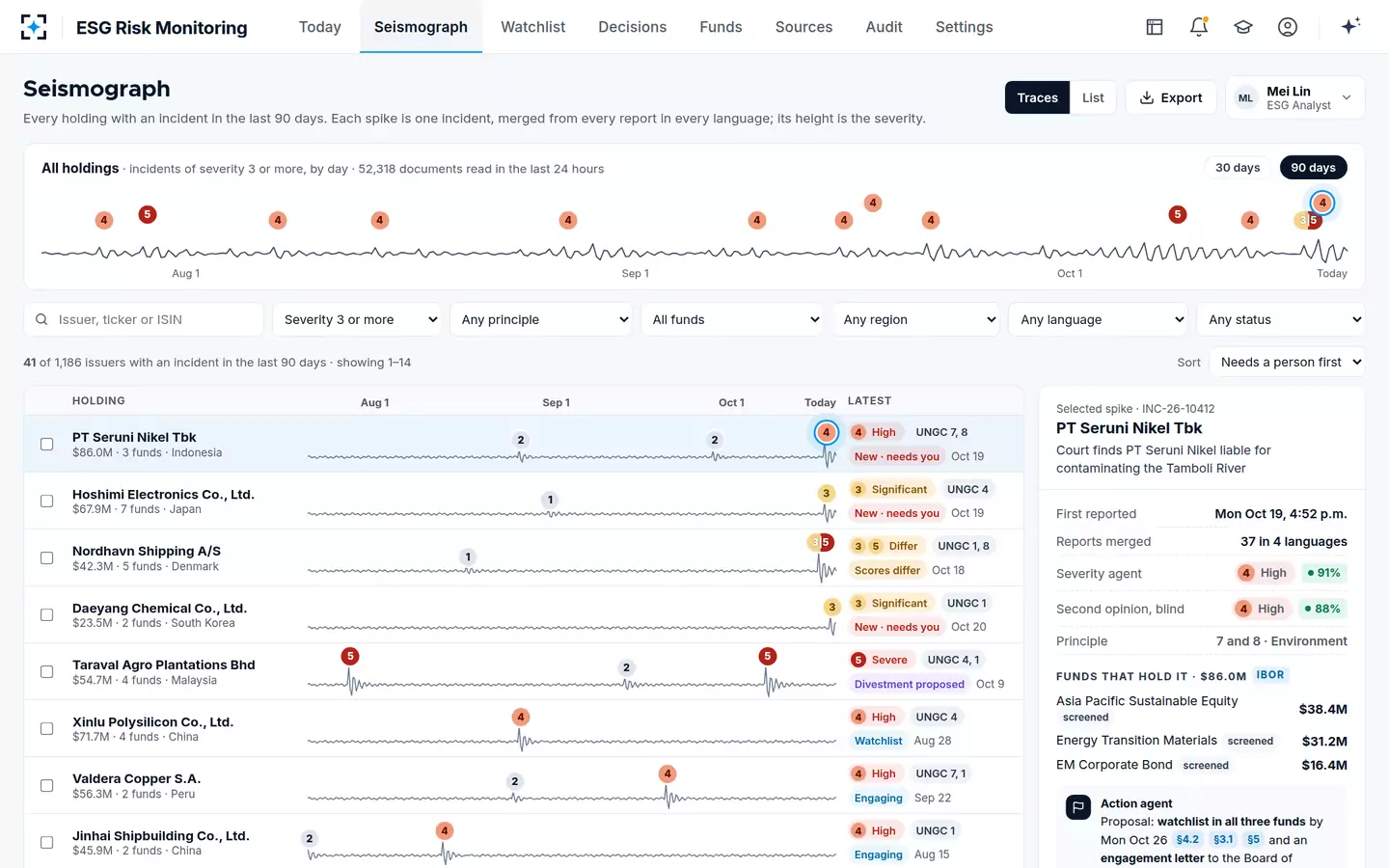
The norms clock also starts at a moment the fund does not choose. In the solution's sample, a district court published a judgment against a nickel miner at 4:52 p.m. on a Monday; under one fund's clause the watchlist decision was due by the following Monday. A screen that checks norms status when its data vendor next updates has, in effect, an annual or quarterly clock on an event that needed a weekly one. The sample firm, Quillfield Capital, and the companies in it are fictional.
A revenue threshold can be checked when the annual report arrives. A breach of a norm has to be noticed when it happens, because the fund's clock starts then.
Is norms-based screening a negative screen?
It can work like one, but it is not the same test. When a norms breach leads straight to exclusion, the result looks like a negative screen: a company is out. The difference is in the input and the judgment. An activity screen asks a yes-or-no question of a reported figure; a norms screen asks whether an event happened, whether the company is responsible, which norm it breaches and how severe it is. Two analysts applying the same activity threshold to the same figure will agree; two applying the same norm to the same incident often will not, which is why scoring each controversy twice is worth the effort.
Positive screening, the other term in the same family, selects companies for good performance rather than excluding for bad. Norms screens are almost always used to exclude or to trigger engagement, rarely to select.
What data does norms-based screening need?
It needs event data: court judgments, regulators' orders, labour inspectorate notices, NGO investigations and press reports, matched to the issuer and every entity it owns. Much of it is published first in the language of the country where the event happened. Activity data, by contrast, comes mostly from annual reports and is relatively standardised.
The two kinds of data are also regulated differently. The EU's new ESG ratings regulation, which applies from 2 July 2026, covers opinions and scores built on a methodology and a ranking system, but its recitals say that the "sole distribution of ESG information on entities or financial products, relying on proprietary or established methodology, which includes, among others, datasets on emissions and data on ESG controversies, should not be covered by this Regulation" (Regulation (EU) 2024/3005, recital 25). A controversy feed bought from a vendor carries no regulatory quality standard; checking it falls to the fund.
ESG Risk Monitoring's seismograph: the event side of the screen
Where supervisors have found screens failing
Both kinds of screen fail, in different ways. Activity screens fail on coverage: the SEC's examiners found advisers without reliable systems to keep clients' negative screens current, so barred securities could end up in client portfolios (SEC risk alert, 9 April 2021). The enforcement cases since then have been about the same thing: data that did not capture every business line a prospectus named.
Norms screens fail on time and on gaps that are filled with zeros. For the principal adverse impact indicators on UN Global Compact and OECD Guidelines violations, supervisors found managers routinely recording a zero where they had no data (ESAs report, September 2025). An unchecked company scored as compliant is the norms equivalent of a missing revenue line.
Two screens, one fund name: what EU and US rules now ask
(a)–(c)
EU benchmark exclusions every ESG-named EU fund should apply, including UNGC and OECD violators
21 May 2025
Date ESMA’s name guidelines applied to funds that existed before November 2024
11 Jun 2026
US Names Rule compliance date for fund groups with $1 billion or more
Smaller groups: 11 Dec 2026
In the United States, the amended Names Rule reaches "terms indicating that the fund's investment decisions incorporate one or more ESG factors" and applies its 80% investment policy to them (SEC adopting release, 2023). It does not prescribe exclusions. A US fund's norms screen is whatever its prospectus says it is, and the SEC tests the fund against those words. Botminds covers the rule itself in Fund Names Rule Compliance.
One company through both screens
A worked case shows why one screen cannot stand in for the other. In the solution's sample, Taraval Agro Plantations, a palm oil grower held in four Quillfield funds, earns nothing from weapons, tobacco or fossil fuels. Every activity threshold in the EU benchmark list passes it. Its norms record is the opposite: forced-labour indicators at its estates, a US import detention order on its products, and three of four engagement milestones missed in 18 months, including an independent labour audit that was never published.
On the norms screen Taraval has stood at severity 5 since March 2025, and the analyst has proposed divestment: two committee votes, then a restriction coded by compliance within one business day and a sale to zero within 30 business days. On the activity screen it would never have appeared. Taraval, its estates and its milestones are fictional sample data; the pattern, a commodity producer that is clean on revenue and failing on conduct, is the reason the EU benchmark list puts both tests in one article.
Why the event side gets harder from 2026
Fewer companies will describe their own conduct in mandatory sustainability reports. The EU's 2026 Omnibus directive limits the obligation to prepare and publish sustainability reporting to undertakings with a net turnover above EUR 450 million and more than 1,000 employees on average (Directive (EU) 2026/470). For the many mid-sized issuers that drop out, the company's own account of grievance mechanisms, supply-chain due diligence and workforce incidents will be voluntary.
That matters twice for a norms screen. Principal adverse impact indicator 11, the share of holdings in companies without policies to monitor compliance with the UN Global Compact or the OECD Guidelines, leans on what companies disclose. And indicator 10 leans on events, which arrive from courts, regulators and NGOs whether or not the company reports. As self-reporting thins, the screen's evidence moves further toward those outside sources, many of them in the local language. Why the first source is usually local looks at where those records appear.
How to run a norms-based screen that holds up
A norms screen holds up when every element a court or examiner would ask about is written down before the first incident arrives. That means the norms, the evidence grades, the relationships in scope, the clock for each grade, and who decides. The US compliance rule adds one more: advisers must check at least once a year that their policies and procedures are still adequate (17 CFR 275.206(4)-7), which for a norms screen means testing whether incidents were caught and decided inside their windows.
Seven decisions to write into a norms-based screening policy
- Which norms
The ten principles, the OECD Guidelines, named ILO conventions: list them, so a finding cites one.
- Which evidence earns which grade
Allegation, first-instance finding, final judgment, admission, and what each leads to.
- Which entities and relationships count
Subsidiaries and joint ventures, finance vehicles behind bonds, suppliers at which tier.
- The clock for each grade
Days to a watchlist decision, to engagement, to a committee decision, to sale.
- Who decides, and who approves
The analyst proposes; a different person approves; divestment needs more than one vote.
- What a missing answer means
Not “compliant”: an unresearched company is unresearched, and the file should say so.
- How the screen is tested each year
Incidents caught, days to decision, decisions inside the window, vendor alerts you were ahead of or behind.
Norms-based screening in practice: one sample firm's 64 funds
In the solution's sample firm, 64 of 412 funds and mandates carry a written norms-based screen or controversy policy, each coded from the prospectus, SFDR annex or client agreement and approved by compliance. The wording differs: a Luxembourg UCITS has a norms-based exclusion clause, a bond fund a watchlist and bondholder engagement clause, a US mutual fund's prospectus excludes severe UN Global Compact violations. The same incident therefore asks something different of each fund.
64 screened funds in ESG Risk Monitoring, each with its own clause
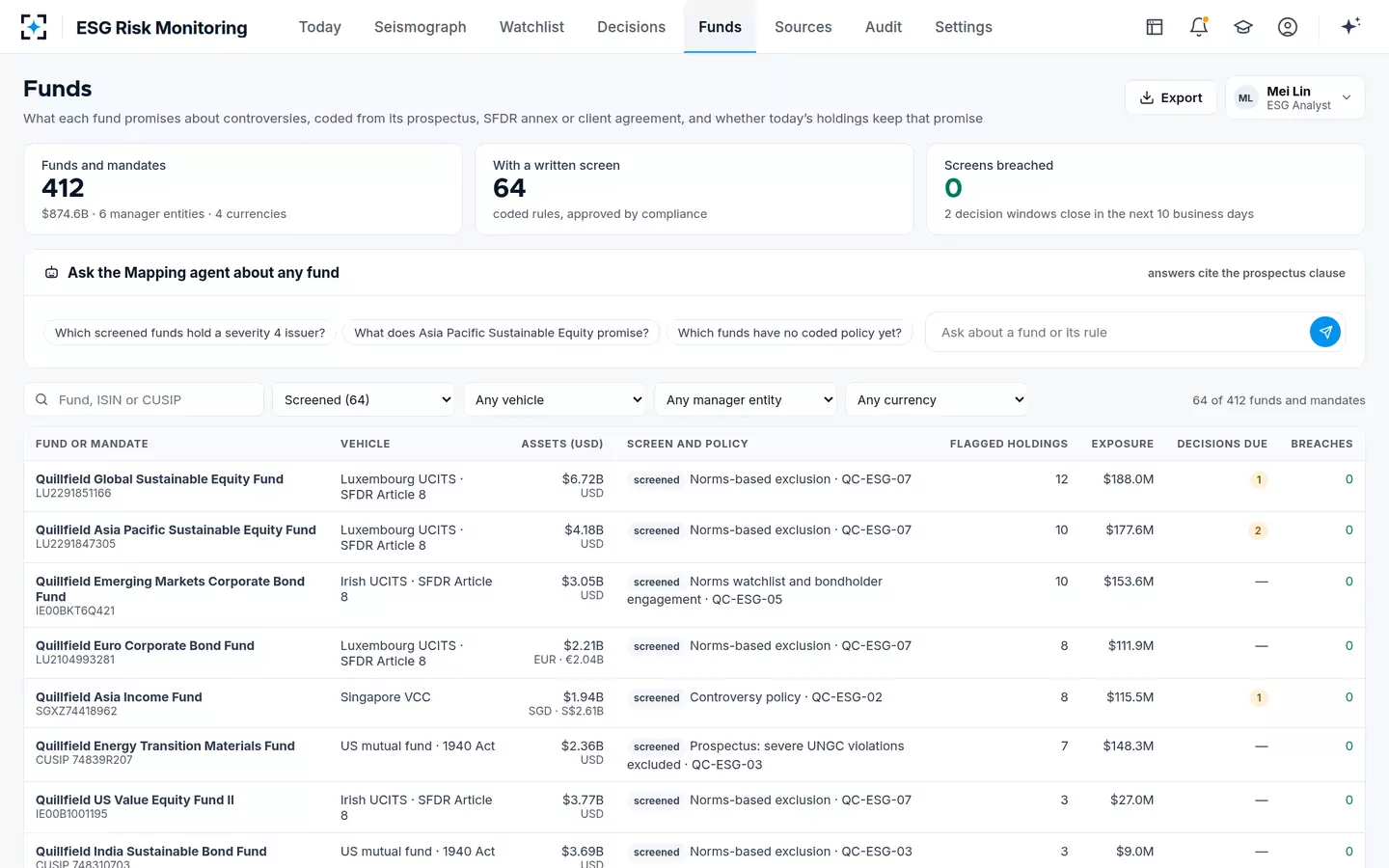
ESG Risk Monitoring runs the event side for those funds. Its Watcher agent reads news, NGO, court and regulator sources in 31 languages and matches them to issuers and subsidiaries; the Mapping agent tests each incident against each fund's coded clause and gives the deadline; an analyst decides. It does not replace the activity screen, which belongs with revenue data, and it does not code restrictions: compliance does. The full set of agents and their limits is on the ESG Risk Monitoring page.
Questions people ask
What does norms-based screening mean in ESG investing?
It means testing companies' conduct against international standards, usually the UN Global Compact's ten principles and the OECD Guidelines for Multinational Enterprises, and applying a consequence when a company breaches them: exclusion, a watchlist or engagement. The test runs on events, so it has to be watched continuously.
What is the difference between norms-based and exclusionary screening?
Exclusionary screening usually means removing whole activities, such as tobacco or coal above a revenue threshold. Norms-based screening removes or flags companies for conduct, such as forced labour or pollution found by a court. The EU benchmark exclusions combine both, which is why an ESG-named EU fund needs both screens.
Is norms-based screening part of ESG integration?
It is a separate method that often sits alongside integration. Under the SFDR, a controversy is also a sustainability risk, an event that could materially hurt the investment's value, so the same incident can feed both the screen and the risk assessment.
How often should a norms-based screen be updated?
As often as the events it tests can happen, which is any day. A quarterly or annual review suits revenue thresholds; for norms, the useful measures are how many days pass between an event's first publication and a decision, and whether any incident was decided outside its policy window.
Can a company pass a negative screen and fail a norms screen?
Yes, and often. A palm oil producer or a nickel miner earns nothing from tobacco, weapons or thermal coal and passes every activity threshold, yet a forced-labour finding or a pollution judgment can make it a UN Global Compact violator under a fund's norms screen.