PAI 10 is the SFDR principal adverse impact indicator for the "Share of investments in investee companies that have been involved in violations of the UNGC principles or OECD Guidelines for Multinational Enterprises" (Delegated Regulation (EU) 2022/1288, Annex I, Table 1). It is mandatory in the entity-level statement that managers considering principal adverse impacts publish by 30 June each year, and its figure is the average of the share on four quarter-end dates. The number looks simple. Behind it sit hundreds of judgments about individual incidents: did this event happen, is this company responsible, is it a violation, and do we hold it on 31 December? Botminds' ESG Risk Monitoring is an agentic solution that makes those judgments traceable, and this page follows one incident through every hop.
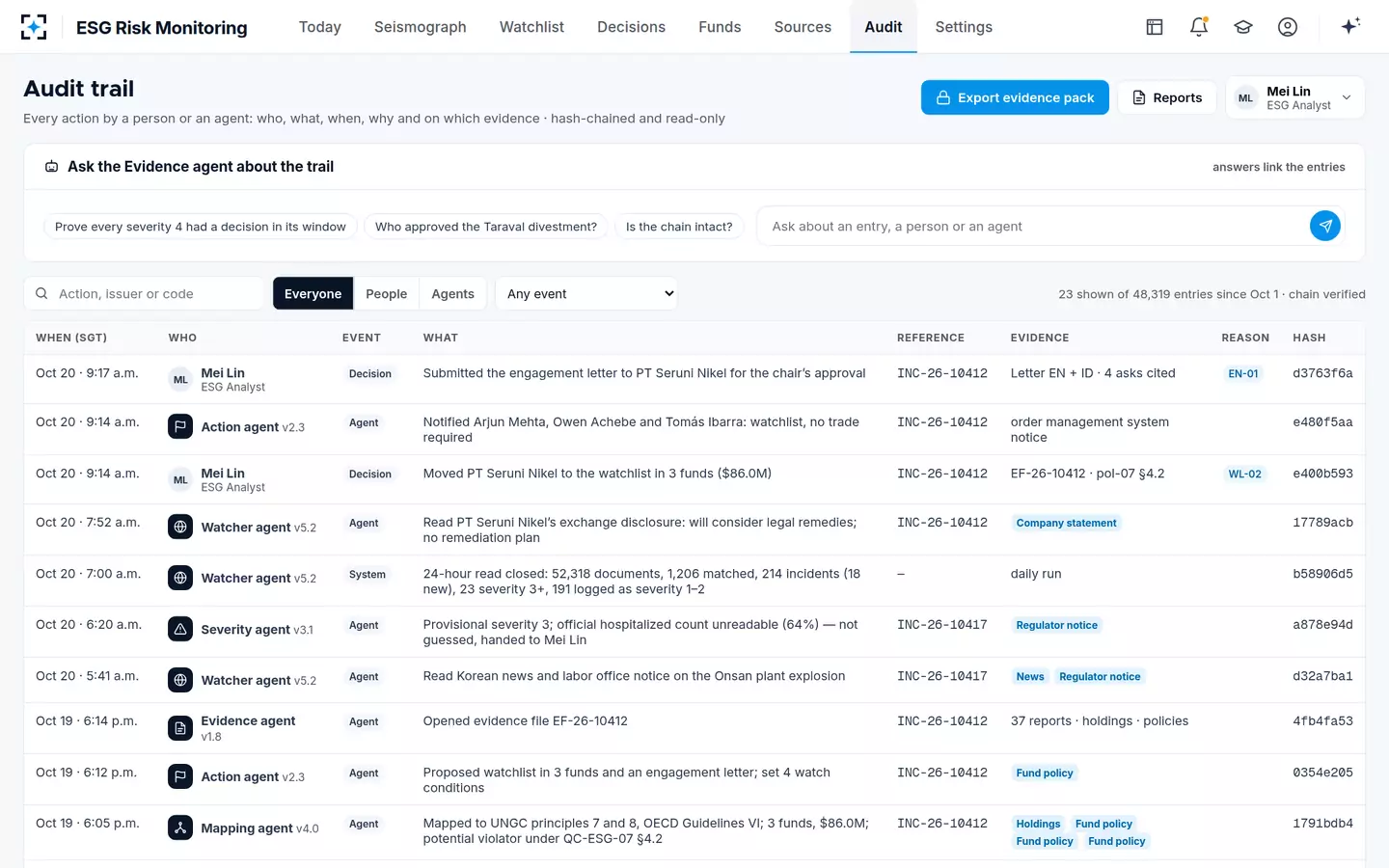
The incident is from the solution's sample data, and the firm, the company and the court case are fictional. On Monday 19 October 2026 a district court in Indonesia publishes a judgment finding PT Seruni Nikel, a nickel miner, liable for contaminating a river. Three funds of Quillfield Capital hold the company: $86.0 million of shares and senior notes.
PAI 10 under SFDR in ESG Risk Monitoring: from one ruling to one line in the statement
Agent
Read and matchThe Watcher agent reads the judgment at the court registry 11 minutes after publication and matches the defendant to the listed shares and a finance subsidiary’s notes
Never: Accepts a name-only match below 0.90 without a person
Agent
Score twiceSeverity agent and a blind Second Opinion agent both give 4 of 5, each factor cited to the ruling
Never: Settles a gap of more than one level
Agent
Map and gradeMapping agent: UN Global Compact principle 7, OECD Guidelines environment chapter; potential violator, because the judgment can be appealed
Never: Changes a fund’s policy
A person decides
DecideThe ESG analyst moves the company to the watchlist in three funds with a reason code; the chair approves the engagement letter
Agent
Snapshot at quarter-endThe Evidence agent reads holdings on 31 December and records which issuers met the firm’s PAI 10 definition that day
Never: Publishes a figure: it drafts, people sign
A person decides
Review and signAn analyst reviews the annual PAI 10 and 11 data; investment compliance signs it before publication by 30 June
What is PAI 10 under SFDR?
PAI 10 is indicator 10 of Table 1 in Annex I of the SFDR technical standards, under "Social and employee matters", titled "Violations of UN Global Compact principles and Organisation for Economic Cooperation and Development (OECD) Guidelines for Multinational Enterprises". Its metric is the share of investments in investee companies involved in such violations. It is one of 14 mandatory indicators for investments in investee companies; Table 1 adds two for sovereigns and two for real estate (Delegated Regulation (EU) 2022/1288).
The statement it appears in is published by 30 June each year and covers the previous calendar year (the SFDR reporting year sets out every date). Managers that consider principal adverse impacts publish it under Article 4 of the SFDR; those above 500 employees must (Regulation (EU) 2019/2088). Each indicator's row carries the impact for the year, the impact for the previous year, an explanation, and the actions the manager took, plans and targets for the next period.
PAI 10 and PAI 11: what each measures
The two indicators are a pair, and they measure different things. PAI 10 measures outcomes: holdings in companies involved in violations. PAI 11 measures controls: the "Share of investments in investee companies without policies to monitor compliance with the UNGC principles or OECD Guidelines for Multinational Enterprises or grievance/complaints handling mechanisms to address violations". A company can score badly on one and well on the other.
PAI 10 and PAI 11 side by side
PAI 10: Holdings in companies involved in UNGC or OECD Guidelines violations
PAI 11: Holdings in companies without compliance policies or grievance mechanisms
PAI 10: Events: judgments, orders, findings
PAI 11: Company disclosures about policies and mechanisms
PAI 10: Any day, when an incident is found to be a violation
PAI 11: Mostly when companies publish reports
PAI 10: Whether an incident is a violation, under your written methodology
PAI 11: Whether a stated policy or mechanism is adequate
PAI 10: Unresearched, not zero
PAI 11: Unknown, not compliant
How is PAI 10 calculated?
As a share of investments, measured on four dates and averaged. The standards require the year's impact figure to be the mean of the readings at the end of each calendar quarter, March, June, September and December (Article 6(3)), and define the "current value of all investments" as "the value in EUR of all investments by the financial market participant". On each date the numerator is the value of holdings in companies that meet the manager's definition of involvement in a violation; the denominator is the value of all investments.
PAI 10, term by term
Numerator, each quarter-end
Σ value of holdings in companies involved in violations
Which companies count is set by your written methodology: violators only, or also companies under a first-instance finding.
ESG analyst
Denominator, each quarter-end
Current value of all investments, in EUR
Supervisors have seen managers differ on the denominator, some excluding derivatives; state your choice and keep it.
Investment compliance
Quarterly share
Numerator ÷ denominator
On 31 March, 30 June, 30 September and 31 December, from the holdings of that day.
Evidence agent drafts
Annual impact
(Q1 + Q2 + Q3 + Q4) ÷ 4
The figure in the statement, beside last year’s and an explanation.
Compliance signs
Take the sample. Quillfield manages $874.6 billion across 412 funds and mandates. Seruni's $86.0 million is about 0.01% of that. If the firm's methodology counts companies under a first-instance judgment, and Seruni is still held on 31 December, it adds about 0.01 percentage points to the fourth-quarter share and about 0.0025 points to the annual figure. If the methodology counts only final findings, it adds nothing yet. That is our arithmetic on fictional sample data, and the lesson is not the size: it is that the methodology, not the incident, decides whether the number moves.
The decision the statement depends on: what "involved in violations" means
The regulation does not define a violation, so the manager must. The EU benchmark rule speaks of companies that administrators "find in violation" (Delegated Regulation (EU) 2020/1818, Article 12), and PAI 10 speaks of companies "involved in violations". Neither says whether a first-instance judgment, an NGO report or a regulator's preliminary order is enough. Article 7 of the technical standards then requires managers to describe their methodologies, including "how those methodologies take into account the probability of occurrence and the severity of those principal adverse impacts", "any associated margin of error", and "the data sources used" (Article 7(1)).
A defensible methodology states, in writing: which norms count; which grades of evidence make a company "involved"; whether involvement through a subsidiary or a supplier counts; and how long a company stays counted after remediation. In the solution's sample, the policy grades a first-instance judgment as a potential violator and a final judgment, or severity 5 without credible remediation, as a violator. Either choice can be defended if it is written down and applied the same way every quarter. What counts as a UN Global Compact violation covers the grading in detail.
The determination behind PAI 10, written to ESG Risk Monitoring's trail when it was made
Why the quarter-end dates change the number
Because only four days count. A violator bought on 2 January and sold on 30 March never appears in PAI 10; one bought on 30 March and sold on 2 April counts for a full quarter. The rule is there for a reason: portfolios change during the year, and the standards' recitals say the determination "should therefore be undertaken on at least four specific dates during such reference period and the average result should be disclosed on an annual basis".
Getting the dates wrong is a known error. In their 2025 review of principal adverse impact statements, national supervisors reported managers computing PAIs from year-end holdings instead of the four-quarter average (ESAs report JC 2025 26, September 2025). The practical point for monitoring is the converse: an incident found on 28 December, decided on 4 January, has already been missed for one of the four dates.
PAI 10 under SFDR in four numbers
4
Quarter-end dates averaged: 31 Mar, 30 Jun, 30 Sep, 31 Dec
30 June
Statement published, covering the previous calendar year
14
Mandatory indicators for investee companies in Table 1
500
Employees above which a manager must publish the statement
A zero is not a data point
The quickest way to a low PAI 10 is to count every unresearched company as clean, and supervisors have noticed. For indicators including 10 and 11, managers "have generally assigned a 0 to issuers/instruments when data was not available" (ESAs report, September 2025). The standards point the other way: where information is not readily available, a manager must describe what it did to get it, from asking the company and doing its own research to using data providers, outside experts or reasonable assumptions (Article 7(2)).
Monitoring is how best efforts become evidence. A company that the firm's sources were read for on every day of the year, with no incident found, is a researched zero. A company no source covered is an unknown, and the statement should be able to say how much of the portfolio is in that state. EU supervisors have also found that practice varies on what goes into the denominator, with some managers excluding derivatives (ESMA, June 2025); coverage and denominator are the two choices to write down before the first quarter-end.
What the proposed SFDR 2.0 would change for PAI 10
The Commission's proposal of 20 November 2025 would delete the entity-level principal adverse impact statement, which until now managers with more than 500 employees have had to publish (European Commission Q&A, 20 November 2025). It is a proposal: the Council adopted its negotiating mandate on 24 June 2026, Parliament's economic affairs committee adopted its report on 10 September 2026, and Parliament's plenary confirmed the decision to negotiate on 7 October 2026, so trilogues are under way (European Parliament legislative train; where SFDR 2.0 stands).
Until it becomes law, the current rules apply: the statement for 2026 is due by 30 June 2027, with PAI 10 averaged over the four quarter-ends of 2026. Even if the entity statement goes, the underlying question does not. EU funds with ESG-related names should exclude companies found in violation of the Global Compact or the OECD Guidelines, and a fund cannot apply that exclusion without the same incident-level determinations. The wider SFDR reporting work is the subject of Botminds' SFDR Reporting, whose guide to the principal adverse impact indicators traces a second indicator end to end.
The controls at each hop
Each hop has one way of going wrong, and one control that catches it. The checklist below pairs them; it is the review a compliance officer should be able to perform on any company inside the PAI 10 figure.
Seven controls between an incident and the PAI 10 line
- Read: was the first source found, and when?
A dated original, not only the article about it.
- Match: is it the company we hold?
Through identifiers and issuer hierarchies; name-only matches confirmed by a person.
- Score: was severity checked independently?
A second, blind score on serious incidents, with gaps resolved by a person.
- Grade: does it meet our definition of involvement?
Applied as written in the methodology, the same way every quarter.
- Decide: who decided, and when?
A named person, a reason code and the date, before the quarter-end that it affects.
- Snapshot: what did we hold that day?
Holdings as of the quarter-end date, with determinations as they stood that day.
- Sign: who reviewed and who signed?
A reviewer and a different signer, with every figure traceable to its incidents.
ESG Risk Monitoring is built so that each hop is done by a named agent or person and written to the audit trail as it happens; its Evidence agent drafts the PAI 10 and 11 data with every number cited to holdings and policies, an analyst reviews and compliance signs. How the minutes of the first hops add up is traced in a court ruling in 49 minutes; the agents are described on the ESG Risk Monitoring page.
Questions people ask
What is PAI 10 UNGC?
It is the SFDR principal adverse impact indicator 10: the share of investments in investee companies involved in violations of the UN Global Compact principles or the OECD Guidelines for Multinational Enterprises. It is reported as a percentage, averaged over the four quarter-ends of the calendar year.
What is the difference between PAI 10 and PAI 11?
PAI 10 counts holdings in companies involved in violations; PAI 11 counts holdings in companies without policies to monitor compliance with those norms or without grievance mechanisms. The first is driven by incidents, the second by company disclosures.
Does a company under a first-instance judgment count in PAI 10?
The regulation does not say. Your written methodology must, and Article 7 of the technical standards requires you to describe it, with its data sources and margin of error. Whichever rule you choose, apply it the same way every quarter.
When is the PAI statement due?
By 30 June each year, covering 1 January to 31 December of the previous year. For the 2026 reference period, that means by 30 June 2027, unless the proposed SFDR 2.0 becomes law and changes the obligation first.
How should missing data be treated in PAI 10?
Not as zero. Supervisors found managers assigning 0 where data was missing for indicators 10 and 11; the standards require a description of the best efforts made instead. Report how much of the portfolio was researched, and treat the rest as unknown.