The SFDR 2.0 timeline, as of late October 2026, has three dates behind it and none in front. The European Commission proposed the revised Sustainable Finance Disclosure Regulation on November 20, 2025; the Council agreed its negotiating mandate on June 24, 2026; Parliament's ECON committee adopted its report on September 10, 2026, and plenary confirmed the decision to negotiate on October 7. The trilogue phase between the three institutions was due to begin in October, and no provisional agreement has been published. The proposal would replace Articles 8 and 9 with three product categories, sustainable, transition and ESG basics, each requiring 70% of a fund's investments to follow its stated strategy, and would delete the entity-level PAI statement. It would apply 18 months after entry into force in the Commission's text and 24 months in both co-legislators' texts. Until then the current SFDR applies, and Botminds' SFDR Reporting keeps producing the current annexes while its SFDR 2.0 Mapping agent tests every fund against each version of the categories.
The mapping examples on this page come from the fictional Quillfield fund range shown as sample data in SFDR Reporting: 300 Article 8 and 9 funds run against the Commission text and the Parliament position on their September 30, 2026 holdings.
The SFDR 2.0 timeline so far: eleven months from proposal to trilogues
- Commission proposal to Council mandateNov 20 → Jun 24
- Council mandate to ECON report→ Sep 10
- Plenary→ Oct 7
After entry into force: 18 months in the Commission text, 24 in the co-legislators'
- Current SFDR, including the PAI statement, keeps applying18 months
- PAI statement deleted at once; current product rules keep applying24 months
When will SFDR 2.0 apply?
Nobody can say yet, because the regulation has not been agreed. The Commission's text says it "shall apply from [ 18 months after entry into force ]"; in the opening positions the Council secretariat circulated on October 12, 2026, the Parliament's and the Council's texts both strike 18 and write 24 (Council document 14335/26, row 361). Entry into force is twenty days after publication in the Official Journal, and publication follows a trilogue agreement and formal adoption by both institutions.
The same document holds the detail that matters most for reporting teams. Both co-legislators list Article 1(5) of the amending regulation, which reads "Articles 4 and 5 are deleted", among the provisions that would apply immediately on entry into force (row 361a). Article 4 is the entity-level PAI statement. If that survives the trilogues, the June 30 statement would end as soon as the regulation is in force, while product disclosures would stay in today's templates until the 24 months run out.
"The concrete changes coming out of a future review of the SFDR will not be applicable in the near future. Hence, it is important that NCAs remain vigilant on the supervision of the current framework and supervised entities continue applying the current provisions."
ESMA, final report on its common supervisory action on sustainability risks and disclosures, June 30, 2025
Where SFDR 2.0 stands today: the proposal, two mandates and the trilogues
The file is in interinstitutional negotiation, with three different texts on the table. The Legislative Observatory lists the Commission proposal (November 20, 2025), the vote in committee (September 10, 2026), the committee report tabled for plenary (September 15), and the committee's decision to enter negotiations "confirmed by plenary (Rule 72)" on October 7, 2026; the stage reached is "Awaiting Parliament's position in 1st reading" (Legislative Observatory, 2025/0361(COD)). The Council document setting out the three positions describes them as the institutions' positions "prior to the commencement of the trilogue phase in October 2026".
The differences between the texts are concrete, and a mapping exercise that ignores them can mis-sort funds. The Parliament's report "allows an exemption from the Art. 7 transition category exclusions" for fossil-fuel companies meeting conditions such as allocating "at least 20% of total CAPEX to Taxonomy-aligned activities"; the Council's mandate likewise says such companies "may be considered for inclusion in the transition category"; both include an opt-out for AIFs sold only to professional investors (European Parliament, Legislative Train).
SFDR 2.0 in three texts: where the Commission, Parliament and Council differ
| Point | Commission proposal | Parliament mandate | Council mandate |
|---|---|---|---|
| Application | 18 months after entry into force | 24 months | 24 months |
| Entity-level PAI statement | Deleted from the date of application | Deleted on entry into force | Deleted on entry into force |
| Taxonomy route to the 70% test | 15% Taxonomy-aligned, sustainable and transition | 20% for sustainable, 15% for transition | 15%, sustainable and transition |
| Fossil-fuel companies in transition | Excluded from transition products | Exemption with conditions, including 20% of capital expenditure Taxonomy-aligned | May be included with 20% of capital expenditure Taxonomy-aligned and a time-bound plan |
| Product-level adverse impacts | Identify and disclose, using appropriate indicators | Named indicators for sustainable products: fossil-fuel exposure, emissions, biodiversity, human-rights processes | At least three indicators from the Commission's list most relevant to the objective |
| AIFs for professional investors only | In scope | May opt out | May opt out |
Why did the Commission propose SFDR 2.0?
Because, in its own assessment, the current rules were used for something they were not designed to do and cost more than they delivered. The Commission says "the mis-use of the disclosure requirements under Articles 8 and 9 of the SFDR as de facto product categories has led to concerns of greenwashing and mis-selling of products", that disclosures are "long, complex and difficult for investors to understand and compare", and that managers "have also struggled to cope with the length and complexity of disclosure requirements" (Commission Q&A, November 20, 2025).
The evidence came from two consultations in 2023 and a call for evidence in 2025. The proposal records that 324 organisations and individuals answered the targeted consultation, and that "the majority of respondents agreed that the SFDR was currently not being used solely as a disclosure framework as intended, but also as a labelling and marketing tool" (COM(2025) 841, explanatory memorandum). The impact assessment itself had a difficult passage: the Regulatory Scrutiny Board gave "a first negative opinion" before issuing "a positive opinion with reservations on 8 October 2025", asking among other things that "the feasibility of creating reliable categories should be better evidenced". That reservation is the open question every mapping exercise is now testing fund by fund.
What are the SFDR 2.0 categories?
There are three: sustainable (new Article 9), transition (new Article 7) and ESG basics (new Article 8). The Commission describes the sustainable category as products "contributing to sustainability goals (e.g. climate, environment or social goals)", the transition category as products investing in companies or projects "that are not yet sustainable, but that are on a credible transition path", and ESG basics as "other products that integrate a variety of ESG investment approaches but do not meet the criteria of the sustainable or transition investment categories" (European Commission, Questions and answers, November 20, 2025). The categories are voluntary, but only categorised products may make sustainability-related claims in their names and marketing (COM(2025) 841, new Article 13(2)).
The order of the new articles is deliberate: the Commission says it reflects "continuity with the existing usage of, notably, Articles 8 and 9 as shorthand". It also expects the broad middle of today's market to land in ESG basics, which "can potentially include a large majority of the ESG products currently in the market".
The three SFDR 2.0 categories in the Commission text: claim, threshold, exclusions
| Sustainable (Art. 9) | Transition (Art. 7) | ESG basics (Art. 8) | |
|---|---|---|---|
| The claim it allows | Invests in sustainable companies, activities or assets, or contributes to sustainability | Invests in, or contributes to, the transition towards sustainability | Integrates sustainability factors beyond sustainability risks |
| 70% of investments must | Meet a clear and measurable objective related to sustainability factors | Meet a clear and measurable transition objective | Integrate the sustainability factors in the binding elements of the strategy |
| Deemed to meet the 70% | Tracking an EU Paris-aligned benchmark; 15% or more Taxonomy-aligned | Tracking an EU climate benchmark; 15% or more Taxonomy-aligned | None named |
| Benchmark exclusions applied | All seven of the Paris-aligned benchmark exclusions | The first four: controversial weapons, tobacco, UN Global Compact or OECD violators, hard coal and lignite | The same first four |
| Also excluded | Companies developing new fossil-fuel projects, or with no coal phase-out plan for power | Companies developing new fossil-fuel projects, or with no coal phase-out plan for power | Nothing further |
| Adverse impacts | Identify, disclose and explain actions | Identify, disclose and explain actions | Not required |
| General-purpose public debt | Does not count towards the 70% | Does not count towards the 70% | May count, with an appropriate method |
The exclusions are where an ESG-named fund of today is most likely to fail tomorrow, because the sustainable category takes all seven of the Paris-aligned benchmark tests, including the revenue thresholds for oil, gas and high-carbon power. How those seven tests are applied to holdings is set out in the Paris-aligned benchmark exclusions, test by test.
What is the 70% threshold in SFDR 2.0?
It is the minimum share of a categorised fund's investments that must follow the fund's own sustainability claim. In the Commission's words, "a minimum portion of 70% of investments by financial products in each category should be made in accordance with the sustainability-related claim"; the remaining 30% may be allocated "based on diversification, hedging or liquidity needs" but "should not contradict the sustainability-related claims of the financial product" (COM(2025) 841, recital 14).
Three details decide whether a fund passes. First, the numerator: in the sustainable and transition categories the 70% "shall not include investment in issuances by public sector bodies" unless they are use-of-proceeds instruments, so a climate fund holding 25% general government bonds starts with only 75% of its assets able to count. Second, the shortcut: a product with 15% or more Taxonomy-aligned investments is deemed to meet the 70% condition, a threshold the Commission says is attainable "by about half of the current investment funds disclosing under Article 9" (Commission Q&A). Third, the phase-in: the disclosures must describe "any applicable phase-in period for the product to reach the threshold", which matters for funds still building their portfolios.
The sample range in SFDR Reporting, run against the Commission text
224of 300
funds fit a proposed category on their September 30, 2026 holdings
171
fit ESG basics, beside 31 sustainable and 22 transition
76
funds fit no category; 63 of them have sustainability words in their names
2
funds move from sustainable to transition under the Parliament position, each 17% Taxonomy-aligned
Why funds fail the 70% test, and what the gap usually is
In the sample range the most common reason a fund fits no category is the denominator, not the strategy. Funds whose ESG approach covers their equities fail because cash, derivatives and general government bonds sit outside the 70%. The screen below shows Asia-Pacific funds at 56% to 67% against the 70% line, with the agent's reason on each row.
Every fund against the 70% test in SFDR Reporting, under either text
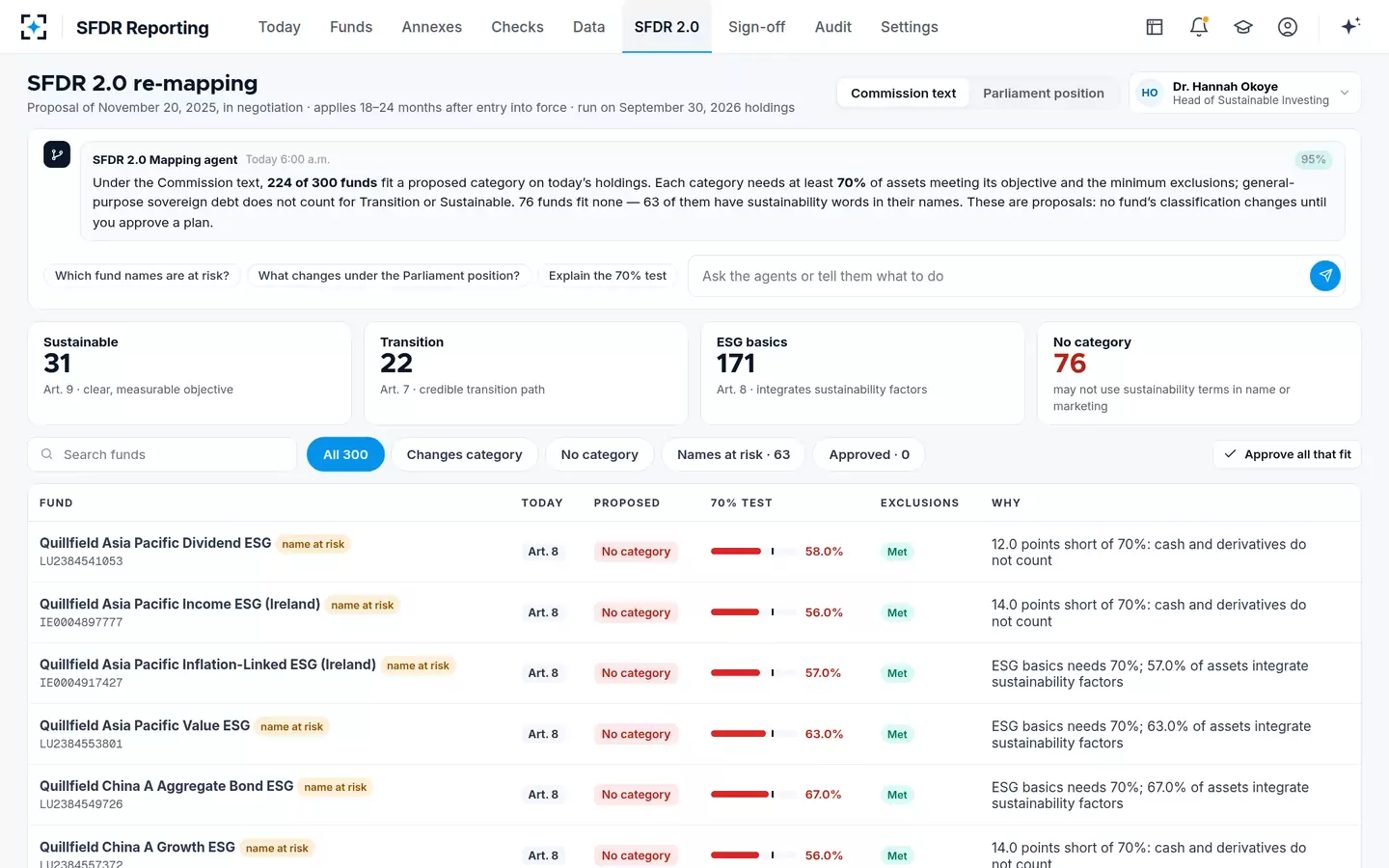
Some gaps are fixed by reallocating the 30% sleeve; others need a change to the strategy that the board has to approve, and those take a prospectus update. The earlier a range is mapped, the more of the fixes fall into the first group. The mapping also has to be re-run on each text: on the sample range, the Parliament's 20% Taxonomy route moves two funds out of the sustainable category without any change in what they hold.
What disappears in SFDR 2.0: the entity PAI statement, Article 2(17) and the long templates
Three things the reporting team builds today would go. The entity-level PAI statement is deleted: "the requirement for Financial Market Participants (FMPs) to publish and maintain on their website where they consider principal adverse impacts of investment decisions on sustainability factors is deleted, including the corresponding templates" (Commission Q&A). The definition of sustainable investment in Article 2(17) is deleted, its concepts moved into the category criteria. And Delegated Regulation 2022/1288, with its Annex II to V templates, is repealed, replaced by category templates the Commission would specify that "shall not exceed two pages" (new Article 19b).
What stays is the work underneath. Sustainable and transition products must still identify and disclose their investments' principal adverse impacts (how each text treats PAI reporting), and every categorised product must report each year "the extent to which the applicable objectives are met" against its chosen indicators (new Articles 7, 9 and 11). A new Article 12a asks managers to base external data on "formalised and documented arrangements" and their own estimates on "formalised and documented methodologies". What the PAI work costs now, and what the proposal would save, is priced in a separate guide.
How to plan for SFDR 2.0 without an application date
Plan by fund, not by date. The legal work cannot start until the text is final, but the analysis can: which category each fund could claim, what blocks it, which names would have to change, and which of those changes need a board decision. Every one of those answers depends on holdings that change each quarter, so the useful output is a re-runnable map, not a one-off memo.
An SFDR 2.0 readiness checklist that does not depend on the final date
- Map every fund to a category under each text
Commission, Parliament and Council differ on the Taxonomy route, fossil-fuel companies and public debt; a fund can pass under one and fail under another.
- Compute the 70% test with the denominator the text uses
Show what counts in the numerator, what does not, and why, per fund and per quarter-end.
- Run the category exclusions on current holdings
The sustainable category takes all seven benchmark exclusions plus new fossil-fuel projects.
- List the names at risk
Only categorised products may make sustainability claims in names and marketing; a fund with no category and an ESG word in its name needs a decision.
- Separate fixes the team can make from fixes the board must approve
Reallocating cash is an operational change; changing the strategy is a prospectus change with its own timetable.
- Keep the current annexes and the June 30 statement running
Nothing changes until the new rules apply, and the entity statement may end before the product rules change.
- Re-run the map at every quarter-end and after each trilogue text
Holdings move and texts move; a map dated once is out of date by the next board.
In SFDR Reporting this is the SFDR 2.0 Mapping agent's job, and its limits are written in: it never changes a fund's current classification, and every category it proposes waits for the head of sustainable investing. The Commission's own impact assessment found the cost of building categories hard to pin down, with initial one-off costs "starting as of EUR 30 000" for a single manager and others suggesting "EUR 500 000" at the top of the range (Commission impact assessment SWD(2025) 838), which is one more reason to know early how many funds need work.
To see a fund range mapped under each text, with the 70% test, the exclusions and the reason for every gap, start from SFDR Reporting; for the current-law question of which article applies today, see SFDR Article 8 vs 9.
Questions people ask
What is SFDR 2.0?
It is the name used for the European Commission's proposal of November 20, 2025 to amend the Sustainable Finance Disclosure Regulation, procedure 2025/0361(COD). It replaces Articles 8 and 9 with three voluntary product categories, deletes the entity-level PAI statement and the definition of sustainable investment, and repeals Delegated Regulation 2022/1288. It is still being negotiated.
Has SFDR 2.0 been adopted?
No. As of late October 2026 the Council has its mandate (June 24, 2026), Parliament's plenary has confirmed the committee's decision to negotiate (October 7, 2026), and the trilogue phase was due to begin in October. No provisional agreement has been published, so the current SFDR and its templates still apply.
What exclusions apply in the SFDR 2.0 categories?
In the Commission text, transition and ESG basics products exclude the first four Paris-aligned benchmark exclusions: controversial weapons, tobacco, UN Global Compact or OECD Guidelines violators, and companies with 1% or more of revenue from hard coal and lignite. Sustainable products exclude all seven, adding oil, gas and high-carbon power thresholds. Transition and sustainable products also exclude companies developing new fossil-fuel projects.
Does SFDR 2.0 keep principal adverse impact reporting?
At product level, yes for the sustainable and transition categories, which must identify and disclose principal adverse impacts and the actions taken. The Council would require at least three indicators most relevant to each product's objective, and Parliament names specific indicators for sustainable products. At entity level, the statement is deleted.
What happens to a fund that fits no category?
It may still describe how it considers sustainability factors, but only as a secondary element: the Commission text limits that information to "less than 10% of the volume" of the description of the investment strategy, and bars sustainability claims in the fund's name and marketing.
How long will funds have to adapt?
The Commission proposes 18 months after entry into force; the Parliament and Council texts both say 24. Insurance-based and pension products get a further 12 months in the Commission text, because they are not covered by ESMA's fund-name guidelines and need more time for the exclusions.