PAI reporting for asset managers costs the EU market about EUR 56 million a year in recurring costs for the entity-level statement alone, out of EUR 246 million for all SFDR disclosure, according to the European Commission's impact assessment of November 2025. The statement is mandatory for managers averaging more than 500 employees, about 400 firms on the Commission's count, and roughly 1,200 smaller ones publish voluntarily. The Commission's SFDR 2.0 proposal would delete it, and both the Parliament and Council negotiating texts would make that deletion apply as soon as the amending regulation enters into force. But the adverse-impact data does not go away: funds in the proposed sustainable and transition categories would still have to identify and disclose their principal adverse impacts. The decision for a COO or head of product is therefore not whether to spend on the PAI statement, but how to price the per-fund adverse-impact work that every version of the rules keeps. Botminds' SFDR Reporting computes both from the same holdings and data, which is the honest basis for that price.
The cost figures below are the Commission's own estimates, quoted from its impact assessment; the product examples are sample data from SFDR Reporting on a fictional manager, Quillfield Asset Management.
What SFDR disclosure costs the EU market each year, and once, by layer
What does PAI reporting cost an asset manager?
On the Commission's estimate, the market spends EUR 56 million a year on entity-level PAI disclosure, about 25% of SFDR's recurring disclosure cost, and spent EUR 120 million once to set it up. The impact assessment says entity-level disclosures represent "around 25% of the overall costs linked to disclosures" and "an annual total of EUR 56 million", while product-level disclosures are "around 75 % of the overall annual recurring costs" and "an annual total of EUR 190 million" (SWD(2025) 838).
The method matters for how far a single firm can lean on those numbers. The Commission collected "a sample of costs (N=17)" from consultation replies, fitted a cost function of assets under management, applied it to every fund in a commercial fund database and summed the results. It is a sound order of magnitude for the market and a weak guide for any one manager, whose cost depends on its fund count, data contracts and languages more than on its assets.
What the estimate does show clearly is scale. The Commission found "strong fixed cost degression effects, meaning that large financial market participants spend significantly lower percentages of their AUM on SFDR disclosures": on average, a tenfold increase in assets under management cut disclosure costs as a share of assets by about two-thirds, 67% in the Commission's calculation. The PAI statement does not shrink with the balance sheet: the template, the 18 indicators and the four quarter-end runs are the same for a small manager as for a large one.
Who pays SFDR's recurring cost: smaller managers carry most of it
Entity-level PAI, EUR 56m a year
- Managers with EUR 25bn or less, EUR 43m · 77%
- Larger managers, EUR 13m · 23%
Product-level, EUR 190m a year
- Managers with EUR 25bn or less, EUR 120m · 63%
- Larger managers, EUR 70m · 37%
Who needs to publish a PAI statement?
Every financial market participant that exceeds "the criterion of the average number of 500 employees during the financial year", and every parent of a large group that exceeds it on a consolidated basis, must publish one by June 30 (SFDR, Article 4(3) and (4)). Others choose: publish in the same template, or explain clearly why they do not consider adverse impacts and whether they intend to. The Commission counts "approximately 400 FMPs reporting on a mandatory basis (i.e. more than 500 employees) and 1200 doing so on a voluntary basis".
Why is the 500-employee threshold criticised?
Because headcount says little about how much a manager's investments harm anything. The employee test has drawn criticism from the supervisors who apply it. One national authority told the ESAs it "found it challenging to verify that financial market participants had more than 500 employees", and the ESAs recommended that the Commission consider other ways of introducing proportionality, since "the ‘more than the 500-employees’ threshold may not be a meaningful way to measure the extent to which investments may have principal adverse impacts on sustainability factors", suggesting instead "a threshold based on the total amount of the FMP's investments" (ESAs, JC 2025 26, paragraph 21 and section 4.1).
The PAI statement in four numbers
~400
managers must publish, having more than 500 employees on average
~1,200
smaller managers publish voluntarily
3.2/ 5
supervisors' average score for how managers quantify actions taken, the weakest element
52%
of consultation respondents said the SFDR should not set entity-level disclosures at all, or not really
Where the PAI cost goes inside one manager
Most of the cost sits in data and calculation, not in the template. The statement needs, for each of 18 mandatory indicators and the chosen extras, an impact averaged over four quarter-ends (Delegated Regulation 2022/1288, Article 6(3)), last year's figure, an explanation, the actions taken and planned, the policies with "any associated margin of error", the data sources, the engagement policies, the international standards followed and a comparison with up to five earlier periods.
Each element has its own cost driver. Data costs grow with the number of issuers and the indicators a vendor does not cover; calculation costs with the number of funds and mandates whose quarter-end positions must be rebuilt; review costs with how many values are estimated rather than reported; and narrative costs with how seriously the "actions" column is taken. Supervisors have been blunt about that last one: "the quantification of actions taken in the PAI statement was the weakest area overall", with managers offering "general statements such as 'will continue to monitor'" (ESAs, JC 2025 26, paragraphs 72 and 73). A statement that does the actions column properly costs more than the market average, and is the one that survives supervisory review.
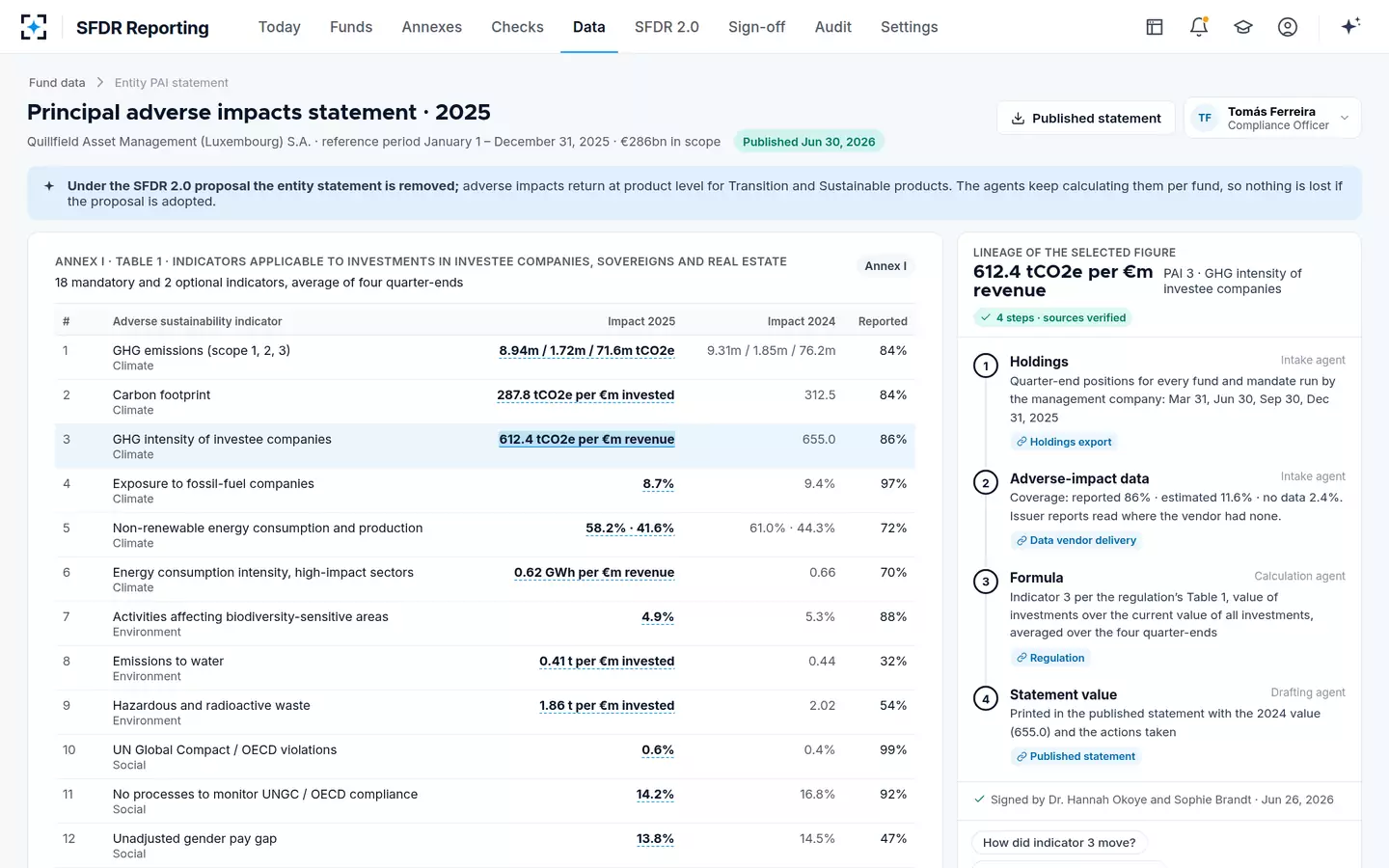
No regulator or independent study publishes a per-manager breakdown, so the useful number is the one a firm measures itself: hours and data spend per indicator per fund for one reporting year, split between reported and estimated values. How one PAI number is built, hop by hop, shows where those hours go.
One manager's 2025 PAI statement in SFDR Reporting, every value with its lineage
Will the PAI statement be removed under SFDR 2.0?
The Commission proposes it, and both co-legislators agree; it is not yet law. The proposal says the requirement to publish entity-level PAI disclosures "is deleted, including the corresponding templates", and puts the saving at "25%, equivalent to €56 million in recurring annual savings" (European Commission, Questions and answers, November 20, 2025). Its stated reason is overlap with corporate reporting: "In the future, only the largest Financial Market Participants, subject to the updated thresholds under the CSRD, will need to disclose their company-level impacts on the environment and society."
When the entity-level PAI statement would end, in each negotiating text
| Text | Entity PAI statement | Everything else | Product-level adverse impacts |
|---|---|---|---|
| Commission proposal, November 20, 2025 | Deleted from the date of application | 18 months after entry into force | Sustainable and transition products identify and disclose them |
| Parliament mandate | Deleted on entry into force | 24 months after entry into force | Named indicators for sustainable products: fossil-fuel exposure, emissions, biodiversity, human-rights processes |
| Council mandate | Deleted immediately following entry into force | 24 months after entry into force | At least three indicators most relevant to the product's objective |
For the 2027 budget, that means two scenarios, not one. If an agreement is reached and published quickly, the June 30 statement could stop within months while the current product templates carry on for two more years. If not, the June 30, 2027 statement for calendar 2026 is due as normal. A manager that has priced the statement as a separate project has to keep two plans; one that prices the underlying per-fund data work needs only one.
What would SFDR 2.0 save, and what would it cost?
The Commission puts the savings at EUR 56 million a year from deleting entity-level disclosures and "at least EUR 55 million" a year from slimmer product disclosures; for the new categories it says it was "unable to collect sufficient quantitative evidence to estimate the costs with a sufficient degree of statistical confidence" (SWD(2025) 838). Its cost table shows how thin the evidence is: for managers with EUR 25 billion or less, the one-off cost of moving to the reduced product disclosures is put at EUR 336 million, "(+170%; N=1)", and the one-off cost of categorisation at EUR 246 million, "(+150%, N=2)", each resting on one or two responses.
For a single manager, the honest reading is that the recurring saving is reasonably well evidenced and the transition cost is not. A firm that already computes per-fund adverse-impact data, tests each fund against its promises and can re-run a category mapping is buying the transition at the lowest cost it can; one that rebuilds those steps for the new templates pays the unknown part of the Commission's table.
Does SFDR 2.0 keep product-level PAI?
Yes, for the sustainable and transition categories in every text. The Commission's new Articles 7 and 9 require those products to "identify and disclose the principal adverse impacts of their investments on sustainability factors, and explain any actions taken to address those impacts", and the Council would require "at least three indicators" most relevant to each product's objective (COM(2025) 841; Council document 14335/26). The proposal also asks managers to base data from external providers on "formalised and documented arrangements" and their own estimates on "formalised and documented methodologies" (new Article 12a).
The data itself may get harder to find, not easier. The Omnibus directive of February 24, 2026 narrowed corporate sustainability reporting to companies with more than EUR 450 million of net turnover and more than 1,000 employees (Directive (EU) 2026/470), so fewer investee companies will publish the figures PAI indicators need, and more values will be estimates. A per-fund adverse-impact process that records which values are reported and which estimated is the part of today's spend that carries forward.
How to price PAI work that survives SFDR 2.0
Price the unit that every text keeps: one fund's adverse-impact figures for one reporting year, with their coverage. The entity statement is then a roll-up of numbers that already exist, not a second project. SFDR Reporting is built that way: on the sample firm the agents compute each fund's indicators from quarter-end holdings and the same issuer data, and the entity statement aggregates them across every fund and mandate the management company runs.
A pricing checklist for PAI reporting, now and after SFDR 2.0
- Count the units: funds, mandates and quarter-ends
Calculation effort follows the number of portfolios rebuilt four times a year, not assets under management.
- Split data spend by indicator and coverage
Know what you pay for values vendors estimate, and how many your issuers publish themselves.
- Measure review hours per estimated value
Estimated and low-confidence values drive review time; reported ones rarely do.
- Cost the actions column honestly
Supervisors scored quantified actions lowest; a credible column needs portfolio-manager input, not boilerplate.
- Separate statement-only work from per-fund work
Summaries, translations and the entity narrative may end with SFDR 2.0; per-fund indicators and data do not.
- Plan both scenarios for the June 30, 2027 statement
Deletion on entry into force is in both co-legislators' texts, but nothing is agreed.
- Keep documented data arrangements and estimation methods
Proposed Article 12a would make them a requirement; supervisors already ask for them.
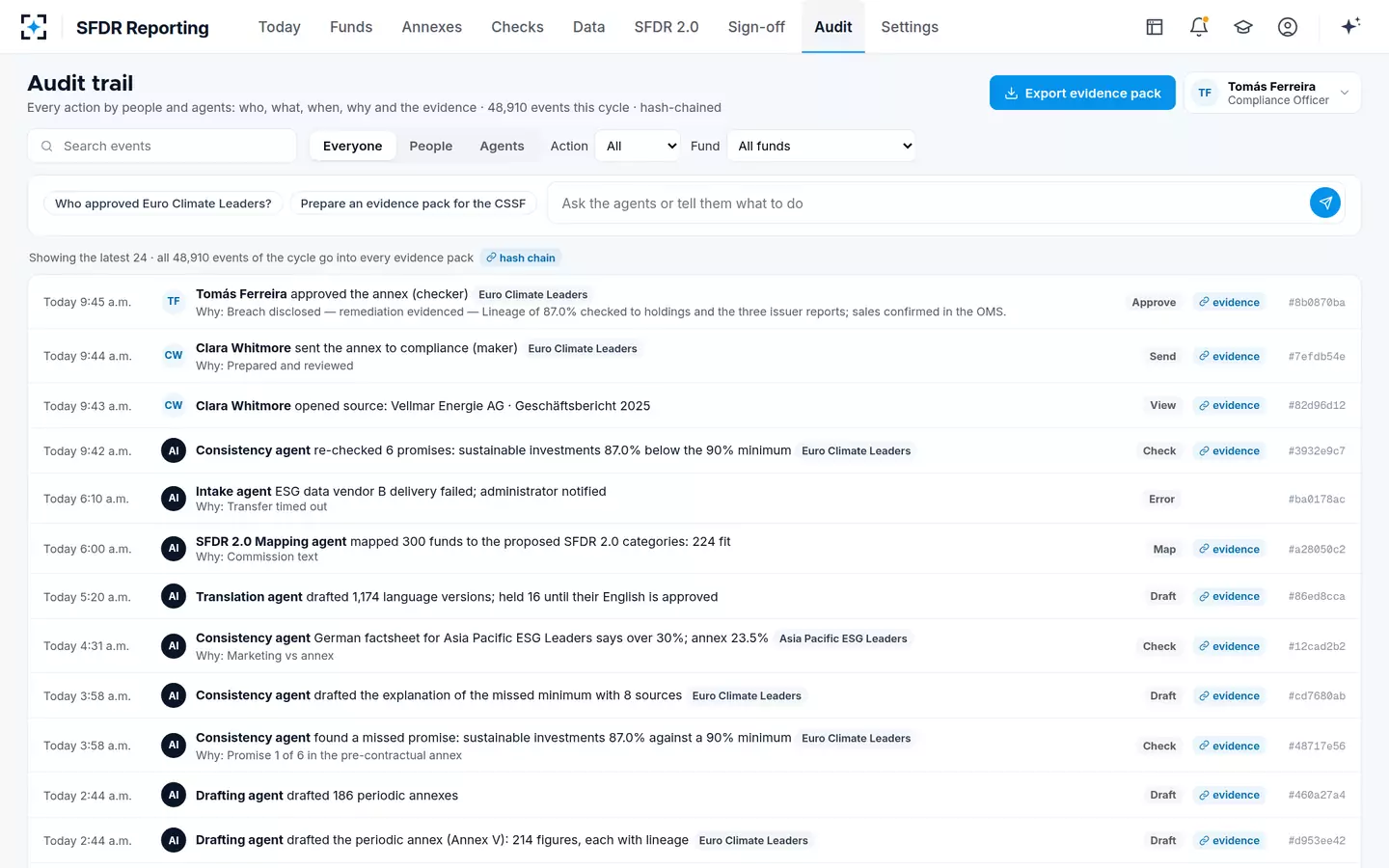
In SFDR Reporting the design targets are 100% of figures traced to holdings, method and source page, and five working days from the data cut to every annex drafted and checked. Every action is on a hash-chained trail, so the evidence for each PAI figure is exported rather than reassembled when a supervisor asks.
Every action by people and agents in SFDR Reporting, ready for an auditor
For the timetable that decides which scenario applies, see where SFDR 2.0 stands; to see the per-fund and entity figures computed from one set of holdings, start from SFDR Reporting.
Questions people ask
What do SFDR compliance costs add up to?
The Commission estimates EUR 246 million a year in recurring disclosure costs across the EU market, EUR 56 million at entity level and EUR 190 million at product level, plus one-off costs already spent of EUR 120 million and EUR 380 million. The estimate rests on 17 cost observations scaled to the market by assets under management.
Is the PAI statement mandatory for firms with 500 employees?
It is mandatory for firms that exceed an average of 500 employees during the financial year, and for parents of large groups exceeding that number on a consolidated basis. A firm at or below the threshold may publish voluntarily in the same template or explain why it does not consider adverse impacts.
Is there a PAI statement template?
Yes: Table 1 of Annex I of Delegated Regulation 2022/1288, with sections for the summary, the description of principal adverse impacts with the indicator table, policies, engagement, international standards and historical comparison. Supervisors treat deleting sections, such as the sovereign and real-estate rows, as a deviation from the template.
How much would SFDR 2.0 save?
The Commission estimates EUR 56 million a year from deleting entity-level disclosures, and at least EUR 55 million a year from slimmer product disclosures. It could not estimate the cost of the new categories with confidence; its table of one-off costs for them rests on one or two responses.
Do smaller managers pay more for SFDR?
Relative to their assets, yes. The Commission found large managers spend a much smaller share of assets on SFDR disclosure, and estimates that managers with EUR 25 billion or less of assets bear EUR 43 million of the EUR 56 million entity-level cost and EUR 120 million of the EUR 190 million product-level cost.
Should we stop preparing the next PAI statement?
No. Until an amending regulation is adopted and in force, the obligation stands, and the statement for calendar 2026 is due by June 30, 2027. The per-fund data behind it is needed under every version of SFDR 2.0 for sustainable and transition products.