The sustainable investment definition under SFDR is Article 2(17) of Regulation (EU) 2019/2088: an investment in an economic activity that contributes to an environmental or social objective, "provided that such investments do not significantly harm any of those objectives and that the investee companies follow good governance practices". The definition names the three tests but not how to run them. The Commission has confirmed that "the SFDR does not set out minimum requirements that qualify concepts such as contribution, do no significant harm, or good governance", so each manager writes its own method, and the share of sustainable investments it reports for a fund is the product of that method as much as of the holdings. That is why two managers holding the same stocks can report very different shares, and why supervisors and the Commission now treat the definition as a problem to be removed. Botminds' SFDR Reporting does not choose the method; it applies the one the firm has approved, version by version, to every holding at every quarter-end, and keeps the reason each holding passes or fails beside the source that decided it.
Examples marked as sample data come from a fictional firm in SFDR Reporting whose methodology, version 3.2, sets the contribution test at 20% of revenue from sustainable activities. The illustrative portfolio further down is our arithmetic, built to show the effect of the method alone.
One company, two methods: is it a sustainable investment?
Method A: the whole company counts if it passes: A rail-equipment maker with 25% of revenue from low-carbon rail systems; it passes the no-harm and governance tests.
Method B: only the contributing activity counts: The same company, the same tests.
Method A: the whole company counts if it passes: Passes if at least 20% of revenue contributes to an environmental objective.
Method B: only the contributing activity counts: Measures the contributing share of revenue, here 25%.
Method A: the whole company counts if it passes: EUR 10 million of sustainable investment (100%).
Method B: only the contributing activity counts: EUR 2.5 million of sustainable investment (25%).
Method A: the whole company counts if it passes: Nothing counts: the company fails the threshold.
Method B: only the contributing activity counts: EUR 1.4 million still counts.
Method A: the whole company counts if it passes: The Commission: sustainable investment "can therefore also be measured at the level of a company".
Method B: only the contributing activity counts: The definition speaks of "an investment in an economic activity", which the Commission reads as targeting specific activities.
What is a sustainable investment under SFDR?
It is an investment that passes three tests at once. Article 2(17) defines it as "an investment in an economic activity that contributes to an environmental objective, as measured, for example, by key resource efficiency indicators" or "an investment in an economic activity that contributes to a social objective", "provided that such investments do not significantly harm any of those objectives and that the investee companies follow good governance practices, in particular with respect to sound management structures, employee relations, remuneration of staff and tax compliance" (SFDR, Article 2(17)).
Everything after "contributes" is an open question the regulation leaves to the manager. What counts as contributing, how much harm is significant, which governance failures disqualify a company: the Commission's answer is that managers "must carry out their own assessment for each investment and disclose their underlying assumptions", a "policy choice" that "gives financial market participants an increased responsibility towards the investment community and means that they should exercise caution" (ESAs consolidated Q&A, answer II.2, Commission interpretation of April 6, 2023).
Can a whole company be a sustainable investment?
Yes, if the manager's method says so and discloses it. Asked about general equity or debt that does not fund a specific activity, the Commission said the reference to economic activities "seems to target cases in which funds are allocated to a specific project or activity", but because funds can invest in a company's general equity or debt, "the notion of sustainable investment can therefore also be measured at the level of a company and not only at the level of a specific activity" (Q&A II.1).
That one sentence explains much of the spread between managers. A manager that counts the whole company once it clears a revenue threshold will report a far higher share than one that counts only the contributing revenue, from the same holdings. Both are lawful if disclosed. They cannot both be compared with each other as if they measured the same thing.
One illustrative fund, three lawful methods, three shares of sustainable investment
What did supervisors find when they looked at the methods?
They found as many methods as managers. In ESMA's common supervisory action, national authorities "reported that managers developed their own criteria for sustainable investments under Article 2(17) SFDR (covering exclusions, maximum thresholds, good governance, adherence to good standing principles, external service provider ratings), leading to a variety of different strategies applied, which is not surprising given the discretion allowed under SFDR" (ESMA CSA final report, June 30, 2025, paragraph 62).
The variety reached the arithmetic. ESMA observed "some different calculation methods for sustainable investments ... especially with regard to the coverage of investments in the denominator", and noted that the ESAs had suggested, in non-binding draft standards, a way to calculate the share (paragraph 68). The thresholds behind the tests were usually invisible: managers' no-harm models used Table 1 indicators, but "the thresholds used are generally not disclosed" (paragraph 63).
What supervisors and the Commission say about the definition
0
minimum requirements in the SFDR for contribution, no significant harm or good governance, the Commission says
1
interpretation of Article 2(17) per manager: it may not differ between the manager's products
14
mandatory Table 1 indicators for companies, every one of which must be taken into account in the no-harm test
What is the DNSH test under SFDR?
The "do no significant harm" test asks whether a sustainable investment harms any environmental or social objective, and SFDR requires the principal adverse impact indicators to be part of the answer. The periodic annex must explain "how the indicators for adverse impacts in Table 1 of Annex I, and any relevant indicators in Tables 2 and 3 of that Annex, were taken into account" (Delegated Regulation 2022/1288, Article 51(d)(i)), and ESMA is explicit that "indicators from Table 1 of Annex I of the SFDR Delegated Regulation cannot simply be left out of the DNSH disclosures" (ESMA CSA, paragraph 73).
Two traps recur. Missing data is not a pass: ESMA recorded as non-compliance an Article 9 fund that said green-bond issuers shared too little information to run the test, because, in ESMA's words, "Lack of information is not a reason to fail to comply with the DNSH principle" (Example 12). And a future plan is not a pass either: the Commission says that referring to a transition plan aiming to avoid harm in the future "could for instance not be considered as sufficient" (Q&A II.2). In practice, ESMA found, managers mostly use "exclusion criteria, analysis of controversies and the degree of alignment with the major international treaties" (paragraph 72).
What is the good governance test in SFDR?
It asks whether the investee company follows good governance practices, "in particular with respect to sound management structures, employee relations, remuneration of staff and tax compliance"; the regulation names the areas but not the standard. The ESAs say the use of reference frameworks such as the UN Global Compact, OECD or ILO principles "is not prescribed, but could form part of the 'policy to assess'" governance (Q&A V.13). ESMA found "the most common strategy is to exclude companies in breach of international norms" (ESMA CSA, paragraph 71).
What the method must settle is time. ESMA criticised Article 8 funds that never said how long, or past what level of breach, engagement with a non-compliant company could go on before exclusion (Example 14). A good-governance test without a clock lets a company stay sustainable for as long as an engagement continues.
The three tests: what the law fixes, what managers decide, and one firm's setting
| Test | Fixed by the rules | Left to the manager | Sample firm, methodology v3.2 |
|---|---|---|---|
| Contribution | An economic activity contributing to an environmental or social objective | Which activities count; revenue, capital expenditure or other measure; company or activity level; threshold | At least 20% of revenue from sustainable activities; whole holding counts |
| Do no significant harm | Table 1 indicators, and relevant Table 2 and 3 indicators, taken into account | Which limits on each indicator mean significant harm; how missing data is handled | Defined in section 4.2 of the method; a failure removes the holding from the share |
| Good governance | Management structures, employee relations, remuneration, tax compliance | Which breaches disqualify; how long engagement may run before exclusion | Formal notices and controversy flags reviewed; a failure removes the holding |
Can one manager use two methods?
No. The ESAs' answer is that a manager may create "their own framework for their financial products as long as they adhere to the letter of Article 2(17) SFDR", but "should not, however, interpret Article 2(17) SFDR differently for different financial products that it makes available" (Q&A V.16). ESMA's supervisors still found it: two funds at one manager, both committed to at least 51% Taxonomy-aligned investments, whose sustainable-investment shares were "calculated differently for the two funds, so that they are not disclosed in a comparable manner" (ESMA CSA, Example 11).
The rule has a practical consequence for how a methodology is kept. If it can change, every change applies to every fund at once, and the periodic annexes that compare this year's share with last year's have to say what changed. In SFDR Reporting the methodology is a versioned setting: version 3.2 applies from February 1, 2026, versions 3.1 and 3.0 stay on file, and a change takes effect only when a second person approves it.
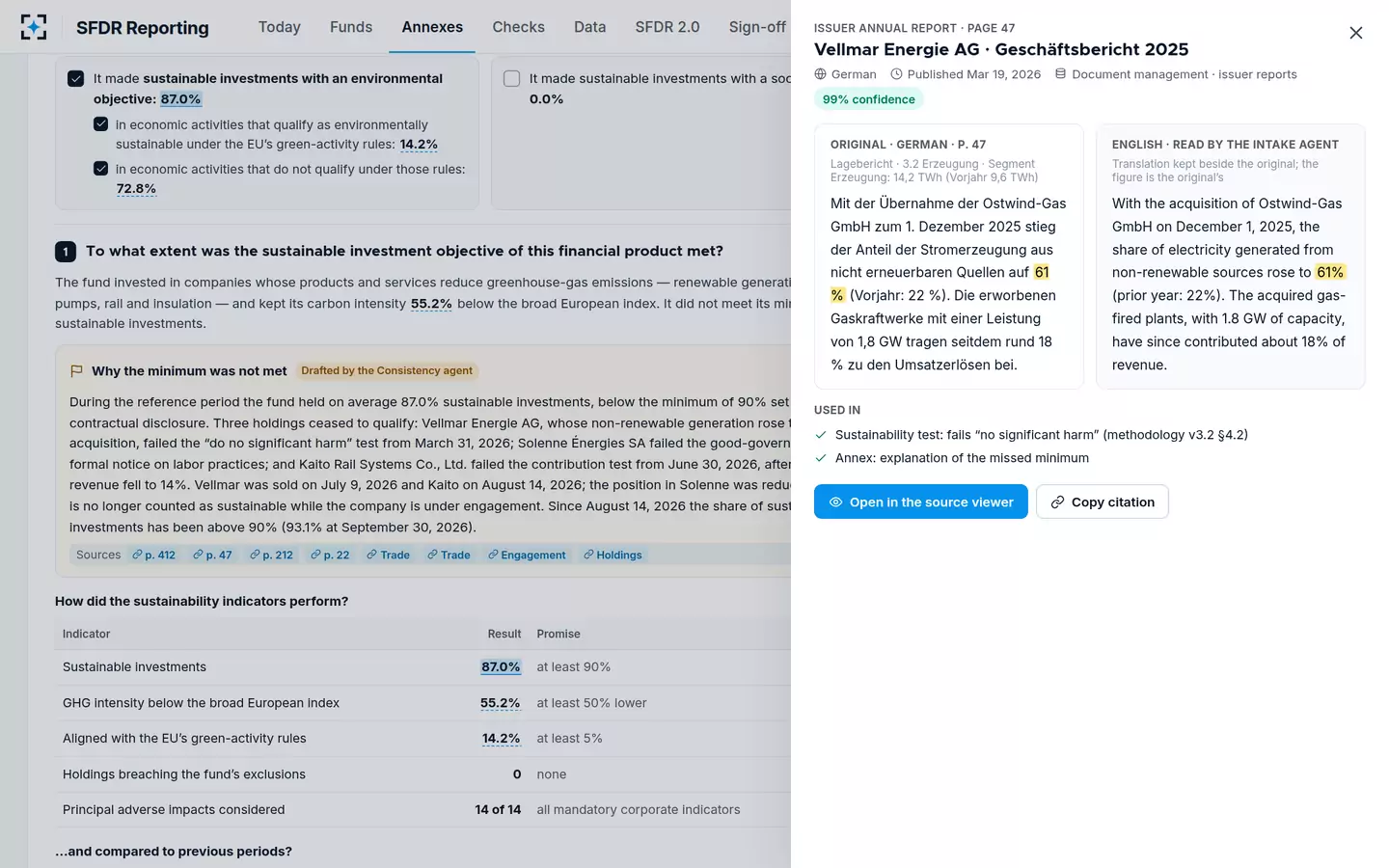
One holding failing one test in SFDR Reporting, with the issuer's page that decided it
The definition of sustainable investment "has generated a considerable number of practical implementation challenges and concerns, queries to supervisors about interpretation and their expectations, and wide divergence in practical application."
European Commission, proposal COM(2025) 841, recital 8, November 20, 2025
Is the sustainable investment definition deleted in SFDR 2.0?
In the Commission's proposal, yes. Article 2, point (17) is deleted, and "the concepts of contribution to an environmental and social objective, of do not significant harm, and of good governance practices should continue to be reflected in the criteria" of the new categories (COM(2025) 841, recital 8 and Article 1(2)(e)). The Commission says the definition "had given rise to diverse interpretations and implementation challenges in practice" (Commission Q&A). The proposal is still in negotiation, so Article 2(17) and the shares calculated under it remain in force.
Its deletion would not end the method question; it would move it. The proposed categories require 70% of investments to meet the product's objective, measured "using appropriate sustainability-related indicators", with the methods to calculate the threshold left to delegated acts. Distributors would also need new reference points, because MiFID sustainability preferences today ask clients for "a minimum proportion" of investments "as defined in Article 2, point (17)" (Delegated Regulation 2021/1253). The SFDR 2.0 categories and the 70% test are covered in their own guide; how the definition decides Article 8 or Article 9 in another.
How SFDR Reporting applies one method to every fund
SFDR Reporting's Sustainability Test agent applies the approved methodology to every holding at each quarter-end, contribution, no significant harm and good governance, and explains each pass or fail with its sources. It never overrides a vendor flag without a person and never re-classifies a fund. On the sample Article 9 fund, three holdings stopped qualifying during the year, one on each test, which is why its average share of sustainable investments was 87.0% against its 90% minimum; 57 of its 64 holdings qualified at June 30.
Because the method is one setting for the whole firm, the result is comparable across funds by construction, and a change of method is a dated, approved event that every annex can explain. That is the control ESMA found missing, and it is what makes a share of sustainable investments a measurement rather than a choice. To see the test run on sample funds, start from SFDR Reporting.
Questions people ask
What does SFDR sustainable investment mean in plain words?
An investment in an activity that helps an environmental or social objective, that does not seriously harm any other such objective, in a company with good governance. All three must hold, and the manager decides, and must disclose, how it measures each one.
Does the SFDR set a revenue threshold for contribution?
No. The Commission has said the SFDR sets no minimum requirements for contribution, no significant harm or good governance. Managers set their own thresholds, and ESMA found the most common approach is a minimum share of revenue contributing to the UN Sustainable Development Goals.
Is a Taxonomy-aligned investment a sustainable investment?
The Taxonomy Regulation says investments in environmentally sustainable economic activities are included among sustainable investments, and the periodic templates report Taxonomy-aligned investments as a subset of them. A sustainable investment does not have to be Taxonomy-aligned; funds investing in non-aligned environmental activities must explain why.
How do you calculate the share of sustainable investments in a fund?
Apply the firm's tests to each holding, decide whether whole holdings or contributing parts count, and divide by the fund's investments. Supervisors found managers differ especially on what goes in the denominator, so the method should state it, and the same method must apply to every product.
Why did my fund's share of sustainable investments change when the holdings did not?
Usually because an input changed: a company's reported revenue mix, a controversy or governance flag, a vendor estimate replaced by a reported figure, or a new methodology version. The periodic annex should explain a material change; a traceable method shows which of those it was.