The difference between SFDR Article 8 and Article 9 is the fund's purpose. An Article 9 fund "has sustainable investment as its objective", so every holding, apart from hedging and liquidity, must meet the regulation's definition of a sustainable investment. An Article 8 fund "promotes, among other characteristics, environmental or social characteristics", provided the companies it invests in follow good governance practices, and it may hold a minority, a majority or none of its assets in sustainable investments. Which one applies decides the templates, the promises written into the prospectus and the result the fund must report every year. Botminds' SFDR Reporting drafts those annexes from the fund's own holdings and checks each periodic result against the promise made under whichever article applies, so a choice made at launch is tested every year after it.
The worked examples below use two fictional funds shown as sample data in SFDR Reporting: an Article 9 climate fund with a 90% minimum in sustainable investments and an Article 8 Asia-Pacific fund that promises at least 20%. The law and the supervisors' views are quoted from their own texts.
SFDR Article 8 vs 9 as a decision path: four questions, and the template each answer triggers
1Does the fund have sustainable investment as its objective?
YesArticle 9. Every investment must qualify as a sustainable investment under Article 2(17), apart from hedging or liquidity that meets minimum safeguards. Templates: Annex III before, Annex V after.
NoGo to question 2.
2Does it promote environmental or social characteristics, and do the companies it invests in follow good governance practices?
YesArticle 8. Templates: Annex II before, Annex IV after. Go to question 3.
NoArticle 6 only: sustainability-risk disclosure, no SFDR annex. Go to question 4.
3Does the Article 8 fund commit to a minimum share of sustainable investments?
YesThe pre-contractual annex states a minimum above zero, and the periodic annex reports the share against it, often called Article 8 plus in the market.
NoThe annex says it promotes characteristics but makes no sustainable investments.
4Does the name or marketing use ESG or sustainability terms?
YesA fund with no annex should not; ESG-named funds must also meet ESMA's name guidelines, including an 80% threshold.
NoCheck that images and wording do not imply characteristics the fund does not promote.
What is the difference between SFDR Article 8 and Article 9?
Article 9 is about the objective; Article 8 is about characteristics. The Commission puts it plainly: "Article 8 and Article 9 SFDR are two distinct product categories", the first for products "that promote environmental or social characteristics or a combination of those characteristics, provided that the companies in which the investments are made follow good governance practices", the second for products "which have sustainable investment as their objective" (ESAs consolidated Q&A, answer V.1, Commission interpretation).
The practical difference shows in what the fund may hold. An Article 9 fund "may invest in a wide range of underlying assets, provided these underlying assets qualify as 'sustainable investments'", and may add investments for hedging or liquidity only if they "meet minimum environmental or social safeguards". An Article 8 fund has no such floor: it can promote low carbon intensity, exclude tobacco and score issuers on governance without making a single sustainable investment, provided it says so.
How much of the EU fund market sits under Article 8 or 9
11,454
Article 8 funds in the ESAs' 2025 sample of UCITS data
970
Article 9 funds in the same sample
~50%
of EU assets under management in Article 8 and 9 products, the Commission says
>60%
of EU funds disclose under Article 8 or 9, by the same estimate
The ratio matters for the decision. Roughly twelve funds are classified under Article 8 for every one under Article 9 in the ESAs' sample, because Article 8 is the article a fund can meet without changing what it owns. That flexibility is also why supervisors see most of their problems there.
What is an Article 8 fund, and what does it promise?
An Article 8 fund is one that promotes environmental or social characteristics and invests in companies that follow good governance practices; the promise is whatever its pre-contractual annex says those characteristics are and how they will be met. The annex is the Annex II template of the Delegated Regulation, attached to the prospectus, and the periodic report repeats it as Annex IV (Delegated Regulation 2022/1288, Articles 14 and 50).
The binding elements are usually three: the characteristics themselves (a carbon-intensity limit, an exclusion list, a minimum ESG score), the proportion of investments used to meet them, and, where the fund commits to one, a minimum share of sustainable investments. The ESAs confirm that an Article 8 fund partly making sustainable investments publishes "a minimum percentage above zero of total sustainable investments" (Q&A V.29, August 4, 2025). In the market these funds are often called Article 8 plus, a nickname the regulation does not use.
Good governance is not optional for Article 8. ESMA's supervisors found Article 8 funds that screened companies but set no time limit or materiality line for how long engagement with a non-compliant company could run before exclusion, and recalled that every Article 8 fund must invest in companies with good governance practices, whether or not it makes sustainable investments (ESMA CSA final report, June 30, 2025, Example 14). The one exception the Commission has confirmed is a fund holding only government bonds: the good-governance requirements "relate to investee companies and companies respectively and do not apply to government bonds" (Q&A V.6).
What is an Article 9 fund, and can it hold anything else?
An Article 9 fund has sustainable investment as its objective, and it may hold anything else only for a specific purpose, such as hedging or liquidity, that fits that objective. Each sustainable investment must contribute to an environmental or social objective, "not significantly harm any of those objectives", and sit in a company that follows good governance practices (SFDR, Article 2(17)). The template asks the fund to state two minimums, one for environmental and one for social sustainable investments (Q&A V.29).
Article 9 has two special routes. A fund with "a reduction in carbon emissions as its objective" must state its objective of low carbon emission exposure "in view of achieving the long-term global warming objectives of the Paris Agreement" and, where no EU Climate Transition or Paris-aligned Benchmark is available, explain in detail how the effort to reduce emissions is kept up (SFDR, Article 9(3)). And a fund that designates an index as a reference benchmark must explain how the index is aligned with its objective and how it differs from a broad market index (Article 9(1)).
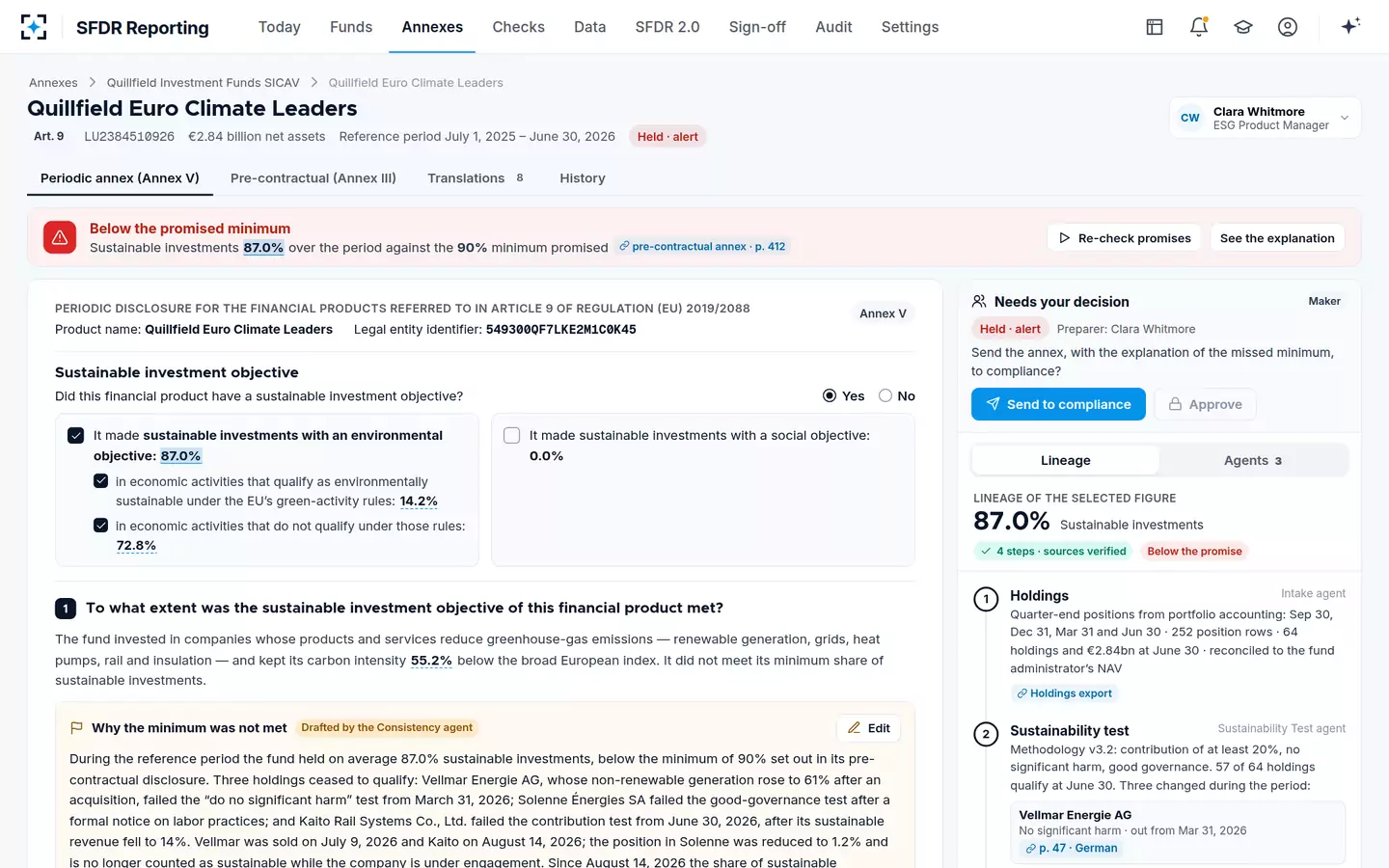
In SFDR Reporting, an Article 9 fund's periodic annex opens on its objective
SFDR Article 6, 8 and 9: what each triggers in the documents
Each article triggers a different set of documents, and that is the cost of the choice. An Article 6 fund discloses how sustainability risks are integrated and, where the manager considers principal adverse impacts, how the product does; it carries no SFDR annex. Articles 8 and 9 each carry a pre-contractual annex, a website section and a periodic annex in a fixed template.
What SFDR Article 6, 8 and 9 funds publish, document by document
| Article 6 | Article 8 | Article 9 | |
|---|---|---|---|
| Pre-contractual | Sustainability-risk integration; principal adverse impacts considered or not (Article 7) | Annex II template, attached to the prospectus | Annex III template, attached to the prospectus |
| Website | Entity-level policies only | Product section with a summary of at most two A4 pages | Product section with a summary of at most two A4 pages |
| Periodic | None under SFDR | Annex IV in the annual report | Annex V in the annual report |
| Sustainable investments | Not claimed | Optional; if committed, a minimum above zero | The objective; environmental and social minimums stated |
| Good governance of investees | Not required by SFDR | Required | Required, as part of Article 2(17) |
Picking Article 8 for a fund that could qualify for Article 9 is therefore not a cheaper template; it is a different promise. The Annex IV periodic template, section by section, shows what an Article 8 fund has to report against the promise every year.
Why is Article 9 read as a label?
Because the market used the two articles as grades of sustainability, although the regulation only asks for disclosure, and the definition behind Article 9 left each manager to decide what qualified. The Commission's own diagnosis is that using the Article 8 and 9 disclosures as if they were product labels raised fears of greenwashing and mis-selling (what SFDR 2.0 proposes instead; European Commission, Questions and answers, November 20, 2025).
Retail investors "often assume that Article 9 funds are necessarily fully sustainable and that Article 8 funds strongly integrate ESG factors, even though this is not necessarily the case."
European Commission, Questions and answers on the SFDR review, November 20, 2025
Two things followed from that reading. First, labels moved money: an early study of the regulation found "a better ESG label leads to larger fund net inflows" (Becker, Martin and Walter, working paper later published in Finance Research Letters, 2022). Second, each Article 9 fund carries a definition its manager has to justify alone, because the Commission has confirmed that the regulation sets no minimum standard for contribution, do no significant harm or good governance (Q&A II.2). Why one holding can be sustainable at one manager and not at another is explained in its own guide.
Where supervisors found the problems: Article 8 or Article 9?
Mostly Article 8. In ESMA's common supervisory action, ten national supervisors found incorrect or misleading disclosures in more than 20% of the funds they sampled, thirteen found none or close to none, and "half of the NCAs identified funds disclosing under Article 8 of the SFDR" as where those disclosures sat (ESMA CSA final report, paragraph 20).
What ESMA's supervisors found, Article 8 against Article 9
Article 8 funds: Characteristics described in vague, generic terms, so nobody could tell how they were measured.
Article 9 funds: Criteria for sustainable investments "found to be clearer than those of corresponding Article 8 SFDR products".
Article 8 funds: Some funds had "no processes in place to ensure that good governance practices were followed".
Article 9 funds: Good governance is part of each sustainable investment's test.
Article 8 funds: Managers "cautious about not overstating the funds' share of sustainable investment"; index funds set very low minimums.
Article 9 funds: Missing data on green bonds does not excuse a fund from the do-no-significant-harm test.
The minimum commitment is where Article 8 gets uncomfortable. ESMA found two funds that beat their minimum share of sustainable investments by a wide margin, "one fund had 20% minimum and 98.5% achieved, the other had 5% minimum and 81.9% achieved", and concluded that a commitment set that low looks deliberately unrealistic and misleads investors (paragraph 67). A promise set too low is a disclosure problem, not only a promise set too high.
Fund names: the third test behind Article 8 vs 9
A fund's article and its name are now tested separately. Since November 21, 2024, and May 21, 2025 for existing funds, ESMA's guidelines expect funds with environmental, social or sustainability terms in their names to put at least 80% of their investments towards the characteristics or objectives they promote, and to apply exclusions taken from the EU benchmark rules (ESMA guidelines on funds' names, ESMA34-1592494965-657). An Article 8 fund with a 40% minimum and an ESG word in its name therefore has two numbers to meet, not one. Botminds handles the name test in Fund Names Rule Compliance, while SFDR Reporting tracks the 80% floor beside the fund's other promises each quarter.
Does SFDR 2.0 replace Article 8 and Article 9?
It would, if adopted. The Commission's proposal replaces Articles 7, 8 and 9 with three voluntary categories, transition, ESG basics and sustainable, each requiring 70% of investments to follow the product's claim, and it deletes the definition of sustainable investment in Article 2(17) (COM(2025) 841, Articles 7 to 9). Until the negotiations end and the new rules apply, Articles 8 and 9 and their templates stand. The SFDR 2.0 timeline and the 70% test covers the categories and where the file stands.
How SFDR Reporting tests the article you chose
For a fund range, the useful question today is not which article sounds better but which promise each fund can keep every quarter. SFDR Reporting answers it from the holdings: on the sample umbrella, the Consistency agent checked 1,912 promises in 186 funds and found four alerts, one of them the Article 9 fund above at 87.0% against its 90% minimum.
Questions people ask
What is the difference between Article 6, 8 and 9 funds?
Article 6 funds disclose how sustainability risks are integrated and make no environmental or social claim. Article 8 funds promote environmental or social characteristics in companies with good governance. Article 9 funds have sustainable investment as their objective, so every holding apart from hedging and liquidity must qualify as a sustainable investment.
What is an Article 8 plus fund?
It is market shorthand for an Article 8 fund that commits to a minimum share of sustainable investments. The ESAs say such a fund publishes a minimum percentage above zero in its pre-contractual annex, and its periodic annex reports the share actually achieved. The regulation itself has no Article 8 plus.
Can an Article 9 fund hold cash or derivatives?
Yes, for specific purposes such as hedging or liquidity. The Commission says such investments must meet minimum environmental or social safeguards so that they fit the sustainable investment objective, and the fund's documents must explain how the mix complies.
Does an Article 8 fund have to make sustainable investments?
No. It must promote environmental or social characteristics and invest in companies with good governance practices. A sustainable-investment minimum is a choice; once it is written into the pre-contractual annex, it becomes a promise the periodic annex reports against.
How many Article 8 and Article 9 funds are there?
In the ESAs' 2025 analysis of European ESG Template data, 11,454 funds disclosed under Article 8 and 970 under Article 9, of 29,635 funds in the sample. The Commission puts Article 8 and 9 products at almost half of EU assets under management.
Who decides whether a fund is Article 8 or Article 9?
The manager does, by what it writes into the fund's pre-contractual disclosures, and national supervisors review it. The SFDR is a disclosure regulation and sets no separate approval of the article; some supervisors review the annexes before launch, and every supervisor can test the periodic result against the promise.