An SFDR reporting tool is software that produces the disclosures the Sustainable Finance Disclosure Regulation requires: the periodic annex of every Article 8 and Article 9 fund in the Annex IV or V template, the entity-level PAI statement in the Annex I template, and the website and translated versions of both. The work is mostly mechanical, quarter-end holdings, adverse-impact data, formulas, template sections, but the decisions inside it are not: whether a missed minimum is material, what the explanation says, which fund belongs in which category. Botminds' SFDR Reporting splits the two. Eight AI agents draft, calculate, test, check, translate and assemble; the ESG product manager prepares, compliance checks with a reason code, the head of sustainable investing signs any missed minimum and the board approves. Each agent carries written limits, and the list of what none of them may do is the part of the design a buyer should test first.
The figures and screens below are sample data from SFDR Reporting on a fictional Luxembourg umbrella, Quillfield Investment Funds SICAV, with 186 periodic annexes due on October 31, 2026. The regulators' statements on AI are quoted from ESMA's own publications.
The eight agents in SFDR Reporting: what each does, and what it never does
| Agent | Does | Never |
|---|---|---|
| Intake | Pulls quarter-end holdings and two vendors' adverse-impact data; reads issuer annual reports in their own language to fill gaps; marks every value reported or estimated | Invents a value; uses a value read below 95% confidence without a person |
| Calculation | Computes the PAI indicators from quarter-end averages, the sustainable-investment share, top investments, sectors and asset allocation | Changes the methodology; uses any version but the approved one |
| Sustainability Test | Tests every holding at each quarter-end for contribution, no significant harm and good governance, and explains each pass or fail with sources | Overrides a vendor flag without a person; re-classifies a fund |
| Drafting | Fills Annexes II to V in template order and writes the narrative from the period's results, every figure linked | Edits a pre-contractual promise; publishes; prints a figure without its lineage |
| Consistency | Compares each result with every promise in the pre-contractual annex, prospectus, name rule, website and factsheets; drafts the explanation of a missed promise | Decides whether a breach is material; softens a result; leaves a missed minimum unescalated |
| SFDR 2.0 Mapping | Maps every fund to the proposed categories under the Commission and Parliament texts, with the 70% test, exclusions and names at risk | Changes a fund's current classification; acts without the head of sustainable investing's approval |
| Translation | Drafts each language with the template's own headings and the firm's glossary; locks every figure to the English | Changes a number; releases a version a local reviewer has not approved |
| Board papers | Assembles the board papers with the exceptions first, the resolution draft and the evidence index | Records a board decision; publishes |
What should an SFDR reporting tool do?
It should produce every figure the templates ask for from the firm's own holdings and data, in the template's own order, and prove where each figure came from. The Delegated Regulation fixes the content: for an Article 8 fund the periodic annex must report how far the fund met the characteristics it promoted, the top 15 investments, the asset allocation, the sector breakdown including fossil-fuel sub-sectors, and comparisons with up to five earlier periods (Delegated Regulation 2022/1288, Articles 51 to 54 and 64). The entity statement needs four quarter-end calculations for each of 18 indicators.
Four requirements separate a tool that helps from one that only fills boxes. It must keep periodic results consistent with the pre-contractual promises, because the periodic annex must report on the same indicators the pre-contractual annex named (recital 25). It must show which values are reported and which are estimated, the practice the ESAs recommend. It must handle languages: the PAI summary alone must exist in the home language, English where different, and the language of each host market (Article 5). And it must keep versions: published information carries "the date of publication of the information and the date of any update", and downloadable files "the version history in the file name" (Article 2(3)).
The supervisors' list of what went wrong is the best specification. ESMA's common supervisory action found disclosures that disagreed across documents and marketing, no process to show that a fund's described ESG strategy was backed by its ESG data, and third-party data taken without checks (ESMA CSA final report, June 30, 2025, paragraph 18). A tool that fixes the formatting and not those three has automated the easy part.
Can AI automate SFDR reporting?
AI can automate the reading, calculating, drafting, checking and translating in SFDR reporting; it should not automate the approvals. That split matches how firms use AI across EU securities markets. In ESMA's survey of firms in the summer of 2025, drafting and summarising was the largest single use, ahead of internal assistants, code generation, data quality and translation, and "Seventy-seven percent of AI use cases operate with low or no autonomy, meaning that human approval is required or the AI system only provides suggestions" (ESMA, TRV Risk Analysis, February 20, 2026).
How EU firms use AI today: drafting and translation, with a person approving
29%
of reported AI use cases are drafting and summarising information, the largest group
105
use cases in data quality and processing
95
use cases in translation
77%
of use cases run with low or no autonomy: a human approves, or the system only suggests
ESMA has also named the failure modes a buyer should design against. Its 2024 statement on AI lists over-reliance, where providers and clients lean on AI and let human judgment lapse; warns that text-generating tools can produce confident statements that are simply false; and counts preparing "drafts of internal/external compliance reports" among the uses it expects (ESMA public statement on AI, May 30, 2024). An SFDR annex is a regulated document: a confident sentence about a fund's characteristics that the holdings do not support is exactly the error supervisors look for.
The defence against both is structural. Every figure in an SFDR Reporting draft links to its lineage, so a sentence with no source cannot be printed, and every decision sits with a named person whose approval is logged with the evidence.
What happens when a fund misses its promise
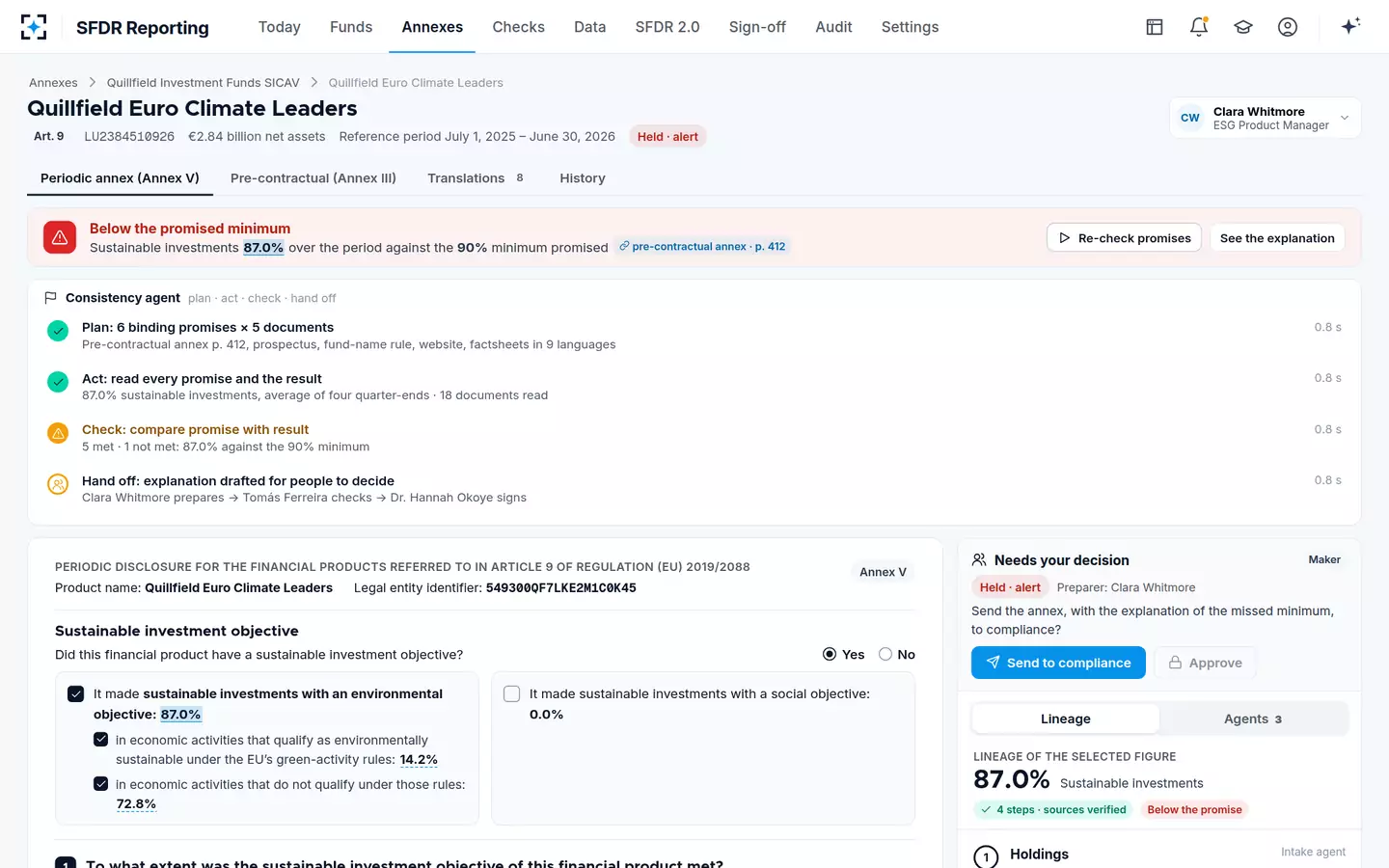
The test of an SFDR reporting tool is a missed minimum, because that is where automation is most tempting and most dangerous. On the sample umbrella, the Article 9 fund Euro Climate Leaders held 87.0% sustainable investments over its reference period against a 90% minimum promised on page 412 of the prospectus. The figure below follows what the agents did and where they stopped.
One missed minimum, from detection to the board, in SFDR Reporting
Agent
Calculation agentAverages the four quarter-end shares, 91.8%, 91.4%, 84.6% and 80.2%, to 87.0% under methodology v3.2.
Never: Changes the method to make the number fit
Agent
Consistency agentReads six binding promises across five documents, finds 5 met and 1 not, and names the three holdings that stopped qualifying, each cited to the issuer's report.
Never: Decides whether the breach is material, or softens the result
A person decides
ESG product managerReviews and edits the drafted explanation and sends the annex to compliance; her own approve button stays locked.
A person decides
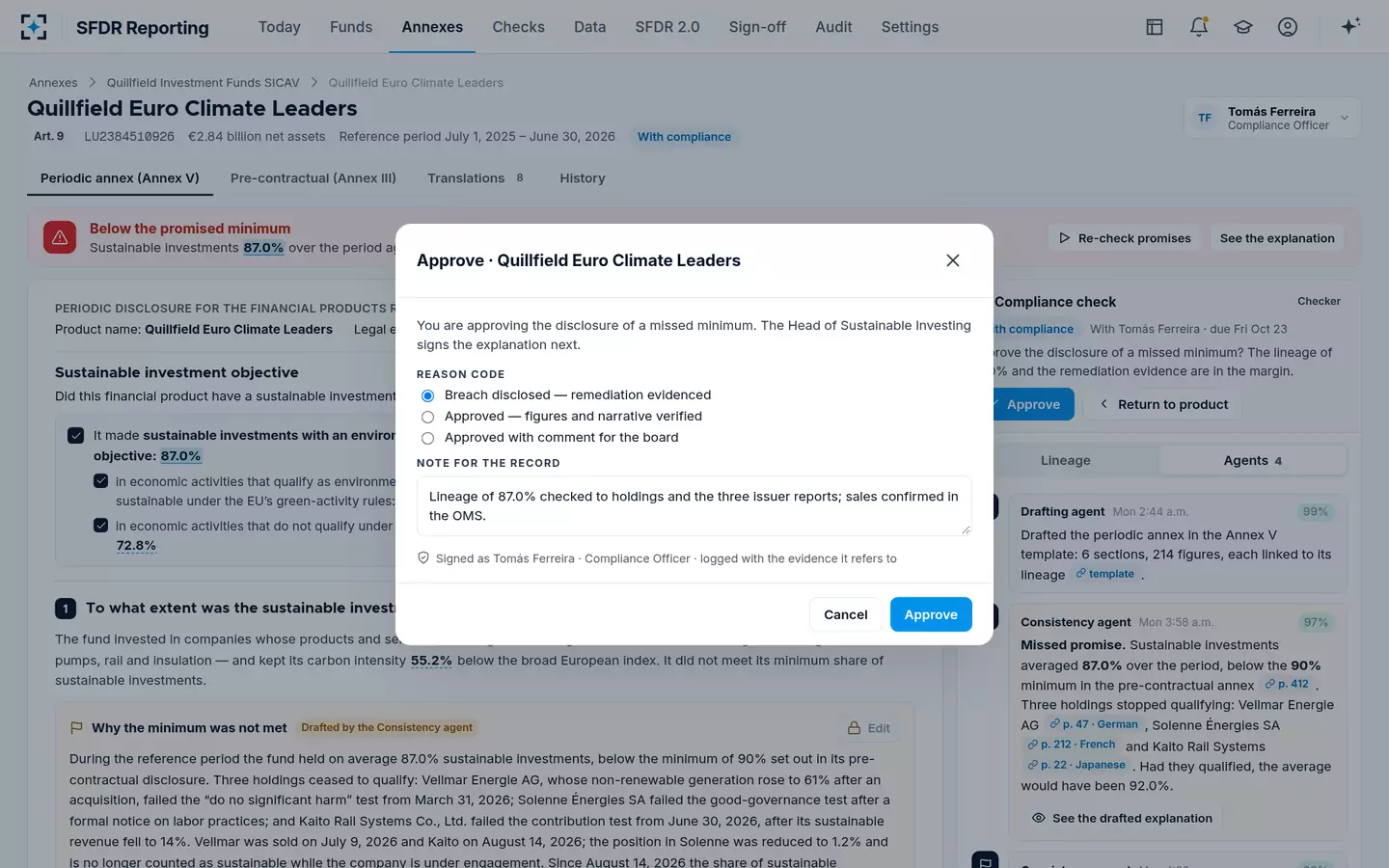
Compliance officerWalks the 87.0% back to holdings and issuer reports, confirms the sales in the order system, approves with the reason code "Breach disclosed — remediation evidenced".
A person decides
Head of sustainable investingSigns the explanation of the missed minimum.
Agent
Board-papers agentPuts the exception on page one of the board papers with the resolution draft and the evidence.
Never: Records the board's decision
A person decides
Board and secretaryThe board approves; the secretary records the decision; people publish the annual report.
The Consistency agent's run: plan, act, check, hand off
Who approves SFDR annexes, and why no agent may sign
People approve: the preparer sends, compliance approves or returns with a reason, the head of sustainable investing signs any missed minimum, and the fund's board approves the annual report that carries the annexes. At entity level the Delegated Regulation names the governing body: the PAI statement must give "the date on which the governing body of the financial market participant approved those policies" (Article 7(1)(a)).
ESMA's statement on AI puts the oversight in the same place: the management body must set up governance that watches how AI tools perform and affect the firm's services, and firms should test and monitor their AI systems regularly (ESMA, May 30, 2024, paragraphs 10 and 11). An agent that could sign would move the decision out of that structure and out of the evidence a supervisor can test.
In SFDR Reporting the rule is enforced, not advised. The preparer of an annex can never approve it; any edit after a compliance check sends it back to compliance; a changed English paragraph holds every translation until compliance approves it; and every action by a person or an agent is logged with who, what, when, why and the evidence, in a hash-chained trail that internal audit can export as an evidence file for the auditor or the CSSF.
Compliance approves with a reason code; the preparer cannot
How should an SFDR reporting tool handle translations?
By treating numbers and words differently: numbers are copied, words are translated and approved. Annexes and summaries reach investors in several languages; the PAI statement's summary alone must be in an official language of the home Member State, in a language customary in international finance where different, and in a language of each host Member State (Delegated Regulation 2022/1288, Article 5), and supervisors found the English summary missing in many statements. Every re-keyed figure is a chance for the language versions to disagree with the original.
In SFDR Reporting the Translation agent drafts each language with the template's own headings and the firm's glossary and locks every figure to the English; on the sample Article 9 fund, 214 of 214 figures in the German version match the English. Local reviewers approve wording only, and when an English paragraph changes, every translation of it is held until compliance approves the new English.
What an SFDR reporting tool should keep for the auditor and the supervisor
It should keep the evidence that a figure was right on the day it was published, not just the figure. The Delegated Regulation already asks for "the date of publication of the information and the date of any update" and a version history in downloadable file names (Article 2(3)). Supervisors are short of that evidence: national authorities told the ESAs that reviewing PAI disclosures "was resource intensive", that "Information has to be searched and extracted manually", and that most "do not have SupTech tools available" (ESAs, JC 2025 26, paragraphs 80 and 81).
A tool that logs who did what, when, why and on which evidence turns a supervisory request from a reconstruction project into an export. SFDR Reporting's trail covers every action by people and agents and is hash-chained; for the sample cycle it held 48,910 events. The same trail answers next year's question of why a figure changed, which the PAI template asks every manager to explain. How one PAI number is traced through that record is shown in a separate guide.
Where SFDR Reporting fits, and where it does not
SFDR Reporting sits on top of the systems a fund manager already runs; it is not a replacement for any of them. It reads quarter-end and month-end positions from portfolio accounting, adverse-impact data and controversy flags from the firm's ESG data vendors, issuer reports and prospectuses from document management, trades from the order system as remediation evidence, and it hands finished annexes and website disclosures to the fund administrator and distribution channels.
What SFDR Reporting does, and what stays with your existing systems and people
Stays where it is: Your vendors deliver adverse-impact data and controversy flags; they remain the first source.
SFDR Reporting: Fills gaps from issuers' own reports, marks reported versus estimated, flags estimates that differ from reported values.
Stays where it is: The head of sustainable investing decides what counts as a sustainable investment and approves each version.
SFDR Reporting: Applies only the approved version and keeps earlier versions on record.
Stays where it is: Portfolio accounting and the administrator own positions, NAV and the annual report.
SFDR Reporting: Reconciles quarter-end positions to the administrator's NAV before using them.
Stays where it is: Compliance decides materiality; the board approves; the secretary records.
SFDR Reporting: Drafts explanations with holdings cited and puts exceptions first.
Stays where it is: People publish the annual report, website disclosures and factsheets.
SFDR Reporting: Prepares every version and holds any whose English changed.
It also has edges a buyer should hear plainly. It does not replace an ESG data vendor; it reduces the number of estimated values by reading issuer reports, but a company that publishes nothing still has no reported figure. It does not choose the methodology or the SFDR 2.0 category; it applies the one approved and proposes the other. And on SFDR 2.0 it maps funds to proposals, the Commission text and the Parliament position, not to law that does not yet exist (COM(2025) 841).
How to evaluate SFDR reporting software on your own funds
Evaluate it on last cycle's annexes, not on a demonstration fund. Give the tool the holdings, data and promises behind annexes you have already published, and compare its draft with what you filed: every figure, every explanation and every promise check. The differences are the evaluation. What to have ready before automating SFDR reporting lists the inputs, and the Annex IV template, section by section, shows what each draft must contain.
Questions to put to any SFDR reporting tool
- Can any printed figure be walked back to holdings, formula and source page?
Supervisors found data used "without further checks"; a figure without lineage cannot be checked.
- Does it separate reported, estimated and missing values?
The ESAs recommend disclosing coverage and estimation separately; a zero for unknown is not a measurement.
- Does it compare each result with every promise, in every language?
Inconsistency between pre-contractual, periodic, website and marketing documents is a recurring supervisory finding.
- Can the preparer approve their own annex?
If yes, the tool has no maker-checker; ask how an edit after review is handled.
- What can the AI never do, and is that enforced or only advised?
Materiality, classification, promises, publication and board records should be outside every agent's reach.
- Does it compute PAI at four quarter-ends with fiscal-year-end values?
A calendar year-end approach is an error supervisors have flagged.
- Can it re-run SFDR 2.0 mapping when the text changes?
Three texts are on the table; a one-off mapping will be out of date by the next trilogue.
- Can you export everything a supervisor would ask for?
Approvals, reason codes, sources and versions, in a form your auditor can open without the vendor.
To see the agents and their limits on sample funds, or to run them on a sample of your own funds and last cycle's annexes, start from SFDR Reporting.
Questions people ask
What is the best SFDR reporting software?
The one that can prove every figure on your own funds. Test candidates on a past cycle: the draft should match your published annexes or explain each difference, separate reported from estimated data, catch any promise the fund missed, and keep every approval with a named person.
Can ChatGPT write an SFDR annex?
A general chatbot can draft prose, but it has no access to your holdings, does not compute the quarter-end figures and cannot show where a sentence came from. ESMA warns that such tools can "hallucinate"; in a regulated annex every figure and claim has to trace to the fund's own data.
Does SFDR reporting software replace an ESG data provider?
No. Vendor data stays the first source for most issuers. A tool can reduce reliance on estimates by reading issuers' own reports, and should mark which values are reported and which estimated, but it cannot create data a company has never published.
Who is responsible if an AI-drafted SFDR annex is wrong?
The firm. ESMA's position is that oversight of AI tools sits with the management body, and the SFDR obligations sit with the financial market participant. That is why every approval in SFDR Reporting is made, and logged, by a person.
How long does an SFDR reporting tool take to go live?
It depends on what the firm brings: its methodology, pre-contractual annexes, prospectuses and a past cycle's annexes. SFDR Reporting is configured from those documents and goes live once its checks pass on the firm's own funds; the design target is five working days from the data cut to every annex drafted and checked.