The European ESG Template, or EET, is a standard data file that fund managers use to send distributors and platforms the sustainability details of each fund, such as its SFDR classification, whether it considers principal adverse impacts and the indicator values behind them. It is an industry template, maintained by the fund-data body FinDatEx rather than by a regulator, and the EU supervisors use the data it carries: the ESAs' 2025 review of principal adverse impact disclosures relied on "the industry-based EET Template". Because every value in an EET is a result of SFDR reporting, the EET is the last thing to automate, not the first. Before any software can fill it, a manager needs six things in order: holdings, issuer data with its sources, the sustainable-investment methodology, every promise each fund has made, last cycle's annexes and the people who approve. Botminds' SFDR Reporting starts from exactly those inputs, drafts the annexes and the PAI statement from them, and hands the finished figures to the systems that distribute them.
Sample figures on this page come from a fictional fund range, Quillfield Investment Funds SICAV, shown in SFDR Reporting; the rules and supervisory findings are quoted from the EU texts and the supervisors' reports.
What to bring before automating SFDR reporting: six inputs, in the order they are needed
- 1
Holdings at every quarter-end
Positions for every fund and mandate, reconciled to the administrator, including cash, derivatives, deposits and fund holdings.
PAI averages use four quarter-ends; "all investments" includes derivatives and cash (ESAs Q&A IV.10, III.2).
- 2
Issuer data, with its source
Adverse-impact values per issuer, each marked reported or estimated, with the vendor or the issuer's own page behind it.
Best efforts where data is missing must be described (Delegated Regulation 2022/1288, Article 7(2)).
- 3
The sustainable-investment methodology
The contribution, no-significant-harm and good-governance tests, with thresholds, in an approved and dated version.
Each manager assesses every investment itself and discloses its assumptions (Q&A II.2).
- 4
Every promise the fund has made
Pre-contractual annexes, prospectus binding elements, website disclosures and factsheets in each language.
Periodic reports must report on the indicators the pre-contractual annex named (recital 25).
- 5
Last cycle's published annexes
The periodic annexes and PAI statements already filed, for comparison and for testing the new process.
Historical comparison runs to at least the last five periods (Article 64).
- 6
Glossary, approvals and owners
Approved terms per language, and who prepares, checks, signs and approves each document.
Summaries are due in the home language, English and host-market languages (Article 5).
What is the EET, and who uses it?
The EET is a fund-level data template that manufacturers fill and distributors read; it exists because distributors need SFDR information on thousands of funds in a machine-readable form. It is not an SFDR template: the regulation's templates are the Annex I statement and the Annex II to V product annexes of Delegated Regulation 2022/1288. The EET restates what those documents disclose as data fields.
Its main reader is the adviser or portfolio manager who must match funds to a client's sustainability preferences. Since August 2, 2022, a client's "sustainability preferences" under MiFID mean a choice about three kinds of instrument: one with "a minimum proportion" in Taxonomy-aligned environmentally sustainable investments, one with "a minimum proportion" in sustainable investments as defined in SFDR Article 2(17), and one "that considers principal adverse impacts on sustainability factors" (Delegated Regulation (EU) 2021/1253, Article 1). A firm may not recommend an instrument "as meeting a client's or potential client's sustainability preferences when those financial instruments do not do meet those preferences". The three answers it needs to make that call come from the fund's SFDR disclosures.
How do supervisors use EET data?
As a source for their own market statistics. The ESAs' 2025 report analysed product-level adverse-impact indicators from "European ESG Template (EET) disclosures data", for 29,635 funds, and found that 10,214 of 11,454 Article 8 funds and 943 of 970 Article 9 funds consider principal adverse impacts (ESAs, JC 2025 26, paragraphs 14, 49 and 50). A wrong value in a fund's EET is therefore not an internal error; it reaches distributors and the supervisors' own statistics.
Why should the EET be mapped last, not first?
Because its fields are copies of decisions made upstream. A minimum share of sustainable investments is a promise in the pre-contractual annex; the share achieved is a result of the methodology applied to holdings; each adverse-impact value is a quarter-end average of issuer data. Mapping the EET first fixes the shape of the output before anyone has agreed the method that produces it, and supervisors' findings show what that produces.
Two ways to automate: start from the EET file, or end with it
Map the EET first: Whatever a vendor feed or spreadsheet holds for each field, often with no link to the fund's own documents.
Map the EET last: The same calculation that produced the periodic annex and PAI statement, so the EET, the annex and the website agree.
Map the EET first: Reported and estimated values sit in one field and look alike.
Map the EET last: Each value carries its coverage and whether it was reported or estimated.
Map the EET first: Minimum shares typed in from the prospectus by hand.
Map the EET last: Minimums read from the pre-contractual annex and checked against each result before release.
Map the EET first: Every field is re-mapped when the template version changes.
Map the EET last: Only the export changes; the calculations stay.
What data do you need for SFDR reporting?
You need holdings, issuer data and a method, in that order, and each has a test it must pass before automation helps. Holdings must be quarter-end positions for every fund and mandate, including cash, derivatives and deposits: for PAI calculations "all investments" means "both direct and indirect investments funding investee companies or sovereigns through funds, funds of funds, bonds, equity instruments, derivative instruments, loans, deposits and cash or any other securities or financial contracts" (ESAs consolidated Q&A, answer III.2).
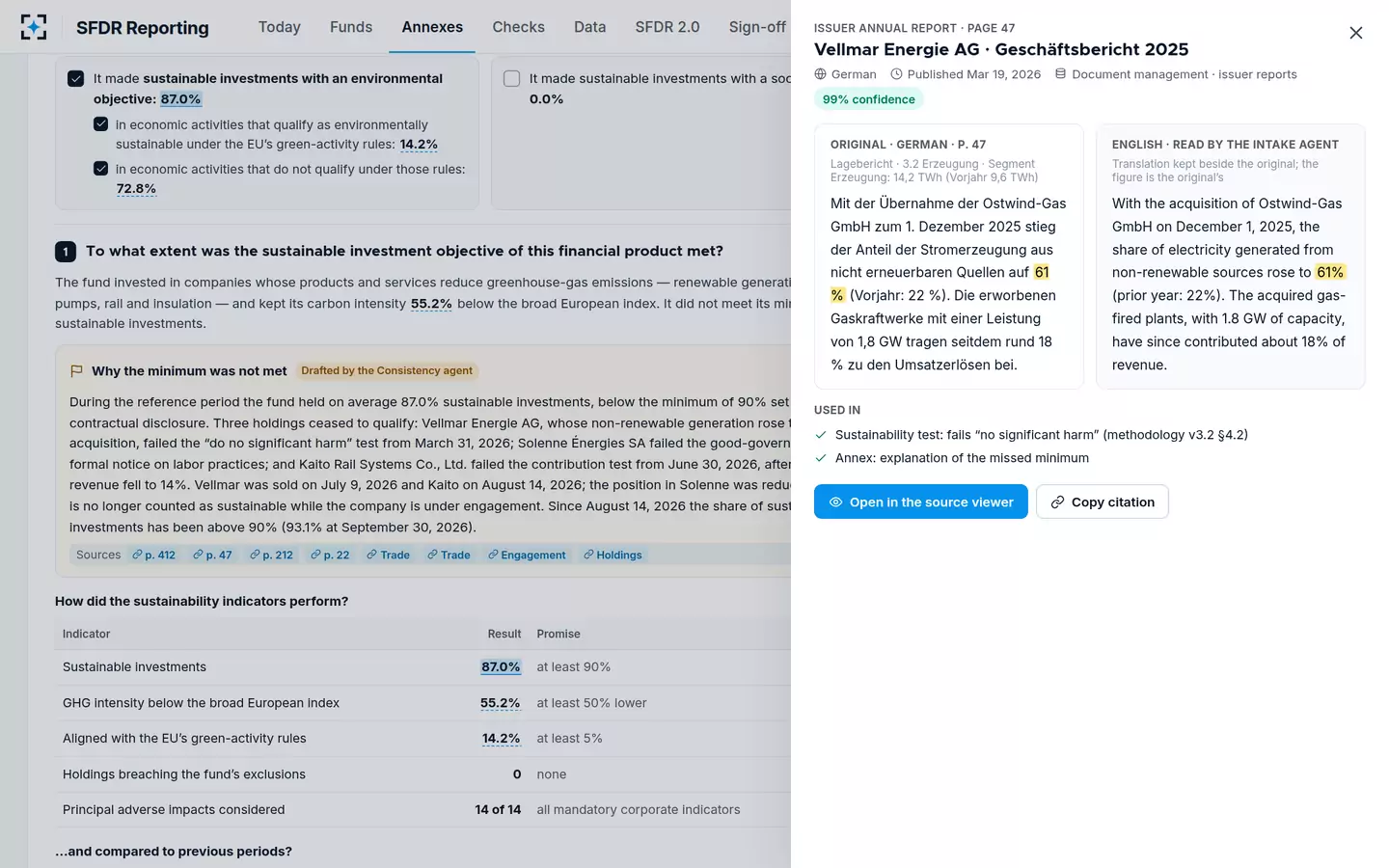
Issuer data must carry its origin. ESMA's supervisors found a "lack of verification or review process of data from third parties, data sometimes incomplete or inaccurate, information obtained by an ESG-provider without further checks" (ESMA CSA final report, June 30, 2025, paragraph 18(g)), and coverage that varied by indicator: "usually high (around 80%)" for greenhouse-gas indicators and "usually below 20%" for topics such as emissions to water (paragraph 47). The Commission's SFDR 2.0 proposal would write the expectation into law, requiring external data to rest on "formalised and documented arrangements" and in-house estimates on "formalised and documented methodologies" (COM(2025) 841, new Article 12a).
Why issuer data needs its source attached
~80%
typical data coverage for greenhouse-gas PAI indicators, supervisors report
<20%
typical coverage for emissions to water
81.4%
of datapoints reported by issuers in the sample range after the agents read 1,326 reports
4,918
sample values moved from vendor estimate to issuer-reported
In SFDR Reporting, the issuer's own page sits beside the reading before any figure is used
Your sustainable investment methodology: the input no tool can supply
The methodology is the one input a manager must write and own. The Commission's reading is that the SFDR sets no minimum standard for contribution, do no significant harm or good governance, so each manager assesses every investment itself, discloses its assumptions and carries the added responsibility that choice brings (Q&A II.2, April 6, 2023). It must also apply one reading of Article 2(17) across all its products (Q&A V.16); why every manager's sustainable share differs is explained in its own guide.
In practice that means a written, versioned document with thresholds: what revenue share counts as a contribution, which adverse-impact indicators and limits define significant harm, which governance failures exclude a company and for how long. ESMA found that the thresholds managers use "are generally not disclosed" (ESMA CSA, paragraph 63); automation cannot fix a method that only exists in analysts' heads. In the sample firm, methodology v3.2 has applied since February 1, 2026, sets the contribution test at 20% sustainable revenue, and is approved by the head of sustainable investing, with earlier versions kept on file. Why one holding can be sustainable under one method and not another is covered in a separate guide.
Every promise, in every language
The fourth input is the full set of promises each fund has made, because the periodic result is tested against them and the EET restates them. That means the pre-contractual annex with its binding elements and minimum shares, the prospectus, the website disclosures, and every factsheet and marketing document in every distribution language. ESMA found pre-contractual, periodic and website disclosures that did not agree with each other or with marketing material, and recorded as non-compliance a fund whose marketing material used SDG logos it had no commitment to (ESMA CSA, paragraph 18(a) and Example 15).
What each input feeds: the annex, the PAI statement and the distributor data
| Input | Periodic annex | PAI statement | Distributor data |
|---|---|---|---|
| Quarter-end holdings | Top investments, asset allocation, sectors | Every indicator, averaged over four quarter-ends | Indicator values and shares |
| Issuer data with sources | Sustainability indicators; no-significant-harm test | Indicator values, coverage, best efforts | Values, with coverage where the template asks |
| Methodology | Share of sustainable investments achieved | Policies to identify and prioritise impacts | Sustainable-investment share |
| Promises | Every section answers against them | Not used | Minimum shares, PAI consideration |
| Past annexes | Comparison with previous periods | Comparison with previous periods | Prior values where kept |
| Glossary and owners | Translations, approvals | Summary languages, approvals | Who releases the file |
What SFDR Reporting needs from you on day one
To run on a firm's own funds, SFDR Reporting needs the six inputs above for a sample of funds and one past cycle: quarter-end holdings files, the vendor delivery and access to issuer reports, your sustainable investment methodology, pre-contractual annexes, prospectuses and factsheets, last cycle's annexes, and the names of the people who prepare, check, sign and approve. It is configured from those documents, and goes live on the firm's funds once its checks pass on them.
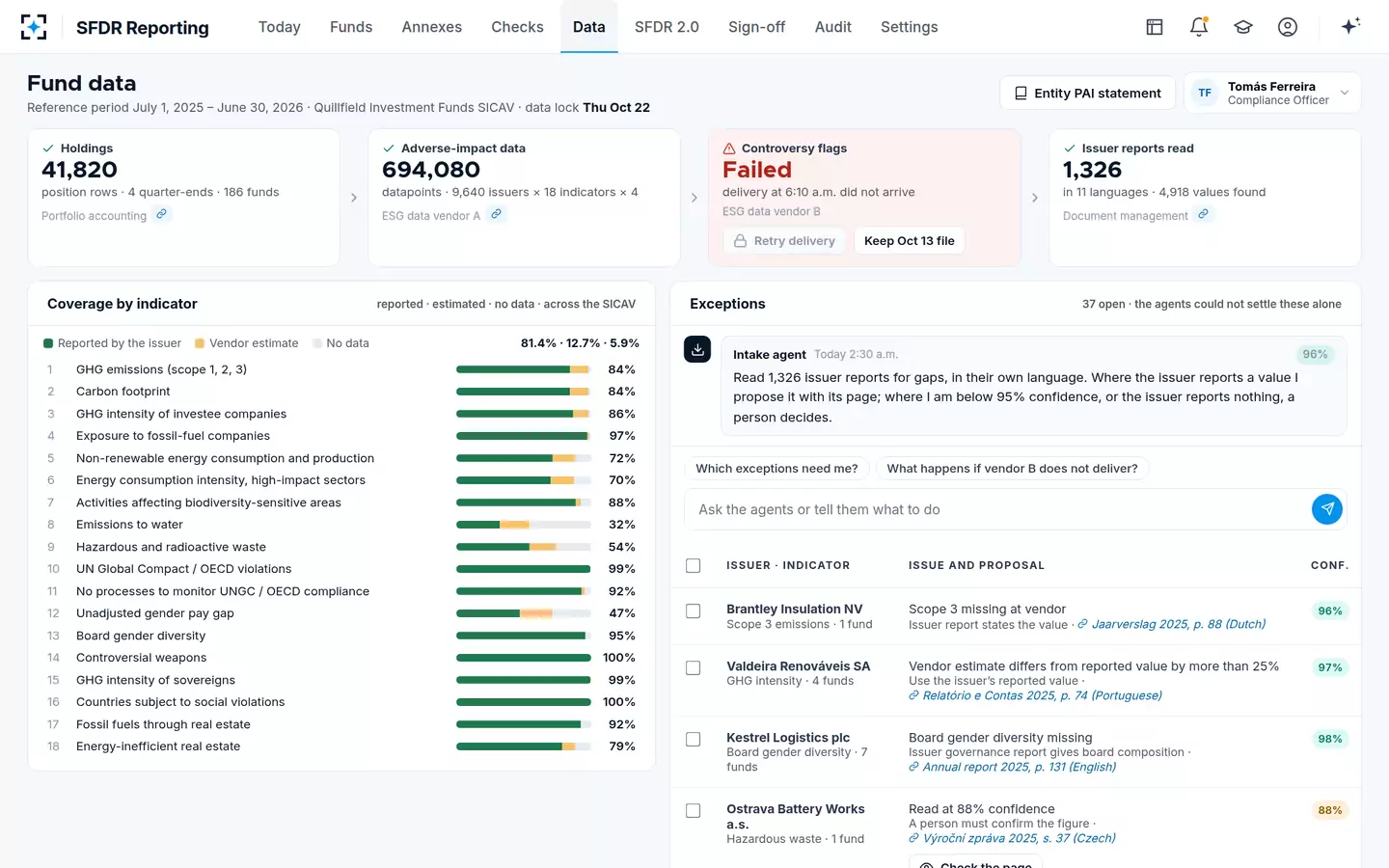
From there the work divides as it does for the sample range. The Intake agent loads the holdings and vendor data and reads issuers' own reports to fill gaps; on the sample range it read 1,326 issuer reports in 11 languages and moved 4,918 values from estimated to reported. Every value the agent read below 95% confidence goes to a person. The Calculation and Sustainability Test agents apply the approved methodology; the Drafting agent fills the templates; and the figures then flow to the fund administrator, the website and the fund-data distribution system that produces the EET.
Holdings, issuer data and reports in, with the exceptions for a person
Before automating SFDR reporting: a readiness check for each input
- Can you produce quarter-end holdings for every fund and mandate, reconciled to NAV?
Including cash, derivatives and fund holdings; the PAI denominator needs all of them.
- Does each issuer value say where it came from?
Vendor, issuer page or estimate, with a date; supervisors found third-party data used without checks.
- Is the methodology written, versioned and approved, with thresholds?
One interpretation across all products; earlier versions kept for comparisons.
- Are every fund's binding promises listed in one place?
Minimum shares, exclusions, indicators, name thresholds, in every document and language.
- Do you have last cycle's published annexes and statements?
They are both the comparison base and the best test of a new process.
- Are owners named for each step?
Who prepares, checks, signs, approves and releases the EET.
- Do you know which EET values are re-used by distributors for client matching?
Those are the fields where an error becomes a mis-sale under MiFID.
Will the EET change under SFDR 2.0?
It will have to, but nobody can say how until the rules are final. SFDR 2.0 is a proposal that would replace Articles 8 and 9 with three categories and delete the definition of sustainable investment that the MiFID sustainability-preference rules refer to; the Commission says the new disclosure templates would be drawn up "in tandem with the changes to implementing rules for how product distributors should consider the revised SFDR" (Commission Q&A, November 20, 2025). Any category field in a distributor file today is provisional. The inputs on this page, holdings, issuer data with sources, a written method and a list of promises, are what any future template will draw on, which is why they are the ones to get right first. Where SFDR 2.0 stands is tracked in its own guide.
To see the inputs turned into annexes, a PAI statement and distributor-ready figures on sample funds, or to try it on a sample of your own, start from SFDR Reporting; the agents and their limits are set out in the SFDR reporting tool guide.
Questions people ask
What is the European ESG Template?
An industry data template for passing fund-level sustainability information, such as the SFDR classification, adverse-impact consideration and indicator values, from fund manufacturers to distributors and platforms. It is maintained by the fund-data body FinDatEx, not by an EU authority, though the ESAs have used EET data in their own analysis.
Is the EET mandatory under SFDR?
No. SFDR prescribes the Annex I to V templates of Delegated Regulation 2022/1288, not the EET. Distributors, however, need the same information to meet MiFID sustainability-preference rules, which is why the EET is widely exchanged.
Where can I download the EET template?
From FinDatEx, which publishes the template and its versions. Before filling it, make sure each value can be traced to the fund's SFDR annexes and the calculation behind them, because the EET restates those disclosures.
How do distributors use EET data?
To match funds to clients' sustainability preferences, which since August 2, 2022 cover a minimum Taxonomy-aligned share, a minimum share of SFDR sustainable investments, and consideration of principal adverse impacts. A firm may not recommend a fund as meeting those preferences when it does not.
What data do you need before automating SFDR reporting?
Quarter-end holdings for every fund and mandate, issuer adverse-impact data marked reported or estimated with its source, a written and approved sustainable-investment methodology, every binding promise in every document and language, and last cycle's published annexes. Software can read, calculate and draft from those; it cannot invent the method or the promises.