The SFDR reporting deadline is really two deadlines. A manager that considers principal adverse impacts, and every manager averaging more than 500 employees, must publish its entity-level statement on principal adverse impacts (the PAI statement) by June 30 each year, covering the previous calendar year. Separately, every Article 8 and Article 9 fund publishes a periodic annex in the official template inside its annual report, which a UCITS must publish within four months of its financial year-end and an AIF within six. The work is hard because the two clocks share the same data, the same people and, for funds with a June year-end, the same summer. Botminds' SFDR Reporting is software that runs both clocks with agents: it pulls the holdings and adverse-impact data, drafts each annex and the PAI statement in the official templates, traces every figure to its source and checks every result against the fund's promises, while the product manager, compliance and the board keep every decision.
The calendar below follows one fictional fund range through its year: Quillfield Investment Funds SICAV, a Luxembourg UCITS umbrella with a June 30 year-end and 186 periodic annexes, shown as sample data in SFDR Reporting. The rules and the supervisors' findings are quoted from the EU texts and reports they come from.
The four numbers that set the SFDR year
June 30
every year: the entity PAI statement, covering January 1 to December 31 of the year before
4months
after year-end: a UCITS annual report, and the Article 8 or 9 annex inside it
6months
after year-end: an AIF annual report, at the latest
4.3/ 5
national supervisors' average score for meeting the June 30 deadline, the best of six scores
What is the SFDR reporting deadline?
There are two. The entity-level PAI statement is due on June 30 for the previous calendar year, and the periodic annex of each Article 8 or Article 9 fund is due inside that fund's annual report. Everything else in the SFDR year, from website updates to translations, hangs off one of those two dates.
The first date is set word for word in the Delegated Regulation: "By 30 June each year" the manager must publish, "in a separate section titled: 'Statement on principal adverse impacts of investment decisions on sustainability factors'", information that "shall cover the period of 1 January until 31 December of the preceding year" (Delegated Regulation (EU) 2022/1288, Article 4(1)). It must follow the template in Table 1 of Annex I.
The second date is not in the SFDR at all. The regulation says only where the periodic information goes: for AIF managers "in the annual report referred to in Article 22 of Directive 2011/61/EU", for UCITS management companies "in the annual report referred to in Article 69 of Directive 2009/65/EC" (SFDR, Article 11(2)). The deadline therefore comes from fund law, which is why two funds in the same range can have different SFDR reporting deadlines, and why a manager's SFDR calendar is really a list of year-ends.
Which SFDR document is due when, and which law sets the date
| Document | Due | Set by | Covers |
|---|---|---|---|
| Entity PAI statement (Table 1 of Annex I) | By June 30 each year | Delegated Regulation 2022/1288, Article 4(1) | January 1 to December 31 of the year before |
| Periodic annex, UCITS (Annex IV or V) | Within four months of the financial year-end, in the annual report | SFDR Article 11(2)(g); UCITS Directive Article 68(2) | The fund's financial year |
| Periodic annex, AIF (Annex IV or V) | No later than six months after the financial year-end | SFDR Article 11(2)(a); AIFMD Article 22(1) | The fund's financial year |
| Periodic disclosure, portfolio management mandates | Once a year, in every fourth quarterly report | SFDR Article 11(2)(h) and (i); ESAs Q&A V.10 | The year of the mandate |
| Website product disclosures | Kept up to date, with the date of publication and of any update | Delegated Regulation 2022/1288, Article 2(3) | Current |
When is the PAI statement due, and what must be in it by then?
The PAI statement is due by June 30 and reports the calendar year before; the 2025 statement was due by June 30, 2026. It is mandatory for a manager with more than 500 employees on average over the financial year, and for a parent of a large group that exceeds it on a consolidated basis (SFDR, Article 4(3) and (4)). Smaller managers either publish one voluntarily or explain why they do not consider adverse impacts.
Three details decide how much of the spring the statement takes. Each impact figure is "the average of impacts on 31 March, 30 June, 30 September and 31 December" (Article 6(3)), so the holdings must be rebuilt at four quarter-ends, not read once. The summary section must exist in an official language of the home Member State, in a language customary in international finance where that differs, and in a language of each host Member State where a product is sold, at "a maximum length of two sides of A4-sized paper when printed" (Article 5). And the statement compares each indicator with the previous years, "up to the last five previous periods" (Article 10).
The ESAs' worked example shows what this means in practice. A manager preparing in May 2026 for publication "before 30 June 2026" looks up the latest data its investee companies have reported for fiscal year 2025, then applies it to its holdings at each quarter-end of 2025; companies do not have to supply quarterly data for the calculation to work (ESAs consolidated Q&A, answer IV.10). The statement therefore waits on company annual reports published in the spring, and that wait, not the drafting, is what pushes the work towards June. How one PAI number is built from those four quarter-ends is traced step by step in a companion guide.
One Article 8 fund's year, month by month
Seen from one fund range, the two clocks overlap rather than alternate. A range with December year-ends finishes its annual reports in April, just as the entity statement's data arrives; a range with June year-ends publishes its PAI statement on the day its own reporting year closes, then has four months to finish 186 annexes. The figure lays the three lanes over one calendar.
Two SFDR clocks on one calendar: the PAI statement and the fund year-ends
- Investee annual reports for 2025 arriveJan–Mar
- Four quarter-end calculations, coverage, actionsApr–May
- Review, approval, publicationJune
- Data cut, calculations, drafting, review, boardJan–Apr
- Other work: the entity statementJan–Jun
- Quarter-end holdings, issuer data, calculationsJul–Aug
- Drafting, checks, translationsSep
- Compliance, board, publicationOct
For the sample umbrella, the last fortnight is where the year is won or lost. Its annual report with 186 periodic annexes, 158 Article 8 and 28 Article 9, is due on October 31, 2026, and its board meets on Tuesday, October 27. The data lock is Thursday, October 22; compliance has a review clock of three business days. Nothing in the regulation sets those three dates, but each is forced by the two that are set: the board must approve the annual report before publication, and compliance must check the annexes before the board sees them.
Who prepares SFDR annexes, and who carries the peak?
The ESG product manager prepares the annexes, compliance checks them, the head of sustainable investing owns the methodology behind the sustainable-investment figures, distribution reviewers approve the translations, and the board secretary assembles what the directors approve. Above them all, the governing body approves the PAI policies themselves: the statement must date the governing body's approval of those policies (Delegated Regulation 2022/1288, Article 7(1)(a)).
No regulator publishes how many people this takes, and supervisors found it varies more than one might expect. In ESMA's common supervisory action, the full-time equivalents working on the integration of sustainability risk "ranged between 0.5 to 16"; in one jurisdiction small firms allocated about 10% of their staff to ESG matters against about 1.5% at larger firms (ESMA, CSA final report, June 30, 2025, paragraphs 31–32). A small team carries the same templates and the same deadlines as a large one.
The five people who carry an SFDR reporting deadline, and what each keeps
Today
Pulls quarter-end holdings and adverse-impact data into spreadsheets, types each narrative, and learns which promise a fund missed when compliance does.
With agents
Opens each annex already drafted in the official template, every figure traced, and starts with the one that missed its minimum.
Still theirs: Preparing the annex and sending it to compliance
Today
Checks annexes against the prospectus a sample at a time, in English, asking where each number came from.
With agents
Walks any figure back to holdings and the issuer's own page, then approves or returns the annex with a reason code.
Still theirs: Approval, and the reason for it
Today
Defends the methodology to the board with no fund-by-fund view of which holdings stopped qualifying.
With agents
Sees each missed minimum with the holdings that caused it, and signs the explanation.
Still theirs: The methodology and the signature on every missed minimum
Today
Re-checks every number in the translated annexes and factsheets by eye.
With agents
Approves the wording only; every figure is locked to the English and a changed paragraph is held.
Still theirs: Approval of the local wording
Today
Builds the board papers by hand from annexes still being checked.
With agents
Receives board papers with the exceptions on page one and the resolution drafted.
Still theirs: Recording the board's decision
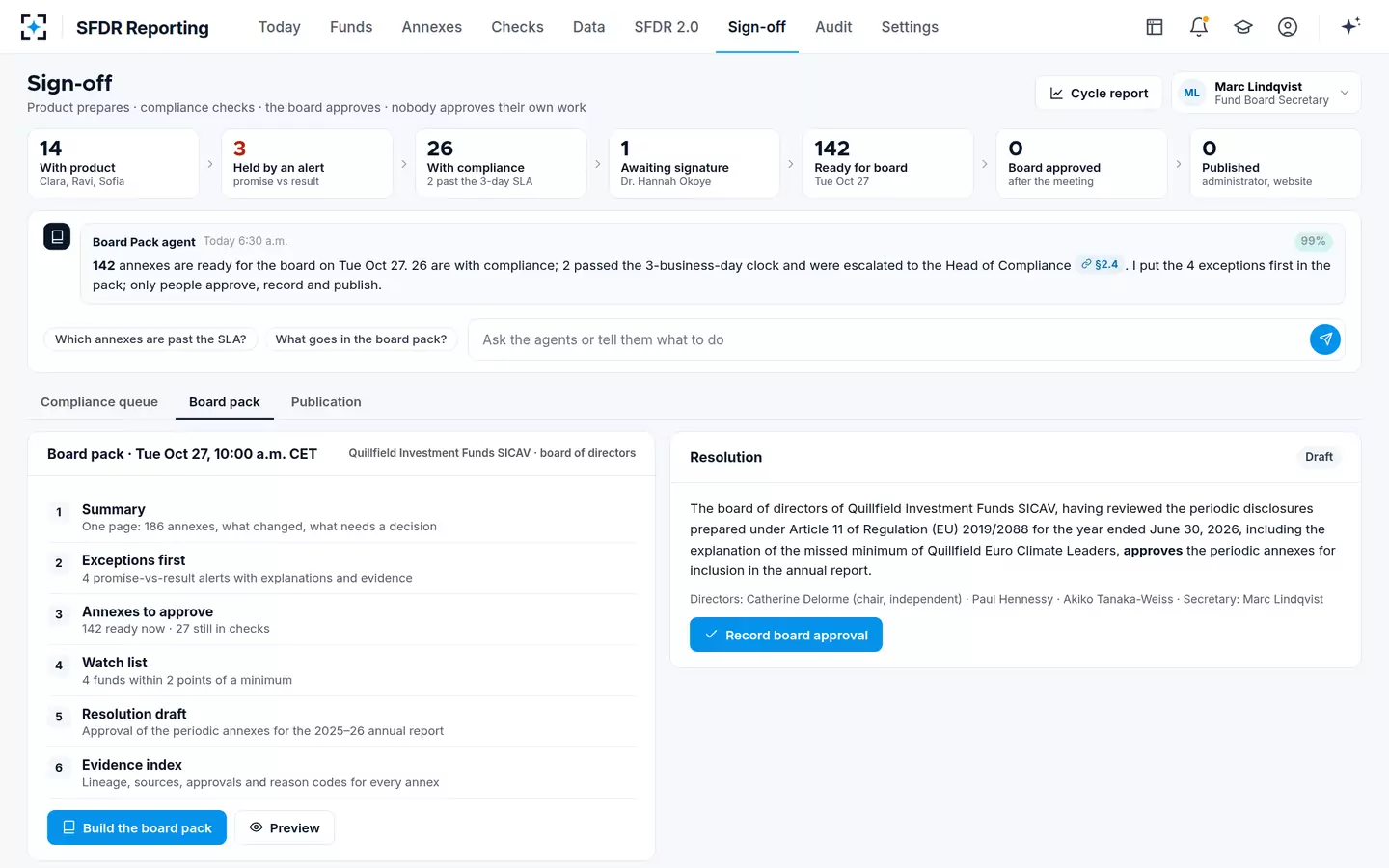
The figure hides one structural rule. In the sample umbrella, the person who prepares an annex can never approve it, and any edit after compliance has checked an annex sends it back to compliance. That maker-checker rule is a setting in SFDR Reporting, not a regulatory requirement, but it is how the firm proves, at the deadline, that the figure the board approved is the one compliance checked.
Where the weeks before the deadline actually go
The weeks go into collecting and reconciling data, not into writing. Every periodic annex must report how the sustainability indicators named in the pre-contractual annex performed, "to ensure consistency between pre-contractual disclosures and periodic disclosures" (Delegated Regulation 2022/1288, recital 25), and compare them with up to five earlier periods. That means quarter-end positions reconciled to the administrator, issuer data with gaps filled and marked, and the sustainability test re-run on every holding.
Supervisors have seen what happens when the data step is rushed. The ESAs found that in PAI statements managers commonly reported zero where they had no data, and that "many PAIs are disclosed as ‘0’, with the FMPs specifying that the result is zero ‘to the best of our knowledge’" (ESAs, JC 2025 26, paragraphs 44 and 79). A zero entered under deadline pressure is a published figure that says no harm was found, when nothing was measured at all.
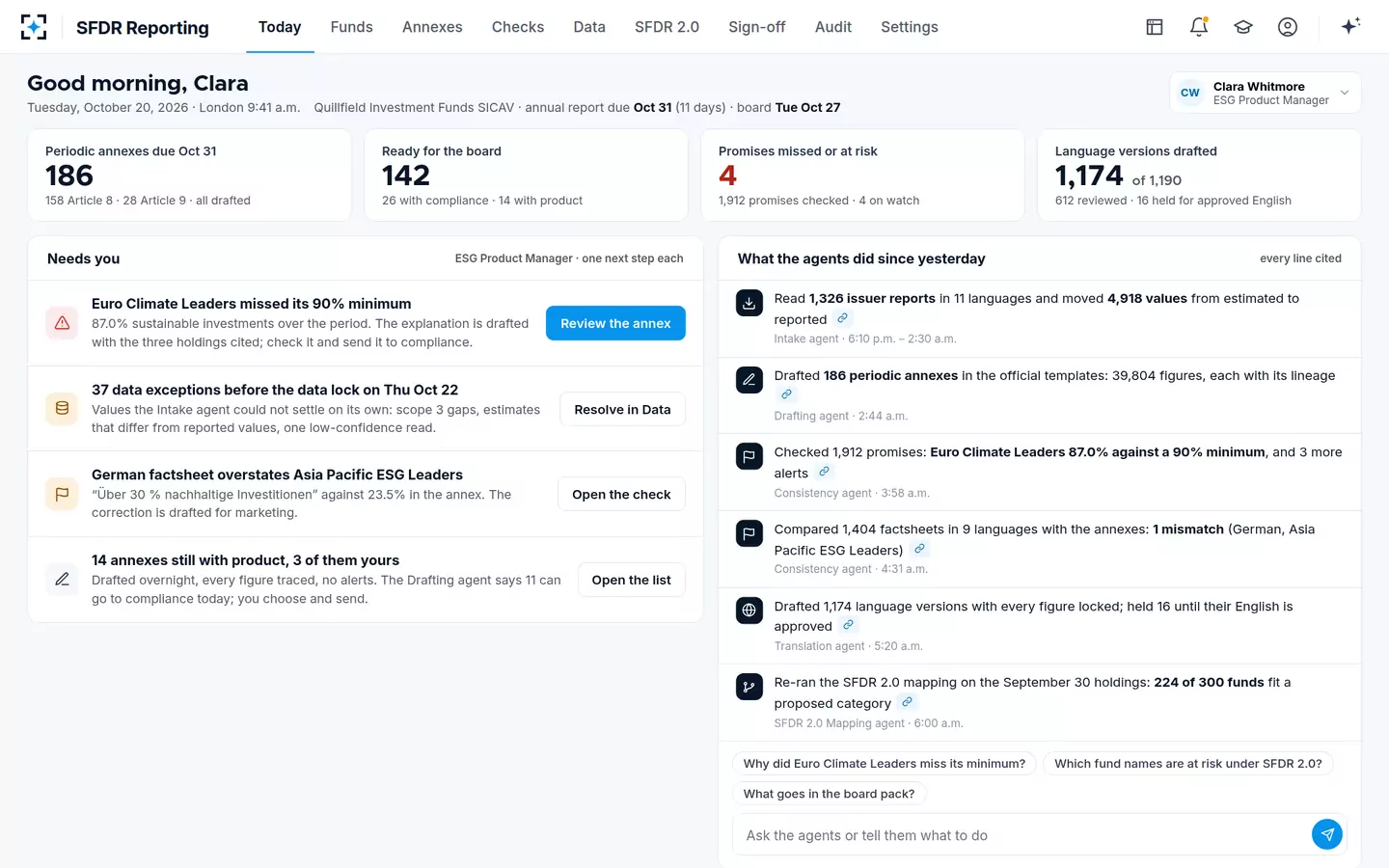
SFDR Reporting on the morning of day 11 before the deadline
What slips before an SFDR deadline, according to supervisors
The deadline itself is rarely missed; what slips is what was published by it. National supervisors gave compliance with the June 30 deadline an average of 4.3 out of 5, the highest of the six elements they scored, while the quantification of actions taken scored 3.2, the lowest (ESAs, JC 2025 26, Graph 7). The ESAs called it "a very high level of compliance with the deadline", then listed "outdated statements dating back to 2022 and 2023" and "statements not including the date of publication" as cases of non-compliance.
Three slips recur in the supervisors' reports, and each is a symptom of the calendar rather than of the rules:
- The English summary goes missing. "Many NCAs found that, despite the obligation to provide a 2-page summary in English, this was not always made available" (JC 2025 26, paragraph 67). The summary is usually the last thing done, in the last week.
- Last year's figures change without a word. Indicators for 2022 published in 2023 "differed from those in the PAI statement published in 2024. However, only a few FMPs provided an explanation" (paragraph 38). A restated comparison is legitimate; an unexplained one reads as an error.
- The documents stop agreeing. ESMA's review found pre-contractual, periodic and website disclosures that contradicted each other and the marketing (ESMA CSA, paragraph 18(a)). When the periodic annex is finished on deadline day, nobody has time to compare it with the factsheet.
How SFDR Reporting runs the year against both clocks
SFDR Reporting does not move either deadline; it moves the work to the front of the window. On the sample umbrella, eight agents drafted the 186 periodic annexes in the official templates overnight, with 39,804 figures each linked to its source, and the design target is five working days from the data cut to every annex drafted and checked. The entity statement uses the same holdings and the same issuer data, calculated at the four quarter-ends the rules require.
The agents divide the mechanical work. The Intake agent pulls quarter-end holdings and two vendors' adverse-impact data and reads issuer annual reports, in their own language, to fill gaps, marking every value reported or estimated. The Calculation agent computes the PAI indicators and sustainable-investment shares with the approved methodology only. The Drafting agent fills the templates in their own order. The Consistency agent compares each result with every promise in the pre-contractual annex, prospectus, website and factsheets. The Translation agent locks every figure to the English. The board-papers agent assembles what the directors see, exceptions first. None of them approves, signs, records a board decision or publishes; what each agent may and may not do is set out in full elsewhere.
The sign-off line: product prepares, compliance checks, the board approves
Does SFDR 2.0 change the deadline?
Not yet. SFDR 2.0 is a proposal, and until it is adopted and applies, the June 30 statement and the annexes in the current templates remain due. The Commission's proposal of November 20, 2025 deletes the entity-level PAI statement and repeals Delegated Regulation 2022/1288, replacing Articles 8 and 9 with three product categories. Parliament's plenary confirmed the decision to enter negotiations on October 7, 2026, and the file's stage is still "Awaiting Parliament's position in 1st reading" (European Parliament, Legislative Observatory, 2025/0361(COD)).
One detail in the negotiating texts matters for the June 30 date. In the opening positions circulated on October 12, 2026, the Commission proposes that the new rules apply 18 months after entry into force, and the Parliament and the Council each write 24 months; but both co-legislators would apply the deletion of Articles 4 and 5, the entity-level PAI statement, immediately on entry into force (Council document 14335/26, rows 78, 361 and 361a). If that survives the trilogues, the statement could end well before the periodic annexes change. Where SFDR 2.0 stands and how to map funds to its categories is covered in its own guide.
An SFDR reporting deadline checklist for the year ahead
- List every fund's financial year-end and legal form
The periodic annex deadline is the annual report deadline: four months for a UCITS, six at most for an AIF, shorter where national law says so.
- Fix the four quarter-end holdings files early
The PAI statement averages impacts at March 31, June 30, September 30 and December 31; rebuilding them in May is the slowest step.
- Decide how missing issuer data is handled before the data arrives
Supervisors criticised zeros entered for unknown values; write the best-efforts rule into the method, not into the last week.
- Schedule the summaries and translations as their own task
The two-page summary in the home language and English is a recurring supervisory finding.
- Explain every restated prior-year figure
Comparisons run up to five periods back; a changed figure without a sentence reads as an error.
- Compare each periodic result with the pre-contractual promise before compliance sees it
A missed minimum found by the board is a bad day; found after publication it is a misstatement.
- Keep the publication date and version history on every file
Article 2(3) of the Delegated Regulation asks for both, and supervisors found statements without a date.
To see the two clocks run on sample data, with every annex drafted and every figure traced, start from SFDR Reporting.
Questions people ask
What is the SFDR periodic reporting deadline?
The periodic annex is due with the fund's annual report, so its deadline is the fund-law deadline for that report. A UCITS publishes its annual report within four months of its financial year-end; an AIF manager makes its report available no later than six months after year-end. A fund with a December 31 year-end therefore has until April 30 if it is a UCITS.
Is the PAI statement due on June 30 every year?
Yes, for every manager that considers principal adverse impacts, which includes every manager averaging more than 500 employees. The statement published by June 30 covers January 1 to December 31 of the previous year. A manager publishing for the first time covers the period from the date it first considered principal adverse impacts.
Who has to publish a PAI statement?
A financial market participant that exceeds an average of 500 employees during the financial year, or is the parent of a large group that exceeds it on a consolidated basis, must publish one. Smaller managers choose: publish a statement in the same template, or explain clearly why they do not consider adverse impacts and whether they intend to.
When did the SFDR annex templates start to apply?
Delegated Regulation 2022/1288 has applied since January 1, 2023. Managers that considered principal adverse impacts by December 31, 2022 published their first statement in the template by June 30, 2023, for calendar 2022.
Do portfolio management mandates have an SFDR deadline?
Yes, once a year. The Commission's interpretation is that only one annual periodic disclosure is required, so managers include the SFDR template information "annually in every fourth report" of the quarterly reports MiFID requires.
Will the June 30 PAI deadline disappear under SFDR 2.0?
Only if and when the amending regulation is adopted. The Commission's proposal deletes the entity-level statement, and the Parliament and Council negotiating texts would make that deletion apply on entry into force. Until then the obligation stands, and the June 30, 2027 statement for calendar 2026 should be planned as normal.