Article 8 fund requirements, under the EU Sustainable Finance Disclosure Regulation, are disclosure duties built around a promise. A fund qualifies when it "promotes, among other characteristics, environmental or social characteristics" and the companies it invests in "follow good governance practices"; it must then describe those characteristics and how they will be met in a pre-contractual annex, keep a website section current, and report each year, in the Annex IV template of its annual report, "the extent to which" they were met. The binding elements, minimum proportions and indicators written into the pre-contractual annex are the test the fund is held to, and the same claims reappear in the prospectus, on the website and in every factsheet and marketing document in every language. The control that follows is simple to state and hard to run: check every result against every promise, in every document, before anything is published. Botminds' SFDR Reporting runs that promise-versus-result check for every fund: its Consistency agent compares each periodic result with each binding promise across the pre-contractual annex, prospectus, fund-name rule, website and factsheets, and drafts the explanation of any miss for compliance to decide.
The fund examples are sample data in SFDR Reporting on a fictional umbrella, Quillfield Investment Funds SICAV. The requirements and supervisory findings are quoted from the EU texts, the ESAs' Q&A and ESMA's reports.
Headroom against each fund's own promise, in percentage points: five funds near the line
What are the Article 8 fund requirements?
An Article 8 fund must promote environmental or social characteristics, invest in companies with good governance practices, and disclose three things in fixed templates: before investment, on the website and after each year. Where a product promotes environmental or social characteristics, alone or among others, and its investee companies follow good governance practices (the Article 8 test itself is set out in the Article 8 vs 9 guide), its pre-contractual information must include "information on how those characteristics are met" (SFDR, Article 8(1)), and its periodic reports must describe "the extent to which environmental or social characteristics are met" (Article 11(1)(a)).
Article 8 fund requirements, document by document, and what each one commits the fund to
| Requirement | Where it is set | What it commits the fund to |
|---|---|---|
| Promote environmental or social characteristics | SFDR Article 8(1) | Named characteristics, measured by named sustainability indicators |
| Good governance of investee companies | SFDR Article 8(1); policy described on the website | A written policy, applied to every company held |
| Pre-contractual annex | Delegated Regulation 2022/1288, Article 14 and Annex II | Binding elements, minimum proportions, PAI consideration, derivatives use |
| Website product disclosures | SFDR Article 10; Delegated Regulation Articles 24 to 36 | Methodologies, data sources, due diligence, engagement, with a summary of at most two A4 pages |
| Periodic annex | SFDR Article 11; Delegated Regulation Articles 50 to 57 and Annex IV | Results against each promise, top investments, allocation, comparison with earlier years |
| Marketing communications | SFDR Article 13 | Must not contradict the disclosures |
| ESG or sustainability words in the name | ESMA guidelines on funds' names | 80% threshold and benchmark exclusions |
For the full decision between Article 8 and Article 9, and Article 6 below both, see SFDR Article 8 vs 9. This guide starts after the decision: the fund is Article 8, and it has made promises.
What are binding elements in an Article 8 fund?
Binding elements are the parts of the investment strategy the fund commits to apply in selecting investments, and they are what a result is tested against. The Annex II template asks: "What are the binding elements of the investment strategy used to select the investments to attain each of the environmental or social characteristics promoted by this financial product?", followed by "What is the committed minimum rate to reduce the scope of the investments considered prior to the application of that investment strategy?" and "What is the policy to assess good governance practices of the investee companies?" (Annex II template, Delegated Regulation 2023/363).
The asset-allocation section adds the numbers. It asks for the minimum share of the fund's investments used to meet its promoted characteristics under the binding elements of its strategy, and, where the fund commits to them, the minimum share of sustainable investments. In practice a fund's promise list therefore has three kinds of item: rules (exclusions, screens, a scope-reduction rate), floors (minimum proportions) and indicators (the measures the periodic annex must report).
ESMA's supervisors found that the promises themselves were often the weak point: characteristics "not clearly disclosed, making it unclear how the characteristics were measured and fulfilled", and identification of features that "was often too generic (e.g., 'the product promotes environmental features', 'the product pursues social objectives')" (ESMA CSA final report, June 30, 2025, paragraph 18(a)). A promise that cannot be measured cannot be checked, and an unmeasurable promise is itself a finding.
What does good governance mean for an Article 8 fund?
It means a written policy, applied to every company the fund holds, covering at least the four areas the SFDR names: how the company is managed, how it treats employees, how it pays staff and whether it complies with tax rules. The template asks for "the policy to assess good governance practices of the investee companies", and the ESAs say frameworks such as the UN Global Compact, OECD or ILO principles are optional, though a manager may build them into that policy (ESAs consolidated Q&A, answer V.13). Funds investing only in government bonds are the exception: the Commission says the requirement does "not apply to government bonds" (answer V.6).
The policy needs a clock and a threshold. ESMA found Article 8 funds with screening but "no defined timeframes or materiality thresholds for how long engagement with a non-compliant company could continue before it would be excluded from the investment universe" (ESMA CSA, Example 14). In the sample umbrella, a formal notice on labour practices took one company out of the sustainable share; the method decides when such a notice is enough, and the check records the date it applied.
What if an Article 8 fund misses its minimum?
The SFDR has no penalty schedule for a missed minimum; what it has is a duty to report the extent to which the characteristics were met, and the general requirement that disclosures be fair, clear and not misleading. A missed minimum must therefore appear in the periodic annex with an explanation. ESMA's supervisors compared achieved levels with minimum commitments and reported one manager that missed its commitment "due to being in a ramp-up period, calling for clarification about whether there was sufficient explanation" (ESMA CSA, paragraph 67).
The same review shows why misses happen even in well-run funds. For passive funds, "changes in the constituents of the reference index can result in the actual share of investments falling below the minimum commitment. Hence, it is common for index funds to commit to very low shares". Promising too little is not safe either: ESMA found two funds that beat their minimums by roughly 77 points, one with a 20% minimum and 98.5% achieved, the other with 5% and 81.9%, and concluded that "investors are misled by what could seem a deliberately unrealistic initial commitment" (paragraph 67). The defensible promise is one the fund expects to meet and can show it met.
In the sample umbrella, the one miss belongs to an Article 9 fund, Euro Climate Leaders, at 87.0% against 90%; three holdings stopped qualifying during the year, two were sold after the period end, and the explanation names each one with the issuer's own report. In SFDR Reporting the Consistency agent "escalates every missed minimum", never decides whether a breach is material and never softens a result; the head of sustainable investing signs the explanation and the board sees it on page one of its papers. How the periodic annex reports a missed promise is covered section by section in another guide.
Why check every result, not a sample?
Because the errors supervisors find sit between documents, and a sample of annexes, read in English, does not reach them. ESMA's review listed "several inconsistencies ... between precontractual, periodic and website disclosures and marketing material", and a "lack of processes to ensure that the description of the funds' ESG strategies is substantiated by the ESG metrics/data used" (ESMA CSA, paragraph 18). Under Article 13 of the SFDR, marketing communications must not contradict the disclosures; ESMA recorded as non-compliance a fund whose marketing used SDG logos and images "without having contributions to the UN SDGs as part of their characteristics in the precontractual documents" (Example 15).
Supervisors have started doing the check themselves. During the same exercise one national authority "challenged misalignments by using a proprietary ESG dashboard tool combining an assessment of the pre-contractual documents for each fund against the latest portfolio submitted for that fund" (paragraph 11(h)), and ESMA encouraged supervisors "to develop tools to be able to perform controls on product level disclosures". A manager that checks a sample will meet a supervisor that checks everything.
What supervisors found, and what one full check finds
10
national supervisors found misleading or incorrect disclosures in more than 20% of the funds they sampled
1,912
promises checked in one sample cycle of 186 funds
4
alerts in that cycle, one of them a factsheet rather than an annex
4
funds on watch, within two points of a promise
The promise-versus-result check, step by step
A full check reads every promise from every document, computes every result on the same basis, compares them, and puts each miss in front of the people who decide. The figure follows one cycle in SFDR Reporting.
One cycle of the promise-versus-result check in SFDR Reporting
Agent
Consistency agent: read the promisesExtracts every binding element, minimum and indicator from the pre-contractual annex and prospectus, and every sustainability claim from the website and factsheets in each distribution language.
Agent
Calculation and Sustainability Test agentsCompute each result on the fund's approved method at each quarter-end: shares, indicators, exclusion breaches, the 80% name threshold.
Never: Change the methodology
Agent
Consistency agent: compareMarks each promise met, not met, or on watch within the firm's band; drafts the explanation of a miss with the holdings and sources cited.
Never: Decide materiality, or soften a result
A person decides
ESG product managerReviews the alert and the draft, edits, and sends the annex to compliance.
A person decides
Compliance officerApproves or returns with a reason code; a marketing correction goes to marketing, with compliance confirming.
A person decides
Head of sustainable investing and boardSign any missed minimum; approve the annual report with exceptions on page one.
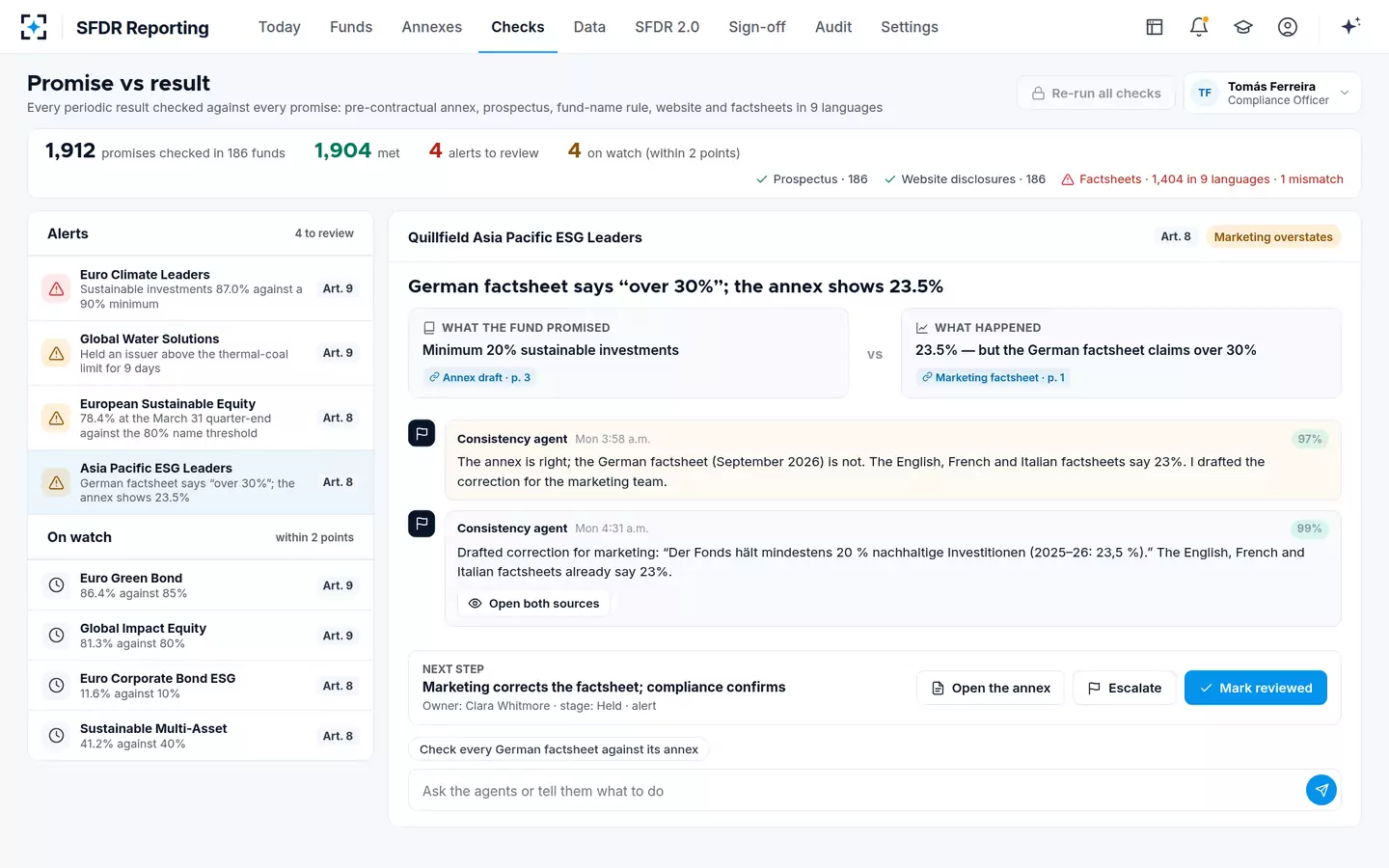
Every periodic result against every promise in SFDR Reporting, alerts first
Promises in every language: the factsheet problem
A promise made in a factsheet is still a promise, and translation is where numbers drift. In the sample cycle the Consistency agent compared 1,404 factsheets in nine languages with the annexes and found one mismatch: the German factsheet for Asia Pacific ESG Leaders said "über 30 % nachhaltige Investitionen", more than 30% sustainable investments, while the annex showed 23.5% against a 20% minimum and the English, French and Italian factsheets said 23%. The annex was right; the claim in the market was not.
The UK regulator's guidance states the principle any EU manager would recognise: claims "should be capable of being substantiated at the point in time at which they are made", and firms should "regularly review their claims and any evidence that supports them, to ensure the evidence is still relevant for so long as those claims are being communicated (eg, a financial promotion is live)" (FCA FG24/3, paragraphs 2.18 to 2.20). For distributors the stakes are concrete: under MiFID, a firm may not recommend a fund as matching a client's sustainability preferences when it does not (Delegated Regulation 2021/1253).
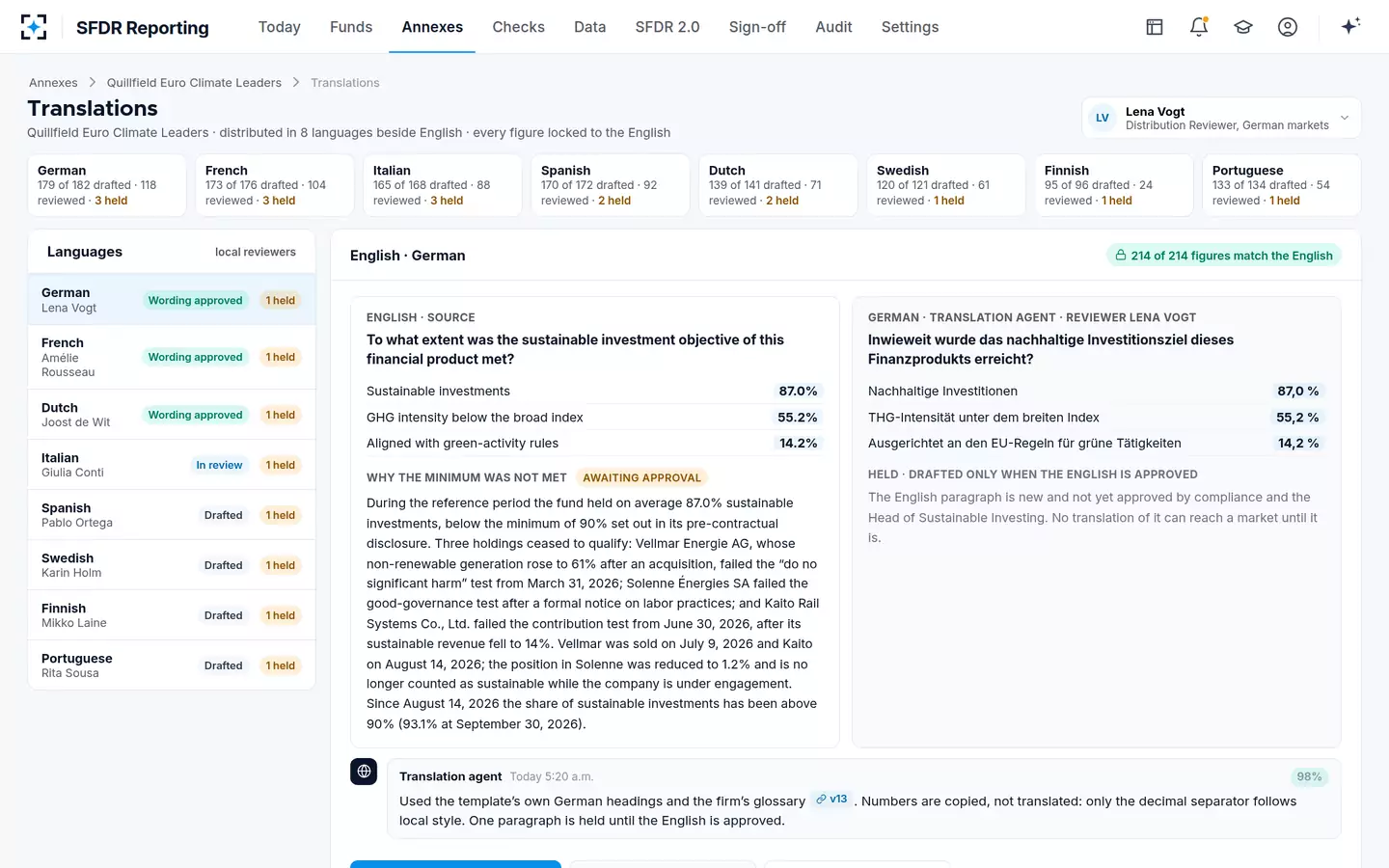
Translations with every figure locked to the English
An SFDR compliance checklist for Article 8 funds
Article 8 fund requirements, as a checklist for each reporting cycle
- Can every promise be measured?
Each characteristic needs an indicator; supervisors flagged generic promises such as "promotes environmental features".
- Are all promises listed, from every document and language?
Pre-contractual annex, prospectus, website, factsheets and marketing; Article 13 bars contradictions.
- Is every result computed on the method and basis the promise implies?
Same denominator, same intervals, same methodology version across funds (ESAs answer V.16).
- Is the good-governance policy applied with a clock?
ESMA criticised Article 8 funds with no timeframe for how long engagement may continue before exclusion.
- Are ESG-named funds above 80% at each check date?
The fund-name guidelines apply alongside the SFDR minimums; Botminds' Fund Names Rule Compliance covers the name test in depth.
- Is every miss explained with holdings and evidence, and signed?
The periodic annex reports "the extent to which" characteristics were met; supervisors asked whether explanations were sufficient.
- Are minimums realistic in both directions?
ESMA called minimums far below the achieved share potentially misleading.
- Are factsheets re-checked against the annex before the next promotion?
A claim must be substantiated for as long as it is live.
The name test has its own rules and its own solution, Fund Names Rule Compliance; in SFDR Reporting the 80% threshold is one of the promises checked at every quarter-end. To see the full check run on sample funds, every promise in every language, start from SFDR Reporting.
Questions people ask
What is the definition of an Article 8 fund?
A financial product that promotes, among other characteristics, environmental or social characteristics, or a combination of them, provided the companies it invests in follow good governance practices. It need not make sustainable investments, but if it commits to a minimum share of them, that minimum becomes part of its promise.
What are the SFDR Article 8 reporting requirements?
A pre-contractual annex in the Annex II template, a website product section with a summary of at most two A4 pages, and a periodic annex in the Annex IV template inside each annual report, reporting the extent to which the characteristics were met, the top investments, the asset allocation and comparisons with earlier periods.
Does an Article 8 fund need good governance?
Yes. ESMA's words are that Article 8 requires, "independently of whether the fund is investing in sustainable investment or not, investments are made in companies that follow good governance practices". The only confirmed exception is a fund holding only government bonds, to which the requirement does not apply.
Do supervisors take enforcement action over missed promises?
Rarely, so far. In ESMA's review only one national supervisor said it had used enforcement actions, most preferring escalated supervisory measures, and ESMA reminded them to use "the full range of the supervisory and enforcement toolkit". Bilateral letters, supervisory orders and corrections were the common outcomes.
Will Article 8 fund requirements change under SFDR 2.0?
If the proposal is adopted, Article 8 becomes the ESG basics category, with a 70% threshold, the first four Paris-aligned benchmark exclusions and short templates. The promise-versus-result logic stays: categorised products must report each year the extent to which their objectives are met against their chosen indicators.