The SFDR periodic reporting template is the form an Article 8 or Article 9 fund attaches to its annual report to show what it did with the promises in its pre-contractual annex. For Article 8 funds it is Annex IV of Delegated Regulation (EU) 2022/1288, as amended by Delegated Regulation 2023/363; for Article 9 funds it is Annex V. Each section asks one question, "To what extent were the environmental and/or social characteristics promoted by this financial product met?", "What were the top investments of this financial product?", "What was the asset allocation?", and each answer comes from one source: the pre-contractual promises, quarter-end holdings, the sustainability methodology or the Taxonomy data. The writing is hard not because the questions are open but because every answer must match the promise, the holdings and the previous years at once. Botminds' SFDR Reporting drafts every section in the template's own order from the fund's data, links each figure to its source, and drafts the explanation wherever a result falls short of what the fund promised.
The examples use fictional funds shown as sample data in SFDR Reporting. The section headings are quoted from the template published in the Official Journal; the rules behind them from the articles of the Delegated Regulation that govern each section.
The Annex IV periodic template in order: each section, the rule behind it and where the answer comes from
- Did this financial product have a sustainable investment objective?
Tick boxes and percentages: for an Article 8 fund, "No", and the proportion of sustainable investments it actually made. Source: methodology applied to holdings.
- To what extent were the environmental and/or social characteristics promoted by this financial product met?
Article 51. Each characteristic, how the sustainability indicators performed, comparison with previous periods, the objectives and no-harm test of any sustainable investments. Source: pre-contractual indicators and holdings.
- How did this financial product consider principal adverse impacts on sustainability factors?
Included where the fund said it would. Source: the pre-contractual PAI section and the indicator values.
- What were the top investments of this financial product?
Article 52. The 15 largest over the reference period, with sector, share of assets and country. Source: holdings at the fund's chosen intervals.
- What was the proportion of sustainability-related investments?
Articles 53 to 56. Asset allocation, sectors, Taxonomy alignment, other environmental and social shares. Source: methodology, Taxonomy data, holdings.
- What investments were included under "other", what was their purpose and were there any minimum environmental or social safeguards?
Article 53(b). Hedging, cash, insufficient data. Source: holdings and risk policy.
- What actions have been taken to meet the environmental and/or social characteristics during the reference period?
Including shareholder engagement. Source: engagement and voting files, trades.
- How did this financial product perform compared to the reference benchmark?
Article 57, only where an index is designated. Source: benchmark data.
What is the SFDR periodic reporting template?
It is the official form, set out in Annexes IV and V of the SFDR Delegated Regulation, in which a fund reports each year how far it met its environmental or social characteristics or its sustainable investment objective. For an Article 8 fund, the manager "shall present the information ... in an annex to the document or information referred to in Article 11(2) ... in the form of the template set out in Annex IV", and must say prominently in the main body of the annual report that the annex exists (Delegated Regulation 2022/1288, Article 50). Article 9 funds use Annex V (Article 58).
The template has applied since January 1, 2023. In 2023 the Commission replaced Annexes II to V to add the fossil-gas and nuclear question and the related Taxonomy graphs (Delegated Regulation (EU) 2023/363), so an annex built on the 2022 form is out of date. The periodic annex is due with the annual report: four months after year-end for a UCITS, six at most for an AIF. The SFDR reporting deadline, date by date, sets out that calendar.
Can you delete sections of the SFDR template?
Only sections the template itself marks as conditional. The ESAs' answer is that managers "can remove the sections that are deemed not relevant for their financial product in the disclosure templates only if those sections are accompanied by a red text instruction that explicitly limits the scope of application of the section" (ESAs consolidated Q&A, answer V.11). The benchmark section, for example, carries the instruction "[include section where an index has been designated as a reference benchmark ...]"; the top-investments section carries none and must always be there.
The template also lets a manager adapt "size and font type of characters and colours" (Article 2(1)), but not its order or its questions. That fixed order is what lets an investor compare two funds' annexes, and why supervisors treat a reshaped template as a disclosure problem.
Writing the section on how far the characteristics were met
This is the section that tests the promise, and it must report against the indicators the pre-contractual annex named. Article 51 asks for "the extent to which the environmental or social characteristics promoted by the financial product were met during the period covered by the periodic report, including the performance of the sustainability indicators used to measure how each of those environmental or social characteristics are met and which derivatives, if any, have been used" (Article 51(a)). The recitals add why: periodic disclosures should report "on the specific sustainability indicators mentioned in the pre-contractual information" (recital 25).
Three sub-questions follow in the template. "…and compared to previous periods?" asks for a comparison "up to at least the last five previous periods", with "figures with a relative measure such as impact per euro invested" and a note of "which indicators are subject to an assurance provided by an auditor or a review by a third party" (Article 64). For funds that made sustainable investments, the template asks what their objectives were and how they did "not cause significant harm", including "How were the indicators for adverse impacts on sustainability factors taken into account?" and whether they were in line with the OECD Guidelines and the UN Guiding Principles on business and human rights (Article 51(d)).
"It is misleading to claim to promote a very high number of objectives when investments only contribute towards achieving very few of them."
ESMA, common supervisory action on sustainability disclosures, Example 10, June 30, 2025
ESMA's example comes from a fund that promoted all the Sustainable Development Goals in its pre-contractual annex and then reported contributing to one or two. The lesson for the writer runs backwards: the periodic section can only be as specific as the promise it reports on. Where the promise was vague, the honest periodic answer exposes it.
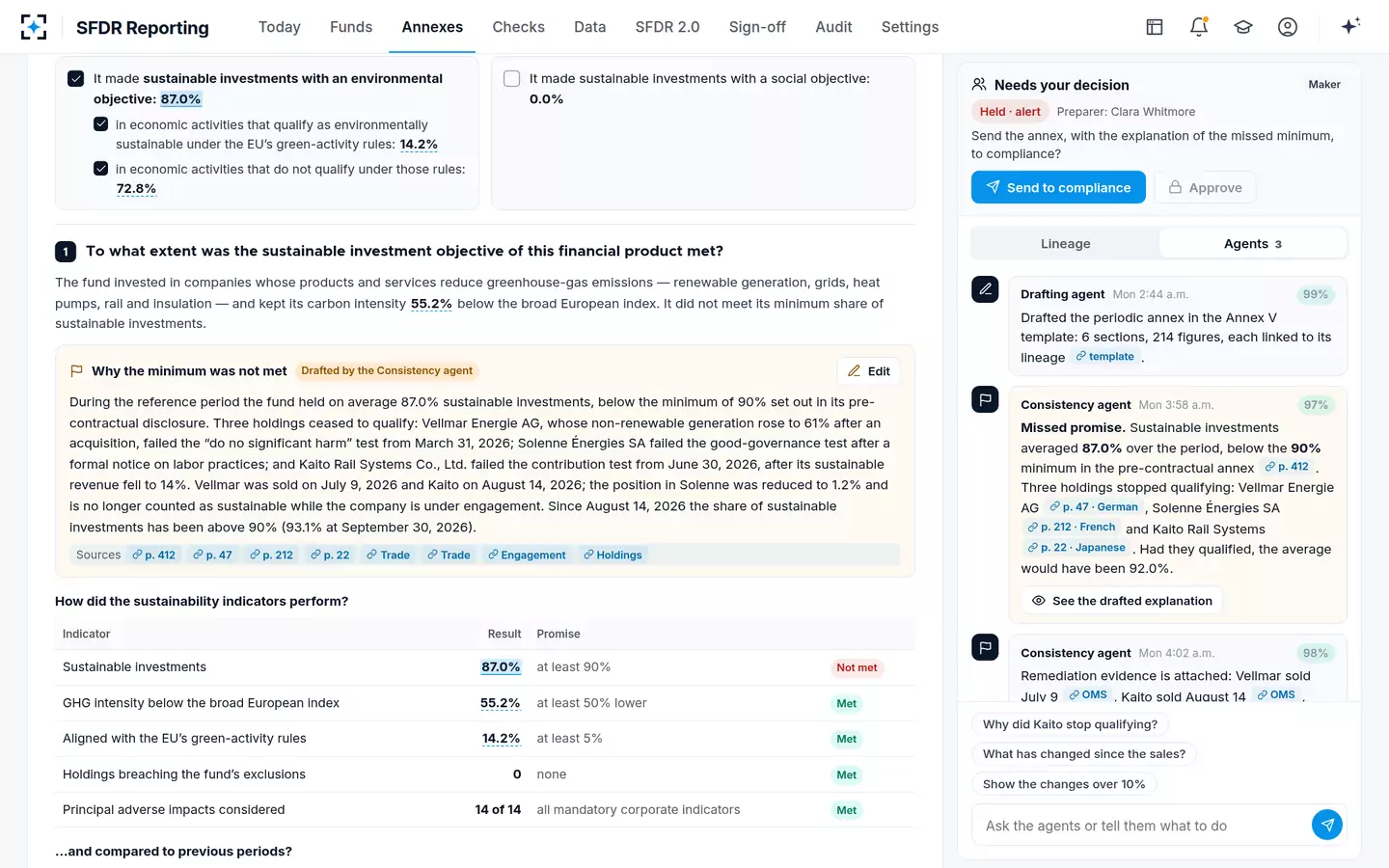
The indicators table, each result against its promise
How are top investments calculated for the SFDR periodic report?
The top investments are the 15 that made up the largest proportion of the fund over the reference period, listed with sector, share of assets and country. Article 52 asks for "the fifteen investments constituting the largest proportion of investments of the financial product during the period covered by the periodic report", and where fewer than 15 investments make up half the fund, only those (Article 52). The recital says they should be "calculated at appropriate intervals to be representative of that period" (recital 26).
The rule does not say which intervals, and the ESAs have declined to fill the gap: because periodic disclosures sit inside fund-law reports, "the ESAs cannot impose a specific way of calculating investments in the periodic reports" (Q&A V.30, August 4, 2025). Most managers therefore choose an approach and must apply it consistently. The template's margin asks the fund to state the reference period the list covers; the method behind "largest" belongs in the same place. Whatever the choice, it should be the same basis as the proportions in the next section, so the top-investments list and the asset allocation describe the same portfolio.
Asset allocation: #1, #1A, #1B and #2 Other
The asset-allocation section sorts every investment into a fixed tree, and the categories are defined by the template itself. "#1 Aligned with E/S characteristics includes the investments of the financial product used to attain the environmental or social characteristics promoted by the financial product"; "#2 Other includes the remaining investments of the financial product which are neither aligned with the environmental or social characteristics, nor are qualified as sustainable investments" (Annex IV template). Where the fund made sustainable investments, #1 splits into #1A Sustainable and #1B Other E/S characteristics.
The Annex IV asset-allocation tree, and the rule behind each branch
#1Aligned with E/S characteristics
The investments used to attain the characteristics the fund promotes. Article 53(a).
#1ASustainable Taxonomy-aligned, other environmental, social
#1BOther E/S characteristics Aligned with the characteristics, not sustainable investments
#2Other
Neither aligned nor sustainable: hedging, ancillary cash, or investments with insufficient data. Purpose and safeguards explained. Article 53(b).
The "other" bucket is where weak annexes hide. Article 53(b) asks for "the purpose of the remainder of the investments ... including a description of any minimum environmental or social safeguards and whether those investments are used for hedging, relate to cash held as ancillary liquidity or are investments for which there are insufficient data". A single line listing cash and derivatives does not answer the safeguards question. The sectors section that follows must break investments down by sector and sub-sector, including those that derive revenues from fossil fuels "including transportation, storage and trade" (Article 54).
The Taxonomy section: three measures, two graphs, one gas and nuclear question
The Taxonomy section reports alignment three ways, by turnover, capital expenditure and operating expenditure, in two bar charts: one including sovereign bonds and one excluding them. The template explains why: "As there is no appropriate methodology to determine the taxonomy-alignment of sovereign bonds*, the first graph shows the Taxonomy alignment in relation to all the investments of the financial product including sovereign bonds, while the second graph shows the Taxonomy alignment only in relation to the investments of the financial product other than sovereign bonds." Since the 2023 amendment it also asks: "Did the financial product invest in fossil gas and/or nuclear energy related activities complying with the EU Taxonomy?"
The periodic annex differs from the pre-contractual one here. The pre-contractual annex uses one measure chosen by the fund, but "the periodic disclosures in the templates contained in Annexes IV and V ... require the disclosure of the proportion of Taxonomy-aligned investments by turnover, CapEx and OpEx" (Q&A V.20). The ESAs' worked example shows how far apart the three can be for one portfolio: 10% by turnover, 49.50% by capital expenditure and 13% by operating expenditure, with cash and sovereign bonds in the denominator but not the numerator. Funds with an environmental objective that are not Taxonomy-aligned must also give "a clear explanation of the reasons for doing so" (Article 55(1)(b)(vi)).
Annex IV and Annex V: where the Article 9 template differs
| Section | Annex IV, Article 8 fund | Annex V, Article 9 fund |
|---|---|---|
| Opening question | Did it have a sustainable investment objective? No; share of sustainable investments made, if any | Yes; shares with environmental and social objectives |
| Main section | To what extent were the characteristics promoted met? | To what extent was the sustainable investment objective met? |
| Asset allocation | #1 Aligned with E/S characteristics (#1A, #1B), #2 Other | #1 Sustainable, #2 Not sustainable |
| Remainder | Hedging, ancillary cash or insufficient data, with safeguards | Hedging or ancillary cash, with safeguards |
| Carbon-reduction objective | Not applicable | How the objective aligned with the Paris Agreement, for Article 9(3) funds |
What goes in an SFDR periodic report when a promise is missed?
The result, the promise and the reason, in the section that reports the characteristic. Nothing in the template has a box marked "missed", but Article 51 asks for "the extent to which" each characteristic was met, so a shortfall has to appear in the indicators table and be explained in the text around it. ESMA's supervisors examined exactly this, comparing achieved levels with minimum commitments, and reported a manager that missed its pre-contractual sustainable-investment commitment while the fund was still ramping up, and asked whether its explanation was enough (ESMA CSA final report, paragraph 67).
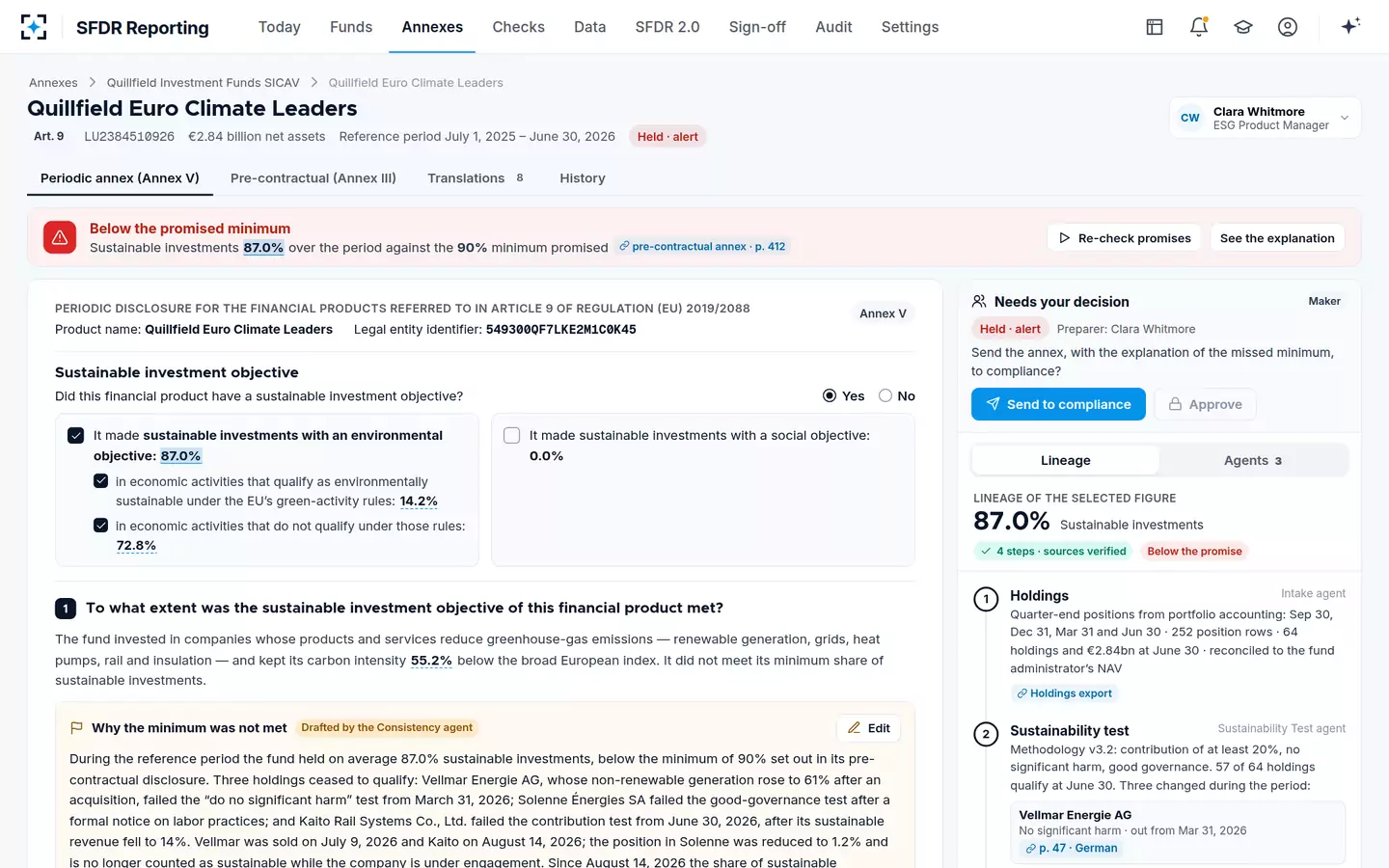
A defensible explanation names the holdings that caused the shortfall, the test each failed, the evidence for each failure, what was done and when, and where the fund stands now. The sample annex shows the shape: during the reference period the Article 9 fund held on average 87.0% sustainable investments against a 90% minimum; three holdings stopped qualifying, one on the no-harm test after its non-renewable generation rose to 61%, one on good governance after a formal notice on labour practices, one on contribution after its sustainable revenue fell to 14%; two were sold after the period and the third reduced; the share was 93.1% at September 30. In SFDR Reporting the Consistency agent drafts that paragraph with each holding cited, but it "never softens a result", and the explanation needs the head of sustainable investing's signature. Checking every result against every promise is covered in its own guide.
Annex V drafted in SFDR Reporting in the official template, every figure underlined
How SFDR Reporting drafts Annex IV
The solution fills the template the way the rules read: section by section, each answer from its source. On the sample range the Drafting agent filled 186 periodic annexes overnight, 158 in Annex IV and 28 in Annex V, with 39,804 figures each linked to its lineage, and the design target is that 100% of annex figures trace to holdings, method and source page. It keeps the template's headings and order, and never edits a pre-contractual promise.
What it does not do is decide. The narrative that explains a change in an indicator is a draft for the product manager; the explanation of a missed minimum is a draft for compliance and the head of sustainable investing; the annex goes into the annual report only after the board approves. The drafted German, French or Italian versions use the template's own headings in each language, copy every figure from the English rather than translating it, and hold any paragraph whose English has changed.
For the full sequence of agents and limits, see the SFDR reporting tool guide; to see Annex IV drafted on sample funds, start from SFDR Reporting.
Questions people ask
What is the difference between the Annex IV and Annex V templates?
Annex IV is the periodic template for Article 8 funds, built around the characteristics promoted; Annex V is for Article 9 funds, built around the sustainable investment objective. Annex V's asset allocation splits investments into sustainable and not sustainable, and it adds a Paris Agreement section for funds with a carbon-reduction objective.
Where is the SFDR periodic disclosure published?
As an annex to the fund's annual report, with a prominent statement in the main body saying it is there. For a UCITS that is the annual report published within four months of year-end; for an AIF, the annual report due within six months. The same information also goes into the fund's website disclosures.
How many previous periods must the periodic report compare?
Up to at least the last five, once earlier periodic reports exist. The comparison should use relative measures such as impact per euro invested, and say which indicators were assured by an auditor or reviewed by a third party.
Which template version should we use?
The Annexes II to V as replaced by Delegated Regulation 2023/363, which added the fossil-gas and nuclear Taxonomy disclosures. The SFDR 2.0 proposal would repeal the whole Delegated Regulation and replace the templates with category templates of up to two pages, but that is not yet law.
Do Article 6 funds need a periodic SFDR template?
No. The periodic annex applies to Article 8 and Article 9 funds; an Article 6 fund's SFDR disclosures are pre-contractual.